The light around the blinds was too bright for the room it failed to illuminate. Walter woke with its white edges burning against his eyes, while the chairs, the carpet, and his sleeping companions remained sunk in darkness. For a few moments he lay still, waiting for the ordinary discomforts of waking. The bitter green draught had left him rested. That, more than anything, seemed wrong. Somewhere beyond this room, Edgar Wellington lay dead beside the things they had taken from him, and Walter had slept beautifully.
The others stirred. Arthur opened his eyes and looked about with immediate suspicion. Viola sat up. Per felt inside his sleeve and drew out the scroll, which had come with them. He unrolled it in the light leaking around a blind. The characters were as stubbornly foreign as they had been before he fell asleep, and he studied them with the concentrated irritation of a man who had hoped that sleep might accomplish something scholarship could not.
Arthur closed his eyes again, and for a little while the others watched him think. He was attempting to furnish himself with a translation guide. Somewhere in the possibilities of dreaming, he felt, there ought to be a book that explained these marks. It was a modest enough request. He opened his eyes.
There was no book.
“Well, we seem to be in the hotel,” he said. “I’m not sure we’re dreaming.”
Per tried a sentence in Swedish. The silence that greeted it was familiar and unhelpful. On the Dreamlands Express, such difficulties had disappeared. Here, apparently, he could be incomprehensible in precisely the same manner as at home.
Walter proposed returning to Wellington’s shop. It was the first suggestion that required no cooperation from the nature of reality, and they accepted it.
Before they left, Per reminded them of Henri’s warnings about what awaited travellers away from the train. The recollection gave them little practical guidance. No one remembered a warning about waking in one’s own hotel, nor an instruction for distinguishing an ordinary room from its sleeping imitation.
The corridor helped. It extended much farther than it should have. Doors stood open along its length, admitting no useful light, and the windows wore the same dark blinds with their fierce white borders. As they walked, the floor gave a faint, familiar sway beneath their feet, and a small jolt passed through it.
Viola slowed. The movement belonged to a railway carriage. Her body recognised it before she could decide what it meant, and she found herself adjusting her balance to the progress of a building that had nowhere to go.
Per reached for a blind, and his fingers passed through it. He tried again, more carefully, as though the fault might lie in his first approach. There was nothing to grip. The blind remained visible around his hand.
“More dream nonsense,” he said.
One door was closed, and nails fixed it shut all around the frame. Per regarded it for a moment.
“That is probably something we should ignore and leave alone.”
As they passed, the smell reached them. Decay had found its way through whatever the nails were intended to contain. Arthur glanced at the door, then ahead. None of the rooms had numbers, and he could not remember noticing their absence until now.
At the place where the staircase should have descended to the lobby, they found another door. Arthur opened it, and daylight struck hard enough to make him recoil. Beyond the threshold lay a grey plain, almost without limit. Dust covered the ground. The air tasted bitter and felt warm against faces that remembered January in Switzerland. There was no wind and no traffic, and the only sound was their own breathing.
About a hundred feet away stood another door. Arthur leaned through the opening and looked back. There was no hotel. The corridor remained behind him when he looked through the doorway, but outside its frame there was only the plain.
“Oh, Per. We’re definitely in the dream. Or at least somewhere else.”
“Yes,” Per said. “I suspect so.”
They stepped out, and Per paused to mark the door they had left. He reached into his pocket with the firm expectation of finding chalk, and found none. This annoyed him more than the missing hotel. He had been able to do things in dreams before. Here, even a small convenience seemed subject to refusal. His notebook and pencil, however, were where they belonged, and he used what he had.
Walter took out his Bible. He opened it with a wariness that would once have seemed absurd to him, then examined the pages. The familiar King James text looked back at him. Whatever else this place intended, it had left him that.
Their footsteps lifted pale dust. It drifted into their clothes and caught in their throats. Arthur began to sneeze, and Viola soon followed, turning aside with a hand raised to her face.
“Someone give me a cigarette,” Arthur managed. “Clear my lungs.”
The distant door grew familiar as they approached. Those who had escaped through Wellington’s back entrance recognised it before they reached it. It stood ajar. Per stopped briefly before going through and tried to prepare himself for what a taxidermist’s shop might become in a place like this.
The effort was inadequate. Torches burned where there should have been electric lights. A gutted deer lay on a table, its opened carcass fouling the warm air. The room kept enough of its proper arrangement to make the changes intimate and unpleasant. They knew where things ought to be, and they could see what had been put there instead.
“Monsieur Wellington?” Per called. “Are you here?”
No one answered.
They went to the door that led upstairs. Its handle turned, but the door would not open. Arthur examined it closely, looking for the resistance he might overcome with a shoulder, and found neither hinges nor seam. Someone had painted a door on the wall and attached a real handle. He stood with the knob in his hand for a moment longer than necessary.
“Per. This door is not a door.”
In the showroom, animals stood in the attitudes Wellington had given them, but their bodies were decaying. Near the entrance a bear towered over them, upright and badly stuffed. Its hide was coming apart. The smell beneath it was so thick that Arthur’s attempt to smoke became a wretched contest between the cigarette and another fit of sneezing.
The front door was open, and its broken latch showed where someone had forced it. Outside, a bell was tolling. Walter listened past Arthur’s distress and heard footsteps, a great many of them, along with the low murmur of people moving together.
“There is a crowd coming.”
They looked out. Lausanne climbed the hill before them beneath a rich purple sky. Dusk lay over the streets, yet there was no sense that night would follow. The buildings had lost their newer fronts, and the shop windows were gone. Beyond the cobbled road, lanes that should have been paved dwindled into dirt.
Walter caught sight of people passing between buildings, dressed in the clothes of the fifteenth century. The cathedral bell went on calling from above, and the people were going uphill to meet it.
Per looked down at his own clothes, then at the others. “We should avoid drawing attention to ourselves.”
Arthur searched the shop for a cloak or hat that might help them blend into the crowd. There was only the fur, and no disguise was worth wearing that bear.
They slipped into the street. Arthur found the shadows readily enough. Persuading the others to occupy them properly was harder.
“In the shadows,” he whispered. “Not next to them.”
No one shouted, and no face turned towards them with any marked interest. Whether they had concealed themselves or merely failed to matter, they could not tell.
As they climbed, Viola became increasingly conscious of a pressure that had little to do with the narrow streets. It worked on her thoughts. She caught herself expecting something cruel around each corner, and understood that the expectation had arrived before any particular evidence for it. Their earlier travels in dreams had held danger, but they had also held room to breathe. Here, even the spaces between buildings seemed arranged to constrain them.
Per felt it too. “I think this place has been constructed,” he said quietly. “For some purpose.”
Arthur looked along the street. “It certainly doesn’t seem to be a pleasant one.”
“We should be on our guard,” Viola said.
At the intersections, bodies occupied iron gibbets. They kept walking.
Without warning, the road ahead split open. There was no earthquake. The cobbles simply parted, leaving a fissure across their path. Icy air burst from it and drove down the street, and a moaning sound came with the cold, stretched thin by the force of the wind. Arthur leaned into it. A few steps farther on, he could scarcely advance.
They took a side street. It offered a convenient way around the obstruction, a convenience Per disliked but used. On the next road another group was making its way towards the cathedral. The investigators waited in the shadows until the last of them had passed, then followed behind.
These people looked ordinary enough. Their clothes belonged to another century, but their faces gave no obvious sign of death or corruption. They walked with the dull purpose of people who knew where they were going.
Walter watched the cathedral above the roofs.
“If I had made a world to conceal something valuable,” he murmured, “I should put it in the tabernacle.”
He intended to get inside, perhaps by a rear entrance, and see what the church contained. Arthur was willing to follow his judgement when they reached it.
They had not yet reached it when the masked people appeared. They came out of a cross street in a disorderly procession. Death walked among them, and an angel, and a soldier. There was a lion, a figure costumed as a Turk, and a hooded assassin. A man and woman in rustic dress moved with the rest. All of them struck themselves as they walked.
Walter heard the words beneath the blows. It was the Lord’s Prayer in Latin, repeated over and over. Their masks held fixed expressions, but through the eyeholes he saw eyes like those of dolls. Blood ran from them and down the masks.
Walter began to pray as well. He kept his voice low, trying to hold to the words while the procession lurched and wandered uphill.
Other bells were ringing now. Their sound gathered around the masked figures. None carried a bell, but the pealing moved with them, growing louder until it battered the narrow street. Ahead, the ordinary crowd continued walking, and no one among them covered an ear or looked back. Claire drew close to the shelter of the buildings. The sound pressed against her teeth.
Then it stopped.
The lion sprouted wings and rose into the air, and the soldier flew after it. For a moment they wheeled overhead, pursuing one another between the roofs, and drops of blood fell from their eyes. A drop struck exposed skin and burned. Walter ducked beneath an archway. The others scrambled into doorways and recesses while the blood pattered down.
The remaining masked figures scattered through the streets. At last the lion flew away, with the soldier still in pursuit, and the burning rain ceased. The crowd farther up the road had scarcely altered its pace.
Per stepped out from shelter.
“Well,” he said. “That was awful.” He looked towards the cathedral. “Let’s keep going.”
A few blocks farther on, they found the flowers. They filled a side street, spilling across the ground and crowding boxes beneath the buildings. Their colours arrested the eye. Only then did Per understand how much grey they had been walking through, how thoroughly the city had reduced itself to stone, dirt, and old cloth beneath that purple sky.
A sweet scent reached him, and he went closer. There were bulbs among the flowers. Garlic bulbs, he thought, though the blossoms resembled tulips and the air carried none of garlic’s pungency.
Then he noticed the shadows. The flowers cast none, and neither did the buildings. He looked down at his feet and found that his own shadow had disappeared. He stood still, turning slightly, searching the ground.
Arthur picked up a bulb. It had the shape and feel of garlic, at least, and he kept it.
Per selected a teal flower and placed it in his breast pocket. He could not account for the street, but he liked the flower. After what they had passed, liking something felt like an activity worth attempting.
When he returned to the main road, his shadow joined him.
“Good to see you, old friend.”
The flower cast a shadow too. Its colour had faded a little, though it remained brighter than anything nearby. He touched its petals once before they continued.
A woman stood over a cauldron outside a doorway farther up the hill, with a fire burning beneath it. She stirred the contents and looked up as they approached.
“You look hungry. Would you like dinner?”
Arthur addressed her with grave courtesy. “Pardon me, Grandmother. Have you seasoned your pot with garlic?”
“All the greatest seasonings are in my stew.”
Walter looked into the rising steam. “What kind of meat have you used?”
“Why not see for yourself?”
She raised the spoon. Several fingers lay in it.
They wriggled.
Walter drew back. Beside him, Claire’s attention remained caught by those small movements. The fingers stirred with a dreadful persistence, as though whatever had happened to the rest of them had failed to settle the matter.
“I am not a cannibal,” Walter said.
Arthur regarded the spoon. “You seem to have quite a handle on your soup.”
The woman cackled. “If you’re hungry after the event, be sure to stop by.”
Per seized on the word. “What event?”
“Up at the church. That’s what the bells are for. That’s why everybody’s going.” Her grin widened. “I wouldn’t want to ruin the surprise.”
“Of course not,” Per said. “Thank you.”
Walter asked whether she knew Edgar Wellington. She stirred her pot.
“No, I’m afraid I don’t.”
They left her to it.
At the next intersection, a magician offered a performance. He displayed an empty hat. Then he put his right arm inside it, and the arm vanished. His left followed. He introduced one foot into the opening, losing the leg with it, then somehow contrived to repeat the feat with the other. His torso fell to the ground, and he lay there laughing.
“Someone, please retrieve my limbs from the hat. I have no way to grab them anymore.”
Per stepped forward. Perhaps he had reached the limit of his patience with the city’s invitations. Perhaps the obvious absurdity of the scene had made a simple gesture seem harmless. He picked up the hat and placed it on the magician’s head.
The head disappeared. The torso collapsed and stopped moving. Per looked down at it, but no voice came from the hat. There was no further appeal and no flourish to complete the performance.
“He wasn’t real,” Per said. The others were silent. “None of this is real.”
The flower in his pocket was still its muted teal. He could feel the pavement beneath his shoes, and he had felt the weight of the hat. He turned away.
“Should we keep walking towards the church, or have we had enough? We could go back to the waking world. Get back on the train.”
“We haven’t reached the church yet,” Arthur said.
Per glanced uphill. The cathedral still waited above them, and between it and where they stood there seemed to be an inexhaustible supply of streets.
“At this rate, most of us aren’t going to survive the walk.”
Nevertheless, he went on.
Walter had reached a decision of his own. “The next person who approaches us gets a brisk ‘No, thank you.’”
The next intersection contained a chessboard.
For an instant, Per responded to the familiarity of it, the squares and opposing sides, an arrangement he understood. Then he saw that the pieces were people, and that each carried a knife. At either end stood a motionless, featureless figure, like an unfinished statue. A pawn moved forward. Another began to advance from the opposing side. Per stopped himself. Arthur had not stopped walking at all.
They skirted the board. Behind them came a soft, wet impact, followed by the sound of a body falling. Footsteps crossed the squares. Another impact followed, then another, with less time between them.
“Sounds like the Sicilian defence,” Per said.
No one turned to see.
The next square was large and almost empty. A figure of woven wire stood in it, perhaps fifteen feet high. Rags hung from its body, and its head was raised above the street. It was singing.
Arthur slowed before he meant to. The voice had a clarity that made the space around it seem newly opened. He could not recognise the words. The melody suggested an aria without resolving into anything he knew, and he listened with the painful attention one gives to something one is already afraid of losing. After the bells, the prayers, the woman laughing over her pot, this sound entered him almost without resistance.
The others had halted too, and tears gathered in their eyes.
Arthur approached. He kept far enough away that the figure could not reach him if its arms moved. Even now he remembered to take that precaution. The wire remained still.
Closer to it, he could see what hung from the hooks. The scraps varied in thickness and colour. Some curled where they had dried. Others hung heavily from the barbs. They were pieces of human flesh.
Arthur recoiled. He turned and motioned the others back.
The singing continued. That was the intolerable part. His recognition changed nothing in the voice, and every note remained beautiful. He stood looking at the wire and what it carried, and felt the music drawing more tears from him. He could not endure another moment of it.
He ran. His feet struck the stones hard. He fled the square with the conviction that if he stayed his heart would fail under the pressure of what he was hearing. Behind him the others followed, weeping, able to walk but scarcely able to speak.
The song pursued them up the street. Then, beyond the square, it could no longer be heard. Arthur slowed. His breathing came unevenly, and his eyes still stung.
The others reached him. Per’s flower was a small patch of colour against his clothes. Viola wiped her face. Claire looked back towards the corner they had passed, although the statue was hidden now. No one suggested returning.
At last the cathedral plaza lay ahead. Hundreds of people surrounded a raised platform in the middle of the square. The church rose beyond them, its doors and walls remote from the purpose for which Walter had hoped to use it.
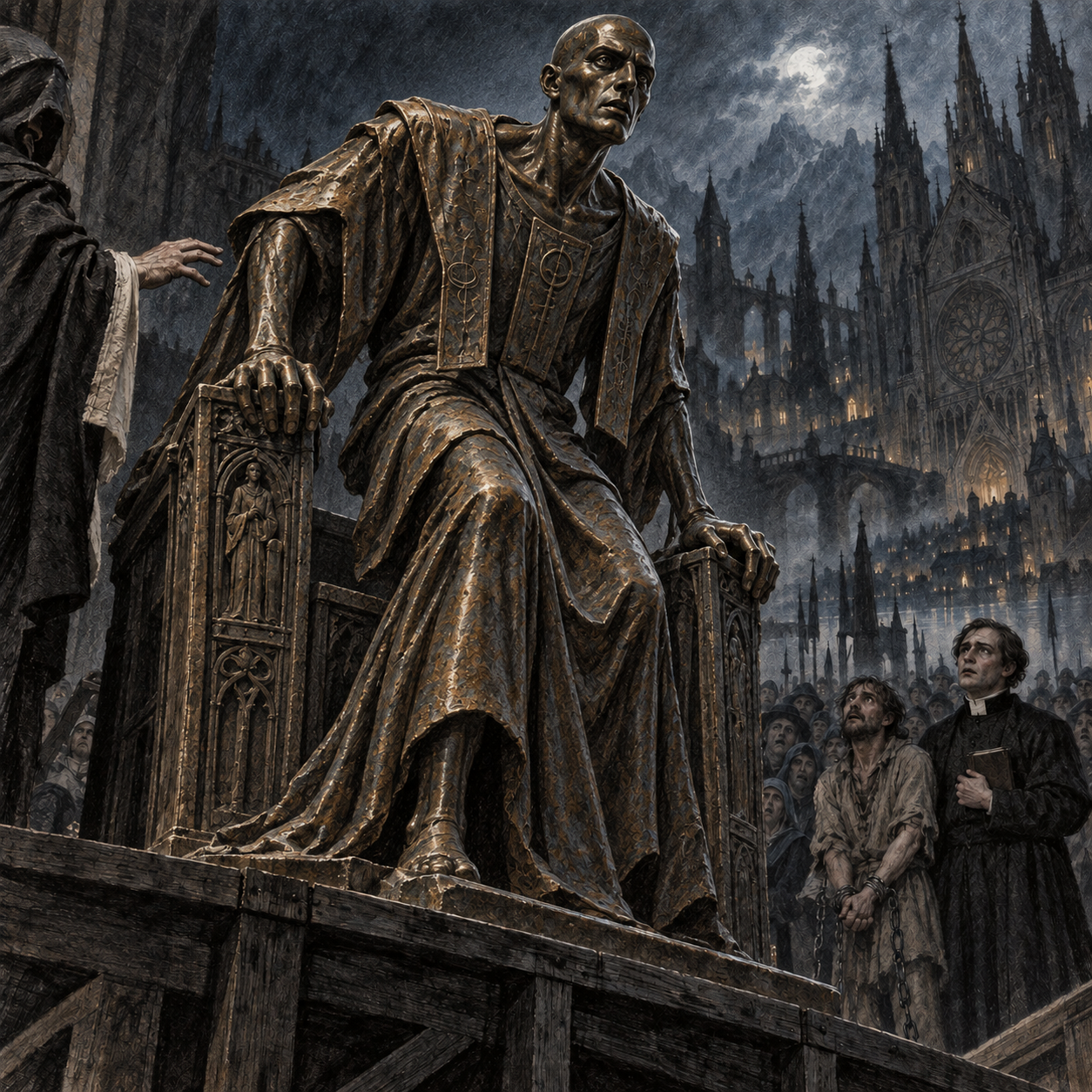
Three figures occupied the platform. One was a large bronze statue, and one wore a hood and robe. The third stood in chains.
Edgar Wellington.
For a moment the distance between the waking room and this square seemed impossible to cross in thought. They had seen him dead. Yet there he stood, upright and bound, his head lowered before the crowd.
The hooded figure raised his arms, and silence travelled through the plaza.
“Before us stands a man accused of grievous crimes. His criminal conduct in withholding what is due to us renders him our enemy, and hence he must stand trial before us.”
He cast back his hood. The Duke looked out over the people.
“As prince and protector of this realm, I appoint myself the judicial representative of the people of Lausanne.” Laughter entered his voice. “And I will see that this rogue gets his just deserts.”
The square erupted. Cheers for the prince mingled with curses directed at Wellington. The prisoner stood through them with his hands bound. At length the Duke quieted his subjects.
“Is anyone willing to take the part of the criminal in these proceedings?”
No one answered.
Per looked at Walter. “It seems one of us might need to speak on Wellington’s behalf.”
Walter studied the platform. The Duke had already called the prisoner a criminal, and the crowd appeared satisfied with the designation. Whatever laws applied here, he doubted they had been devised to trouble the prosecution.
“Anyone?” the Duke asked.
Walter raised his hand. “I will.”
The Duke found him towards the back of the crowd and smiled.
“Ah. Another outsider. But, as per the rules and laws of our land, please come forward to represent this guilty man.”
People moved aside. Walter entered the narrow opening. Per followed, and Arthur went with them. Viola and Claire came behind. Hostile faces turned as they passed, and someone hissed. The gap remained just wide enough for them to walk through, with the crowd pressing close on either side.
They mounted the platform. Here, near enough to see the Duke properly, Viola recognised the effort beneath his composure. His welcome had been performed for the square. Rage showed in his eyes when he looked at them. Per saw it too. Their presence had angered him, and neither of them could tell whether that should give them courage.
The Duke turned away. “Is there one among you who wishes to offer himself to justice?”
Hands shot up. People shouted and strained towards the platform, desperate to be chosen. He indicated a man near the front, and the man cried out in triumph.
Those around him fell upon him. They struck with such sudden eagerness that the investigators lost sight of the chosen man almost at once. His neighbours closed over him. There were screams from within the mass, and the sounds of blows landing, bones giving way.
Arthur stood rigid. The movement below the platform continued for a little while, then subsided. Someone rose from the crowd and came forward carrying the man’s skin.
Per reached for his flower and brought it closer to his face. The colour had gone. He stared at it, struggling to find the teal among the shapes dissolving before him.
“The colour,” he said. “The colour is gone.”
Arthur looked at the bloom. “No, Per. I assure you, it’s still there.”
Per raised it nearer. The platform disappeared, and then the Duke. The flower was gone too, though he could feel its stem between his fingers.
“All the colours. They have gone.”
His eyes were open. He could hear the crowd, and he could hear his companions beside him, and that was all. Arthur’s reply came from somewhere in the darkness.
“That seems potentially rather bad.”
While Per stood blind, the Duke accepted the skin. He carried it to the bronze statue and draped it over the metal. His lips moved, but whatever he said was too low for the investigators to hear.
The skin began to merge with the bronze. Viola watched the boundaries disappear. The material sank into the figure until there was no loose edge left hanging, nothing to suggest that a man had been brought there in pieces a few moments earlier.
The statue opened its eyes. Its chest moved, and it breathed.
“You are the overseer,” the Duke told it. “Determine the guilt or innocence of the accused at the conclusion of proceedings.”
The bronze gaze passed across the platform. Per’s sight began to return. Shapes emerged slowly, then faces, then the flower in his hand. He lowered it. Before him stood a statue that now watched them.
The Duke gave them permission to speak with the accused. Wellington had been staring at his feet. When they drew him a little aside, he looked up. Recognition relieved his expression for a moment, though his trembling continued.
“I came here a few hours ago,” he said. “To get the scroll.”
Walter urged him to speak quickly. Wellington had been resting in the dream version of his shop when the prince’s men broke in and dragged him away. He did not know why the Duke had done this to him. The broken latch acquired its explanation.
“Is this your dream?” Walter asked. “His? How often have you been here?”
Wellington shook his head. It was not his world. The prince appeared to rule it, but Wellington knew little more than that. The Duke had given him the elixir because he could not sleep. Memories of the war had troubled him. So he had taken the draught, and every night he had come here.
Arthur listened as Wellington spoke of the discovery that had made the place useful to him. If he held something as he fell asleep, he possessed it on arriving. He had brought the scroll into the dream and hidden it there while he decided what to do. He had thought it a safe place. Now he looked from one of them to another.
“Please. Save me. You can have the scroll. I don’t need any money.” The words came faster. “I just want to wake up.”
No one answered that immediately.
Per drew out the scroll they had carried from the hotel. “Is this a faithful copy of the text?”
Wellington looked at it. “No. I tried to do it from memory.”
Arthur’s efforts to translate it and Per’s examination in the strange hotel light had been spent on an imitation whose own maker could not vouch for it.
Walter pressed on. Did Wellington know the rules of the trial? Did he understand the creature appointed to judge him? What could they say that might save him?
“Convince it I’m innocent.”
“Do you know what crime you’re accused of?”
He did not. Nor did he know the laws of this place.
Walter glanced towards the Duke. “If he rules here, and he’s prosecuting you, what are we supposed to do?”
Wellington stared at Walter’s collar. “You’re a man of the cloth. Aren’t you supposed to give me hope?”
Walter had brought his Bible, and had verified its words in the grey waste beyond the hotel. He had prayed in the street while masked things recited the same prayer through blood. Now he stood before a dead man who begged to wake, beneath the attention of a bronze judge that breathed because someone had been torn apart.
“I am here to guide souls to God,” he said. “That I can do.”
Per remembered the judge they had encountered on the train. The thought of some greater authority, someone who could be called upon to intervene, returned with desperate force. Could they invoke him here? Could anything reach into this place from outside it? There was no time to discover an answer.
The Duke turned towards them. Wellington fell silent. Per still held the flower. Beyond the platform, the people waited, and the overseer’s bronze chest rose and fell.
“Your time is up,” the prince said.
“The trial has begun.”
The session opened with a recap of the investigators’ previous evening in Lausanne. The Duke and Edgar Wellington had failed to appear at Le Chat Noir. Maximilian von Wollheim had arrived instead, entertained the investigators with hours of autobiographical stories, then claimed to have forgotten his wallet and signed an IOU. Per and Viola had judged him to be a vain confidence man rather than a conspirator. Maximilian had disclosed the location of the Duke’s townhouse. Arthur had subsequently followed Maximilian to a modest hotel, but the surveillance had produced little of interest. Meanwhile, Per, Walter, Viola, and Claire had found the Wellington taxidermy shop dark, with its front door ajar. Claire had remained outside to watch while the others entered. Upstairs, William had been found lying face down in blood, with skin cut from his back. Edgar had been found dead in bed beside morphine, a syringe, a diary, a scroll, and a green bottle labeled Dream Lausanne. The approaching police had forced the investigators to leave after taking the scroll and the bottle. Back at the hotel, Arthur had connected the scroll to Edgar’s stationery purchase. The investigators had inferred that Edgar entered Dream Lausanne and was then killed with a second injection while helpless. They hoped that his dream self might survive and still possess the genuine scroll. Walter had taken a spoonful of the bitter green liquid first and fallen into a blissful sleep. The others had followed, with Claire taking the substance last. The group also recalled that their earlier dream journey had occupied several nights within the dream but only one night in the waking world. Walter awoke first in what appeared to be the same hotel room, with his companions still dozing in chairs and on couches around him. The others opened their eyes one by one. Their clothing and the room’s general arrangement appeared unchanged, but the lights were now off. Harsh, bright light seeped around the blinds, providing enough illumination to see inside the otherwise dark room. Per still had the scroll concealed on his person. He examined it and found that its appearance had not changed, but he remained unable to read it. Wanting to understand the writing did not give him that ability within the dream. Arthur attempted to use Dreaming to produce a translation aid, proposing something like a dictionary for the presumed ancient Turkish text. His attempt failed. After concentrating and opening his eyes, he still could not read the scroll. He remarked that the group appeared to be in the hotel, but his failed attempt left him uncertain whether they were dreaming. Per tried another test by speaking Swedish to see whether his companions would understand him as they had understood one another during their earlier dream travels. Nobody understood him. He suggested that the shared understanding might have been a property of the Dreamlands Express rather than dreams generally. Walter proposed returning to Wellington’s house. Per agreed but urged vigilance, recalling Henri’s warnings about the dangers encountered away from the train. He did not remember any specific advice concerning this dream destination. Outside their room, the investigators found that the hotel corridor was longer than they remembered. It remained dark, with bright light showing around covered windows. Nearly all the doors to the other rooms stood open. Everyone except Walter noticed a faint movement in the building as they walked. The corridor seemed to sway and bump slightly, recalling the sensation of walking through a carriage on the Orient Express. One door stood closed and had been nailed shut around its entire edge. When the investigators looked for a room number or name, they realized that none of the doors had numbers. Per cautiously tried to lift a window blind to inspect the source of the bright light. His hand passed through it. There was nothing solid to grasp or move. Per recommended leaving the nailed door alone. As the group passed it, those who had noticed the corridor’s peculiarities smelled decay coming from the room beyond. They continued without opening it. At the place where the staircase to the lobby should have been, the investigators found another closed door. This one had not been nailed shut. Arthur opened it, and harsh daylight momentarily dazzled him. Beyond the doorway lay an almost limitless, empty gray plain. The air smelled bitter, and the only nearby sounds were the investigators’ breathing and the movement of their feet. A second freestanding doorway stood approximately one hundred feet ahead. Arthur looked back around the doorway they were leaving and found no hotel behind it. The door stood by itself. He told Per that they were definitely dreaming, or at least somewhere other than their hotel. Walter favored crossing to the second doorway rather than returning to the room that smelled of decay. The others agreed. Outside, the air was warm, though not uncomfortably hot, and distinctly warmer than January in Switzerland. Their steps stirred dust from the plain. Per wanted to mark the doorway they had just used with the hotel’s name. He attempted to produce a piece of chalk through Dreaming and spent one Luck point to turn the roll into a success. Despite that success, no chalk appeared. Per did find the small notebook and pencil he normally carried. These remained available to mark the doorway. Walter also checked his Bible to see whether it had become the strange version he had encountered on the Dreamlands Express. It was his ordinary King James Bible. As the investigators crossed the plain, the second door began to look familiar. The rising dust irritated everyone, but Arthur and Viola suffered sneezing fits. Arthur called for a cigarette and later tried to smoke while still sneezing. On reaching the doorway, the investigators recognized it as the back door of the Wellington taxidermy shop, through which they had recently escaped. It stood slightly ajar. Per braced himself before entering the dream version of the shop. Inside, the back room was recognizable but more primitive than its waking counterpart. Burning wall torches had replaced the electric lighting. A gutted deer lay on a table, its carcass reeking in the warm room. Per called for Monsieur Wellington but received no answer. The investigators turned toward the familiar door leading to the upstairs rooms. Its handle turned, but the door would not open. Arthur examined the obstruction closely and discovered that the door was painted onto the wall. The knob was real, but there were no hinges, no gap around the frame, and no actual opening. The group found no alternative route upstairs. The front room still contained the taxidermy showroom, but many of its animals were decaying. Near the entrance stood a badly stuffed bear, taller than the investigators, rotting and falling apart. Its smell was particularly foul. The shop’s front door stood open. Arthur moved toward it, and Per followed, preferring the outside air to the stench inside. The investigators noticed damage to the latch and frame consistent with the door having been forced or kicked open. A bell tolled outside. The group’s initial attempts to hear anything beyond it failed, with Arthur’s continuing sneezing distracting them. Walter spent five Luck points to succeed at his Listen roll. Walter heard the footsteps and low murmuring of a large crowd approaching along the street. It sounded like people walking together rather than an organized military march. He shared what he had heard with his companions. Outside the shop lay a distorted version of Lausanne. The streets and buildings remained familiar enough to recognize, but the city had the appearance of a Gothic nightmare. Modern shopfronts and large glass windows were absent. The main street was cobbled, while side streets that had been paved in the waking city were now dirt. The tolling bell came from the cathedral uphill. The gathering crowds appeared to be heading in that direction. Walter examined the surroundings and glimpsed people in outdated clothing between the buildings. His successful History roll placed the city’s apparent period around the fifteenth century, earlier than the era he had associated with Count Fenalik. The investigators also noticed that the city seemed fixed in perpetual dusk beneath a rich purple sky. A large crowd approached up the road, heading toward the cathedral. The group decided to follow the crowds uphill. Per warned against drawing attention to themselves, especially by displaying the scroll while wearing conspicuously modern clothing. Arthur searched the taxidermy shop for hats or outer garments that might help them blend in, but found no clothing. Arthur led the group through the shadows. He succeeded particularly well at concealing himself, while the others were less adept. Nevertheless, nobody immediately shouted, challenged them, or otherwise reacted to their presence. As they proceeded, Viola recognized a psychological oppression unlike anything she had experienced aboard the Dreamlands Express. This felt like a fundamentally different kind of place. Per’s occult knowledge led him to suspect that the realm had been created by some method different from the dream world they had previously visited. Several intersections held gibbets, many of them occupied. Farther ahead, a fissure suddenly tore open in the street without an accompanying earthquake. An icy wind, carrying a moaning sound, blasted toward the investigators. The wind grew strong enough that they could barely make progress uphill. Arthur asked about an alternate route, and the group took a convenient side street that would bring them to another road leading toward the cathedral. Per told the others that he suspected they were inside a constructed reality created for a nefarious purpose. Arthur agreed that the place was certainly unpleasant. Viola urged everyone to remain on guard. On the next main street, the investigators encountered another group of people walking uphill. They remained in the shadows while that group passed, then slipped into the space behind it. More crowds approached from farther down the road, but there were gaps between them. From closer range, the people appeared ordinary apart from their fifteenth-century clothing. They did not look undead. They showed no particular interest in the investigators. Walter reasoned that, if he had constructed a world to conceal something valuable, he would hide it in the church’s tabernacle. He proposed entering the back of the cathedral and taking a seat in one of the rearmost pews. He whispered this plan to his companions, and Arthur agreed to follow his lead once they arrived. At another cross street, a different procession joined the road. Its members wore grotesque costumes, masks, and cowls. The figures included Death, an angel, a soldier, a lion, a man costumed as a Turk, a hooded assassin, and a rustic man and woman. They flagellated themselves as they walked. Walter recognized the procession’s chant as the Lord’s Prayer in Latin. The other townspeople had been largely silent, but these figures repeated the prayer as they moved. Behind their expressionless masks, their eyes resembled dolls’ eyes, and bloody tears ran down their faces. Walter turned to prayer himself. The costumed figures advanced irregularly, moving in the same general direction as the investigators but wandering rather than keeping straight lines. A new sound of bells grew around the procession, distinct from the cathedral bell. No visible bells accounted for it. The noise increased until it nearly drowned out everything else, yet the ordinary crowd ahead showed no sign of reacting. At the height of the cacophony, the bells stopped. The lion sprouted wings and flew into the air. The soldier followed, chasing it overhead. Bloody tears fell from the airborne figures onto the investigators. Where the droplets touched exposed skin, they produced a slight acidic burning sensation. Walter sought shelter beneath a doorway or archway, and the group took cover among the buildings. The remaining costumed figures scattered in different directions. Eventually, the lion flew away with the soldier still pursuing it, and the falling blood ceased. The ordinary townspeople continued uphill as before. The encounter prompted Sanity checks. Failure cost one Sanity point, while success cost none. Claire failed and lost a point. The investigators then resumed their climb toward the cathedral. Several blocks farther on, they noticed a side street filled with flowers and bulbs, spread on the ground and in boxes. Their bright colors emphasized how gray and drab the surrounding city had been. A sweet floral scent reached the main road. Per approached the flowers and examined them. He discovered that the bulbs were garlic, although the blossoms resembled tulips and the entire display smelled sweet rather than pungent. Per also noticed that nothing in the flower street cast a shadow. Neither the flowers nor the buildings produced one. His own shadow disappeared when he stepped into the street, although he had possessed a normal shadow moments before. Arthur took a garlic bulb. It retained the shape of ordinary garlic but lacked the expected strong smell. Per selected a teal flower and wore it as a boutonniere. When Per returned to the main road, his shadow reappeared. The flower cast a shadow as well. Its color became somewhat muted outside the flower street, but it remained brighter than anything else nearby. Approximately another block uphill, the investigators encountered a woman stirring a large cauldron over a fire beside a doorway. She looked up and offered them dinner. Arthur asked whether she had seasoned the pot with garlic. She replied that her stew contained all the greatest seasonings. Walter asked what kind of meat she had used. The woman invited Walter to see for himself and raised her spoon. Several fingers lay in it, still wiggling. The sight prompted another Sanity check, with one point lost on failure and none on success. Arthur succeeded, and Claire’s check was also reported as a success. Walter declined the stew, explaining that he was not a cannibal. The woman cackled and invited the investigators to return after the event if they became hungry. Per asked what event she meant. She said it was taking place at the church, explained that the bells were summoning everyone there, and refused to spoil the surprise. When Walter asked whether she knew Edgar Wellington, she grinned and said she did not. At the next intersection, the investigators came upon a street magician demonstrating an apparently empty hat. He placed his right arm inside, and the arm vanished. He repeated the trick with his left arm, then each leg, until only his torso and head remained on the ground. Laughing, the magician asked someone to retrieve his limbs from the hat because he could no longer reach them. Per picked up the hat and placed it on the magician’s head instead. The hat felt empty, and nothing fell out. The magician’s head disappeared into the hat. His torso collapsed and stopped moving or breathing. Per failed the resulting Sanity check and was instructed to roll 1d3 for his loss. Per insisted that the magician had not been real and that none of the surrounding events were real. He questioned whether they should abandon the search, return to the waking world, and get back on the train. Arthur reminded him that they had not yet reached the church, and the group continued. Walter declared that the next person who approached them would receive a brisk refusal. At the following intersection, however, the investigators encountered a giant chessboard occupying the street. Motionless, featureless humanoid statues stood at the two sides of the board. They appeared androgynous and mannequin-like. The chess pieces themselves were people, each holding a knife. Per initially suggested advancing the queen’s pawn two squares, then withdrew his interest when he understood the nature of the pieces. A pawn moved forward, another began to respond, and the game proceeded. Arthur had not stopped walking, and the others went around the board rather than remaining to watch. As they walked away, the investigators heard wet, squishing sounds, bodies or objects collapsing to the ground, and footsteps. The noises repeated with increasing frequency. They continued without investigating further. The group next entered a large, otherwise empty square containing a wire statue roughly fifteen feet tall. Its woven framework formed a human shape, with what initially appeared to be rags hanging from it. An extraordinarily beautiful song came from the statue’s head. Its voice had the clarity of an angel’s singing and brought tears to the investigators’ eyes. Arthur thought it resembled an aria, but he could identify neither the song nor its language. Arthur approached, drawn by the singing, but deliberately remained far enough away that the statue could not reach him if its arms moved. The statue itself showed no movement. From closer range, Arthur realized that the hanging scraps were flesh rather than cloth. Barbs and hooks along the wires held the pieces in place. The combination of the mutilated flesh and the beautiful singing forced him to make a Sanity check. Arthur succeeded but still lost one Sanity point. He recoiled, turned away, and signaled for the others to stay back. He wanted the group to move on. The emotional force of the song then prompted POW checks. Arthur became overwhelmed and ran from the square, feeling that he had to escape before his heart broke. The others were also moved to tears but retained enough control to follow him without fleeing in the same manner. Once the investigators had gone farther up the road and could no longer hear the song, its immediate effect faded. They stopped crying, and Arthur no longer felt compelled to keep running. Ahead lay the plaza outside the cathedral. Hundreds of people had assembled around a large platform erected in the middle of the square. Three figures occupied it: a large bronze statue, a hooded and robed person whose face was concealed, and a man whose hands were bound in chains. The chained man was Edgar Wellington. Despite his death in the waking world, he stood alive before the crowd. As the investigators approached, the hooded figure raised his arms and silenced the gathering. He announced that Edgar stood accused of grievous crimes and had become their enemy by withholding what was due to them. The speaker threw back his hood, revealing the Duke. He declared himself the prince and protector of the realm and appointed himself the judicial representative of the people of Lausanne. He laughed as he promised to ensure that Edgar received his punishment. The crowd cheered the prince while others booed and cursed Edgar. After quieting them, the Duke asked whether anyone would represent the accused. The square fell silent. Per suggested that Walter should speak for Edgar. Walter raised his hand and volunteered. The Duke smiled, identified him as another outsider, and invited him forward under the realm’s laws to represent the man he was already calling guilty. Per approached in support of Walter, Arthur accompanied them, and the crowd made room for the entire group. The townspeople gave the investigators hostile looks and hissed as they passed but allowed them to reach the platform. Once they were onstage, Per and Viola studied the Duke. Although he attempted to appear unconcerned, they detected rage behind his expression at the sight of the investigators joining the proceedings. The Duke then asked whether anyone in the crowd wished to offer himself to justice. People near the platform shouted and waved eagerly for his attention. He selected one man, who reacted with enthusiasm. The people around the chosen man immediately attacked him and beat him to death. The investigators lost sight of him beneath the crowd but heard screams of pain and the breaking of bones. When the movement subsided, someone emerged carrying the dead man’s skin and presented it to the Duke. Witnessing the killing and flaying required Sanity checks. Successful checks still cost two Sanity points, while failed checks cost three. Per’s accumulated Sanity loss reached his daily threshold, triggering a bout of madness. The result was a psychosomatic disability, resolved as blindness lasting four rounds. Per clutched his teal flower and held it closer to his face, crying that its color had disappeared. Arthur assured him that the color remained, but Per then exclaimed that all the colors were gone. While Per could not see, the Duke accepted the skin and draped it over the bronze statue. He muttered words the investigators could not make out. The skin merged into the bronze, and the statue opened its eyes, began breathing, and looked across the platform. The Duke addressed the animated statue as the Overseer. He instructed it to determine the accused man’s guilt or innocence at the conclusion of the proceedings. The Duke allowed the investigators a brief opportunity to speak with Edgar before the trial began. Per’s sight started returning at this point. Edgar had been trembling and staring at his feet. When the investigators drew him aside, he recognized the familiar faces and showed some relief, although he remained terrified. Edgar explained that he had arrived in the dream realm only a few hours earlier to retrieve the scroll he had hidden there. While he rested in his shop, the prince’s men had broken in and dragged him away. He did not understand why he had been arrested or why the prince was doing this to him. Walter questioned Edgar about who controlled the realm, whether he had been there before, and whether it belonged to him or the Duke. Edgar said it was not his dream world and that the prince appeared to be in charge. Edgar revealed that the Duke had given him the elixir to help him sleep. Memories of the war had been tormenting him, and the substance offered relief. Each night after taking it, he dreamed and came to this place. Through those visits, Edgar had discovered that anything he held while falling asleep would accompany him into the dream. He had therefore chosen the realm as a hiding place for the scroll while he decided what to do with it. Edgar begged the investigators to save him. He offered them the scroll without payment and said that he no longer wanted money. He only wanted to wake up. Per asked whether the apparent forgery the investigators carried accurately reproduced the genuine scroll’s text. Edgar admitted that it did not. He had attempted to recreate the writing from memory. Walter asked about the trial’s rules, its judge, and how Edgar might be saved. Edgar could offer little guidance beyond asking them to convince the animated statue that he was innocent. Edgar did not know what crime he was being charged with and said nobody had explained it to him. He also knew nothing useful about the realm’s laws. Walter questioned their prospects when the same person appeared to rule the realm and prosecute the case. Edgar appealed to Walter as a man of the cloth and asked him to provide hope. Walter answered that he could guide souls to God. Per suggested trying to invoke the powerful judge they had encountered during their earlier train journey. No summoning took place before their opportunity to speak with Edgar ended. The Duke announced that their time was up and that the trial had begun. The session ended with Edgar still in chains, Walter committed to representing him, and the animated Overseer appointed to decide his guilt or innocence.Session Notes