Blood ran down the statue’s legs in thin lines, following the carved folds of its robe before it dripped onto the boards of the stage. The skin stretched across its back had begun to settle into place. When the thing drew breath the skin lifted a little, and Reverend Walter Lake caught himself watching for the rise and fall as he had once watched the chests of men in field hospitals, waiting to learn whether they would take another.
The resemblance ended when it coughed.
Nothing with lungs should have made that sound. Walter kept his eyes on the judge’s face, which gave no sign that it understood its own discomfort, or the prisoner in front of it, or why a clergyman had been chosen to plead a case in a court whose laws nobody could explain. His friends had thought he would be good at this.
Edgar Wellington stood in chains. He knew neither what he was accused of nor the rules by which he would be judged. He had promised them the real scroll if they could get him free; the one they carried was only his attempt to set it down again from memory. Walter had already considered offering that imitation in exchange for Edgar’s release. He disliked how many qualifications the offer would need. There were lies, and then there were statements arranged so carefully that their honesty seemed likely to offend something worse than a magistrate.
Across the stage the Duke stepped forward. Here he called himself the Prince, and the crowd in its medieval dress accepted him readily enough.
“People of Lausanne.”
The voice carried over the square. Edgar, he announced, had refused to cooperate with the duly appointed officers of the realm. Summoned to court, he had kicked and screamed and protested, putting those sent to collect him to unnecessary trouble. Such behaviour was a challenge to the law of the Prince’s will.
“Were he innocent, he would be meek. Were he meek, he would be released.”
The crowd cheered. Walter waited for the judge to respond. It wheezed instead, and the Prince turned to him with an inviting gesture. Walter stepped forward.
“So a policeman had to persuade someone to come to court. He barely did his job, and for this we are holding a trial?”
He heard his own voice take on the firm, reasonable tone that usually carried people through distress. Encouraged, he went on.
“I move that these proceedings be adjourned at once, owing to the frivolous nature of our having to witness a mediocre policeman barely perform his duties.”
A pause followed, in which the square seemed very large.
“Citizens of Lausanne,” Walter added, “you deserve better.”
Nobody appeared to appreciate the offer. Arthur applauded from beside him, with the loyalty of a man determined to hold a position after everyone else had noticed its disadvantages.
“Yes. Quite compelling.”
The Prince looked pleased.
Behind Walter, Per murmured to Viola, “He is very handsome and very friendly. Perhaps not the most persuasive.”
“It is quite difficult to speak extemporaneously,” she replied.
Walter felt a gentle hand between his shoulder blades.
“Very well done,” Viola told him. “Why don’t you take a little break?”
“I think I’ve warmed them up for you.”
“Yes,” she said, and took his place.
Viola had addressed hostile people before. Most of them had wanted, somewhere underneath, to think well of themselves, and that gave an argument a place to begin. Looking over the faces below the stage, she could not yet tell whether that ordinary human vanity operated here. These were the people who had supplied their judge with its skin.
She kept her voice conversational.
“The argument that one would protest an arrest only if guilty scarcely takes human nature into account. Who among us has not panicked in an unfamiliar situation, with or without cause?”
A few faces stayed fixed on her. She could not call it interest, but she could use it.
“Being frightened does not establish guilt.”
“There is also the broken lock on the accused’s door,” Per put in. “Did it break before or after the officers presented themselves?”
“A very good question.”
Nobody answered it. Viola tried again, more plainly, describing the natural alarm of a man confronted and carried off without explanation. The longer she spoke, the more comfortably the crowd settled against her. They were beginning to enjoy disliking the defence, whatever its argument.
The judge coughed. Its borrowed covering shifted.
“Well,” said the Prince, smiling, “there is more than this one charge.”
He turned back to his people.
“The accused is a foreigner.”
That, at least, nobody could deny. There the Englishman stood, the Prince declared, living testimony to his guilt. Lausanne prided itself on purity of blood, the source of its strength and of its unity beneath his will. Edgar’s presence was a cancer, drawing other foreign bodies into the realm.
He indicated Viola and her companions.
“They must be cut out.”
The roar that followed made her first failure seem almost friendly. Walter began to move, and a restraining hand found his shoulder before he could renew his contribution. Viola waited until she could be heard.
“Would you wall your fair city off from the world around it? Everyone would lose by it. Trade, commerce, the exchange of ideas. Lausanne is a wonderful place, but it cannot produce every article the world has to offer.”
She let her gaze travel through the crowd, as though she were speaking to reasonable householders inconvenienced by an unfortunate proposal.
“How long would you care to live without your favourite imports? Or without making new friends, however different they might be?”
She could hear the thinness of that last appeal against the memory of their cheering. And yet something had shifted, very slightly. People who would applaud the removal of foreigners might hesitate over the removal of something they enjoyed.
Per stepped up beside her.
“I wonder,” he said to the Prince, “whether these people know you as we do. As the Frenchman we met in Istanbul.”
The Prince’s expression tightened.
“As a cosmopolitan yourself, surely you appreciate the advantages of living among foreigners. You have so often been one.”
“It is not true. I have lived here my entire life.”
“In this land?” Per asked. “Then you will know something of its history.”
Viola gave him room. He spoke of the peoples who had settled and resettled the country, of Celts and Romans and those who had come after them. His manner was almost scholarly, but she could hear the point beneath it. The Prince’s distinction depended on everyone forgetting how people came to be where they were.
“Though you now call yourselves Swiss,” Per said, “you are an amalgam of the peoples and nations that came before.”
Viola came back to the things people carried with them: goods, knowledge, useful work, companionship. This time she did not hurry when the crowd resisted. She gave them time to look at one another, and the noise began to thin.
It was a strange pleasure, winning even this much from them. A man below the stage turned towards his neighbour, and Viola wondered what he was seeing in that familiar face. She could not know, but he had stopped shouting, and others followed him into silence. The Prince’s smile had gone. The judge remained unreadable, labouring over another breath.
Then came the scroll.
“People of Lausanne, we accuse the treacherous enemy before us of possessing forbidden knowledge.”
The Prince gathered force as he went. Edgar had entered the sacred realm carrying something only its ruler might possess. He had hidden it, pursuing his own devious advantage. What did he plot? Why conceal what belonged to the Prince by fiat?
“He has secreted the scroll somewhere within this princely realm, like a mine ready to explode beneath our foundations. Were he to bring it forth, I should have reason for clemency. But he persists in deceit. He mocks and despises my Caesarian will.”
Some of the crowd answered him. It was enough to restore a little satisfaction to his face as he gestured for Viola to reply.
“You appear to suggest that nothing should be secret from you,” she said. “That the mere fact of a thing being kept secret proves wickedness.”
She turned to the square.
“By that reasoning, everyone here ought to surrender their diaries. And their trade secrets. Some things are kept private out of simple propriety.”
Walter leaned towards the others.
“He sees the tree of knowledge and wants to eat all the apples. We know how that ended.”
There was still the imitation scroll. They conferred in low voices while Viola watched the audience. Walter could offer a scroll belonging to the accused without calling it the one the Prince wanted. Per thought the deception would be found out almost at once, though permanent exile might sweeten an offer of settlement.
But the faces below them had changed again. Opening one’s diary to the Prince seemed a much less welcome prospect than surrendering someone else’s scroll. Viola glanced at Per. He had seen it too.
“Keep it,” she murmured.
They left the false scroll where it was. Viola finished her argument without embellishment, letting the crowd sit with its discomfort. When she stopped, the square was quiet.
The Prince rounded on the judge.
“What is your verdict for this guilty man?”
The statue stood wheezing. It coughed, and Viola watched a fresh drop fall from its covering. Then an arm rose and pointed towards them. For a moment she thought she had misunderstood everything.
Edgar’s chains vanished.
There was no clatter of metal or unlocking, no ceremonial declaration. One instant he was bound; the next his hands were free. The Prince began stamping about the stage, muttering with a fury that made Viola want to move before it found a direction. Below them, the crowd parted, leaving a clear path through the square.
“Come,” Arthur said. “Let us depart.”
Edgar followed them down, barely able to manage his gratitude.
“You were right, Father. Apparently God can see us here.”
“Yes,” Walter said. “I believe it was my argument that won the day.”
Viola did not correct him. They were walking out, and for several precious moments that was enough.
Per waited until they were beyond the Prince’s hearing before attending to Arthur’s question about the scroll.
“It’s here? Can we retrieve it before we leave?”
“In my shop,” Edgar assured them.
“In the rotting bear, I expect,” Per said.
Edgar explained that they should go back through the shop to the place where they had woken. Once they reached it, they would wake properly. He spoke with the confidence of a man describing a familiar journey home.
Per had something to say about that journey. Behind them, however, the stamping stopped.
“Today,” the Prince called, “we have seen justice only partly done. What of the foreigners who defended the criminal? What of their conspiracy?”
The quiet square seemed to take a breath.
“Find them and bring them to me.”
The answering roar caught them in the street.
“Perhaps we should run,” Arthur said.
“Yes,” said Per. “Let us run.”
His legs objected almost immediately. Claire and Walter got them all moving, urging the slower members along while Arthur struggled with a knee that had chosen a poor moment to remind him of the war. Per tried to remember the way. There had been a fissure in the street; they must not be driven into it.
The city offered its earlier entertainments in silence as they hurried past. The wicker figure no longer sang. Per kept his eyes off the scraps hanging from it and looked ahead, towards the chessboard. Thirty-one bodies lay across the squares. The remaining player stood over them with a bloody knife, but made no move to stop them. Per was grateful for that in a way he had no intention of examining.
Farther on lay the magician’s hat. Beside it, the magician had been reduced to a torso. Per knew the place and hurried past, the memory of his own part in that performance intruding unpleasantly on the business of escape. An old woman watched them go by, stirring her cauldron. In the alley, the flowers were still beautiful and still cast no shadows.
There were drops of blood on the street beneath the place where the fight overhead had passed. Then the ground where Per expected the chasm was whole. He almost stumbled at the absence of the obstacle he had braced himself for.
They reached the taxidermist’s shop together. Edgar plunged both hands into the rotten bear. The smell seemed to thicken around the movement. He drew out a scroll fouled along part of its length and pressed it into Per’s hands.
“Here. This is the real one. Quickly.”
Per gripped it without looking closely. People were coming in through the front door they had left open.
The back door gave onto the enormous grey plain. Across it stood the other door, unsupported, with nothing around it to explain where it led. Arthur pulled the shop door shut behind them, and they ran again.
There was no useful measure of distance out there. Per could see where he had to go, but the emptiness denied him any sense of progress. His breath hurt. The scroll was slick in his hand. He heard pounding behind them, absurdly domestic in a space without walls.
They reached the far door and opened it onto the hotel corridor. Across the plain, the shop door burst open. The pursuers came through and flung their hands up before their eyes, recoiling from the light. Per had hardly registered its brightness until he saw them blinded by it.
The others hurried him inside. Arthur shut the door and dragged a small table against it. Per pulled open another door as they passed, hoping the corridor might offer something useful. There was nothing behind it, not even an empty room. He could not fit what he saw within the reasonable dimensions of a building. He let the door go and followed the others.
Behind them, the table scraped across the floor.
They reached their room. Edgar was still with them. Per looked from him to the familiar furniture and saw its distorted outlines begin to soften. Another room was appearing through this one, each object settling towards its proper shape. There was very little time.
“Your body in the waking world is dead,” Per told Edgar. “I don’t know what that means for you. This may be our last chance to leave this room.”
Edgar stared at him.
“What? No. You just wake up.”
The wall behind him grew clearer. Per could see it through his shoulder.
“You just wake up.”
Per had known the fact before they ever entered the square. He had carried it through the trial, through their victory, through all that running. Now, with Edgar looking at him, he had no answer to give and no certain place to send him.
Edgar began to scream.
“No! I just wake up! Why am I dead? I’m supposed to wake up!”
The room went on with its quiet restoration.
“Oh God, help me!”
Then he was gone.
Claire could see through the window. That ordinary fact held her because she could not bear, for a moment, to look at where Edgar had been. Darkness lay beyond the glass. Real darkness, with a city in it, and no impossible blind refusing her fingers. Someone checked the time. Two in the morning. Per still held the scroll; they had brought that through.
An immense tiredness came down on her. Her arms felt too heavy to lift; even the effort of standing seemed unreasonable. Arthur managed something about having made it, collapsed onto the bed and was asleep almost before he settled. Claire watched him with exhausted envy and apprehension.
“I could do that,” she said. “I’m not sure I want to go back into the trial.”
“That was the substance we took,” Walter told her.
She wanted to accept the distinction. Edgar had sounded equally certain about waking.
Per had not sat down. He looked older than he had on the stage, and his voice had lost its public smoothness.
“I hesitate to suggest this. But the Frenchman, the Duke, the Prince, seems capable of causing us no end of trouble. We have an address for him. We may assume he is still asleep.”
Claire looked up.
“I do not know whether it has come to arson or murder to protect ourselves and our mission,” he went on. “But such an opportunity may not present itself again.”
“That is a very un-English suggestion,” Viola said. “The man is sleeping.”
“It is true. I am quite Swedish.”
The answer was so composed that Claire almost laughed. Instead she heard herself say she was not opposed to killing him. It came out more easily than she would have expected. The Prince’s voice still seemed near enough to call the crowd after them.
Per suggested that, whatever they did, they should be hard to find by morning. The Orient Express left at seven. Perhaps they were too tired to commit arson, but surely they could reach the station.
This met with more general approval. Claire shook Arthur awake.
“We can sleep on the train. We ought to go.”
He surfaced slowly, blinking at her as though the room might still be subject to revision.
“Yes. The train. Lead the way. I’ll carry my bag.”
But leaving at once meant dealing with the rest of their belongings, including the chest with the statue’s leg in it. The station was some way off. The hotel could arrange transport; persuading someone to shift everything in the middle of the night was another matter. They began to weigh the danger of staying against the labour of leaving.
“The Duke doesn’t necessarily know our hotel,” Arthur said. “We followed him outside the taxidermist’s, and he never met us at the restaurant. Why should he know where we are?”
“He does have magic,” Per observed.
That brought them back to arson. Viola suggested putting the proposal to Arthur now that he was awake.
“Late-night arson?” He considered it with a groggy seriousness. “The perfect time for it. Yes.”
The discussion turned practical with alarming speed. Claire found herself thinking about the hotel’s heating, about fuel, about the sleeping clerk downstairs. Viola raised the possibility of other people in the building, and of a fire spreading to the houses on either side.
Their information about the address was second-hand, Per admitted. They had followed someone else and asked him where the Frenchman lived. They might even have the wrong house.
Nobody found a reassuring answer to that. Nevertheless, they went downstairs.
The lobby was nearly empty. The clerk at the desk barely glanced up as Arthur slipped past towards the basement. Claire followed, glad of a task that required her to notice ordinary things: stairs, pipes, the warmth below. They found portable cans of fuel oil, enough for the purpose they had discussed upstairs. The weight of one in her hand made the proposal seem suddenly less like conversation.
Per detained the clerk with arrangements for their departure.
“Our plans have changed. We shall take the seven o’clock train. Would you arrange for our belongings to be delivered?”
“The Orient Express, sir?”
“Yes. Thank you.”
The clerk assured him that everything would reach the station in time.
“I shall return to my room now,” Per added, “where I will certainly be for the rest of the night.”
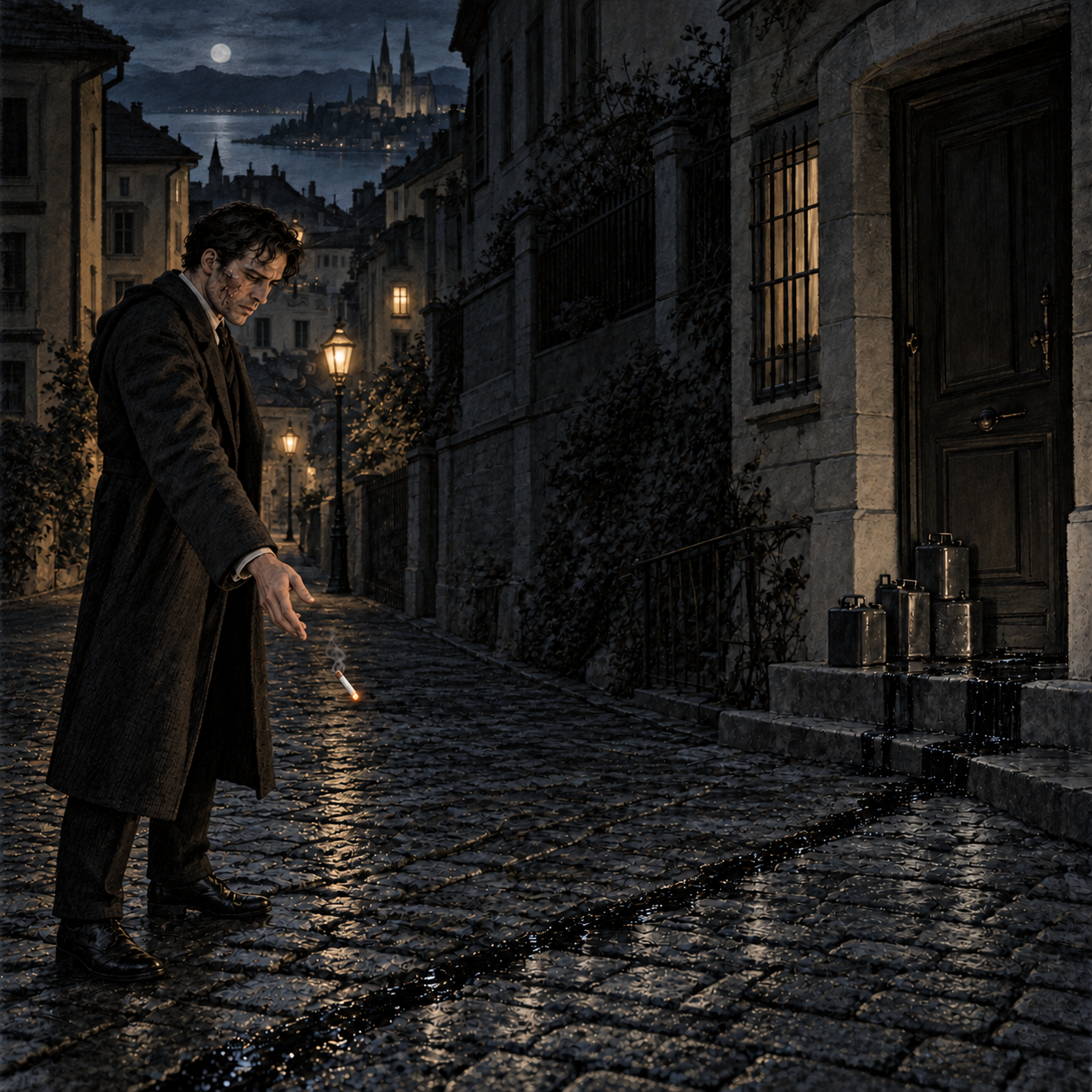
They left the hotel carrying its fuel.
The houses stood close together. Claire noticed that before she noticed the bars.
There were gaps between the buildings, and the ground was damp, with no dry growth lying about. Even so, she could see how a fire might pass from one roof to the next if nobody checked it. Viola’s objection had acquired walls and chimneys. These were ordinary houses on an ordinary sleeping street.
One stood apart in character, if hardly in distance. Every window was barred, every curtain drawn. It looked fortified against the street.
“Is it made of wood?” Arthur asked.
It looked entirely capable of burning.
“Claire,” he said, “I am very tired. What do we do with these cans we’ve been carrying?”
The confidence behind the question was undeserved. She understood machinery. Houses were not machinery, and she had no professional experience of setting them alight.
The bars ruled out the most obvious scheme. Viola suggested a letter slot, then discovered that the house kept a separate box. Her next suggestion involved the chimney.
“A fireplace,” Per pointed out, “is generally among the less flammable parts of a house.”
Claire tried the door. It was locked, of course. She almost resented the sensible precaution. They had argued their way out of an impossible court, fled a mob across an empty world and watched a man disappear. Now they stood in the cold with stolen fuel, defeated by an ordinary front door.
Someone remembered the burning of Professor Smith’s house. They knew too little about how that had been managed for the memory to be any use. Besides, he had survived it.
They considered forcing their way in. Arthur’s former profession seemed to recommend him until he made it clear that the war had taken strength rather than conferred it. Walter offered little improvement. Per looked briefly as though he hoped an education might compensate for the lack of muscle.
Claire had a pry bar, picked up on the way. Examining the door, she thought she might work it against the lock rather than try to break the whole thing down. She set to, but the fittings resisted her. Every small sound seemed louder than it should have been in the quiet street, and after several attempts she stopped. More force might accomplish something; it might also wake the neighbours before they had accomplished anything at all.
The others waited beside their cans.
“We could leave it at the front,” she said.
After a pause, they accepted the suggestion wearily. Their elaborate assault had dwindled to a fire at a locked door.
“I am not hopeful,” Per said. “But perhaps it is the way to go.”
“We’ll send a message, if nothing else.”
Claire did not try to say what the message was. They had come to stop the Prince from pursuing them. They had also come because he had smiled while demanding Edgar’s condemnation, because he had set that crowd on them after the verdict, because they were exhausted and angry and still heard a dead man calling for help. None of that told her who lay behind the curtains.
They set the fuel by the entrance and stepped back. Cigarettes glowed between their fingers. The small, familiar indulgence had kept them company through the night with remarkable persistence. Together they flicked them away, and the spilled oil caught. Light began to move towards the house.
“I suggest we leave now,” Viola said.
They did. Claire kept her pace measured until the house was behind them, though every part of her wanted to run. Nobody called from a window. No door opened to demand an explanation. Their footsteps sounded indecently normal.
A few streets on, an explosion broke the quiet. She turned far enough to see brightness rising from the direction they had come. It might have been the cans going up. She could not see the house itself, or anyone inside it.
They had been heading back towards the hotel when the decision changed. Their luggage would reach the train without them. There was no reason to return.
“The station,” Arthur said.
This time they went straight there.
Per sat where he could watch the approach to the platform. It was half past three. They had three and a half hours before the train, and his body received that information as an accusation.
Arthur fell asleep on a wooden bench. Walter settled down too.
“The train will wake us,” he said. “It is loud.”
Per could find no fault with the reasoning. He encouraged the others to rest and kept himself upright.
Firefighters had passed them on their way uphill. Now he could see smoke and an intermittent brightness above the streets. The fire went on while the station returned, around them, to its ordinary business. Trains came through in the night. People arrived with somewhere to go and no interest in five exhausted travellers waiting among the benches.
He tried to keep up that appearance: a man awake because someone must watch the bags, a passenger inconvenienced by an early departure. The scroll was with them. The leg would follow with the luggage. Whatever else the night had cost, they had recovered what Edgar promised.
Per remembered the moment the chains vanished: the release of Edgar’s hands, his gratitude, his certainty that God could see him even there. He had seemed a man restored to his future. Per shifted on the bench and watched the street.
By half past six, police were passing more often. The glow uphill had lasted through the hours, but from here he could not tell whether one building burned or several. The fire brigade’s presence gave him something to hope for without supplying any news.
An officer paused nearby. Per kept still. Rousing everyone now, gathering them into a hurried little group, would only make them conspicuous. The train was due soon. It ought to be due soon. He found himself placing an unreasonable amount of confidence in a timetable.
At last the hotel porters arrived with their belongings. The chest was among them. Per watched the luggage pass into the care of the station staff, relieved that one of the night’s arrangements had worked exactly as intended.
More passengers gathered. Police moved along the platform, speaking to people. One officer was questioning someone a short distance away. No finger pointed towards the benches.
Per woke the others. Arthur sat up stiffly. Claire looked towards the luggage; Viola straightened her clothes. Walter’s faith in the volume of an approaching locomotive was vindicated as the Orient Express came in precisely on time.
They boarded before the officer reached them.
Inside, the corridor and compartments offered a familiarity Per had not expected to find comforting. He checked that the others were aboard, then allowed himself to sit. Beyond the window, the platform was still occupied by people who could yet decide to interrupt their departure.
Seven minutes passed before the train moved.
Lausanne slid slowly past the glass, its roofs withdrawing as the carriages gathered speed towards Italy. Behind them, smoke still rose over the houses. Per watched until a turn in the line took the fire out of sight, and the wheels carried them on with the scroll and the leg.
Dream Lausanne: three charges before the Overseer Edgar Wellington remained chained on the cathedral plaza’s trial platform, with Walter Lake acting as his advocate and the Duke prosecuting him. The animated Overseer was the sole judge; there was no jury. Human skin hung across the statue’s back, blood dripped down its legs, and its repeated coughing and wheezing punctuated the arguments. The crowd surrounding the platform initially remained hostile to Edgar and his defenders. The investigators still had the reconstructed scroll recovered before their dream expedition. It had not changed upon entering Dream Lausanne and could look convincing to someone unable to read Turkish. They had not read it themselves, however, and did not know whether the Duke could recognize it as a reconstruction. Walter was willing to offer it if that would secure Edgar’s release, but exposing the substitute could make their situation worse. They kept it available as a possible bargaining instrument. The Duke’s first charge concerned Edgar’s alleged resistance to the officers sent to bring him to court. He accused Edgar of kicking, screaming, and protesting, treating those actions as defiance of his authority. According to the Duke, an innocent man would have submitted meekly. Walter attacked the prosecution as a frivolous spectacle built around a mediocre policeman barely doing his job, demanded adjournment, and told the citizens they deserved better. Walter’s opening failed to persuade the audience. His Persuade roll was 58 against a skill of 10, and he declined the substantial Luck expenditure needed to change that result. The poor opening left the next rebuttal requiring a hard success. Per Oskarson quietly suggested that Viola Suttcliffe take the lead while he supplied supporting arguments. Viola praised Walter’s effort and gently encouraged him to take a break rather than continue as the principal advocate. Viola argued that innocent people could panic when confronted with an unfamiliar and frightening arrest; resistance alone did not establish guilt. Per questioned the broken lock on Edgar’s door, asking whether it had been broken before or after the officers announced themselves. Despite those arguments, Viola failed the required hard Persuade check. She pushed the attempt and failed again, leaving the crowd unreceptive and making the next argument require another hard success. The Overseer offered no separate verdict on the first charge. The Duke then accused Edgar of being an English foreigner. He praised the realm’s supposed purity of blood and pointed to the investigators as further foreign bodies that should be removed. Viola answered in practical terms: shutting out foreigners would also mean losing commerce, favorite imports, new ideas, and new friends. Her defense challenged the value of the isolation the Duke was urging upon his audience. Per also challenged the Duke’s consistency, identifying him as the Frenchman the investigators remembered meeting in Istanbul. The Duke denied that recognition and claimed to have lived in this land all his life. Per’s successful Idea roll supplied a broader historical argument: the region had been settled repeatedly by different peoples, and the Swiss themselves were an amalgam of those earlier populations. The Duke’s connection to the remembered Frenchman remained disputed. Viola’s first attempt on the foreignness charge still fell short, but she pushed it with Per’s assistance and a bonus die. The result was 01. The crowd quieted, considered the defense, and became receptive; the Duke was visibly upset. This was the turning point in the public response to the trial, although the Overseer still gave no distinct reaction to the individual argument. For his final charge, the Duke claimed that Edgar possessed forbidden knowledge. He asserted that the concealed scroll belonged to him by fiat and that only he, as ruler, was entitled to possess it. Producing the scroll, he said, would give him reason to show clemency. Viola challenged the idea that secrecy itself proved wrongdoing: the same reasoning would require everyone to surrender private diaries and trade secrets. She argued, “Some things are kept secret not out of wickedness, but out of propriety.” Walter contributed an analogy about wanting every apple from the tree of knowledge. The investigators considered offering the reconstruction without explicitly identifying it as the particular scroll the Duke sought. Per also proposed permanent exile as a possible conciliatory term. Neither proposal became an agreement. A successful reading of the audience showed that Viola’s argument was already taking hold and that the Duke had become less smug. Rather than risk exposing their substitute, they kept it in reserve. Viola succeeded at the regular Persuade check for the final rebuttal without surrendering either document. When the Duke asked for judgment against Edgar, the Overseer coughed, wheezed, and raised an arm toward the defense. Edgar’s chains vanished. The Duke stamped around the platform in fury while the crowd fell silent and opened a path out. The investigators immediately took that opening with Edgar. Their defense had secured his release, despite the unsuccessful beginning. Edgar thanked them and acknowledged Walter’s earlier reassurance that God could see him in this place. Dream Lausanne: the Duke’s pursuit and Wellington’s shop Away from the platform, Edgar explained that they should return to the place where the investigators had awakened in the dream. He expected that going back there would let them wake again, and the route ran through his shop. Arthur Zorba waited until they were beyond the Duke’s hearing before asking about the promised scroll. Edgar confirmed that it was in the shop, giving the party both a destination for the recovery and a route toward escape. The Duke did not accept their departure. Once his stamping stopped, they heard him declare that justice had only partly been done. He accused the foreign defenders of conspiring against him and ordered the crowd to find them and bring them back. The crowd answered with a roar. The investigators ran, turning their legal victory into a flight through the city. They remembered that their usual ability to manipulate dreams had not worked here and worried about the fissure that had previously obstructed their route. The opening Dexterity checks were uneven, and Claire Corning and Walter helped get the slower members moving. Arthur’s old war injury, including scar tissue in his knee, made running difficult. This was an existing injury rather than new damage from the chase. The group nevertheless kept together and continued toward the shop; nobody was captured during the street retreat. Several of Dream Lausanne’s grotesque spectacles had changed while they were occupied with the trial. The singing statue was silent. On the chessboard, 31 bodies lay around a single standing figure holding a bloody knife. The magician had been reduced to a torso beside his hat. The old woman still stirred her cauldron and watched them pass without intervening, while the beautiful flowers continued to cast no shadows. Blood remained from the earlier violence overhead. The fissure they had feared encountering was gone, removing the anticipated obstacle. The investigators did not stop to investigate the altered spectacles or the vanished opening in the street. They reached Wellington’s decaying taxidermy shop with the pursuit still behind them. Edgar hurried to the rotting bear and plunged both hands inside it, retrieving a scroll partly covered in foul matter. Edgar pressed the hidden scroll into Per’s hands and called it the real one. This was a distinct document from the reconstruction the party had considered offering in court. Its recovery fulfilled Edgar’s promise, but nobody had time to read, translate, or authenticate it. Further Dexterity checks and a Luck check accompanied the flight through the shop. As the fugitives reached the rear exit, pursuers entered through the front door they had left open. Edgar urged them onward. The gray plain and hotel: returning without Edgar The shop’s rear door opened onto the apparently endless gray plain, with the other freestanding door visible across it. Arthur closed the shop-side door behind them, and Per asked Edgar to hold it while they crossed. A final Constitution check reflected the strain of the sustained run. The older investigators were tiring, but everyone reached the opposite doorway; the chase caused no recorded physical damage. Pounding sounded behind them. As they opened the hotel-side door, the crowd burst out onto the plain, then raised hands to shield its eyes from the light. That reaction helped give the fugitives a brief separation, though its cause remained unexplained. All five investigators and Edgar reached the familiar dream-hotel corridor and closed the door behind them. Arthur pushed a small corridor table against the entrance to delay the pursuers. While the others headed toward their room, Per tried opening other unlocked corridor doors, carefully avoiding the previously encountered nailed door. The openings revealed nothingness rather than usable rooms. He abandoned the experiment and continued with the group. Behind them, the pounding persisted and the barricading table began scraping across the floor, but they reached their room before the pursuit caught them. Once everyone entered, the distorted dream room began fading into its waking counterpart. Per immediately warned Edgar: “Your body in the waking world is dead. I do not know what this means for you, but this might be our last chance to leave this room.” Edgar’s waking death was already known to the investigators; what remained uncertain was what the transition would mean for the Edgar who had accompanied them through the dream. Edgar insisted that he would simply wake. Instead, he began fading along with the dream room, screaming in disbelief and begging for help. “I’m supposed to wake up!” he cried. He disappeared from the investigators’ presence and did not join them in waking Lausanne. They witnessed his disappearance, but could not tell whether his dream existence had ended, whether he remained elsewhere in the dream, or whether something else had happened to him. The investigators found themselves standing in their real hotel room, still in darkness. A watch put the time at approximately 2 a.m. Per continued to hold the scroll Edgar had delivered, establishing that the recovered object had crossed from Dream Lausanne into waking life. Edgar’s claim that it was the authentic scroll remained untested, but the party had successfully brought the hidden document out of the dream. Witnessing Edgar fade cost Claire three Sanity and Arthur three Sanity. Per passed his check; Walter and Viola suffered no Sanity loss from the incident. Arthur experienced a bout of madness that manifested as sudden sleep: he collapsed onto the bed. His companions were left to consider their next move without his immediate participation. No new physical injuries were recorded during the escape or return. All five felt intensely tired. Claire worried that sleeping again might send them back to the trial, while Walter attributed their journey to the substance they had consumed. Their exhaustion made rest tempting, but the Duke’s pursuit had left them concerned about remaining in Lausanne. Arthur’s abrupt sleep added an immediate practical difficulty to any plan for leaving the hotel. Lausanne hotel: departure or a preemptive attack Per argued that the Duke could continue interfering with the investigators and their mission. If he was still asleep, Per suggested, they might have an opportunity to attack him that would not recur. He raised arson or murder as possible ways to protect the group from future trouble. The Duke’s sleep, waking location, and vulnerability were assumptions, however; the investigators had not watched him return to a waking residence. Viola objected to attacking a sleeping man, calling it un-English. Claire expressed willingness to join an attack. Arthur remained asleep and could not yet contribute. The morning Orient Express, due around seven, offered a near-term route out of Lausanne. Air travel was mentioned but never developed into a workable alternative. With fatigue mounting, the discussion initially favored leaving for the station and resting there instead of undertaking an attack. Claire tried to wake Arthur. A successful Constitution check brought him around, groggy but able to function and carry his bag. This ended his immediate sleeping episode sufficiently for him to rejoin the group; it did not establish full recovery from the underlying madness condition. Moving directly to the station also meant dealing with the party’s other possessions, especially the chest containing the statue leg they already carried. The station platform was accessible overnight. The hotel could arrange ordinary delivery of their luggage for the train, while asking for immediate help at that hour would be an unusual request. Those logistics complicated a hurried move with all their belongings. Arthur observed that they had no particular reason to think the Duke knew their hotel. Per countered that the Duke’s apparent magical abilities made his reach difficult to judge. Once awake, Arthur supported the late-night arson proposal. Viola raised the danger to other occupants and neighboring buildings. The investigators also corrected their understanding of the residence lead: Arthur had previously followed Maximilian, not the Duke, and the address associated with the Duke was second-hand information. Per acknowledged that they could be targeting the wrong house. They had neither verified the Duke’s residence nor confirmed that he would be inside. Despite those objections and uncertainties, the party chose to obtain fuel oil from the hotel basement and proceed to the reported address. Their stated aim was to prevent further interference from the Duke before leaving Lausanne. The decision replaced the immediate station plan with an attack followed by departure, while preserving the need to arrange transport for the luggage and statue-leg chest. Lausanne hotel: fuel and luggage Arthur handled the stealthy access to the basement. The lobby was almost empty, and the overnight desk attendant was not paying close attention. The investigators reached the basement without difficulty or a confrontation with staff. A Luck check accompanied the search for portable containers, and they found several reasonably sized cans of fuel oil. There was enough fuel available for each investigator to take a can if desired and enough overall to start a substantial fire. The party took fuel for the attack, although the exact number of cans and their capacities were not fixed. These were portable supplies from the hotel, rather than fuel acquired at the target house. The investigators now had the material for their plan but still needed to secure their departure arrangements. Per approached the desk attendant, partly to distract attention from the fuel collection. He announced that their travel plans had changed and asked for their belongings to be delivered for the seven o’clock train. The attendant consulted the schedule, identified the Orient Express, and agreed to have the luggage ready. That arrangement covered the party’s existing baggage, including the chest containing the statue leg. Per then said he would be in his room for the rest of the night. Instead, he and the others left with the fuel and walked through the quiet streets toward the reported residence. The luggage arrangement meant that they could later go directly to the station without returning to the hotel to collect everything themselves. Rue du Pré: the fortified house and the fire Following the residence information, the investigators reached a street where the houses stood close together without touching. Claire recognized a real chance that a fire could spread to another building if it was not contained quickly. The surroundings were not especially dry and lacked a mass of dry vegetation, but the spacing still posed a danger. This gave substance to Viola’s earlier concern about neighboring property. One house stood out for its barred windows and drawn curtains, giving it a fortress-like appearance. It looked flammable, and the party selected it as the target associated with the reported Rue du Pré address. Nobody saw the Duke there, and no other occupant was identified. Its actual ownership and the Duke’s presence remained unverified as they began trying to find a way to put the fuel inside. The window bars were too close together to admit the cans. Viola proposed using a mail slot, but a failed Luck check left them with a separate mailbox and no slot into the house. A chimney was available and discussed as another possibility, but nobody climbed to it. Claire tried the front door and found it locked. With the accessible routes blocked, the investigators turned to forcing the entrance. Claire used her equipment ability to obtain a pry bar, spending ten Luck and reducing her total from 29 to 19. The bar had been found in the street on the walk over. A successful assessment identified the lock mechanism as a possible point of attack: despite the sturdy door, she could use the tool to attempt Mechanical Repair rather than rely on strength alone. Claire’s Mechanical Repair skill was 56, making the required hard success 28 or less. She failed to open the lock. When she considered pushing the attempt, the danger was clear: another failure would make noise and risk attracting attention after their quiet approach. She declined to push. The front door stayed locked, nobody entered the house, and the party changed to an exterior fire. They poured oil around the front entrance, left the fuel cans there, and laid a trail of fuel out toward the street. Claire regarded the attempt as sending a message even if it achieved little else. Per doubted how effective the exterior arrangement would be but supported it as the quieter alternative to forcing the door. Their plan now depended on a fire spreading from the entrance rather than placing the fuel inside. Together, the investigators flicked cigarettes into the trail. The fuel caught and began burning toward the house. Viola urged them to leave immediately, and the group withdrew rather than stay to watch the result. The cans and poured fuel were left behind. At departure, they had not seen the interior catch fire, encountered an occupant, or established what the attack would do to anyone inside. Their withdrawal was quiet, despite uneven Stealth checks. A couple of blocks away, after further Luck checks from Arthur, Walter, and Per, an explosion sounded behind them and bright light appeared in that direction. The investigators did not return to inspect it. The explosion’s exact cause, the condition of the house, and any casualties remained unknown. They chose to head straight for the station rather than return to the hotel, relying on the arranged luggage delivery and loading. On the way, they saw the fire brigade rushing uphill and could see smoke and fire behind them. The attack had produced an escalating emergency, but they still had no confirmation that the Duke had been present, injured, or prevented from pursuing them further. Lausanne station: waiting for the Orient Express The investigators reached the station at approximately 3:30 a.m., leaving roughly three and a half hours before the train. They settled on wooden benches. Arthur fell asleep again, and Walter also took a nap, trusting the arriving train’s noise to wake them. Per intended to remain awake and encouraged the others to rest, though it was not certain that he maintained an uninterrupted watch. By about 6:30 a.m., police patrols had become visibly more numerous in the nearby streets. Firelight and smoke remained visible after the long wait. The investigators could not tell whether the fire was confined to the original building or had spread to its neighbors. No officer had approached them for questioning. Per chose to avoid attracting attention while they waited for the train. Walter succeeded at a final Luck check. Shortly before the Orient Express arrived, hotel porters brought the party’s belongings and handed them over for loading. The arrangements made during the night had worked: the investigators did not need to go back through Lausanne for their baggage or the chest containing the statue leg. More travelers gathered on the platform as departure approached. Police mingled among the travelers and questioned someone nearby, but nobody pointed out the investigators. An officer was approaching their position when the punctual Orient Express arrived. All five boarded and reached their cabins before he reached them. They escaped the immediate prospect of questioning without any direct encounter with the police. Seven minutes after its arrival, the Orient Express departed Lausanne, at approximately 7:07 a.m., carrying the investigators southeast toward Italy. Their luggage and statue leg were aboard, and Per had the hidden scroll recovered from Dream Lausanne. They left behind a continuing fire, emergency activity, and unanswered questions about both the target house and the Duke. Skill improvements were deferred until the beginning of the next adventure. No development rolls or resulting skill increases were completed before the session ended. The station naps also produced no recorded mechanical recovery; fatigue remained part of the party’s situation as they reached their cabins. Where things stand Location and departure: Arthur Zorba, Claire Corning, Walter Lake, Viola Suttcliffe, and Per Oskarson are all aboard the Orient Express toward Italy. Their luggage, including the chest containing the statue leg, arrived and left Lausanne with them. None was questioned at the station, although later police identification or investigation remains possible. The scrolls: Per has the hidden scroll Edgar retrieved from the rotting bear, and its passage into waking life is established. Edgar called it the real one; authentication and translation remain outstanding. The earlier reconstruction was kept in reserve during the trial and was neither surrendered nor destroyed. Its custody was not separately checked after the return. Edgar Wellington: The defense won his release, and he delivered the promised document. He then faded while begging to wake and did not return to Lausanne with the investigators. His waking body’s death predates this session. What ultimately happened to his dream existence remains unknown. The Duke and the fire: The Duke ordered the investigators captured after Edgar’s release. Per’s identification of him as the Frenchman from Istanbul remains disputed by the Duke. The party ignited fuel outside his reported residence, then heard an explosion and observed sustained fire and emergency activity. They do not know whether they attacked his actual home, whether he was inside, whether anyone was hurt, or how far the fire spread. Health and resources: Arthur and Claire each lost three Sanity. Arthur’s bout of madness manifested as sudden sleep; he was roused successfully, but its broader duration and resolution remain unspecified. All five remain fatigued, with no completed restorative recovery recorded. Claire obtained a pry bar at a cost of ten Luck and has 19 Luck remaining. The other last stated Luck values were Arthur 56, Walter 62, Per 24, and Viola 10. The fuel cans were used and left at the house entrance. Next steps: The recovered scroll still needs examination, authentication, and translation. The Duke’s identity and ability to interfere remain open concerns, as do the consequences of the Lausanne fire. Deferred skill improvements await the beginning of the next adventure.Session Notes