Le Chat Noir had the particular warmth of a respectable restaurant at night: polished glass, low conversation, candlelight caught in wine, and the mingled smells of meat, cheese, and butter. Outside, Lausanne had withdrawn into darkness. Inside, waiters moved between the tables with the solemn efficiency of priests attending a more agreeable sacrament.
The Duke was not there. Neither was Edgar Wellington. In their place stood Maximilian von Wurtheim.
He was handsome in the polished, effortless fashion of a man who had spent considerable portions of his life ensuring that other people noticed it. His German accent was refined, his clothes good, his smile practiced without appearing practiced. He approached the investigators with the apologetic confidence of someone delivering unfortunate news that did not inconvenience him personally. The Duke, he explained, sent his regrets, and Edgar Wellington would not be attending either. Maximilian, however, belonged to what he called the 7.30 Club, and since everyone had already assembled at Le Chat Noir, it would be a dreadful waste not to enjoy dinner together.
Per regarded him across the table. “Is Mr. Wellington well?”
Maximilian could not say. He had not spoken with Wellington himself. The Duke had merely mentioned that Edgar would also be absent.
“And does the Duke intend to remain in Lausanne?”
As far as Maximilian knew, yes. He had heard nothing about any travel. That was at least something. The Duke was elusive enough already without disappearing entirely.
Per had wanted very much to speak with him. Questions were gathering around the man like storm clouds, and the morning’s encounter had done nothing to dissipate them. Wellington’s behavior was stranger still. The taxidermist had claimed business at a bank concerning the mysterious Ottoman scroll, yet Arthur had watched him spend the afternoon buying ink, pens, and unusually large sheets of paper before going home. No bank, no scroll, only stationery.
Walter sat with the alert discomfort of a man who suspected a trick was being performed somewhere just beyond his line of sight. The Duke had cancelled. Wellington had cancelled. And here they were, being encouraged to spend hours eating dinner with a stranger while, perhaps, other work proceeded elsewhere. Arthur, seated near him, murmured the practical counterargument: they had to eat. It was difficult to dispute.
So they ate, and they asked Maximilian about the 7.30 Club. His explanation was almost aggressively simple. They met at half past seven, and that had apparently been sufficient inspiration for the name. Sometimes the Duke and Edgar discussed history, which Maximilian found unbearably dull. Sometimes they permitted him to tell more entertaining stories. The food, he assured them, was always excellent.
Viola asked what sort of historical interests occupied the Duke and Wellington. Maximilian waved vaguely toward Turkey and farther east, toward old histories, artifacts, fanciful stories, the detritus of vanished civilizations. Edgar had lately become particularly interested in something Turkish, though Maximilian could not provide much more than that. When the Duke and Edgar began speaking of such things, he confessed, he did not always pay close attention. Viola concealed any disappointment behind perfect courtesy. She was merely curious, she said. A hobbyist herself.
Walter studied Maximilian instead. How well did he know the Duke? Not terribly well, it seemed. Maximilian had been in Lausanne for some time, well-to-do gentlemen naturally encountered one another in suitable establishments, and over time acquaintance had grown into friendship. He spoke warmly enough of the Duke, though warmth in Maximilian seemed less a matter of affection than of proximity to comfort. The Duke was interesting. His hobbies were peculiar. His historical discussions were tedious. But he was always good for a meal.
That last detail lingered. Edgar Wellington did not appear wealthy. The Duke very obviously did. And Maximilian, whatever else he might be, had made a friendship with both.
Per scrutinized him too openly for too long, and Maximilian noticed. The German’s expression did not change much, but something small hardened behind the pleasantness, a flicker of irritation from a man unaccustomed to being examined instead of admired. Per immediately changed course. He apologized. He had been preoccupied; he had expected to speak with the Duke about important matters and had allowed that disappointment to overcome his manners.
“What interests you,” he asked, “apart from all this artifact business?”
That question restored Maximilian completely, and the transformation was extraordinary. He began to talk. Dinner arrived in stages, and he talked through all of them.
He spoke of his family, his inheritance, his misfortunes. His father, according to Maximilian, had intended to alter his will but died before the change could be completed, and an evil brother had somehow ensured that matters remained exactly as they were, leaving Maximilian robbed of the fortune that should rightfully have been his. From there the story spread in all directions. Every disappointment acquired an antagonist. Every missed opportunity became evidence of the world’s peculiar determination to deny Maximilian von Wurtheim his proper station.
The story was absurd. It was also, irritatingly, compelling. He knew precisely when to lower his voice, when to pause, when to laugh at his own supposed foolishness, when to allow some old injury to darken his expression. He turned petty disappointments into tragedies and family grievances into dynastic betrayals. Courses came and vanished. Wine glasses emptied and were replaced. The candles burned lower.
Walter’s suspicion slowly altered shape. This did not feel like a conspiracy. It felt like being trapped beside a talented bore. Hours passed, and whatever the Duke and Wellington were doing, if indeed they were doing anything, Maximilian showed no sign of being involved in it. He was too absorbed in the much larger drama of Maximilian.
At last dessert disappeared, the remains of dinner settled upon the table, and the bill arrived. Maximilian looked at it. Then he looked at his companions. His expression became beautifully stricken.
“My friends,” he said, “I am so sorry.”
He had forgotten his wallet.
Arthur stared at him. After all the evening’s misfortunes, this was apparently one more injustice the universe had visited upon Maximilian von Wurtheim. Arthur suggested an IOU. Maximilian did not appear delighted by the proposal, but pride demanded that he accept it, and he wrote one out and signed his name with an elegant flourish.
By then Per and Viola understood the man rather well. His stories might contain grains of truth, perhaps even whole kernels, but the pattern surrounding them was obvious. He attached himself to wealthier men, entertained them, accepted their hospitality, and allowed accidents to occur when payment became necessary. He was a confidence man of a soft and largely harmless variety, and he was so absorbed by his own grievances that conspiracy seemed almost beyond him. There was no hidden malice in the dinner, only vanity, appetite, and Maximilian. That itself was useful.
Near midnight he finally prepared to leave. Before he went, Per returned once more to the matter of the Duke. He wished to thank the man, he said, for arranging such an enchanting evening, and more importantly he still needed to speak with him. Where might one find him? Maximilian knew that much. The Duke lived in a townhouse near the center of Lausanne, along Rue du Pré. Maximilian had visited the vicinity but never the interior. The Duke was private, and he rarely seemed to invite anyone into his home.
Per stored the address away. Then Maximilian departed into the night, leaving behind an IOU of uncertain monetary value and several hours of autobiography.
Arthur followed him. He slipped out after a suitable interval and kept his distance as Maximilian walked through the quiet streets, whistling softly, apparently content with the evening’s success. Whatever sorrows he carried over his stolen inheritance, they did not weigh especially heavily upon him after a free dinner.
Arthur shadowed him for several blocks until Maximilian entered a small hotel. There was nothing grand about it, no marble lobby, no liveried staff, no gleaming motorcars outside. It was the sort of modest establishment where a man might rent a room for a month and explain to acquaintances that his permanent residence was temporarily unavailable. Arthur watched long enough to fix the location in his mind, then turned back toward his own hotel.
Elsewhere, the others chose a different route home, and Wellington’s shop lay conveniently enough along the way. By then the street had thinned. There were still occasional pedestrians, couples and solitary figures moving to and from bars or late engagements, but the city’s daytime motion had retreated. The buildings seemed taller after midnight, their windows dark and watchful.
The taxidermy shop was closed. The sign said so. The door was open.
At first it appeared to be nothing more than carelessness, a mistake, some hurried departure. Per stopped across the street and Walter drew nearer. No light showed from the windows, and the door stood slightly ajar. They listened, and heard nothing.
Walter knocked loudly. “Monsieur Wellington?”
Silence. He called again, announcing that the door had been left open and asking whether everything was all right. Nothing answered him.
The proper thing, Walter decided, was to investigate. It was not, after all, as though they needed to break in. The building had already done that part for them.
Claire remained outside to watch the street. Per, Walter, and Viola entered.
The smell embraced them immediately: heat, dust, preservatives, dead fur, the peculiar chemical sweetness of taxidermy. They had endured it earlier beneath electric light and daylight’s reassurance, when the crowded animals were merely grotesque decorations in Wellington’s overheated business. At midnight they had changed.
The dim shop was full of bodies. A feline shape crouched in the darkness. Antlers became reaching branches. Glass eyes gathered the weak illumination from outside and returned it in tiny cold points. Every animal seemed poised on the verge of completing some movement that death had interrupted years before.
For several uncomfortable moments the investigators searched by memory for the electric switch. The lights came on, not brightly, since nothing in Wellington’s shop ever seemed entirely bright, but enough. The stuffed creatures became stuffed creatures again.
Nothing downstairs appeared disturbed. No broken furniture, no blood, no sign of struggle. Everything remained almost precisely as they remembered it. Almost. It was the open door that troubled them, and the silence above.
The Wellington brothers had living quarters upstairs. Per called toward them. “Monsieur Wellington?”
No reply. The stairway climbed into darkness, and they ascended.
At the landing, the upstairs rooms lay behind mostly closed doors. The kitchen stood open, receiving a little pale illumination through its window from the sleeping city outside. Per paused. Something lay across the kitchen floor.
At first his mind supplied only fragments. Shoes. Trouser cuffs. Lower legs. A man lying facedown, mostly hidden from the landing.
He found the light switch. The landing brightened, and the kitchen brightened with it. The body did not move. Per stepped closer. The man on the floor was William Wellington, and blood surrounded him.
For a moment the room lost all proportion. The overturned chairs and disturbed table became meaningless details beside the violence worked upon the body. William’s shirt had been torn open at the back, and beneath it someone had removed a broad section of skin. Not a stab, not an accidental wound. The flesh had been cut deliberately and peeled away, an oblong patch roughly the size of a man’s spread hand. A bloody knife lay nearby.
William’s head was turned partly to one side, and his face wore the final expression his killer had allowed him to keep. It was horror, and not merely pain. Something had happened in that kitchen that had frightened him beyond the wound itself.
Viola stared at the missing skin. Some acts announced hatred and others announced hunger. This seemed worse than either. It announced purpose.
The kitchen bore evidence of struggle. Chairs had been knocked over and the table had shifted. Whatever killed William Wellington had not taken him gently.
Per steadied himself. There was still Edgar. He moved from room to room until he reached the bedroom.
Edgar Wellington lay in bed. Unlike his brother, he had not fought. There was no blood surrounding him, no torn clothing, no immediate violence at all. Per called his name and got no response. He approached and shook him. Nothing. Edgar was dead.
On each arm was a fresh needle mark. One arm also carried older marks, healed punctures suggesting repeated injections over time; the other had only the new wound. Beside the bed stood an empty bottle of morphine, and an empty syringe lay nearby.
And another bottle. Green glass. Mostly full. Its label carried two words:
DREAM LAUSANNE.
The room seemed suddenly colder despite the stifling heat below.
They searched. A diary lay nearby, and under the bed Walter discovered a scroll. For an instant the object appeared to answer everything. Then Viola examined it. The parchment was wrong. Not merely suspicious. Wrong. The scroll was supposed to be old, a relic carrying the weight of another century, and this looked recent.
Further searching made the deception impossible to ignore: pens, ink, a receipt from the stationer’s shop, another piece of similar blank parchment. Arthur’s observations from that afternoon returned with ugly clarity. Wellington had bought unusually large paper, ink, and pens. He had not gone to the bank.
The scroll under the bed was complete, carefully written in Arabic script, but the object itself was new. A forgery, or a copy. The distinction remained uncertain, and uncertainty mattered. Walter considered whether Wellington might simply have been reproducing some genuine document.
Per turned instead to the diary, and what they found there turned the strange green bottle from a curiosity into an invitation. Edgar had written of another Lausanne. A dreamed Lausanne. His notes suggested that he had gone there more than once and that objects could somehow pass between that place and waking reality. Most importantly, they suggested that the true scroll had been there. In Dream Lausanne.
The dead man had a counterfeit in his bedroom. Somewhere else, perhaps, he had the genuine thing.
Then Claire shouted from below. Police. The word collapsed contemplation into urgency. Someone had noticed the open shop and summoned the authorities.
Walter’s first instinct was honesty. They had discovered a crime, they had entered because the door was open, and there was nothing to conceal in that. Per’s instincts were less charitable toward coincidence. The door had been left open. Two men were dead, one brutally mutilated, the other apparently poisoned with morphine while sleeping. And now the police were arriving while a group of foreigners stood inside the house examining the bodies. It felt too convenient. A trap did not require that they understand how it worked, only that they remain inside long enough for it to close.
Per pocketed the green bottle. The diary remained behind, but after a moment of visible frustration he took the scroll as well. Whether forgery or copy, it was evidence, and perhaps their only immediate bridge to understanding what Edgar had intended.
They withdrew through the back, down into the alley behind the building, and Claire caught up with them as they moved away. From the shop came heavy knocking. Then a voice.
“Monsieurs Wellington!”
The police had entered. The investigators kept walking. No running, no sudden glances backward, nothing that would transform pedestrians into fugitives. Only when the building lay safely behind them did Per inspect their clothes and shoes for blood. There was none. By some small mercy, none of them had stepped into the pool surrounding William.
They returned to the hotel, where Arthur was already waiting in the bar. Maximilian, he reported, lived at a modest hotel and had shown no sign of doing anything more sinister than returning home after dining at someone else’s expense. The others answered with news of the Wellingtons, and the humor left the room.
Upstairs, away from curious ears, they laid out what they had taken. The green bottle. The scroll. Arthur recognized the materials immediately: this was what Wellington had bought. The parchment was new, and though the writing had dried, nothing about the document suggested antiquity. It was good enough to deceive someone who saw it only briefly, perhaps, but close examination betrayed it.
The script appeared consistent with what they had been told, Turkish written in Arabic characters. None of them could read it. They had arranged for Yunus Ferat to help translate the promised Ottoman scroll, and perhaps on the following day he could tell them whether Wellington’s version contained meaningful text or elaborate nonsense. If they remained in Lausanne.
The Orient Express departed at 7:07 that morning. There would be another train later, but the early departure offered an obvious escape from the consequences gathering behind them. They had been in the home of two murdered men. The police would investigate, and their own innocence did not make the prospect attractive. Arthur suggested the simplest solution: leave, take the scroll with them, and find another translator farther along the route.
Per was tempted. But the bottle sat before them. Dream Lausanne. The words were absurd only if one ignored everything they had already experienced, and none of them could do that anymore. They had dreamed together before. They knew there were places concealed behind sleep with their own landscapes, inhabitants, roads, dangers, and laws, and they knew that the boundary between waking and dreaming was thinner than sane men understood. Edgar Wellington’s diary suggested that he had used that boundary repeatedly.
The investigators returned to the circumstances of his death. The green bottle had been beside him, the morphine bottle was empty, and there were two fresh injections. One puncture had been made in the arm already marked by older injections, perhaps the place Edgar habitually administered whatever drug carried him into dreams. The other was new. A second injection. A lethal quantity of morphine given while he lay helpless.
An image assembled itself. Edgar drinking or injecting whatever substance allowed him to enter Dream Lausanne. Edgar falling into unnatural sleep. Someone entering the room, taking the syringe, pushing morphine into the body while its owner wandered somewhere impossibly far away.
The flesh in the bed died. But what happened to the dreamer?
That question silenced them. They knew enough about the realm of dreams to fear the answer. Death there did not always obey death here. A man might have a corpse in Lausanne and still, in some fashion, walk beneath the sky of another Lausanne. If Edgar had gone into that world to retrieve the real scroll and had been murdered before he could awaken, then perhaps he remained there. Perhaps the scroll remained there too.
Per stared at the green bottle. Part of him wanted nothing to do with it. The Dreamlands had offered wonders, certainly, and had also demonstrated with considerable enthusiasm that wonder and terror shared a long and unguarded border. Each journey beyond waking seemed to extract some invisible toll. The mind could endure only so many impossible things before impossibility became the only thing it expected.
Yet the clue sat plainly before them. They had spent days chasing a scroll through Lausanne, and now two men were dead. One had been flayed. The other had died beside a bottle labeled with the name of a city that did not exist except in sleep. There are moments when prudence and cowardice become difficult to distinguish.
Walter finally settled the matter in the manner most characteristic of him. He would try it.
The bottle offered no instructions, no dosage, no warning, nothing but green glass and a handwritten promise. They considered the substance. Edgar’s diary had described its effects favorably enough, and there had apparently been no lingering sickness from the drug itself. Still, the leap from reading that to swallowing a mysterious substance taken from the bedroom of a murdered man was considerable.
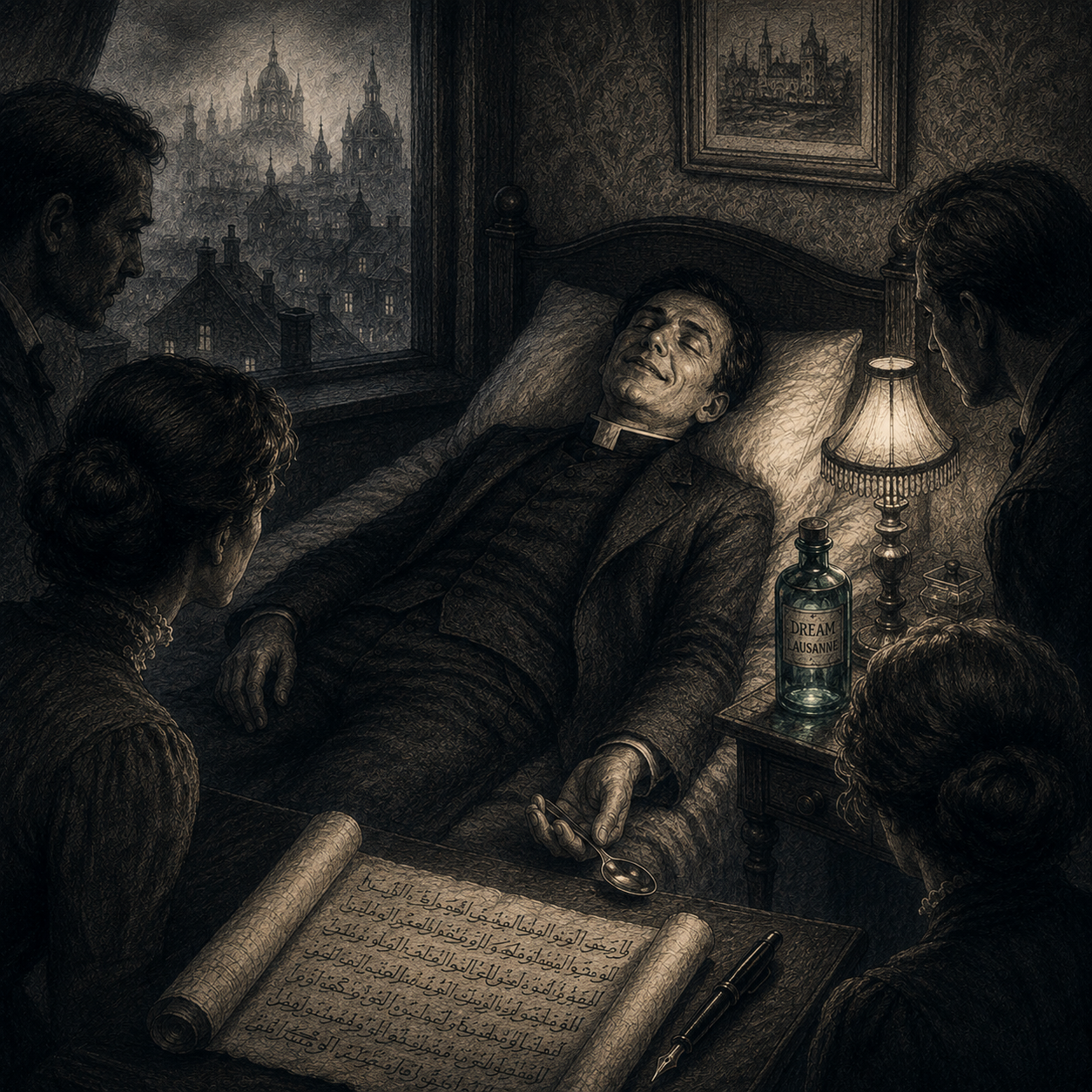
Walter made himself comfortable on the bed. The others gathered nearby. He poured a spoonful. The liquid was bitter enough to punish the tongue, and Walter grimaced.
“It tastes terrible.”
Then, almost immediately, his expression changed. Warmth entered his face and his shoulders relaxed. A broad, almost childlike happiness spread across him, and he looked around the room with the dreamy satisfaction of a man pleasantly drunk beside a fire, though nothing in the room had changed. His eyes closed. He sank back.
Arthur checked him. Breathing. Alive. But deeply asleep.
They watched him. Nothing terrible happened, at least nothing visible, and that was almost worse. Walter lay peacefully before them while his mind, spirit, dream-self, or whatever portion of a human being can travel beyond the flesh had presumably gone somewhere else. Somewhere called Dream Lausanne.
Per looked again at the bottle. His reservations had not vanished. They had merely become less important than the necessity of following. He drank. The bitterness came first, then warmth, then sleep. The others followed, one after another swallowing the green liquid and surrendering themselves to its impossible promise, while Claire watched over the sleeping room until it was her turn to close her eyes as well.
Outside, Lausanne remained Lausanne. Police moved through Edgar Wellington’s darkened shop. William Wellington lay upon the kitchen floor with a piece of himself missing. Edgar Wellington lay dead in his bed, emptied syringe nearby. Somewhere in the city, Maximilian von Wurtheim slept comfortably in a modest hotel, perhaps dreaming of the fortune his brother had stolen from him. And before dawn, the Orient Express would arrive to carry its passengers onward.
But for the investigators, the railway timetable had ceased to matter. The last waking sensation was bitterness. Then warmth. Then the soft collapse of the ordinary world.
They had spent days searching Lausanne for a dead man’s secret. Now they were going to search another Lausanne for the dead man himself.
The session resumed with the investigators at Le Chat Noir, the restaurant listed as the meeting place for the so-called 7:30 Club. The previous session had ended after the investigators arrived expecting to meet the Duke and Edgar Wellington, only to be approached by a handsome, German-accented man named Maximilian von Wurtheim, who explained that neither the Duke nor Edgar would be attending and offered to dine with the investigators instead. Per Oskarson immediately questioned Maximilian about Edgar Wellington, asking whether Wellington was well and whether he had also sent his regrets. Maximilian replied that he had not personally spoken with Edgar. The Duke had merely told him that Edgar would not be attending. Per asked whether the Duke intended to remain in Lausanne for long, explaining that there were matters he wished to discuss with him. Maximilian said that, as far as he knew, the Duke had no plans to travel. Per then asked what the 7:30 Club actually was. Maximilian explained that the name was his own invention and referred simply to the fact that the three men met at 7:30. Their dinners were informal gatherings. Sometimes the Duke and Edgar discussed historical subjects that Maximilian found boring, while at other times Maximilian entertained them with stories he considered more interesting. Regardless of the topic, he considered the food consistently good. The investigators agreed to remain for dinner, partly because they were already at the restaurant and partly because Maximilian had offered to tell them one of his stories. Walter Lake questioned how Maximilian knew the Duke. Maximilian explained that he had been in Lausanne for some time and that members of the city’s wealthier social circles naturally encountered one another at fine establishments. He and the Duke had eventually become friends through these encounters. Walter asked whether Maximilian knew much about the Duke. Maximilian described the Duke as an interesting man with interests that he personally did not find particularly compelling. The Duke frequently discussed obscure historical subjects with Edgar Wellington. Maximilian nevertheless enjoyed the Duke’s company, particularly because dining with him generally guaranteed a good meal. Viola Sutcliffe asked what sort of hobbies Maximilian meant. Maximilian explained that the Duke and Edgar were interested in old historical matters, including subjects related to Turkey and Asia. He regarded some of their interests as fanciful stories rather than serious matters. He added that Edgar had recently become especially interested in something connected with Turkey, although Maximilian admitted that he rarely paid close attention to their conversations. Viola clarified that she was curious whether the Duke and Edgar were interested primarily in physical artifacts, stories, or similar antiquarian subjects. She explained that she was something of a hobbyist herself. Maximilian reiterated that his own knowledge was limited because the historical discussions were primarily between the Duke and Edgar. Walter asked whether the Duke often failed to appear for dinners with invited guests. Maximilian said he was not aware of such behavior, although he could not speak for every interaction the Duke had with other people. He said the Duke had described the investigators as pleasant company and had suggested that Maximilian might enjoy dining with them. As the meal began, Walter privately expressed concern that the dinner might be a distraction. He wondered whether the Duke or Edgar might be using the investigators’ absence to complete some activity elsewhere, possibly involving the suspected forged scroll, or perhaps to leave Lausanne altogether. The investigators acknowledged that they had no firm evidence of a forgery at that point. Their suspicions rested primarily on Edgar Wellington’s behavior earlier that day: he had claimed that he needed to visit a bank concerning the purported Ottoman scroll, yet Arthur had followed him and observed that he instead went to a stationer and purchased ink, pens, and unusually large sheets of paper before returning home. Per attempted to determine whether Maximilian was being candid with them. His initial effort to read Maximilian was unsuccessful, and Maximilian appeared to notice Per’s scrutiny and became somewhat wary of him. Per responded by apologizing for his poor manners. He explained that he had been looking forward to discussing specific matters with the Duke and had allowed that disappointment to affect his behavior. He then redirected the conversation toward Maximilian, asking what interests he had beyond the Duke and Edgar’s historical pursuits. Arthur likewise encouraged Maximilian to tell one of the supposedly more interesting stories he had mentioned. During the meal, Walter asked exactly when Maximilian had learned that the Duke would not attend. Maximilian said he had spoken with the Duke earlier that afternoon, at which time the Duke asked him to deliver his regrets to the investigators. Maximilian then launched into a long and elaborate account of his family history. He claimed that his father had died while preparing to alter his will and that Maximilian’s supposedly evil brother had prevented the change from being completed, thereby inheriting the family fortune that Maximilian believed should have been his. Maximilian’s story continued throughout virtually the entire meal. He described numerous wrongs he believed had been done to him and opportunities he had unfairly lost. Despite the self-centered nature of the subject, his storytelling was genuinely entertaining and engrossing. The dinner lasted for several hours, through the various courses and drinks, with Maximilian continuing to dominate the conversation with stories about himself and his family. When the bill finally arrived, Maximilian announced that he had unfortunately left his wallet at home and asked the investigators to cover his portion of the meal. The investigators assessed Maximilian’s behavior over the course of the evening. Per and Viola concluded that the forgotten wallet was entirely consistent with the impression they had formed of him. Per and Viola came away believing that Maximilian was probably something of a confidence man who associated with the Duke in part because doing so provided him with free meals and access to wealthier company. At the same time, they did not detect any deeper or sinister purpose behind Maximilian’s behavior. He appeared to be genuinely absorbed in himself, enjoyed talking about his own life, and seemed motivated by vanity and opportunism rather than participation in some occult or criminal conspiracy. Maximilian wrote out and signed an IOU for the meal before thanking the investigators for the evening. By the time dinner concluded, it was close to midnight. The investigators still had no explanation for why the Duke and Edgar had both failed to appear. Before Maximilian departed, Per asked where the Duke could be found. Per explained that he still wished to discuss an important matter with him and now also wanted to thank him for sending Maximilian to entertain them. Maximilian said the Duke lived in a townhouse near the center of Lausanne, along Rue du Pré. Maximilian had been past the residence but had never been invited inside. From that, he inferred that the Duke did not often invite people into his home. Per remarked that this fit what he already understood about the Duke’s private nature and suggested that, if necessary, he might leave a note at the Duke’s residence before the investigators departed Lausanne. After Maximilian left the restaurant, Arthur Zorba decided to follow him discreetly through the streets. Per considered assisting Arthur by conspicuously walking in another direction and behaving like an intoxicated Swede, thereby drawing attention away from Arthur. Arthur ultimately proved capable of following Maximilian without assistance. Arthur successfully shadowed Maximilian for several blocks. Maximilian appeared relaxed and pleased with himself after the dinner, walking through the streets and quietly whistling. Maximilian eventually entered a small, modest hotel rather than an expensive establishment. Arthur judged it to be the sort of place that might rent rooms by the month rather than a luxury hotel appropriate to someone truly wealthy. Arthur noted the location so that the investigators could find Maximilian again if necessary, then returned to the investigators’ hotel. Meanwhile, the other investigators realized that their route back to their own hotel could conveniently take them past Edgar Wellington’s taxidermy shop and residence. Per, Walter, Viola, and Claire therefore passed Wellington’s property on their way back. The street was still active enough that their presence would not appear particularly suspicious. Per walked on the opposite side of the street, while Walter chose to walk directly past the building. Both Per and Walter noticed something unusual: the front door of Wellington’s taxidermy shop was ajar even though the shop was closed. The building appeared dark. There were no visible lights either downstairs in the shop or upstairs in the residential portion. Per approached and listened for movement inside. Walter also listened carefully. Neither heard footsteps, conversation, or any other indication that someone was moving around in the building. The investigators considered the possibility that someone might simply be asleep inside, but the open door remained suspicious. Walter decided to approach openly rather than sneak inside. He knocked loudly at the door and called out that the door was open and asked whether everything was all right. No one responded. Per looked around the street to determine whether anyone was watching the building or watching the investigators. He saw no one paying particular attention to them. There were a few distant pedestrians who appeared to be traveling to or from drinking establishments, but no obvious observer or lookout. Walter checked for immediately visible signs of violence near the entrance, such as broken glass or evidence of a struggle. Nothing near the front door appeared disturbed. Because the interior of the taxidermy shop was very dark, Walter entered far enough to locate the electric light switch and turned on the downstairs lights. Per, Walter, and Viola entered the shop. Claire remained outside to watch the street and warn them if necessary. The front door was left open so that Claire could easily call to the others if something happened outside. The interior remained as unpleasant as they remembered from their earlier visit. It was hot, smelled strongly of preserved animals and formaldehyde, and was crowded with taxidermied creatures. Before the lights came on, the shadowy outlines of the mounted animals made the shop particularly ominous. Once illuminated, however, the downstairs area appeared essentially unchanged from earlier in the day. Nothing obvious in the shop itself appeared disturbed or out of place. The investigators recalled that William Wellington, Edgar’s brother, could hear normally even though he communicated by writing instead of speaking. They therefore did not want to enter the residence too aggressively or unexpectedly frighten him. Per approached the stairs leading to the upstairs living quarters and called out for Monsieur Wellington. There was again no response. The door leading toward the upstairs residence was also open. Per, Walter, and Viola decided to proceed upstairs to determine whether the Wellington brothers were safe. The upstairs landing was dark. The investigators remembered the general layout from their previous visit: a kitchen, bathroom, and bedrooms opened from the landing. Most of the upstairs doors appeared closed. The kitchen door, however, stood open. A small amount of outside light entered through the kitchen window. Before the investigators could turn on the upstairs lights, Per noticed what appeared to be a pair of feet and lower legs lying motionless on the kitchen floor. From the position of the legs, it appeared that a person was lying face down inside the kitchen. Per found the upstairs light switch and turned it on, illuminating the landing and casting additional light into the kitchen. The investigators could now see more clearly that someone was indeed lying motionless inside. Per entered the kitchen to determine whether the person required assistance. Per, Walter, and Viola were confronted with the body of William Wellington. William was lying face down in a pool of blood. His shirt had been badly torn. A bloody knife lay on the floor nearby. A roughly six-inch by four-inch section of skin had been cut and peeled from William’s back. The wound was not perfectly rectangular but covered approximately that area. When the investigators saw William’s face, it was frozen in an expression of extreme horror. The kitchen itself clearly showed signs of a violent struggle. Chairs had been knocked over, the table was disturbed, and the room was in general disarray. The sight disturbed all three investigators. Per was particularly shaken, though he managed to regain control of himself after the initial shock. After examining William’s body, Per decided that they needed to determine whether Edgar Wellington was also in the residence. Per searched the remaining rooms and entered one of the bedrooms. Edgar Wellington was lying motionless in bed. Unlike William, Edgar showed no obvious external wounds and there were no signs of a struggle in the bedroom. Per tried calling Edgar’s name and attempted to rouse him. Upon examining him more closely, the investigators determined that Edgar Wellington was dead. They could find no pulse. Edgar had fresh needle marks on both arms. His left arm also had a number of older, healed needle marks, indicating repeated previous injections. In addition to those older marks, there was one fresh puncture on the left arm and another fresh puncture on the right arm. The investigators searched Edgar’s bedroom for clues. They found what appeared to be Edgar’s diary lying on the floor. They found an empty bottle of morphine. An empty syringe was also lying on the floor. They found a mostly full green bottle labeled “Dream Lausanne.” Walter noticed something beneath the bed and pulled it out. It was a scroll. The investigators examined the scroll and quickly determined that it did not appear ancient. Viola, in particular, could tell that the material did not have the age that would be expected of the historical Ottoman scroll Edgar had previously described. Further examination of the room strengthened the possibility that the scroll had been recently produced. The investigators found pens and ink among Edgar’s belongings. They found a receipt from the stationer Edgar had visited earlier that day. They also found another piece of similar blank parchment, closely resembling the material used for the completed scroll. The completed scroll did not look unfinished or experimental. Whatever Edgar had written on it appeared complete. Walter initially cautioned that the investigators could not yet know with certainty why Edgar had produced the document. It might have been a forgery intended to deceive someone, but it was also theoretically possible that Edgar had been reproducing or copying a genuine document. The investigators examined Edgar’s diary, including its most recent entry. The diary contained information indicating that Edgar had been using Dream Lausanne and that his experiences there were connected to the scroll. Based on the diary, the investigators understood that Edgar believed objects could in some manner be transferred between waking Lausanne and a corresponding dream version of Lausanne. While the investigators were still searching the bedroom, they heard Claire shout from downstairs. Claire had seen that the police were arriving at Wellington’s building. The investigators immediately had to decide whether to remain and explain their presence or leave before the authorities entered. Per’s first instinct was to escape and conceal the most important evidence they had found. Walter was less concerned about their legal position, reasoning that they had entered because the door was open and they were checking on the Wellingtons’ welfare. He was prepared to tell the authorities the truth if necessary. Nevertheless, the investigators recognized that being discovered inside the scene of a brutal murder while carrying unusual items from the dead man’s room could create serious complications. Per took the green bottle of Dream Lausanne and concealed it in a pocket. The group discussed the diary and the scroll. Per initially intended to leave them behind. Walter was reluctant to personally conceal stolen evidence, but he considered the scroll important enough that the investigators should take it. Eventually, Per reluctantly took the scroll as well. The diary was not described as being taken with them when they fled. The investigators headed for the back exit of the building. They were fortunate enough to make it into the rear alley before the police came through the front. As they moved away from the building, Claire joined them. From behind them they could hear the police knocking and calling out for Monsieur Wellington. The investigators successfully avoided immediate contact with the authorities. Their immediate plan was to return to their hotel and keep a low profile. While traveling back, Per became concerned that one of them might unknowingly have blood on their clothing or shoes from the murder scene. Walter carefully checked the group. They had managed to avoid stepping in William’s blood, and since the rest of the building had been relatively clean, none of them appeared to be carrying obvious bloodstains that would attract attention. The group returned to the hotel shortly after 1:00 a.m. Arthur had arrived before them after completing his surveillance of Maximilian and was waiting in the hotel bar. Arthur reported that Maximilian had gone to a modest hotel and provided the location. The others informed Arthur about the discovery of William and Edgar Wellington’s bodies, the apparent murder of William, Edgar’s probable drug-related death, and the evidence found in Edgar’s bedroom. The investigators were reminded that the Orient Express departed Lausanne at 7:07 that morning. They did not have to board that particular train, but missing it would mean waiting roughly another day for the next convenient departure. This gave the group a possible opportunity to leave Lausanne quickly before the police connected them with the Wellington residence. The investigators returned to their rooms to examine the recovered evidence privately. Arthur inspected the recovered scroll. The writing used Arabic script, consistent with what the investigators had previously been told about the Ottoman Turkish document Edgar claimed to possess. Arthur recognized the parchment itself as resembling the unusually large paper that Edgar had purchased at the stationer earlier that day. The document was clearly not an ancient scroll. The parchment and writing were far too recent. Although the work was convincing enough that it might look old or authentic at a casual glance, close inspection made it obvious that the document had been produced relatively recently. Per could identify the script as Arabic but could not read the actual Turkish text. None of the investigators present could translate the scroll. The group discussed bringing it to Yunus Ferat, the diplomatic assistant and amateur historian whom Per and Walter had previously arranged to use as a translator. They had not brought Ferat to dinner that evening, and he had said they could find him the following day if they needed his help. Per wondered whether he might recognize the phrase “Sedefkar Simulacrum” within the Arabic script based on previous documents the investigators had encountered. The group concluded that they had only encountered references to the Simulacrum in translated French or English sources, not in its original Turkish written with Arabic characters, so Per could not identify the phrase visually. The investigators discussed whether it was wise to remain in Lausanne long enough to consult the translator. Per pointed out that several members of the group had just been present at the scene of a brutal murder and had fled immediately before the police entered. Although they were innocent of the killings, the circumstances could still cause serious complications if the authorities traced them. Arthur suggested that they could simply take the morning train, continue their journey, and attempt to find another translator in a later city. The Dream Lausanne bottle complicated that decision. The investigators discussed the contents of Edgar’s diary and what they had seen in his bedroom. Their understanding was that Edgar had apparently been traveling to a dream version of Lausanne, where the genuine scroll might have existed or been stored. It remained uncertain whether Edgar had successfully retrieved the real scroll from Dream Lausanne, whether he had only copied it while there, or whether the newly made scroll found beneath his bed was intended as a substitute. The investigators considered whether the forged-looking scroll might be connected to whatever Edgar had been doing in the dream. They examined the circumstances of Edgar’s death more carefully. The green bottle of Dream Lausanne had been open and was beside Edgar. The morphine bottle was empty. Edgar had one fresh injection mark among the many older marks on his left arm, together with another fresh injection mark on his right arm where there were no comparable old marks. From these facts, the investigators reasoned that Edgar may have deliberately used Dream Lausanne to enter the dream state and that someone else subsequently administered a lethal quantity of morphine while he was unconscious. They also remembered from their previous Dreamlands experiences that death in the waking world did not necessarily mean immediate disappearance from the Dreamlands. This led them to consider the possibility that Edgar might still exist in Dream Lausanne even though his physical body was dead. If Edgar had entered Dream Lausanne to retrieve the scroll before being murdered in the waking world, he might still be there with information about what had happened or with access to the genuine document. This possibility made entering Dream Lausanne significantly more important. Per was intrigued but hesitant. He had survived the group’s previous Dreamlands expedition, but the experience had badly affected his sanity, and he was conscious of the risks of returning to such a place. Arthur was also mentally worn down from the group’s previous experiences but noted that entering Dream Lausanne during the night would not necessarily cost them any waking time. They could potentially investigate the dream and still leave Lausanne on the morning train. The investigators discussed the mysterious green liquid itself. There were no dosage instructions, and they did not know precisely how Edgar had administered it. The available evidence suggested that the needle and syringe found beside Edgar were associated with the morphine, not necessarily with the Dream Lausanne liquid. The investigators therefore considered simply drinking a small amount. Walter Lake volunteered to serve as the initial test subject. The others arranged to remain awake and watch him, specifically to ensure that no one could approach and kill him in his sleep as they believed had happened to Edgar. Walter made himself comfortable and took roughly a spoonful of the green Dream Lausanne liquid. He attempted to describe what he was feeling to the others as the drug took effect. The liquid tasted extremely bitter and unpleasant. Despite the awful taste, Walter rapidly developed an expression of intense warmth and happiness. He began to resemble a pleasantly intoxicated man, appearing relaxed and content. His eyes then closed and he fell into a very deep sleep. The others checked Walter after he lost consciousness. Walter remained alive and continued breathing normally, although he was sleeping very heavily. Seeing that Walter had apparently taken the substance without immediate physical harm, the others reconsidered whether they should join him in Dream Lausanne. Per ultimately decided that he would participate rather than allow Walter to enter the dream alone. Per drank some of the green liquid as well. The remaining investigators likewise prepared to take the Dream Lausanne substance so that they could investigate the dream together while someone remained available to watch over the sleeping group. The session ended with the investigators preparing to return to the Dreamlands, this time seeking Dream Lausanne, in hopes of discovering what Edgar Wellington had been doing there, whether his dream-self still survived, and what had happened to the genuine Ottoman scroll.Session Notes