Lausanne wore civility like a mask carved from pale stone. Its steep streets climbed toward churches and universities, its cafés smelled of coffee and warm pastry, and the cold air descending from the mountains seemed clean enough to scour corruption from the lungs. Yet across from the café stood Wellington’s taxidermy shop, its windows dark beneath the weak winter light, and behind those windows waited ranks of dead creatures whose glass eyes had witnessed too much.
Per Oskarson emerged from the shop without looking toward his companions. He walked at an unhurried pace, neither furtive nor relaxed, and continued until the building’s narrow windows could no longer observe him. Only then did he turn slightly and offer the smallest signal toward the café, less a gesture than a fragment of movement, the sort of thing one might dismiss as a man adjusting his coat against the chill. Those who knew him understood.
The others drifted from their places one by one. A group of foreigners clustering beneath Wellington’s windows would invite precisely the attention Per wished to avoid, so Arthur made a show of considering another pastry, Claire lingered with a cigarette, and Viola joined Per around the corner. Walter, still troubled by what he had seen upstairs, kept his own counsel.
“Well,” Per said when they were beyond the storefront’s view, “that was a very interesting conversation.”
Claire had noticed the elegant visitor who left before Per and Walter, and asked whether the man was important. Before Per could answer, Viola spoke.
“I recognized him. The Frenchman from Constantinople.”
For a moment Per could only stare. He had met the man himself, but memory was an unreliable museum. It preserved certain horrors in exquisite detail while allowing ordinary faces to decay. The Frenchman had once worn a beard, and thirty years should have transformed him as surely as they had transformed Per. Yet Viola had no doubt. Nor, apparently, had the Frenchman.
“He knew you?” Per asked.
“Oh yes. He made quite a double take. Most gauche.”
Per looked at her with the delicacy of a man approaching the edge of a deep and familiar precipice. To speak directly of her unchanged appearance would have been indelicate, and unnecessary besides. The Frenchman had survived thirty years without surrendering so much as a wrinkle to them, and Viola’s own face remained a quiet rebellion against the calendar. Two people had stepped beyond time’s proper current, and neither knew why the other had done so.
“Then he may remember me as well,” Per said. “He did not recognize me inside, but seeing you may lead him to the answer afterward.”
The Frenchman had once been an ally only in the narrowest sense, aiding them because their purposes briefly overlapped and because another man’s death had suited his own designs. Such arrangements resembled truces between predators over the carcass of a third beast; they endured only while hunger permitted. Now he was interested in Wellington’s scroll, and that alone made him dangerous.
Per described what had passed inside. Edgar Wellington claimed the scroll was locked safely in a bank and would be produced that evening before the so-called 7.30 Club, yet everything in his manner suggested concealment. He wanted the Duke’s money, and he wanted the investigators’ interest to raise the price, but he had refused to show them the scroll despite professing eagerness to sell it. His explanations were plausible in isolation; together they formed a structure without foundations. And then there was William. Per described the mute brother’s rigid posture, his motionless eyes, the oppressive heat of the apartment, and the message he had written after Walter offered prayer.
God can’t save us now.
Even in the open street, with daylight lying upon the roofs, the sentence seemed to carry the furnace heat of Wellington’s rooms.
Viola wondered whether Edgar wanted the scroll for himself, or perhaps meant to use it to help his brother. Per could not imagine what might be written upon it that would help William.
“Neither can I,” she said. “But there is something wrong in that house.”
There was no argument to make against that. Per had spent too much of his life among occult phenomena to dismiss atmosphere as mere imagination. Places acquired pressure. Secrets produced their own climates.
Whatever Wellington was hiding, Per preferred that he not learn they were all associated. Walter would help Per seek a translator who could read Turkish written in Arabic characters; if the scroll appeared that evening, they needed someone capable of deciphering it before the Duke could turn knowledge into possession. The others would watch the shop. Arthur and Claire took the rear alley, while Viola remained near the front, where she could observe the entrance without appearing threatening. Their surveillance had none of the romance found in detective novels. It consisted of cold stone, steep streets, cigarettes, pastries, and the slow corrosion of patience.
Behind the shop, Arthur and Claire found a narrow alley that smelled faintly of damp masonry and refuse. Anyone leaving Wellington’s rear door would have to pass one end or the other. Arthur inspected the route with a soldier’s eye and found no innocent reason for two foreigners to remain there for hours. Claire lit another cigarette.
“Good for the lungs,” Arthur observed.
“At this altitude, I expect it’s medicinal.”
They settled into the wait. Out front, Viola occupied herself with coffee while the taxidermy shop continued its quiet business. Near noon, the sign in the door turned from OPEN to CLOSED. No one emerged; the shop simply withdrew from the world.
Meanwhile, Per and Walter climbed toward the university. The ascent made Lausanne feel less like a city than a test devised by some Alpine moralist, and the cathedral watched from above, vast and solemn. Walter looked toward it. “No time,” Per told him. “We need a translator.”
The university had the general air of an institution that believed all knowledge could be properly catalogued if only given sufficient shelving. Per’s letter of introduction earned them polite attention, but the people they approached were more skilled at redirecting questions than answering them. No professor of Turkish studies could be found, no linguist was available, and the library staff suggested that someone else, somewhere else, might know more.
The failure worried Per more than it irritated him. Wellington had selected the hour and location of the meeting, the Duke already commanded extensive occult knowledge, and every delay left the investigators dependent upon what others chose to reveal.
Yet Lausanne itself supplied another possibility. The city was crowded with delegates to the ongoing conference on the remnants of the Ottoman Empire, men who had arrived from Turkey, Britain, France, and elsewhere to decide the shape of nations over polished tables. There were more Turkish speakers in Lausanne than in almost any other Swiss city.
Per and Walter searched the cafés frequented by delegates and their staffs, a method bordering on absurdity, but persistence eventually led them to two Turkish men in business dress, assistants to diplomats, temporarily unoccupied because no formal meetings were being held that day. One of them, Yunus Fırat, had an amateur love of history, the dangerous kind of curiosity that persuades sensible men to enter rooms already marked by disaster. When Per warned that the document might contain unusual or disturbing material, Yunus smiled with the indulgence of someone who assumed he was being warned of obscenity. He agreed to come, took the address, and promised to be punctual.
For the first time that afternoon, Per felt the shape of a modest victory. It was not much, only a stranger’s promise, but in investigations of this nature the smallest secured fact could serve as a nail driven into a wall of mist.
Back at Wellington’s shop, patience finally bore fruit. Shortly after one, Edgar Wellington stepped into the street and turned away from the alley where Arthur and Claire waited. They had discussed surveillance, but not the precise manner by which watchers at opposite ends of a building should communicate, and Wellington was already moving. Viola hurried around the corner and into the alley.
“Cuckoo! Cuckoo!” she called. “He’s on the move!”
By the time the three regained the street, Wellington had gained distance. Viola caught sight of him farther uphill just as he turned onto another road. Arthur, who had never seen the man, followed her indication, while Claire, her eyes irritated by smoke and cold, searched the wrong direction before finding her bearings. They followed through fragments of cover, past shop windows that reflected the watchers in pale distortions, until at the next corner Wellington entered a shop.
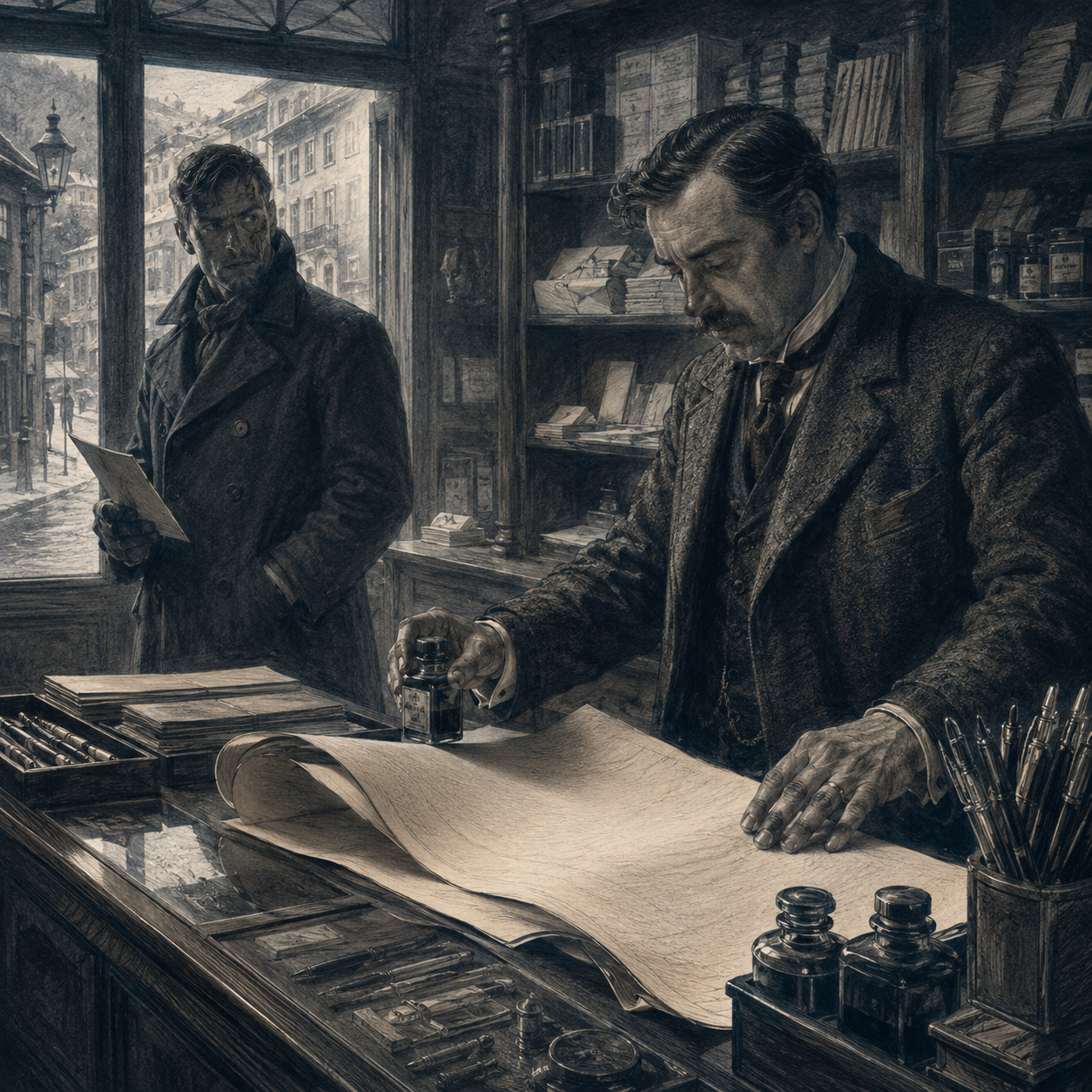
The establishment sold stationery: writing paper, envelopes, pens, and ink. It was an ordinary place, which made it immediately suspect.
“He’s making a false scroll,” Viola whispered.
Neither Arthur nor Claire had met Wellington face to face. Arthur adjusted his coat and stepped inside.
The shop smelled of paper, glue, dust, and ink. Wellington stood at the counter with his back partly turned, speaking to the shopkeeper in English, buying paper, ink, and pens. None of those things should have carried menace, yet the purchase occurred only hours before he was meant to display an ancient scroll he claimed to keep in a bank. Arthur listened while pretending to consider card stock, and noticed among the items on the counter sheets larger than those ordinarily used for correspondence. Nothing obviously fraudulent. Merely large paper, large enough, perhaps, for a copy.
Arthur bought a single piece of card stock, left before the taxidermist, and slipped around the corner to report. “Paper, ink, and pens. Some of the sheets were unusually large, but nothing looked ancient.”
“A man who can make dead animals resemble living ones,” Viola said, “should not be underestimated as an artist.”
The argument was difficult to dismiss. Taxidermy depended upon illusion: it preserved shape while discarding life, stretched a convincing surface over emptiness, and invited the observer to mistake resemblance for truth. If Edgar Wellington wished to create a false scroll, his entire profession had prepared him for the task. Claire suggested he might only be making a copy, which was more troubling in its way. A forger meant to deceive the Duke; a copyist might sell the original while retaining its knowledge, its power, or whatever corruption lay encoded in its script.
Wellington emerged carrying a bundle and returned directly to his shop, and the building sealed itself once more. The investigators watched for several hours. No one departed, and the windows offered no useful view of whatever labor went on behind the walls.
At last they abandoned the vigil and returned to their hotel, where Per’s news of Yunus Fırat and Arthur’s account of the stationery shop combined into several competing theories, none of them comforting. Perhaps Wellington had never had the scroll and intended to fabricate it, though that did not explain how he had known to write to Lausanne in connection with the Sedefkar Simulacrum. Perhaps he owned the genuine document but planned to sell a forgery, or meant to copy it before surrendering the original. Perhaps the paper had nothing to do with the scroll at all. That last explanation was the simplest, and therefore the least persuasive.
There was one further problem. Wellington had not visited a bank. He had left his shop only to purchase stationery, then returned, and by the time the surveillance ended the banks were closing. If the scroll truly rested inside a secure vault, he had made no apparent effort to retrieve it for the evening meeting.
“He lied,” Per said quietly. No one contradicted him.
They dressed for the 7.30 Club with the care demanded by any gathering involving aristocrats, occultists, and possible fraud, and they drank before leaving, partly from habit and partly because certain doors were easier to approach with warmth already spreading through the blood.
The address led them to Le Chat Noir, which was not a private club at all but a comfortable, respectable restaurant with polished tables and a bar prepared for the evening’s trade. There were no signs bearing the name 7.30 Club, no guarded staircase, no hidden salon. Yunus waited outside, greeted Per with enthusiasm, and appeared pleased to learn the address belonged to a good restaurant, though the gathering’s true purpose remained difficult to explain without sounding either deceitful or mad.
Inside, the maître d’ seemed genuinely puzzled by their question, until Per mentioned the Duke. The Duke was a regular customer, the man explained, who often dined there at roughly the same hour with companions; the staff knew of no formal organization by the name Wellington had given them. The 7.30 Club was merely an ironic title for a recurring dinner. The small deception irritated Per. Wellington had allowed them to imagine an occult society when he meant only a table reserved by habit, as though every statement he made naturally acquired an unnecessary layer of falsehood.
The maître d’ had seen neither Wellington nor the Duke, so the investigators waited at the bar and drank. At half past seven, neither man appeared. At a quarter to eight, their absence became discourteous. Yunus, introduced to schnapps while they waited, embraced it with admirable dedication, his willingness to translate intact though the object requiring translation was nowhere to be seen. Arthur looked for concealed passages and private rooms, and Claire studied the maître d’ for evidence that they were being deliberately excluded, but nothing suggested conspiracy within Le Chat Noir. The staff seemed honestly confused. The unease came from the men who had failed to enter.
At eight o’clock, a tall young man arrived, fair-haired and blue-eyed, with a handsome face that seemed designed to inspire immediate confidence. The maître d’ greeted him warmly and indicated the investigators gathered at the bar. The newcomer smiled and approached.
“Are you the people who came to meet the Duke for the 7.30 Club?”
Conversation ceased, and Per lowered his glass. The man introduced himself in a German accent as Maximilian von Wurtheim, one of the members of the so-called club. His manner was gracious, his expression apologetic, and his arrival precisely timed to deliver disappointment with the greatest possible elegance. He brought the Duke’s regrets. The Duke would not be attending. Nor would Edgar Wellington.
For a heartbeat, no one responded, and the empty place where the scroll should have been seemed to widen around them. All afternoon they had watched Wellington’s shop, followed him through Lausanne, found a translator, and arrived at the appointed hour. Yet Wellington and the Duke had slipped beyond reach without needing to evade pursuit. They had simply sent another man to close the door.
Per looked at Maximilian and felt the day’s scattered clues align into a pattern whose meaning remained hidden. The Frenchman who had not aged. Viola, equally untouched by time. William’s unmoving eyes. The lie about the bank. Fresh paper and ink carried into a house full of preserved corpses. A promised scroll that had failed to appear, and a dinner club that was not a club. Every answer had produced a more carefully shaped absence. Somewhere in Lausanne, Edgar Wellington held either an ancient document or the means to imitate one. Somewhere else, the Duke had chosen not to face them. Perhaps the scroll was being copied even now beneath the gaze of dead animals.
Around them, Le Chat Noir continued its evening trade. Glasses touched, cutlery moved against china, and the ordinary world performed itself with flawless discipline. Yet the investigators had begun to understand Edgar Wellington’s art. A convincing surface did not require life beneath it.
It required only that the observer wished to believe.
Session Notes
-
The session opened with a recap of the investigators’ arrival in Lausanne after an uneasy night aboard the Orient Express.
- The group had taken rooms at the Hotel Cécile.
- Their principal reason for visiting Lausanne was to find Edgar B. Wellington, whose letter had drawn them to the city.
- Edgar lived above his taxidermy shop, an oppressively hot establishment crowded with glass-eyed animals.
- Arthur Zorba, Claire Corning, and Viola Sutcliffe had watched the shop from a café across the street while Per Oskarson and Walter Lake entered to speak with Edgar.
-
During the previous meeting, Edgar Wellington had explained that he acquired a mysterious scroll during the Great War and had spent years attempting to understand it.
- The scroll appeared to be written in Turkish using Arabic script.
- Edgar believed it might be connected to the writings of Captain Louis Malon.
- He claimed the scroll was safely stored in a bank.
- He promised to display it that evening during a meeting of the “7:30 Club.”
- Despite their interest, Edgar refused to show the scroll to Per and Walter before the evening meeting.
- Per was convinced that Edgar was lying about his reason for withholding it.
-
Per and Walter had also met Edgar’s brother, William Wellington.
- William was a mute Great War veteran who appeared to be suffering from severe shell shock.
- His eyes remained unnaturally fixed and did not move.
- When left alone with him, Per and Walter attempted to communicate by asking him questions in writing.
- William initially responded only with unsettlingly polite pleasantries.
- When Walter offered to pray for him, William wrote, “God can’t save us now.”
-
The previous conversation had been interrupted by the arrival of the Duc d’Essang.
- The Duke was a wealthy French occultist and a prospective buyer for Edgar’s scroll.
- He appeared polished, knowledgeable, and deliberately guarded.
- He recognized several names associated with the investigators’ current search.
- Per tested the extent of the Duke’s occult knowledge and concluded that he knew considerably more than he admitted.
- Edgar hoped that the investigators’ interest in the scroll might pressure the Duke into finally purchasing it.
- The Duke departed before Per and Walter left the shop.
-
As the Duke emerged from the taxidermy shop, he saw Viola and recognized her.
- Viola simultaneously recognized him as the Frenchman she and Per had encountered in Constantinople approximately thirty years earlier.
- The Frenchman appeared unchanged despite the passage of three decades.
- His recognition of Viola also highlighted that she had not visibly aged during the same period.
- The investigators were therefore confronted with two people from the earlier Constantinople affair who had been preserved beyond the ordinary effects of time.
-
At the beginning of the present session, Per clarified the group’s situation after leaving the taxidermy shop.
- He had intended to leave without openly approaching the investigators across the street.
- Because Edgar and William had seen Per and Walter, Per did not want to reveal that they were associated with the people watching from the café.
- He moved around the corner, beyond the view of the shopfront and the upstairs windows.
- From there, he discreetly signaled for his companions to meet him.
- The group did not require a formal Stealth roll because the available street geometry allowed Per to move out of sight before attracting their attention.
-
Per reported that the conversation inside the Wellington residence had been highly unusual.
- Claire asked whether the Duke’s visit had been noteworthy.
- Viola immediately revealed that she had recognized him.
- She identified him as the Frenchman from Constantinople whom she and Per had known during the Blood Red Fez affair.
- Per was visibly shocked by this revelation.
- Although Per had also met the Frenchman thirty years earlier, he had not recognized him during their encounter in the taxidermy shop.
- Per reasoned that his memory had faded and that the Frenchman’s removal of his beard had altered his appearance.
- More importantly, Per had expected the man to look thirty years older and therefore had no reason to identify him as the same person.
-
Per proposed that the investigators conceal their association from the Wellington brothers.
- He believed something strange was occurring in the building.
- He wanted the group to maintain surveillance without making the Wellingtons aware that Per and Walter were connected to the watchers outside.
- Per was particularly suspicious of Edgar’s statement that the scroll was stored in a bank.
- He considered the story implausible and wanted to determine what lie Edgar was attempting to conceal.
- Arthur suggested that the group should also watch the rear entrance in case someone attempted to leave without passing the café.
-
The investigators divided their surveillance responsibilities.
- Arthur volunteered to watch the rear entrance.
- Claire initially considered remaining at the café but decided to accompany Arthur, reasoning that two people together might appear more casual and provide greater safety.
- Viola remained in a position to watch the front of the taxidermy shop.
- Walter was initially discussed as another possible front watcher, but Per and Walter instead decided to visit the university in search of a translator.
- Per hoped that people who had not entered the shop would be less likely to attract suspicion while watching it.
-
Per and Viola discussed the return of the Frenchman from Constantinople.
- Per asked what Viola believed his presence and unchanging appearance meant.
- Viola initially treated the question lightly, but then agreed that the situation was suspicious.
- She described the matter as having “the odour of the fish about it.”
- Viola confirmed that the Duke had clearly recognized her and had performed a conspicuous double take.
- She considered his reaction extremely gauche.
- Per found it somewhat reassuring that the Duke had been surprised, because this suggested that he had not expected to encounter Viola or Per in Lausanne.
- However, Per acknowledged that seeing Viola might prompt the Duke to remember him after the fact.
- He therefore concluded that they could not safely assume the Duke remained unaware of Per’s identity.
-
Per and Viola considered how the Duke’s involvement might affect their search for the Sedefkar Simulacrum.
- They knew they were scheduled to encounter him again at the 7:30 Club.
- Per wondered whether the Duke was merely a rival attempting to purchase the scroll.
- Viola believed they could not dismiss the possibility that he posed a more serious threat.
- Per noted that the Duke was unquestionably a master of the occult.
- During their earlier conversation, however, Per had not discovered evidence that the Duke specifically knew about the Sedefkar Simulacrum.
- Per considered this lack of recognition mildly comforting.
- He also warned that, if the scroll contained the information they suspected, the Duke might understand its significance as soon as he read it.
-
The investigators recalled their earlier dealings with the Frenchman in Constantinople.
- He had acted as an ally of convenience rather than a trustworthy friend.
- He had directed them toward a former acolyte who had become troublesome and needed to be eliminated.
- Once he learned that the investigators intended to deal with that enemy, he had willingly indicated where the target could be found.
- In exchange, the investigators had been required to surrender notes or a book concerning the Blood Red Fez.
- Per believed they might once again possess information or materials that could be used as leverage.
- He was nevertheless reluctant to involve the Duke before the investigators had secured the scroll or learned exactly what it contained.
- Per did not trust the Duke to share their apparent objective of destroying the Simulacrum.
- The investigators had not explicitly discussed their final plans for the complete artifact, but Per believed destruction was their intended goal.
-
Viola suggested that Edgar Wellington might want to use the scroll to help his brother William.
- Per initially doubted that the scroll could contain anything capable of helping William.
- Viola admitted that she had no evidence and was relying on instinct.
- She nevertheless felt that the circumstances surrounding William’s condition and Edgar’s behavior indicated a hidden connection.
- Per agreed that something was clearly wrong.
- He noted that William’s immobile eyes might conceivably result from a brain injury, but a meaningful diagnosis would require examination by someone with neurological expertise.
- Per remained deeply unsettled by the combination of the oppressive heat, the taxidermied creatures, William’s behavior, and the coincidental arrival of the French occultist.
-
Per decided to look for someone capable of translating the scroll.
- He wanted a person who knew Turkish and could read the Arabic script in which Turkish was written during this period.
- He preferred someone associated with history or another scholarly field who might also recognize historical references.
- He considered finding a graduate student or junior academic who would be willing to assist in exchange for money.
- The translator would need to accompany the investigators to the 7:30 Club that evening.
- Per wanted the translator to understand the language while ideally remaining unaware of the occult importance of the material.
-
Arthur and Claire went to examine and watch the rear of the Wellington building.
- The rear entrance opened into an alley running between adjoining buildings.
- Another building stood opposite the Wellington property and fronted onto the next street.
- The alley was wide enough for pedestrians but was not heavily traveled.
- Several doorways opened into the alley.
- Anyone leaving through the Wellingtons’ rear door would have to proceed toward one of the streets at either end unless they passed through another building.
- Arthur and Claire settled in to watch the entrance.
- They remained there from late morning until early afternoon.
- The weather was chilly but not miserable, and it was not raining.
- Very little occurred in the alley during their surveillance.
-
Viola continued observing the front of the taxidermy shop from the café.
- Around noon, she saw the shop’s sign turned from “Open” to “Closed” from inside.
- The surrounding street remained moderately active with pedestrians and occasional carriages.
- The café staff continued serving Viola as she waited.
- Nothing else significant occurred for approximately another hour.
-
Meanwhile, Per and Walter traveled to the nearby university and library.
- The complex included a large university, a library, and a museum.
- A prominent Protestant cathedral stood at the top of the hill nearby.
- Per attempted to use his academic reputation and connections to identify someone at the university who could assist.
- His Credit Rating roll failed, indicating that he had no useful personal connection with the local academics.
- Per still possessed a letter of introduction from his own college, which was sufficient to persuade people to speak with him.
- However, neither the university offices nor the library staff could identify anyone currently available who knew Turkish.
- No member of the library staff possessed the necessary skill, and the investigators did not locate a suitable scholar.
-
Although the university search failed, the librarians provided a useful lead.
- They mentioned that an unusually large number of Turkish nationals were presently in Lausanne because of a major international conference.
- Per was familiar with the Conference of Lausanne through his regular attention to current events.
- Representatives from Turkey, Britain, and France were negotiating the disposition of the former Ottoman Empire.
- The negotiations had been underway since November.
- The historical outcome would eventually be the Treaty of Lausanne and the establishment of the Republic of Turkey, although that result had not yet occurred in the campaign’s present.
- Per concluded that the conference explained why Turkish speakers might be found elsewhere in the city.
-
Per and Walter searched local cafés for Turkish nationals associated with the conference.
- They found two Turkish men in business attire who appeared to be junior secretaries or assistants attached to diplomatic representatives.
- Their official services were not required that day because the conference meetings were not in session.
- Per approached them and explained that he needed help translating an old scroll.
- He succeeded at a Persuade roll with two levels of success.
- One of the men became noticeably interested when Per mentioned the old document.
- The man explained that he had always been something of a history enthusiast and would be pleased to examine the scroll.
-
Per warned the prospective translator that the document might contain strange or disturbing material.
- The man accepted the warning without objection.
- He asked where and when they should meet.
- Per arranged for him to come to the address associated with the 7:30 Club that evening.
- The translator did not recognize the club’s name, but he accepted the address and promised to arrive punctually.
- He introduced himself as Yunus Fırat.
- Per planned to meet Yunus outside the club before entering.
-
At approximately one o’clock, Viola saw Edgar Wellington leave the taxidermy shop.
- Edgar began walking up the street.
- Arthur and Claire could not see this from their position behind the building.
- Because Edgar was not walking in the direction of the rear alley, he would not naturally pass them.
- Viola left her observation point and hurried into the alley to alert them.
- She called out the agreed signal, shouting, “Cuckoo! Cuckoo! He’s on the move!”
-
Viola, Arthur, and Claire attempted to reacquire Edgar after Viola briefly lost sight of him.
- Viola and Arthur succeeded at their Spot Hidden rolls.
- Claire failed and initially looked in the wrong direction, distracted in part by pain from her injured arm.
- Viola spotted Edgar farther along the street and saw him turn a corner.
- Arthur had not previously met Edgar and therefore relied on Viola to identify the correct man.
-
The three investigators followed Edgar through the streets.
- They attempted to remain inconspicuous.
- Their initial Stealth results were mixed.
- Arthur failed his first roll but pushed it and succeeded on the second attempt.
- The group managed to follow Edgar without alerting him.
- After turning the corner, they saw him approximately two-thirds of the way up the next street.
- Edgar entered a shop before the investigators could get close enough to identify it.
-
The investigators approached and discovered that Edgar had entered a stationery shop.
- The establishment sold paper, pens, ink, and other writing materials.
- Viola immediately suspected that Edgar might intend to create a false scroll.
- The shop had front windows through which the interior could be partially observed.
- Arthur decided to enter because Edgar had never met him and would not recognize him as one of the investigators.
- Claire and Viola remained outside.
-
Arthur entered the stationery shop while presenting himself as an ordinary customer.
- He greeted the shopkeeper in French and began browsing.
- Edgar stood with his back toward the door, speaking with the shopkeeper in English.
- Arthur overheard Edgar asking for paper, ink, and pens.
- Edgar did not purchase an enormous quantity, but the amount was sufficient for writing several letters or preparing another document.
- Arthur attempted a Psychology roll to determine whether Edgar’s behavior revealed a hidden purpose but failed.
- From Arthur’s perspective, Edgar appeared to be making a normal stationery purchase.
-
Arthur examined Edgar’s purchases more closely.
- A successful Spot Hidden roll revealed several unusually large sheets of paper among the materials.
- The sheets were larger than one would ordinarily use for a mailed letter.
- They could conceivably have been intended for a poster or shop notice, but they were also consistent with the size needed to imitate a scroll.
- Arthur saw nothing obviously antique or specifically designed to resemble ancient parchment.
- Edgar was also comparing two bottles of ink.
- Arthur purchased a piece of cardstock to justify his presence in the shop.
- The shopkeeper briefly left Edgar to complete Arthur’s inexpensive transaction.
- Arthur then departed before Edgar finished shopping.
-
Arthur reported his observations to Viola and Claire.
- He explained that Edgar had purchased paper, pens, ink, and several larger sheets.
- Arthur did not see anything definitively scroll-like or antique.
- Viola nevertheless believed Edgar might be preparing a facsimile.
- She pointed out that Edgar was a taxidermist whose profession required artistic skill and the ability to make dead things appear lifelike.
- She therefore considered him capable of producing a convincing copy.
- The investigators remained suspicious that he intended either to substitute a forgery for the original scroll or create a duplicate.
-
Edgar soon left the stationery shop carrying a bundle of purchases.
- Viola, Arthur, and Claire resumed following him.
- They did not need to make another Stealth roll because their previous success was allowed to carry forward.
- Edgar retraced his route to the taxidermy shop.
- He entered through the front door.
- The “Closed” sign remained displayed.
- The investigators could not clearly observe what he did once inside because the shop had only a small window in the door rather than a broad display window.
-
The investigators considered the implications of Edgar’s stationery purchase.
- Per had already warned them that Edgar’s story about storing the scroll in a bank was suspicious.
- Edgar had claimed that he would retrieve the scroll and bring it to the evening meeting.
- The surveillance established that he had not visited a bank before returning to his shop.
- The investigators therefore considered it possible that the real scroll was already inside the building.
- They also considered that Edgar might possess the original but be preparing a copy to keep after selling it.
- They did not yet know whether the physical scroll itself possessed supernatural importance or whether only the information written on it mattered.
- They agreed to be alert for signs of fresh ink, new paper, or other evidence of forgery at the evening presentation.
-
With no further immediate leads, Arthur, Claire, and Viola ended their surveillance later in the afternoon.
- They returned to the Hotel Cécile around four o’clock.
- Per and Walter also returned after arranging for Yunus Fırat’s assistance.
- The full group exchanged information.
- Arthur described Edgar’s stationery purchase and the larger sheets of paper.
- Per confirmed that Edgar had not been observed visiting a bank before banks would normally have closed.
- This strengthened the investigators’ doubts about Edgar’s claim that the scroll was stored there.
-
The investigators prepared for the evening meeting.
- They changed into suitable formal clothing.
- They had at least one drink at the hotel before departing.
- Per planned to meet Yunus at the address supplied for the 7:30 Club.
- The investigators arrived punctually at the stated location.
-
The address did not appear to contain a private club.
- Instead, it belonged to a café or restaurant called Le Chat Noir.
- The restaurant was open and contained several patrons seated at tables.
- Edgar Wellington and the Duc d’Essang were not present.
- Yunus Fırat was waiting outside as promised.
- He recognized Le Chat Noir once he saw the establishment, although he had not recognized the name “7:30 Club.”
- He commented that the restaurant was known for serving a good meal and was pleased that this appeared to be where he would perform the translation.
- Per introduced Yunus to the other investigators.
-
The group approached the maître d’ and asked about the 7:30 Club.
- The maître d’ did not recognize that name.
- He offered to provide the group with a table.
- Per explained that they were supposed to meet Edgar Wellington and the Duke at that address.
- The mention of the Duke prompted recognition.
- The maître d’ explained that the Duke was a regular customer.
- The Duke frequently dined at Le Chat Noir around that time with the same small group of associates.
- The maître d’ had not yet seen him that evening.
- The investigators inferred that “7:30 Club” was an informal name for the Duke’s recurring dinner gathering rather than an officially established club.
-
The investigators chose to wait at the restaurant’s bar rather than immediately take a table.
- Arthur and the others looked for a concealed staircase, back room, or other area that might house a private club.
- Psychology rolls indicated that the maître d’ was genuinely confused by the name “7:30 Club” and was not deliberately misleading them.
- A search of the visible restaurant revealed only an ordinary dining area, a bar, and access to the kitchen.
- There was no obvious shadowed doorway, secret staircase, or private rear corridor.
- The investigators ordered drinks while waiting.
- Yunus joined them and drank enthusiastically.
-
Fifteen to twenty minutes passed without any sign of Edgar or the Duke.
- The investigators continued waiting.
- By approximately eight o’clock, both men were significantly late.
- No scroll had appeared.
- The investigators remained uncertain whether they had been deceived, delayed, or deliberately sent to the wrong place.
-
At approximately eight o’clock, a new man entered Le Chat Noir.
- He was young, tall, blond, blue-eyed, and notably handsome.
- He spoke with a German accent.
- The maître d’ greeted him warmly and spoke with him briefly.
- The maître d’ then pointed toward the investigators at the bar.
- The young man smiled broadly and approached them.
-
The newcomer asked whether they were the people who had come to meet the Duke for the 7:30 Club.
- He introduced himself as Maximilian von Wurtheim.
- He explained that he was one of the members of the so-called 7:30 Club, along with the Duke and Edgar Wellington.
- He then delivered a message from the Duke.
- The Duke asked the investigators’ forgiveness because he would not be able to attend that evening.
- Maximilian added that Edgar Wellington would also not be attending.
- The session ended immediately after this announcement, with the investigators still at Le Chat Noir, the promised scroll absent, and both principal members of the arranged meeting unexpectedly missing.