Lausanne received them with a cold, brittle brightness, the sort of winter morning that made every shadow look drawn in ink and every pane of glass seem too clear. The city had not the choking fog of London nor the old, damp rot of Paris, but its cleanliness did not comfort them. There was something almost surgical in it: white light on stone, sharp air in the lungs, the faint chiming order of a place that had made neutrality into a kind of religion.
After the night on the train, none of them had found true rest. Sleep had come, if it had come at all, as a thin and unreliable veil after the dream, and beneath waking conversation lay the memory of that other place, that other pressure upon the mind. The train had carried them onward regardless, iron wheels grinding through the dark while each of them kept private company with whatever had followed them out of sleep.
By morning they had disembarked in Lausanne and taken rooms at the Hotel Cécile, choosing modest comfort over grandeur. Breakfast followed, and then, with the sensible fatalism that had become second nature, they went looking for the man whose letter had pulled loose another thread of the long, knotted history of Fenalik.
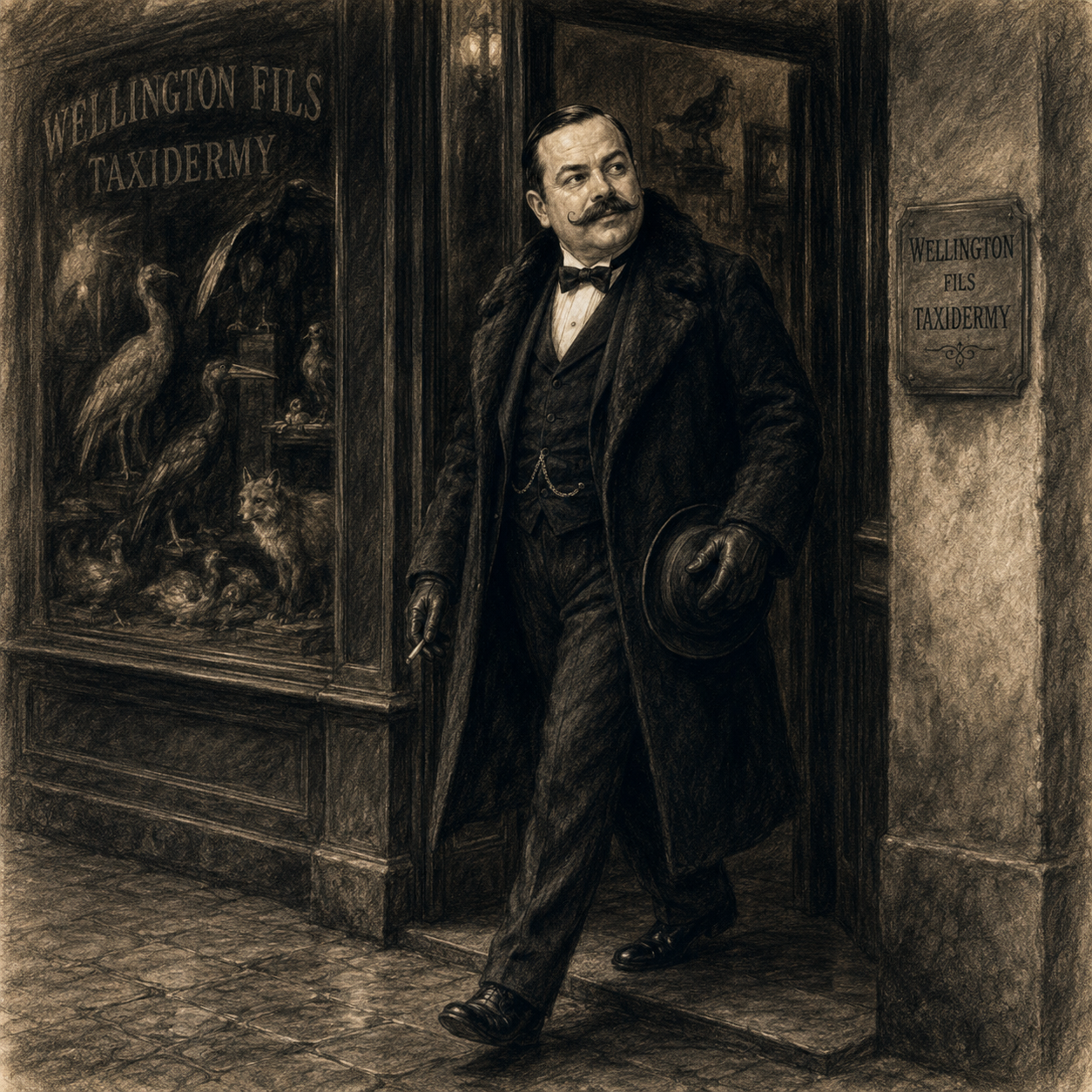
Edgar B. Wellington kept his rooms above the family taxidermy shop, which might have seemed merely eccentric had the world been a kinder place. The painted sign read Wellington Fils Taxidermy, and behind the windows lay stiff little tableaux of conquered nature: birds staring with lacquered eyes, small mammals posed in attitudes of eternal alarm. The dead had been taught to pretend at life, and in that pretence there was something indecent.
Arthur, Claire, and Viola took up watch from a café across the street, where the warmth of breakfast and coffee could not quite disguise the purpose of their vigil. Arthur had the look of a man who would have preferred a direct assault, a fist upon the door and a pistol near the hand. His suspicion had hardened overnight into something nearly metallic. Claire watched with a more open curiosity, though she had grown wise enough to know that curiosity, in their affairs, was never innocent. Viola, composed as ever, gave little away. Time had done strange things to her, or perhaps failed to do them, and the morning light treated her face with the same old courtesy it had shown decades ago.
Per and Walter crossed the street and entered the shop.
The heat struck them first. It was far too warm within, almost feverish, as though some great animal panted behind the walls. A fire burned with unnecessary vigor, filling the place with an oppressive glow. Beneath it lay the odor of the profession: dust, singed fur, preserving chemicals, old hides, and the faint sweetness of decay held just barely at bay. The shop seemed less a business than a pause between death and judgment.
Edgar Wellington admitted them after some delay. He was courteous, eager, and anxious in that particular British manner which attempted to hide unease beneath propriety. He led them through the shop, past the glass-eyed congregation of his trade, and up into the apartment above. There, in a small kitchen made close by the heat below, he offered tea.
The tea itself seemed ordinary enough. That was not reassuring.
They spoke of the scroll. Wellington said he had obtained it during the war and had spent years trying, with little success, to understand it. His letter to the Lorien family had been part of that effort, a blind cast into murky water. When Fenalik’s name surfaced in conversation, Wellington showed no obvious reaction, though Per was careful not to give too much away. The French National Library was mentioned, and the writings of Captain Louis Malon, whose trail seemed to run near the scroll like a buried vein.
Then William Wellington entered.
He did not announce himself. He simply appeared, a second man in the apartment, wearing his hat indoors as though unaware of the impropriety or incapable of correcting it. He did not speak. He sat, poured tea, and drank it with the careful movements of one who had learned human habits by rote. His eyes did not move.
When he turned his attention toward Per or Walter, he turned his entire head. The pupils remained fixed, dead ahead, as though some invisible pin had fastened them in place. Per, who had known the living wreckage of the war in more than one country, recognized at once the signs of profound trauma. The silence, the thousand-yard stare, the strange obedience of motion without presence: these belonged to the shattered men Europe had produced in abundance. Yet the eyes were wrong. Shell shock might hollow a man, might leave him trembling at a dropped plate or unable to bear the shriek of a train whistle, but it did not freeze the muscles of the gaze into that awful immobility.
Per asked, gently but directly, whether William had served. William nodded.
Edgar answered for him. Yes, both brothers had served in the British Army. William had suffered injuries in the war. He could no longer speak. The trouble with his eyes, Edgar said, had come from the same injury. The doctors had offered little more than labels before casting him back into civilian life, one more broken remnant of the great machinery.
Per accepted this with the grave sympathy of a man who knew how much suffering hid beneath tidy explanations. Yet something in William’s presence unsettled the room: not his silence alone, but the quality of it, the way it seemed to absorb questions and return only formalities.
A bell rang downstairs, and Edgar excused himself to answer it, leaving Per and Walter alone with William.
For a moment there was only the small domestic sound of tea being drunk. Then William took up a notepad and wrote.
Welcome to Lausanne.
Per thanked him and asked whether Edgar had long been interested in the scroll.
William wrote again.
Lovely weather today.
The words sat on the page with the terrible cheer of a parlor automaton.
Per answered as if the exchange were perfectly normal. Yes, the weather was pleasant, cold but clear. He asked another question, this time writing it himself: had William noticed anything strange about the scroll, or about Edgar’s dealings with it?
William read the question and wrote.
Edgar isn’t feeling well. Perhaps I can help you?
The air in the kitchen seemed to draw inward.
Per asked what ailed Edgar.
William wrote again.
I think some tea will do him well.
At that, Per’s eyes moved meaningfully to the cup. Walter, who had not been drinking with any enthusiasm, needed no elaborate warning. The tea sat between them, fragrant and perfectly civilized, and for a moment it became the most sinister object in the room.
Per asked whether there was something medicinal in it.
William wrote only:
Earl Grey.
The answer might have been absurd under other circumstances. Here, in that overheated apartment above the dead animals, it felt like a joke told by something that did not understand laughter.
Walter tried another approach. As a priest, he said, he prayed regularly for the healing and well-being of others. Was there anything William wished him to include in those prayers, for himself or for Edgar?
William bent over the pad. The pencil moved.
God can’t save us now.
The words remained visible on the page.
Walter felt the phrase strike him not as despair alone, but as challenge. He could not leave it unanswered. He summoned the full force of his vocation, the hard-won rhetoric of pulpit and battlefield alike, and urged William toward faith and endurance, toward the possibility that grace could still find its way into the most ruined places.
William did not seem moved. Then footsteps sounded on the stairs.
Edgar returned with a new visitor: a rotund, immaculately dressed gentleman with a fine mustache, polished manners, and an unmistakable French accent. Edgar introduced him as the Duke d’Esseintes, an old friend and amateur occultist. The word hung delicately in the kitchen, respectable enough in 1923 to pass in conversation, though in the present company it carried a sharper edge.
The Duke was all charm and cigarette smoke. He seemed amused by the meeting, perhaps even pleased by it. Edgar introduced Per and Walter as scholars. Per returned the courtesy, noting the happy coincidence of the Duke’s arrival just as they had come to speak with Wellington about the scroll.
The Duke admitted that Edgar had told him of it, though he had not yet seen it himself. He was interested, naturally. Authentic occult objects were rare, and rarer still were those that survived the war’s hungry destruction. He presented himself as a collector, a man of means with expensive curiosities and the languid patience of someone accustomed to eventually getting what he wanted.
Per mentioned Professor Smith, the Lorien family at Poissy, and the winding path by which their investigation had reached Lausanne. As he spoke, he watched the Duke’s face.
The man was skilled at indifference, rather too skilled. Per sensed recognition beneath the surface: a faint tightening about the eyes, a measured stillness when certain names were spoken. The Duke knew more than he volunteered, and the scroll was not merely a pleasant curiosity to him.
Per tested him further. He raised occult topics with the casual precision of a scholar laying traps for a fraud: obscure texts, known falsehoods, fashionable nonsense, the sort of distinctions that separated a parlour spiritualist from someone who had looked too long into darker cupboards of history.
The Duke did not stumble. Nor did he boast, which was almost worse; he knew enough to know what need not be said, and his restraint suggested practice.
Per asked, with a collector’s courtesy, whether the Duke possessed any items of particular pride. The answer came in the form of rare books and obscure writings, strange enough to be impressive but not, so far as Per could tell, directly connected to the matter that had drawn them across Europe. Whatever else stood on the Duke’s shelves, he was not showing it.
At last the conversation returned to the scroll.
Edgar confessed that he did not keep so precious an artifact in his home. It was in the bank, he claimed. If they wished to see it, they could meet that evening at the 730 Club, where he would produce it. The Duke agreed at once, smiling with the heavy-lidded pleasure of a man who expected the evening to cost him money and perhaps yield something far more valuable. If the scroll was genuine, he observed, Edgar should expect a substantial bank note.
Per, knowing they could not hope to outbid such a man, shifted the ground beneath the exchange. He had no desire to collect the thing, he said. His interest lay in the knowledge it contained. Perhaps, if the Duke acquired it, arrangements could be made. Per might examine it, take notes, and later share what their research uncovered.
The Duke asked whether he spoke Turkish or Arabic, and Per admitted he did not. According to Edgar, the Duke explained, the scroll appeared to be written in Turkish using Arabic letters. A quick glance would not suffice; a proper translation would be required.
The problem settled over Per with irritating clarity. They had an evening appointment, an unknown scroll, a wealthy and knowledgeable rival, and only a few hours in which to find someone in Lausanne who could read what none of them could.
The Duke soon took his leave, offering polished pleasantries and the promise of seeing them that evening. Edgar, left with Per and Walter, became more candid. The Duke, he explained, was a French aristocrat who had lived in Lausanne for years and shared his interest in the occult. Edgar had hoped to sell him the scroll for a good sum, but the Duke had delayed and delayed. The investigators’ arrival, Edgar thought, might finally spur him into action.
Walter attempted to turn that greed to their advantage. If Edgar wanted a better price, a second interested party could only help. They might even vouch for the scroll’s authenticity, help stir the Duke’s appetite, perhaps create the beginnings of a bidding war. But to do so, they would need to see it first.
Edgar was tempted, Per could see that much; the idea of using them to raise the price appealed to him strongly. Yet he refused. There simply was not time, he said. The scroll was locked away, inaccessible until later. Per did not believe him.
The lie was not clumsy, exactly, but it was shaped wrong. There was something behind it, something Edgar wished to conceal, though not fear. Per probed gently, suggesting that the trade in occult artifacts attracted unsavory figures. He and his companions had dealt with dangerous people before. If Edgar needed help, he had only to ask.
Walter added his own careful assurances. They had seen objects whose influence wounded those around them, objects that gathered coincidences the way a corpse gathers flies. They understood that some artifacts were not merely rare, but malignant.
Edgar’s reaction was confusion, not fear. Whatever he was hiding, he did not seem afraid of the scroll, not in the way a sane man ought to have been.
They did not press harder, for fear of shutting a door that still stood ajar. As they departed, Per noted the rear exit beyond the shop’s back room, past supplies and half-finished taxidermy, where unfinished creatures waited in various stages of false resurrection. The knowledge lodged in his mind against future need.
Rather than return directly to the café, Per and Walter crossed away from the shop’s sightline and signaled the others to join them discreetly. Across the street, Arthur settled the bill with the air of a man paying ransom to impatience. Claire and Viola rose with equal care, their attention still fixed on Wellington’s door.
Then the Duke emerged. He stepped from the taxidermist’s shop and looked about the street; his gaze passed over the café, moved on, then snapped back. Arthur and Claire noticed the movement, and so did Viola, but it was Viola who understood what it meant. The Duke had looked at her with surprise, and not the ordinary surprise of a stranger noticing a woman across a street. It was recognition, sudden and involuntary, quickly masked.
And in that same instant her own memory stirred. Constantinople returned to her: heat, perfume, danger, the old intrigues around the Blood Red Fez, and a man known only as the Frenchman. An occultist of influence, pleasure, and poisonous courtesy; a man who had known Nisra, who had traded knowledge for knowledge, who had toyed with them even as he pointed them toward their enemies. He had been amused then. He had enjoyed the game.
The Duke d’Esseintes looked very much like him. Too much like him. Thirty years had passed since Constantinople, but the man who had just left Edgar Wellington’s shop did not look thirty years older than the Frenchman Viola remembered; he had not weathered as living men weather.
And then the deeper horror of it unfolded, quiet and intimate: if the Duke had recognized Viola, it was because she too remained unchanged. The street seemed suddenly colder.
Lausanne’s clean façades, its cafés and banks and orderly winter morning, became a thin painted screen, and behind it moved old appetites and older bargains, figures who had survived too long and remembered too much. The scroll was no longer merely an artifact in a taxidermist’s possession. It had begun to look like bait, drawing toward it men who properly belonged to earlier chapters of history.
The investigators had come seeking a scrap of writing. Instead they had found a dead-eyed veteran writing polite phrases over despair, a taxidermist hiding more than he knew how to admit, a wealthy occultist who understood too much, and the returning shadow of Constantinople wearing a fresh title and an old face. That evening, at the 730 Club, the scroll would be shown at last; but it was already clear that the scroll was not the only thing in Lausanne preserved beyond its proper time.
Session Notes
-
The session began with a recap of the investigators’ previous events in Lausanne, Switzerland.
- The investigators had awakened from a disturbing shared dream while aboard the train.
- Some of them felt somewhat better afterward, but most remained disturbed by the experience.
- They did not appear to return to sleep after waking, instead riding out the early morning until the train arrived in Lausanne.
- Upon arrival in Lausanne, the group disembarked and took rooms at the Hotel Cecile.
- The hotel was described as the mid-range option, with the group having decided to “slum it” compared to more expensive accommodations.
- After settling in, the group went to breakfast.
- They then decided to stake out the location associated with Mr. Edgar B. Wellington.
- They found a cafe across the street from Wellington’s premises and had a second breakfast while watching the location.
-
The investigators identified Edgar Wellington’s place as a taxidermy shop with an apartment above it.
- The shop was called “Phil Wellington Taxidermy.”
- Arthur Zorba was characterized during the recap as being strongly distrustful of Wellington and ready to go in aggressively.
- Per Oskarson favored trying to speak with Wellington first.
- Per and Reverend Walter Lake went inside to meet Wellington.
- The rest of the group remained across the street at the cafe, watching the shop discreetly.
-
Per Oskarson and Walter Lake approached the taxidermy shop and knocked on the door.
- A man eventually answered and identified himself as Edgar Wellington.
- Per and Walter told him they had received or learned of his letter.
- Edgar seemed excited by this and invited them inside.
- They passed through the taxidermy shop, which was hot and unpleasant.
- The shop smelled of dead animals, formaldehyde, and taxidermy materials.
- A fire was burning strongly in the fireplace, making the interior almost uncomfortably warm.
- Edgar led them upstairs to the apartment above the shop.
- They entered a small kitchen, where Edgar served them tea.
- No one specifically objected to drinking the tea at the time, though later the tea became a point of concern.
-
Edgar Wellington explained why he had contacted the people near Paris.
- He said he had acquired a scroll during the war.
- He had tried to follow up on information connected to the scroll.
- His search for information led him to write the letter to the people near Paris, associated with the family or location previously investigated by the group.
- The name Fenalik came up during the conversation.
- Edgar did not seem to have any notable reaction to the name Fenalik.
- Per was preparing to tell Edgar what he knew about Captain Louis Malon.
- Per intended to explain that some of Captain Malon’s letters could be found at the Bibliothèque Nationale.
- Before that discussion could continue, the meeting was interrupted by the arrival of Edgar’s brother.
-
William Wellington entered the kitchen during the meeting.
- Edgar introduced the newcomer as William Wellington.
- William wore a hat indoors, which the investigators recognized as unusual for someone in that era, especially in his own home.
- William did not speak.
- He sat down and watched Per and Walter.
- His head turned as he looked around, but his eyes did not appear to move independently.
- Instead of moving his eyes, he turned his entire head to scan the room or look at people.
-
Per attempted to understand William’s condition.
- Per asked whether William’s behavior resembled symptoms of any known condition.
- Per rolled Psychology and achieved a regular success.
- Based on the roll, Per believed William showed signs of severe shell shock.
- William appeared to be one of the worst cases Per had seen or heard of.
- The condition was especially notable because several years had passed since the Great War.
- William was still able to move around, sit, pour tea, and drink it.
- His silence, thousand-yard stare, and subdued behavior all suggested a man badly affected by wartime trauma.
- Per could not account for William’s eye condition as part of the psychological symptoms.
- The lack of eye movement seemed separate from the shell shock presentation.
- William’s manner nevertheless strongly suggested that he had served in the war and had not fared well.
-
Per addressed William directly and politely.
- Per greeted him as Mr. William Wellington and said it was good to make his acquaintance.
- Per observed that William had the valiant look of someone who had served in the war.
- Per asked whether William had served with the British Army.
- William looked at Per and nodded.
- Edgar quickly answered on William’s behalf.
- Edgar confirmed that both he and William had been in the army during the war.
- Edgar said the war had been a rough time.
- Edgar explained that William had been injured and was no longer able to speak because of his injuries.
- Per asked about the absence of eye movement, noting that he had professional experience with soldiers and that this was not a symptom he recognized.
- Edgar said the lack of eye movement was related to the injuries William had taken.
- Edgar explained that the muscles controlling William’s eyes seemed frozen or unable to move.
- Edgar said doctors had not provided a detailed diagnosis.
- Edgar implied that after the war, soldiers were often labeled with shell shock or injury and sent back into ordinary life.
- Per asked directly whether the injury had been to William’s head.
- Edgar confirmed that it had been a head injury.
- Per said he did not wish to dwell on an unpleasant subject, but he appreciated Edgar telling him.
- Per remarked that the number of men of a certain age with similar symptoms was troublingly high.
-
Per redirected the conversation back to the scroll and the Comte Fenalik.
- Per said they were there to speak about the letter concerning the notorious Comte Fenalik.
- Per said he understood Edgar might no longer be interested in pursuing the matter.
- Per explained that Captain Malon, presumably an ancestor of the person from whom Edgar received the scroll, had writings and letters in the French National Library.
- Per offered to share what details he could remember if Edgar ever wanted to find the writings himself.
- Per admitted that he might be assuming more interest or energy than Edgar was willing to spend.
- Edgar replied that even without the scroll, Per and his associates seemed to have made more progress than he had.
- Per said there were still large gaps in his colleagues’ understanding of the whole business.
- Per admitted he did not know all of it, but what he did know was intriguing.
- Per asked whether Edgar had contacted anyone else who had interest in the topic.
-
Before Edgar could answer, someone rang the doorbell downstairs.
- Edgar said he would go check who it was.
- Edgar left Per and Walter upstairs with William.
- William continued sitting silently and slowly drinking tea.
-
William began communicating through written notes.
- William took a notepad.
- He wrote something on it and held it up.
- The note read: “Welcome to Lausanne.”
- Per thanked him and said it was a pleasure to meet Edgar and William.
- Per asked whether Edgar had long been interested in the scroll.
- William wrote another note and held it up.
- The note read: “Lovely weather today.”
- Per considered whether the weather actually was lovely.
- The weather had been cold but clear, with no rain or snow.
- Per agreed that the weather was lovely and asked whether it was frequently like this in the middle of winter.
- William wrote again and held up the note.
- The note read: “Would you like some tea?”
- Per wondered whether William was on autopilot or if there was some deeper reason for the notes.
- William appeared to Per to be behaving on autopilot, making polite conversation without fully engaging.
-
Per tried to use the notepad to ask William more directly about the scroll.
- Per asked, by gesture, if he could hold the pad and pen.
- William handed the notepad and pen to him.
- Per wrote a new message on a fresh page.
- Per asked whether William had noticed anything strange about the scroll or about Edgar’s interactions with it.
- William read the note, then wrote a reply.
- His reply read: “Edgar isn’t feeling well. Perhaps I can help you?”
- Per asked in writing what ailed Edgar.
- William replied: “I think some tea will do him well.”
- Per then examined the tea and gave Walter a meaningful look.
- The tea became a point of suspicion.
- Walter had not really been drinking the tea.
-
Walter also tried to question William indirectly.
- Walter asked how long Edgar had needed tea, using the question as a roundabout way of asking how long Edgar had been sick.
- William wrote a response.
- His note read: “We have plenty of tea.”
- Per wrote that the tea was delicious and emphasized the word “is.”
- Per asked whether there was something special or medicinal about it.
- William wrote back: “Earl Grey.”
- The investigators considered what skill might apply to detecting poison or medicine in the tea.
- Pharmaceuticals was identified as a possible relevant skill, though neither Per nor Walter appeared to use it at that moment.
-
While Per and Walter were upstairs with William, conversation could be heard downstairs.
- It sounded as though Edgar was speaking with whoever had arrived at the door.
- The people across the street at the cafe had seen a man approach the taxidermy shop.
- The man had come from another direction, around the corner.
- He did not appear to be following the investigators.
- He was well-dressed and carried himself like a person of high status.
- Viola Sutcliffe and Arthur Zorba were able to judge his social presentation.
- Viola especially recognized him as aristocratic in bearing.
- He was dressed dapperly.
- He had well-groomed hair, a nice mustache, and was somewhat rotund.
- He rang the bell at the taxidermy shop.
- Edgar answered the door, seemed to recognize him, greeted him, invited him inside, and closed the door behind him.
-
Walter asked William if there was anything he should pray for.
- Walter said that, as a priest, he regularly prayed for the healing and well-being of others.
- He asked whether there was anything William would like included in those prayers for himself or Edgar.
- William wrote a response on the pad.
- The note read: “God can’t save us now.”
- Walter took this as a direct challenge to the power of God.
- Walter urged William to try to have faith.
- Walter drew on his sermonizing, attempting to offer words of encouragement and spiritual comfort.
- Walter made a Charm roll.
- Walter rolled 75.
- William did not really respond to Walter’s attempt.
- The note saying “God can’t save us now” remained visible on the notepad.
-
Edgar returned upstairs with the man from downstairs.
- Edgar entered the room with the well-dressed aristocratic man.
- Edgar introduced him as his old friend, the Duke d’Essaintes.
- Edgar introduced Per and Walter to the Duke as Professor Oskarson and Reverend Lake.
- Edgar described them as scholars.
- Edgar said the Duke was a bit of an amateur occultist.
- The Duke spoke English well, but with a French accent.
- The Duke was interested in occult happenings and phenomena.
- Edgar indicated that the Duke had an interest in the scroll, though the Duke had not yet seen it himself.
-
Per greeted the Duke and noted the coincidence of his arrival.
- Per called it a happy coincidence that the Duke arrived just as they came to visit Edgar Wellington.
- Per asked whether Edgar had consulted the Duke regarding the scroll.
- The Duke said Edgar had mentioned the scroll to him.
- The Duke said he was interested in it.
- The Duke also said he had not yet seen the scroll himself.
- The Duke asked what Per and Walter’s interest was in Edgar and the scroll.
-
Per explained the investigators’ interest in the scroll.
- Per said he was working on behalf of a colleague, Professor Julius Smith of King’s College, London.
- Per said their research led them to a chateau in Poissy and to the Lorien family.
- Per explained that when they arrived and began asking questions, the family mentioned having received a letter from Mr. Wellington.
- Since the investigators were heading in Wellington’s direction, they stopped in Lausanne to see what they could learn.
- Per noted that happy coincidences seemed to be piling up.
-
Per attempted to read the Duke’s reaction to the names and places being mentioned.
- Per wanted to know whether the Duke recognized the names Professor Smith, Poissy, or related details.
- Per rolled a people-reading skill, initially clicking Psychoanalysis rather than Psychology.
- The result was treated as close enough for the purpose of the interaction.
- Walter also tried to read the Duke but did poorly.
- Per detected that the Duke was trying to act indifferent.
- The Duke appeared to be playing off his interest casually, as though Edgar merely had some occult artifact.
- Per got the impression that the Duke was more interested in the scroll than he let on.
- Per believed the Duke probably knew more about the matter than he was saying.
- Per suspected that some of the information he had name-dropped was not new to the Duke.
- The Duke appeared to have at least some understanding of the relevant history.
-
Per invited the Duke to describe his occult interests.
- Per said he did not wish to bore the Duke.
- Per asked the Duke to say more about his interests or ask questions of his own.
- Per’s aim was to see whether the Duke would reveal more.
- The Duke said he was interested in all kinds of occult happenings and phenomena.
- He described it as a personal hobby.
- He also said that when one has more money than one knows what to do with, one finds things to spend it on.
- The Duke said Edgar claimed to have an authentic artifact.
- If the scroll was real, the Duke said he would be very interested.
- He looked at Edgar and noted that Edgar had yet to produce the scroll for him.
-
Per assessed whether the Duke was a true occultist or merely a wealthy dilettante.
- Per was concerned that the Duke could be searching for the simulacrum or involved in a conspiracy, possibly connected to those who had attacked Professor Smith.
- Per also considered that the Duke might simply be an occult enthusiast.
- Per wanted to bring up occult topics that would distinguish a knowledgeable occultist from a fraud.
- Per rolled Occult.
- With assistance or a bonus die, Per achieved a hard-level success.
- Per politely raised different occult topics to gauge the Duke’s response.
- The Duke appeared to be genuinely knowledgeable.
- He understood the deeper traps and references Per used.
- He had real occult knowledge.
- However, he was not trying to show off.
- Per concluded that the Duke was the real deal, a man of means with significant occult knowledge.
-
Per asked the Duke about his collection.
- Per mentioned the Duke’s collecting and asked, as a fellow enthusiast, whether there were items in the Duke’s collection of which he was especially proud.
- The Duke mentioned a few obscure books.
- Per had heard of the books.
- Nothing the Duke mentioned immediately raised alarm.
- The collection seemed to consist mostly of writings and books.
- None of the described items appeared directly connected to the investigators’ current research.
-
Per asked Edgar what he intended to do with the scroll.
- Edgar said that if both Per and the Duke were interested, there was a possible next step.
- Edgar explained that he did not keep such a precious artifact in his home.
- He said he kept it in the bank.
- Edgar invited them to come to the 7:30 Club that evening.
- He said he could arrange a pleasant evening and show them that the scroll was real.
- Per agreed that this sounded pleasant.
- The Duke agreed to the proposal.
- The Duke smiled and said that if the scroll was real, they should bring a hefty bank note.
-
Per explained that his interest was scholarly rather than commercial.
- Per said he was in no position to outbid someone like the Duke.
- Per asked whether, as a fellow enthusiast, the Duke might allow him to examine the scroll and take notes so he could continue his research.
- Per suggested that if the Duke and Edgar desired, the Duke could add the scroll to his collection.
- Per offered that he might update the Duke as the investigators learned more from the information in the scroll.
- The Duke said such an arrangement could likely be made.
- The Duke then asked whether Per spoke Turkish or Arabic.
- Per said he did not and asked whether the Duke did.
- The Duke explained that Edgar had told him the scroll seemed to be written in Turkish but in Arabic letters.
- The Duke warned that a quick perusal might not provide much information if that description was accurate.
- Per asked whether the Duke intended to have it translated or whether he read Turkish and Arabic.
- The Duke said he knew a little Turkish but not Arabic.
- The Duke said he would of course have the scroll properly translated.
- Per emphasized that the contents of the scroll were his particular interest.
- Per said he was not interested in collecting such artifacts and was not in a position to buy them.
- He said the knowledge contained in the scroll could prove invaluable.
- Per suggested that some arrangement might be possible.
- The group confirmed that none of the investigators were known to speak Arabic or Turkish.
- Since the appointment was in the evening, the group realized they had roughly six hours to find a translator.
-
The Duke departed.
- The Duke excused himself.
- He said it was a pleasure to meet Per and Walter.
- He expressed hope that he would see them that evening.
- After the Duke left, Edgar politely ended the meeting in a very British fashion by waiting for the investigators to leave.
-
Walter asked Edgar about the Duke before leaving.
- Walter asked Edgar for his read on the Duke.
- Edgar said the Duke was an aristocrat from a line of French aristocrats.
- Edgar believed the Duke’s title was inherited.
- Edgar said the Duke had been living in Lausanne for many years.
- Edgar had come into contact with him a few times while seeking information.
- Edgar had discovered that the Duke was also interested in the occult.
- Edgar said they had had interesting conversations.
- Edgar admitted that he had been hoping to get a decent sum of money from the Duke for the scroll.
- Edgar said the Duke had been delaying or stalling.
- Edgar thought the investigators’ appearance and interest might finally have caused the Duke to take action.
- Edgar appreciated that their arrival might help him sell the scroll.
-
Walter tried to convince Edgar to show them the scroll before the 7:30 Club meeting.
- Walter suggested that if the investigators saw the scroll, they could help vouch for its authenticity.
- He implied they might help spark a bidding war.
- Walter admitted they likely could not outbid the Duke.
- He said that to properly hype up the scroll’s authenticity and occult or historical value, they would need to see it first.
- Walter presented this as a way to help Edgar obtain a better financial reward.
- Edgar said the scroll was locked up and that he could not obtain it in time to show it to them early.
- Walter continued pressing gently, framing the request as useful to Edgar’s sale.
- Walter made a Charm roll.
- Walter succeeded.
- Edgar appeared tempted by the idea that the investigators might raise the price.
- Per noticed that the idea appealed to Edgar.
- However, Edgar maintained that he could not get the scroll with enough time to show it early.
- Per made a Psychology roll and achieved a hard success.
- Per was not convinced that the scroll was actually in a bank.
- Per believed Edgar’s statement about the bank might be a line.
- Per could not determine exactly why Edgar was hiding the truth.
- Edgar insisted there was no way to arrange an earlier meeting.
-
Per tried to determine whether Edgar was afraid of the scroll or of someone connected to it.
- Per did not want to push too hard.
- He suspected that the explanation about not being able to retrieve the scroll before dinner did not quite make sense.
- Per made a careful conversational move.
- He said it was comforting to have met the Duke d’Essaintes and that the Duke’s character was clearly above board.
- Per noted that there were less savory individuals involved in such business.
- He said some of those individuals could be frightening and difficult to deal with.
- Per said that he and his colleagues had proven capable of dealing with such unsavory figures in this community.
- Per told Edgar that if he needed help with such a thing, he only needed to ask.
-
Walter reinforced Per’s offer of help.
- Walter spoke vaguely about the group having dealt with powerful occult artifacts before.
- He did not mention the arm of the simulacrum directly.
- He described having helped people affected by occult artifacts with troubling and seemingly coincidental effects.
- Walter said they had helped families afflicted by such artifacts.
- He emphasized that this was not their first experience with dangerous occult objects.
- Walter suggested Edgar could trust them and that they could help.
- Edgar appeared surprised and confused by Walter’s comments.
- Per got the impression that Edgar was not sure what Walter was getting at.
- Per also determined that Edgar was certainly not afraid of the scroll.
- Mentions of unsavory occult figures did not visibly move Edgar.
-
Per examined the building’s layout as he left.
- Per wanted to observe whether there was a rear exit leading to an alley or behind the building.
- As they left through the first floor, he saw the shop area in front and a back area beyond a curtain.
- The back area contained more taxidermy supplies and partially taxidermied animals.
- There was a door at the back of the building leading outside.
- Per noted the existence of the rear exit.
-
Per did not immediately return to the cafe after leaving the shop.
- Rather than crossing the street to rejoin the others, Per stayed on the same side of the street.
- He went around the corner, intending to position himself where the cafe group could see him but someone at the storefront could not.
- He looked pointedly back toward the rest of the investigators.
- The group across the street paid their bill at the cafe and prepared to move.
-
The Duke exited the taxidermy shop after Per and Walter.
- Those watching from outside saw the Duke leave the building.
- The Duke looked around the block.
- He seemed to look toward the investigators at the cafe, then past them.
- Claire and Viola were asked to roll Spot Hidden.
- Claire succeeded.
- Viola also rolled Spot Hidden.
- Both noticed that the Duke looked past the group, then quickly looked back at them, and then looked away again.
-
Viola noticed something significant about the Duke.
- Viola was asked to make an Intelligence roll.
- The roll required an extreme success.
- Viola spent 17 Luck to achieve the required level of success.
- As the Duke exited the shop, Viola got a better look at his face than she had when he entered.
- She saw surprise and recognition in his eyes when he looked back at her.
- The Duke reminded Viola of someone she had met many years earlier.
- Specifically, he looked very much like the man known as “the Frenchman” from Constantinople during the earlier Blood Red Fez incident.
- The Duke did not appear thirty years older than that man had looked during the earlier adventure.
- This was notable because the events in Constantinople had taken place around thirty years prior.
- Viola also has not visibly aged since that time, and seeing her appeared to trigger recognition in the Duke.
-
The group recalled what they knew about the Frenchman from Constantinople.
- The Frenchman had been a known figure among occultists in Constantinople.
- Professor Demir had believed he might help the investigators find the people who had kidnapped his son.
- The investigators had visited the Frenchman at his palatial estate.
- The Frenchman knew about Nisra, the woman running the cult of the Blood Red Fez.
- Nisra had been his former student.
- She had insulted him or offended him by leaving his tutelage.
- He believed she deserved a comeuppance.
- He directed the investigators toward her.
- His assistance seemed to serve his own motives as well as the investigators’ needs.
- He had toyed with and teased the investigators, but ultimately pointed them in the direction they wanted.
- He had a heavy French accent.
- He may have been smoking opium when they met him.
- The Frenchman valued politeness, enjoyed life’s pleasures, and traded knowledge for knowledge.
- He had an antagonistic relationship with the Blood Red Fez cult, whom he considered rivals.
- He had a particular connection to Nisra because of their former teacher-student relationship.
- He had been amused that someone had been tricked into wearing the cursed fez.
- In exchange for his information, he requested to study Per Oskarson’s notes and apocrypha for a day.
- He had shown particular fascination with ancient hieroglyphs.
-
The session ended with the mystery of the Duke’s identity unresolved.
- The Duke d’Essaintes strongly resembled the Frenchman from Constantinople.
- He recognized Viola, who herself still looks as she did thirty years earlier.
- The Duke did not appear to have aged significantly since the earlier encounter.
- Per also would likely recall the Frenchman, though Viola’s successful roll brought the recognition to the forefront.
- The investigators had an evening appointment at the 7:30 Club to view Edgar Wellington’s scroll.
- The scroll was believed to be written in Turkish using Arabic script.
- Edgar claimed the scroll was kept in a bank, though Per suspected this was not true.
- Edgar was not afraid of the scroll, but he was clearly hiding something about its availability or location.
- The Duke was a genuine and knowledgeable occultist, wealthy, and interested in buying the scroll.
- The session concluded just after the realization that the Duke might be connected to the Frenchman from the Blood Red Fez affair.