Dawn came to the Orient Express like a reluctant absolution. The train was still running through the last dark hours before Lausanne, its wheels whispering over the rails in a rhythm too like a pulse to be any comfort; the lamps in the compartments burned low; and beyond the windows Switzerland lay in winter silence, all black slope and unseen water, the world scoured clean by cold. Inside the sleeping cars no one woke cleanly. They came up the way drowning men come up, dragging breath into their lungs with the violence of survival, the sweat going cold beneath their nightclothes, their hands closing on blankets that were not aircraft controls, not the splintered seats of a falling carriage.
Per woke first. For a long while he only lay there, eyes open on the dim compartment, listening to the train and to his own breathing while he took a private and faintly ridiculous inventory of himself: his neck unbroken, his head still upon his shoulders. The impossible sky was gone, and with it the leathery things that had come shrieking up out of the gulf. Yet the memory of them clung behind his eyes with a precision no ordinary nightmare ever owned, the talons and the rushing air, and the dreadful instant in which he had been torn loose from his own body.
Arthur slept a few feet away, if sleep was the word for that strained and twitching stillness. Per rose quietly, with the old care of a physician moving among the wounded. In another and kinder life, tea would have been a small civilised defence against a bad night; here, after a journey through Nodens’ black gulfs and the long accounting of his own guilt, the making of it came nearer to a sacrament. Chamomile, cups, a pot held steady in hands that trembled rather less than he had any right to expect.
When Arthur woke it was with a fractured murmur and a face left, for a moment, unguarded. The dream still clung to him, though already it was rearranging itself into something less like a sequence of events than a weather that had passed over him: the flying train, the spectral enemies, Karakov pulled apart by the dead, Viola undone in a single flash of sorcerous will. Impossible things, and very nearly beautiful, in the way a shell burst can look beautiful from a sufficient distance. He took the tea Per offered him as though it were at once absurd and necessary.
“I had the most dreadful dream,” Arthur said, and then, with the uncertain frown of a man catching his own mind in a betrayal, corrected himself. “No. It was rather a good one, I think. A mixed sort of business, perhaps.”
Per watched him over the cup. Arthur’s face, already mapped by old violence, seemed somehow altered: not healed, nothing so sentimental as that, but eased, as though the abyss had drawn some venomous splinter of the war out of him while he slept.
“If your dream was anything like mine,” Per said, “then it was almost certainly something more than a dream.”
Arthur, who preferred the world to come at him with fists and rifles rather than with metaphysics, looked unhappy at the suggestion. “You’re a doctor. You know perfectly well that isn’t how dreams work.”
Per looked down into the tea. “I am fairly sure I know very little of how anything truly works.”
It was not comfort, exactly; but comfort, after such a night, would have been indecent, and they both seemed to understand as much.
They went to find the others. Claire and Viola had surfaced in much the same fashion, startled out of the shared phantasm with the taste of it still in their mouths. Viola accepted tea with the gracious composure of a woman who had survived enough impossible things to know that gratitude and terror often share the same chair. Claire, still bright even through her exhaustion, asked after the dream with a frankness that somehow sharpened the horror rather than dulling it; a plane-train dream, she called it, as if naming the impossibility plainly might shame it into harmlessness. It had not been harmless.
They remembered enough of it. Madame Bruja’s breast opening to show the burning, heart-shaped gem; the revenants beaten back by its terrible radiance; Karakov and the trunk and the cataract of trench rats pouring down into the gulf, an immeasurable congregation of the dead; the red-eyed sorcerer, and Viola’s annihilation, and Arthur’s cry, and Claire’s desperate piloting toward the abyss. The particulars were already fraying at the edges, as dreams do, but the shape of the thing held, and the weight of it. Each of them had carried something down into that night, and each had come back up with the sense of having left something behind.
Arthur, unwilling to trust the mind’s habit of softening what it could not bear, took himself to the parlor car and wrote. He wrote while the train murmured on through the morning dark, setting down every detail he could seize before it could dissolve, and the writing was both a discipline and a kind of defence: if the world insisted on becoming a dream, then he would hold a line of ink against it. He set down enough, he believed, to return to that impossible journey later and study it with waking eyes. Outside, slowly, the horizon began to pale.
The Orient Express reached Lausanne at a quarter to seven in the morning. The city received them coldly, though not unkindly. It rose from the station in winter layers, hilly and elegant above the unseen breadth of Lake Geneva, with snow still clinging where the sun had not yet reached and a clean blade to the air, the sort of cold that gets into the lungs and scrapes them bright. The dream’s heat, all its blood and its darkness, seemed an indecency beside so ordinary a morning.
They had come because of a letter. Edgar B. Wellington’s return address had been waiting like a pin set in a map, a sober clue after the grotesqueries beneath Fenalik’s former estate outside Paris: Rue Saint-Étienne, Lausanne, one more thread in the long history of the Sedefkar Simulacrum and the one that now drew them across Europe.
A porter met them at the station, in French at first. Arthur stepped forward, relieved, perhaps, to face for once a difficulty that could be settled with language rather than courage, and asked to be directed toward Rue Saint-Étienne and then, more practically, toward a hotel near it. They settled on the Hotel Cécile, respectable without being grand, a place that neither flaunted wealth nor confessed to poverty. They took two rooms, left the luggage, and went out into the morning city, tired and hungry and watchful.
Breakfast turned, by degrees, into reconnaissance. At a café, over pastries that suffered by comparison with Paris but fortified the living all the same, they talked over how to go about it. The memory of the dream sat among them like an uninvited guest, but practical suspicion soon found its feet. Wellington might be a scholar, or a fool, or one more of those smiling men who kept ritual knives among their papers and spoke very politely until the moment blood was wanted.
Arthur distrusted him already, on principle. They ought not, he said, to show their whole number at once; it would be foolish to lay themselves out like a full hand of cards before a man whose loyalties were unknown. Better to watch the place first and learn its rhythms, and to assume danger and be pleasantly disappointed. Per, whose instinct ran toward inquiry rather than ambush, would sooner have begun with conversation; if Wellington was a colleague of sorts, however amateur, he might hold information worth more than anything gathered by lurking across a road. Even so, he could not quite dismiss Arthur’s caution. The road behind them was too crowded with dead men and cultists and sorcerers, and with dreams that left marks.
Claire and Viola brought their own lightness to it, though not quite frivolity. There was talk of keeping an eye out for robed figures, candles, ritual daggers, and the other unmistakable signs of foul play; someone invoked pygmy jaguars with the weary familiarity of people whose past adventures had made the ridiculous disturbingly plausible. The humour was thin, but welcome, a match struck in a cellar. And so they walked.
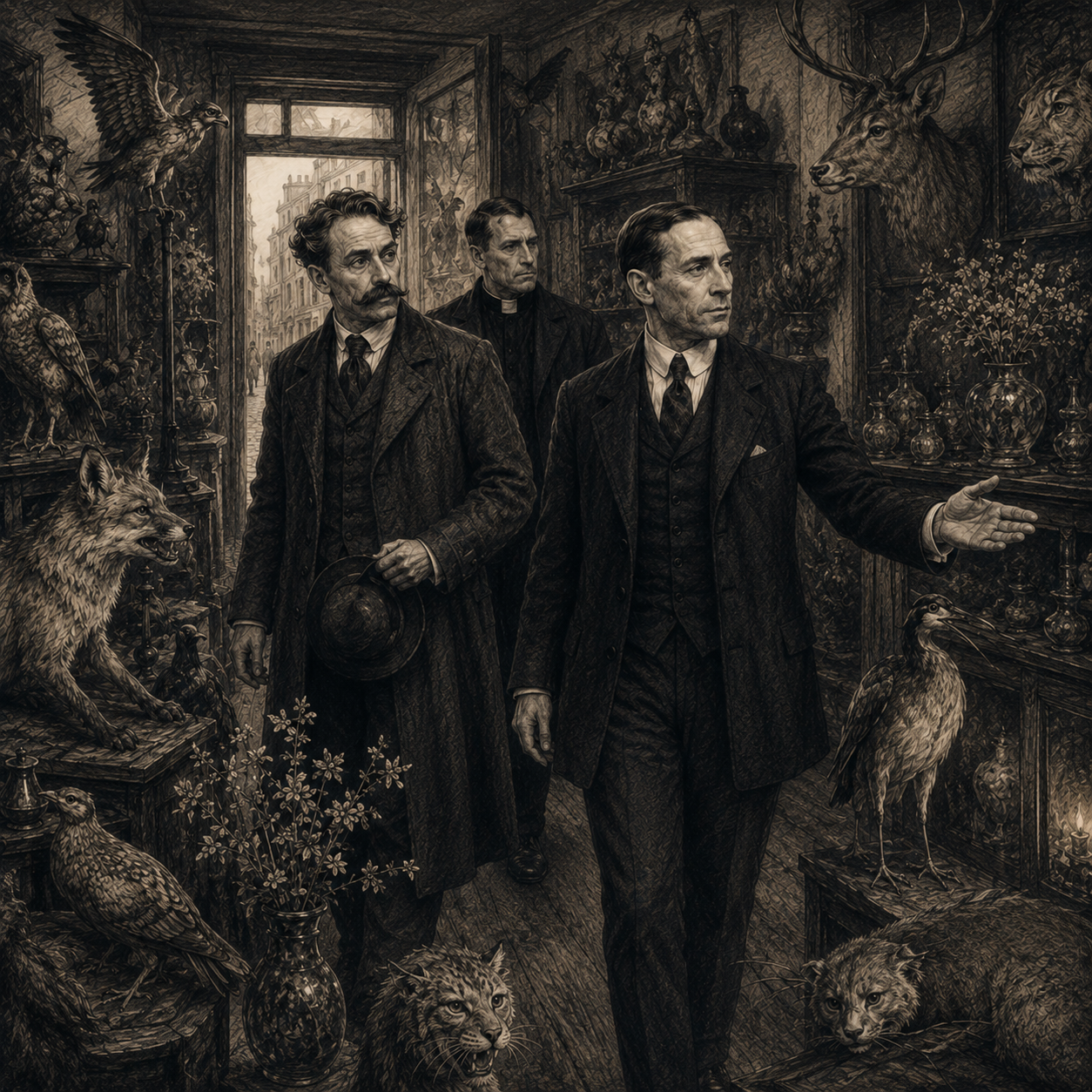
Rue Saint-Étienne lay in a quieter quarter of the town, cobbled and slow to wake. Shops took up the lower floors of narrow buildings, with living quarters above, and most of the shutters still held; a chocolatier, a watchmaker, a clothier, and on the corner a café already open and breathing faint steam into the chill. At number fifty they found the sign: Wellington Fils Taxidermy, the words repeated in several languages, an unassuming announcement above a shut door. The building looked ordinary enough, and the ordinariness of it carried its own unease, for the horrors they pursued had a gift for exactly such masks. Ancient evil did not always keep to ruined temples. Sometimes it took rooms above a respectable business, paid its rent, kept its appointments, and swept its own front step.
They took a table across the street at the café and watched. For a long while little happened. Lausanne went by in morning fragments, footsteps on stone, cups set down on saucers, breath smoking in the cold, the small ordinary business of a town waking to its day. Then Arthur noticed something that did not quite belong to the scene. Turkish men were passing along the street, not many, but enough to draw the eye, three or four of them among the Swiss, respectably dressed, all moving the same way, none stopping at Wellington’s shop, none speaking to one another in any obvious conspiracy. They were simply there. In another town, on another morning, it would have meant nothing; but nothing on this journey could be trusted to be innocent. Per, watching the shop more closely, caught movement at an upstairs window, a shadow crossing the glass. Someone was at home, neither spying nor alarmed, merely present.
At nine o’clock the sign in the taxidermy window turned from closed to open. No rush of custom followed, no line of eager men with parcels of dead birds and household pets; Wellington Fils Taxidermy stayed exactly as it was, its dark interior keeping its own counsel.
At last Per’s curiosity outlasted the café’s thin disguise. Walter went with him while Arthur kept his place across the street on watch, and Claire and Viola stayed behind as well, so that the party was divided now between open inquiry and guarded observation. Per and Walter crossed Rue Saint-Étienne. At the door they found a bell, and the door itself locked in spite of the open sign, which was not encouraging. Per rang, and somewhere inside a delicate ting-a-ling answered, absurdly cheerful as it travelled its hidden way through the shop.
After a short wait the door opened on Edgar Wellington: a man in his forties, English by his accent and his bearing, polite and, once Per mentioned the letter found outside Paris, perhaps a little too eager. His first greeting came in French, but he changed quickly to English, and at the mention of that correspondence his manner warmed with an unmistakable excitement. He asked them in.
The shop was too hot. The heat met them at the threshold, heavy off the fireplace, thickening the odours that the many flowers could not quite hide. Dried arrangements stood in vases among mounted animals fixed in attitudes of flight or snarl, and beneath the floral sweetness lay formaldehyde and damp fur and old flesh, the intimate corruption of bodies kept from their proper decay. The room was not dirty, which made it worse. Its disorder was of the soul rather than the household: dead things had been made to counterfeit life, and the living were expected to admire the workmanship.
Wellington seemed to know the place was ill-suited to civilised talk, and led them through the back and up a narrow stair to the apartment above. The living quarters were cramped, set directly over the shop, a domestic life resting on a foundation of preserved carcasses. Several closed doors gave onto the landing. He brought them into a small kitchen where six chairs stood about a table, four of them piled with books, and cleared space quickly and apologetically before setting about the tea. Per’s eye went over the books as they were moved aside. Nothing in them was openly occult: ordinary novels and pamphlets, a general text on psychology, a few broad histories of Europe. The little library spoke of curiosity, of a man schooling himself, building a ladder by hand toward knowledge he had not been born to.
Wellington asked the question they had expected, how they had come by his letter and why they had come at all. Per answered carefully. He described himself as a researcher in psychology who helped a colleague with certain historical inquiries; the colleague, he said, had grown interested in a similar thread, and when Per was in Paris he had been asked to call at the address, where the residents had passed Wellington’s letter along to him. It was not a lie, but it went around the truth with the care of a man crossing thin ice. Wellington accepted it, or seemed to.
He had been researching a statue, he told them, the Sedefkar Simulacrum. He had the name from a scroll in his possession, though his own translation of it was meagre, and the Paris address and Fenalik and the Simulacrum had all come to him out of those fragments. He had written in the hope that whoever owned the estate might know more. The scroll itself had reached him during the war; he had traded for it from a Frenchman, rations and cigarettes against a roll of old paper. The man had claimed it had been in his family a long while, and Wellington, a history enthusiast and not especially hungry that day, had reckoned the bargain worth making. The Frenchman’s name was Raul Malon.
The surname struck Walter at once, harder than the given name. Paris had given up a report by a Captain Louis Malon, a man bound into the history of Fenalik’s estate. A family line, perhaps, and another old document carried along on blood and accident until it surfaced in the trenches among the hunger and the cigarettes. Per listened closely, to Wellington’s words and to the silences that framed them. There was more here than was being said. Wellington was careful, not hostile, at least not yet, but coy, testing them, measuring how much they wanted the scroll and deciding what manner of people had walked into his kitchen. The scroll, he said, was kept somewhere safer than the apartment, which was reasonable enough and somehow unsatisfying all the same; he could fetch it, but he did not offer to, not yet.
Per asked whether the Simulacrum had interested him before the scroll came. No, Wellington said; the scroll had started it. He spoke of Fenalik as a possible first owner, of the Paris house, of his research running into a wall. He admitted he might not be the right man to carry it further. Then came the phrase that gave his caution its shape. Perhaps, he said, they might come to some arrangement. Money, then, or something close enough to it. He did not look like a cultist hungry to spill blood under the kitchen table; he looked like a man holding a curiosity that had outgrown him, wondering what it might fetch.
Per had just begun to offer the little they knew of the notorious Comte Fenalik when another door opened off the landing and a man came in. Edgar looked up and called him William, and the air of the room seemed to alter. William Wellington carried no weapon and made no threat; indeed he made no sound at all. Edgar introduced Per and Walter, helped William into a chair, put tea in front of him, the gestures practised and almost tender, or perhaps only habitual. But Per saw at once what kind of wound had come into the kitchen. William had the stare. It was not fear, nor vacancy, nor madness of the theatrical kind, but the fixed inward gaze of a man still pinned beneath some bombardment no one else could hear. His head turned toward the visitors, yet his eyes did not properly follow; they held forward, past them and through them, into a place the living could not easily go. He seemed less to see his guests than to bear their presence as one more far-off sound in an endless artillery dusk, and the kitchen, cramped already, seemed to draw in tighter around him.
Below, the dead animals held their poses in the overheated shop. Across the street Arthur watched the building from the café, not knowing that upstairs the conversation had taken on a new and fragile witness, while Claire and Viola waited in the cold morning brightness. Lausanne went on about them, respectable and clean, and beneath its waking surface they had struck a deeper current: the Malon name come round again, the scroll, the Simulacrum, the two brothers Wellington, and at the heart of it William, shut as tight as a sealed room. They had reached Lausanne; and Lausanne, like every city the Sedefkar Simulacrum had ever touched, had opened to them no more than its first door.
Session Notes
-
The session began with the investigators waking from the shared Dreamlands experience aboard the Orient Express.
- The recap established that the investigators had recently been caught in a strange dream involving a phantasmal train and aeroplane hurtling toward the black gulf of Nodens.
- In the dream, Arthur Zorba had summoned a cricket bat and struck a spectral enemy that no ordinary weapon could affect.
- Karakov had been attacked in the rear cars by ghostly Cossacks.
- The Cossacks were marked with English pound signs on their brows and represented men killed by Karakov’s profitable arms traffic.
- Claire Corning and Per Oskarson had been in the cockpit, struggling against reptilian winged horrors descending from the void.
- Per struck one of the creatures deeply with a crossbow bolt.
- Claire made a desperate maneuver that sent the craft spinning.
- Per was thrown from the craft into the dream air.
- Per was seized and decapitated by one of the flying horrors before waking in terror on the Orient Express.
- Arthur and Viola Suttcliffe reached Karakov while the ghosts were tearing at him.
- Madame Bruja saved them by opening her own breast and revealing a burning heart-shaped gem.
- The radiance from the gem drove the dead away.
- Madame Bruja confessed that a malevolent pursuer wanted the stone.
- She entrusted the gem to Viola, who carried its searing weight toward the abyss.
- Karakov cast his trunk into the darkness, releasing an immeasurable cataract of trench rats, described as the embodied refuge of the dead.
- With that burden released, Karakov’s ill and infirm body in the waking world went still as his heart stopped.
- Karakov vanished from the dream.
- A red-eyed sorcerer then appeared, hunting the gem.
- The sorcerer was deceived by Madame Bruja’s empty valise.
- He nevertheless annihilated Viola’s flesh with a single word.
- Arthur was left shrieking and mad in the dream.
- Claire, with Arthur warning her of impossible obstacles, drove the train-plane into the gulf.
- The investigators woke before dawn, altered by what they had surrendered: infirmity, war trauma, guilt, and the dread of violent pursuers.
- Their next destination was Lausanne, where Edgar B. Wellington and further secrets of the Sedefkar Simulacrum awaited.
-
After the recap, the group clarified the immediate effects of the dream.
- Arthur noted that he was only mad in the dream and was awake and fine.
- It was clarified that the dream was still deeply affecting despite being a dream.
- Arthur had an “underlying insanity” marker on his sheet and asked whether anything needed to be done with it.
- Claire also had an underlying insanity marker.
- The assistant Keeper indicated that the underlying insanity should clear after waking, because the investigators were no longer in the dream.
- The players removed those markers from their sheets.
- The group also reset daily counters and performed a rest through the game system.
- The rest reset counters and restored at least some hit points and magic points.
- The group confirmed they had already rolled for luck recovery during advancement.
-
Per Oskarson woke first after the dream.
- Per had exited the dream earlier than the others because he had been decapitated by a flying horror.
- By the time the others woke, Per had prepared chamomile tea and cups.
- Per also had a towel or washcloth ready in case Arthur needed to wipe his brow.
- Arthur woke in the same compartment as Per.
- Arthur initially said he had the most dreadful dream.
- Arthur then reconsidered and said the dream had been “kind of good,” or at least a mixed experience.
- Arthur said he did not really remember it anymore and thanked Per for the tea.
- Per said dreams can be a window into the underlying psyche, but if Arthur’s dream was anything like his, it was almost certainly something more.
- Arthur described the flying train as “fantastic.”
- Per suggested they had shared memories of a shared dream.
- Arthur challenged this, reminding Per that as a doctor, he should know dreams do not work that way.
- Per responded that he was becoming increasingly sure he knew very little of how things truly worked.
- Arthur said he did not want to think too hard about that and suggested they wait for the others.
- Per agreed that might be best, but also suggested checking on their companions and offering them tea.
-
Per and Arthur first checked on Walter Lake.
- They knocked on Walter’s door.
- Walter did not stir.
- Arthur concluded that they should continue on to the ladies.
- Per suggested Walter’s dream may have ended less traumatically than theirs.
- Walter had exited the dream earlier by getting off the train in the City of the Lost.
- It was established that Walter’s dream had been less immediately traumatic and that he would simply wake up later in his bed.
-
Per and Arthur checked on Claire Corning and Viola Suttcliffe.
- Per gently knocked on the ladies’ cabin door.
- Claire opened the door.
- Claire asked Per if he had also had a plane-train dream.
- Per confirmed that he had.
- Claire expressed relief that Per’s head was still attached.
- Claire said the experience had been intense.
- Claire was unsure what to make of it.
- She observed that they seemed to have lost or gained a stone and had let down their burdens, but she did not feel much closer to finding the next statue piece.
- She also said it had been nice to fly a plane again.
- Per said he did not know whether the lessons they learned or the experience they had would help or hinder them.
- Per offered Viola tea.
- Viola accepted the tea and thanked him.
- Per said he had heard chamomile tea could help people sleep again, though he was unsure.
- Per learned that it was about 4:30 in the morning.
- The train was expected to arrive in Lausanne in roughly two hours.
- Per said the sensible thing would be to get a couple more hours of sleep, but he did not think sleep was in his future.
- Claire agreed that she was not likely to sleep.
-
The investigators discussed the emotional and mystical aftermath of the dream.
- Arthur considered going to the parlor car to write in his book for a while.
- He invited the others to join him.
- The group considered checking on Henri, though the name was recognized as not quite right.
- Per hoped Henri was all right.
- The Keepers reviewed what each investigator had thrown away or surrendered during the dream.
- Arthur’s burden was clarified as his PTSD from the Great War.
- Per’s burden was the attention of the people who burned Professor Smith’s house.
- Viola’s burden was her infirmity.
- Claire’s burden was guilt over her inability to help during the war, and possibly also a ghost.
- Walter did not give anything up in the same way.
- Walter instead received assurance that he could withstand temptation.
-
The investigators confirmed the dream was shared and made Sanity checks.
- The characters spoke with each other and confirmed that they had all experienced the same dream.
- The shared nature of the dream unsettled them.
- The Keepers debated whether confirming the shared dream required a Sanity roll.
- The investigators had not known beforehand that the dream would happen.
- The Dreamlands ticket came with them when they woke, but it had been given to them in the dream and was not something they possessed beforehand.
- The group made Sanity checks.
- On a failed check, the loss was 1 Sanity.
- On a successful check, the loss was 0.
- Arthur passed his check.
- Claire failed and lost 1 Sanity.
- Walter also succeeded on his check.
- The Keepers noted Walter’s Sanity was very high.
-
The Keepers described how the dream’s consequences remained with the investigators after waking.
- The investigators were wrung out and rattled by the shared dream.
- Those who had gained underlying insanities still felt the residual effects on their psyches.
- Arthur felt that his PTSD had been alleviated.
- Claire felt her war guilt had been alleviated.
- Viola’s body was still clearly the same age as when she went to sleep, but her mind felt younger and rejuvenated.
- Viola felt as though she were mentally about sixty again.
- Per did not immediately know whether he had gained anything, but his concern or paranoia about being chased was currently absent.
-
The Orient Express arrived in Lausanne.
- The train arrived at Lausanne station precisely at 6:45 in the morning.
- The group was reminded that Edgar Wellington’s letter had included a return address in Lausanne.
- The letter had been found at Fenalik’s estate outside Paris, where the investigators had discovered the arm of the Sedefkar Simulacrum.
- The investigators had only purchased tickets for the previous leg of the journey.
- It was clarified that they were buying train tickets one leg at a time rather than holding open-ended passage.
- The investigators did not feel particularly rested.
- They had tossed and turned through the night, and the events of the dream felt emotionally vivid despite dreamlike distortions.
- The party from the previous night with the opera singer Katerina Cavallaro was recalled.
- Katerina had invited them to see her perform in Milan.
- The dream felt both as if it had lasted a very long time and as if it had happened only the night before.
- Some details were already fading, but the emotional impact and major events remained clear.
-
Arthur wrote down the dream.
- Arthur had gone to the parlor car after waking and tried to record the dream in his book.
- He wrote it down like a dream journal.
- Arthur made an Intelligence check to see how much detail he could capture.
- He succeeded.
- Arthur recorded many of the dream’s details.
- The notes were detailed enough that he believed he could refer back to them later if he needed to interpret or investigate something from the dream.
-
The investigators disembarked at Lausanne and arranged transport.
-
The investigators got off the train with their luggage.
-
A head porter at the station asked where they were heading in the city.
-
The porter initially addressed them in French.
-
Arthur, as the French speaker in the group, stepped forward.
-
Arthur asked to be directed to Rue Saint-Étienne.
-
The porter said he did not know of any hotels on that road.
-
The investigators asked which hotel would be closest.
-
The porter mentioned several hotels:
- The Beau-Rivage Palace, described as the highest class.
- The Grand Hotel Lausanne-Palace, also a high-standard hotel.
- The more modestly priced Hotel Cécile.
- The Hotel Beau-Séjour.
-
Because Arthur’s Credit Rating was above average but not truly elite, the porter also suggested the cheaper options after assessing the group.
-
Arthur indicated that Hotel Cécile sounded suitable.
-
The porter arranged a car for the group and their luggage.
-
The investigators checked into Hotel Cécile.
- The car took the group to the Hotel Cécile.
- The hotel was not far from the station.
- It was still a nice hotel, though not as fancy as the hotel where they had stayed in Paris.
- The hotel was still expensive enough to keep out most riffraff.
- The group booked two rooms near each other on the second floor.
- The arrangement was based on the group’s usual concern about gender propriety and Walter’s clerical status.
- Walter was not paying for his own separate room.
- By the time the rooms were arranged, it was about 7:15 in the morning.
- The investigators were still tired.
- Some cafés were beginning to open.
- The investigators were probably hungry, as they had not had breakfast on the train.
-
The investigators considered breakfast and their next step.
- The group considered finding breakfast before investigating the address.
- Someone suggested they ask where British expatriates liked to gather.
- Walter suggested that they might simply run into Wellington that way.
- The group remembered that they already had Wellington’s address from the letter.
- They considered going directly there first.
- Arthur joked about hoping there was a pâtisserie directly beneath Wellington’s home so they could accomplish both breakfast and investigation at once.
- The group headed toward the address while looking for breakfast.
- They found a café.
- The pastries were considered good, though not as good as those in Paris.
- The investigators ate breakfast.
- Per suggested they strategize before speaking with Mr. Wellington.
- Per said it would probably be best not to reveal too much about what they had found beneath the château.
-
Arthur proposed a cautious approach to Wellington.
- Arthur said it was probably not wise for all of them to arrive at once.
- He said they did not need to reveal their full number to someone who might be an adversary.
- Arthur suggested that it might be worth examining some of Wellington’s belongings without his knowledge, though Arthur admitted he had no particular skill in that area.
- Per asked what Arthur imagined they would discover that way.
- Arthur said that based on what they had seen in London, they might find cult papers, strange ritual daggers, or vials of blood.
- Per said he was open to a more open and transparent approach.
- Arthur said that based on what they had encountered, he trusted Wellington less than he otherwise might.
- Arthur proposed staking out Wellington’s place and learning about him before revealing themselves.
- Per understood Arthur’s concern.
- Arthur clarified that they should look for signs such as robed figures, candles, and other obvious indications of foul play.
- Arthur invoked his grandmother’s advice about what to watch for.
- Per referred back to the earlier pygmy jaguar incident.
- Viola corrected Per when he addressed her as “Mrs. Suttcliffe,” reminding him that she was Miss Suttcliffe and had never married.
- Per apologized.
- Viola said she did not think she had been much help the last time they encountered a pygmy jaguar.
- Arthur said that perhaps the story was more entertaining than the experience.
-
The investigators walked toward Rue Saint-Étienne.
- The group decided to walk by Wellington’s address and see what sort of place it was before choosing a direct or indirect approach.
- The day was cold because it was January.
- There was likely snow around, though it was not snowing at the time.
- The sun had risen by then.
- Lausanne was described as a hilly town near Lake Geneva.
- From the station, the investigators traveled uphill toward the north.
- Trams were available, but the address was within walking distance.
- The investigators reached Rue Saint-Étienne.
- Most businesses were not yet open.
- Cafés were open, and the group had seen several.
- Rue Saint-Étienne was described as a cobblestone street in a quiet part of the town.
- Shops lined the ground floors.
- The buildings appeared to have apartments above them.
- The investigators expected many of the shops to have the proprietors’ living quarters above or behind them.
- They passed a chocolatier and a watchmaker.
-
The investigators found Edgar Wellington’s address.
- The address was 50 Rue Saint-Étienne.
- The sign on the building read “Wellington Fils Taxidermy.”
- The sign suggested Wellington and sons, or a family business.
- A sign in the window was written in French, English, German, and Italian.
- The sign currently said the business was closed.
- The investigators noted a café on the corner across the street.
- There was also a clothing shop next door.
- At this point it was just before 8:00 in the morning.
- The investigators chose to use the café across the street for a plain-sight reconnaissance of the taxidermy shop.
-
The investigators watched Wellington Fils Taxidermy from the café.
- The group took seats at the café across the street.
- Arthur’s plan was to observe the shop.
- Others agreed this was a little reconnaissance while hidden in plain sight.
- The building looked as though it was both a residence and a business.
- It appeared to have an apartment above the taxidermy shop.
- The morning was brisk and slightly cloudy, but the sun and blue sky were visible.
- The group made Spot Hidden checks while watching the shop and the street.
- Arthur achieved a normal success.
- Per achieved a hard success.
- Walter failed his check and declined to spend a large amount of Luck to improve it.
- Arthur noticed that very few people stopped at the taxidermy shop.
- Arthur noticed a surprising number of Turkish men walking through the city.
- The Turkish men were not interacting with the taxidermy shop.
- They seemed to be going somewhere rather than loitering.
- They appeared well dressed, in normal suits.
- They were all heading in the same general direction.
- Arthur did not think the neighborhood was particularly Turkish.
- The number was only three or four men compared to a larger number of white Swiss pedestrians, but it stood out because Turkish men were not something he expected to see often in Lausanne.
- Per noticed occasional movement in the upstairs windows of the taxidermy building.
- He saw shadows passing across a window.
- Someone appeared to be home.
- Per did not notice anyone furtively watching from behind the curtains.
- Around 9:00 in the morning, the closed sign flipped to open.
- Despite the shop being open, there was no rush of customers and no thriving taxidermy business visible.
- No one came or went from the shop.
-
The investigators discussed how to proceed.
- Per wondered aloud what a taxidermist would have to do with ancient Arabic scrolls.
- Walter suggested taxidermy might simply be Wellington’s day job, with cult worship happening at night.
- Arthur joked that if the shop dealt only in taxidermied cats, that might be a giveaway.
- Arthur wanted to watch longer, leave for a while, and perhaps rotate observers so it did not look as if they were all sitting there all day.
- Per’s impulse was to treat Wellington as a colleague and see what he might know.
- Arthur said that was valid, but he would remain outside observing while Per tried the open approach.
- Walter favored going in and talking to Wellington.
- Claire expressed concern that the whole group standing around staring at the shop might itself be off-putting.
- Arthur insisted they were just having coffee.
- Per noticed a doorbell on the taxidermy shop door.
- Per’s curiosity got the better of him, and he decided to go in.
- Walter went with Per.
- Arthur stayed at the café, watching from across the street.
- Claire and Viola remained outside as well.
- Claire told Per to give them a sign if he got into trouble.
- Per said he would cuckoo like a cuckoo bird if he encountered trouble.
-
Per and Walter approached the taxidermy shop.
- Per and Walter crossed the street.
- The open sign on the door was visible in four languages.
- Per rang the bell and tried the door.
- The door was locked.
- The bell made a pleasant ting-a-ling-a-ling somewhere deep inside the shop.
- After a few moments, the door opened.
- A man in his forties greeted them.
- He initially spoke in French, beginning with “bonjour.”
- Per responded in English.
- The man quickly switched to English and asked how he could help them.
- He invited them inside.
- He introduced himself as Edgar Wellington.
- Edgar had a British accent and appeared to be a native English speaker.
- Per asked whether he could presume Edgar was one of the Wellington brothers.
- Per addressed him as “Doctor Wellington,” but Edgar corrected him, saying he was “Mr.” Wellington.
- Per introduced himself as Per Oskarson.
- Per introduced Walter Lake as Father Lake.
- Per stated that he was not there to speak about taxidermy.
- Per said they had come into possession of a letter Edgar had written to an address outside Paris.
- Per said he hoped to speak with Edgar about the contents of that letter.
-
Edgar Wellington reacted with excitement to the mention of the letter.
- Edgar appeared to take a moment to process what Per said.
- He then seemed quite excited.
- Edgar invited Per and Walter inside for tea and conversation.
- Edgar said he would love to talk about the matter.
- He said he had not received a response to his letter.
- He asked whether Per and Walter were the owners of the estate.
- Per said he was not the owner but would be happy to sit and chat if it was a convenient time.
- Edgar said it was absolutely convenient and ushered them inside.
-
Per and Walter entered Wellington Fils Taxidermy.
- The shop was quite hot.
- There was a fire in the fireplace.
- The fire kept the space almost uncomfortably warm.
- The shop was filled with animals in many different poses.
- Large vases held dried flowers and live flowers.
- The floral smell appeared to be masking the odors of the taxidermy work.
- Per and Walter could smell decaying flesh, formaldehyde, wet fur, and embalming odors beneath the flowers.
- The heat made the unpleasant smells more noticeable.
- Edgar commented that the shop was not the nicest ambience for tea and conversation.
- He invited them upstairs to sit in the apartment.
-
Edgar led Per and Walter to the apartment above the shop.
- Edgar took them past the shop front into the back.
- A staircase led up to a small apartment above the taxidermy business.
- The apartment appeared to occupy roughly the same footprint as the shop below.
- The stairway connected through the back of the taxidermy shop.
- At the top of the landing, there were several closed doors.
- The apartment felt small overall.
- Edgar led them into a small kitchen.
- The kitchen had a small table and six chairs.
- Four of the chairs were piled with books.
- Edgar quickly moved books aside to clear two seats for Per and Walter.
- Per looked over the books and made a Spot Hidden check.
- Walter also tried to get a glimpse but failed.
- Per noticed that most of the books were small fiction novels or pamphlets.
- Per also noticed an introductory psychology text.
- He saw a few general history texts, such as broad histories of Europe from roughly 800 AD to 1400 AD.
- The books suggested a general interest in history rather than deep scholarly specialization.
- Per noticed nothing especially esoteric among the visible books.
- Edgar went to the stove and turned the burner back on.
- Edgar appeared to have already had tea earlier and was preparing more for his guests.
-
Edgar asked how Per came into possession of the letter.
- Edgar admitted he was quite curious.
- Since Per and Walter were not the owners of the estate, he wanted to know how they found the letter and why they came.
- Per said the feeling of curiosity was mutual.
- Per explained that his main work was in psychology, but he also assisted a colleague with historical research.
- Per said his colleague might have found a thread similar to the one Edgar had found.
- Per said that when his colleague learned Per would be in Paris, he asked Per to stop by the address and see whether he could discover anything interesting.
- Per said his colleague had told him little about what to expect.
- Per stated that he discovered the site had once been a strange residence belonging to someone of ill repute.
- Per said the current residents mentioned Edgar’s letter and kindly gave it to him so he could follow up.
- Per asked how Edgar came to know of the address and the subject of the letter.
- Per intentionally kept his account vague and did not reveal too much about what the investigators had actually found.
-
Edgar explained his interest in the Sedefkar Simulacrum.
- Edgar said he was also doing some research.
- His research concerned a statue known as the Sedefkar Simulacrum.
- He had heard of it through a scroll in his possession.
- The scroll mentioned the Simulacrum.
- Edgar had not been able to translate much of the scroll.
- Some words and the location in Paris emerged through his attempts at translation and research.
- He had written to the address to ask whether anyone there knew anything.
- Edgar admitted he was not a formal researcher.
- He described himself as doing his best.
- He said the matter had piqued his curiosity.
-
Per asked about the scroll.
- Per asked whether Edgar had the scroll there.
- Per also asked how Edgar had come to possess it.
- Edgar said he had traded for the scroll during the war.
- He had received it from a Frenchman who was looking for rations and cigarettes.
- The Frenchman said the scroll had been in his family for a long time.
- Edgar described himself as a history buff.
- He said he had not been especially hungry that day and thought it seemed like a fair trade.
- Per observed that in war, the value of food usually exceeds the value of history for most people.
- Per suggested Edgar had the foresight to recognize a valuable artifact.
- Per asked whether Edgar had gotten the Frenchman’s name.
- Edgar said the Frenchman’s name was Raoul Malon.
- He spelled the surname as M-A-L-O-N.
-
Per and Walter assessed Edgar’s account and the name Raoul Malon.
- Per and Walter were asked for Psychology and Intelligence checks.
- Walter’s Intelligence check succeeded.
- The name Malon immediately reminded Walter of Captain Louis Malon.
- During the Paris investigation, the investigators had found the report of Captain Louis Malon.
- Captain Louis Malon had visited Fenalik’s estate and seen what was happening there.
- Raoul Malon shared the same surname as Captain Louis Malon.
- Per’s Psychology check succeeded.
- Per sensed that Edgar was being somewhat coy.
- Per believed Edgar knew more than he was letting on.
- Per felt Edgar was sounding them out and trying to judge their interest in the scroll.
-
Edgar said the scroll was not kept in the apartment.
- Edgar said he was keeping the scroll in a more secure location.
- He described it as an old historic document.
- He said he would not want to risk keeping it in a home like his.
- Edgar said he could get it.
- Per said he was heartened that Edgar was treating the document with the respect it deserved.
- Per said there was no need to rush off to see the scroll.
- Per asked whether the scroll was truly Edgar’s first exposure to the Simulacrum, or whether his interest predated the scroll.
- Edgar said he had not heard of the Simulacrum before the scroll.
- He described it as a passing curiosity about an artifact.
- He again said he was interested in history.
- Edgar said his research had reached a dead end.
- He had been contemplating what to do with the scroll, since he could not figure out anything else.
-
Edgar discussed what he had learned from the scroll.
- Per said the Sedefkar Simulacrum was his colleague’s main area of research rather than his own.
- Per suggested there might still be bits and pieces they could connect.
- Per asked about the other references Edgar mentioned in his letter.
- Edgar said most of what he knew came from the small amount he had translated from the scroll.
- He had found some names.
- He believed the original owner may have been Fenalik.
- Edgar said information was hard to find.
- He believed Fenalik had once lived at the Paris location.
- He had hoped there might be more artifacts at the site, or something else that could help.
- Edgar admitted he was no longer sure he was the right person to continue the research.
- He suggested that if Per’s colleague was interested, perhaps they could come to an agreement.
- Per understood Edgar to mean that he likely wanted to be paid.
- Per said an agreement could probably be struck, though he could not speak for his colleague.
- Per said he would be happy to share what little they had learned about the notorious Comte Fenalik if Edgar cared to know more.
-
William Wellington entered the conversation.
- As Edgar expressed curiosity, a door opened from the hallway.
- A man entered.
- Edgar looked up and identified him as William.
- Edgar introduced Per and Walter as Dr. Oskarson and Father Lake.
- William was visibly shell-shocked.
- Per recognized the stare of a man who had been severely shell-shocked.
- William turned his head to look at each of the visitors.
- His eyes did not move as his head turned.
- His eyes remained focused forward.
- He seemed to stare through Per and Walter rather than directly at them.
- William did not speak.
- He only nodded when introduced.
- Edgar got up and helped William sit down.
- Edgar gave William a cup of tea.
- Edgar said they were just discussing some things.
- William continued staring silently.
- The session ended there, with Per and Walter upstairs in Edgar Wellington’s apartment, Arthur and the others outside across the street, and William Wellington now present.