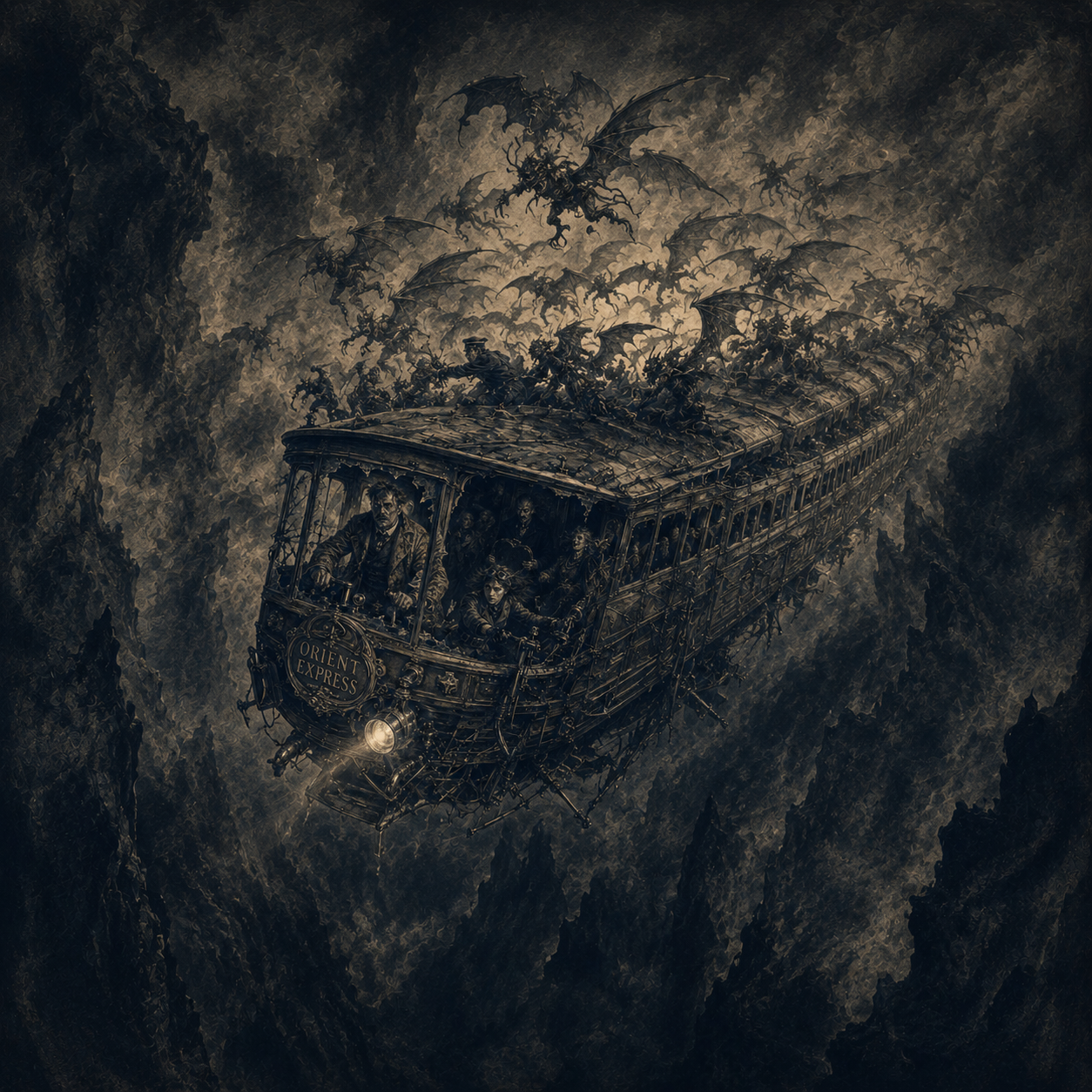
The train had stopped being a train in any honest sense of the word. It still remembered rails, perhaps, and lamps, and polished wood, and the hush of sleeping compartments at impossible hours of the morning. But it plunged now through a place where rails meant nothing, wearing wings and engines and the bones of a carriage the way a fever wears the face of a man. Beyond its windows lay no sky at all, only the black gulf of Nodens, a depth so absolute the mind flinched from trying to measure it. And out of that dark came the dead and the damned and the hungry things that fly between one dream and another.
Arthur Zorba stood in the middle of it with a cricket bat in his hands.
It had not been there a moment before, but nothing in that place could be trusted to have been there a moment before. The bat had come because some instinct in him demanded a weapon, and the dream, whether out of malice or mercy, had obliged. The thing in front of him was a spectre, a leftover of violence and rage, one more shape crawling through the train’s torn logic. His earlier blows had met only mist and mockery; fists went straight through dead men, and there was nothing in vapour for courage to take hold of.
The cricket bat, though, struck solid.
The impact cracked through the compartment with a vulgar, satisfying sound, and for one glorious instant Arthur felt the old certainty of the body again — that brute, reliable truth that if a thing means to kill you, you hit it first. The apparition reeled. Half-mad with relief, he barked at it like a conductor confronting a fare-dodger.
“You don’t have a ticket for this train!”
Then the bat went to vapour in his hands.
The thing he’d struck was already gone, pitched into the dark by one of the train’s infernal tenders — those hulking attendants whose monstrous faces had terrified everyone earlier and who now, horribly, seemed to be on the passengers’ side. The lull that followed felt worse than the fighting. In the quiet, the roar of distant engines and the thunder of gunfire came pressing back into the senses.
Arthur and Viola Sutcliffe turned toward the front, where the flying engine lurched and groaned. Somewhere up ahead Claire and Per were trapped in the cockpit, driving the impossible machine out over the gulf. From behind them came a cry of fear and pain.
Viola heard it first — or at least was the first to admit it couldn’t be ignored. Arthur hesitated only as long as it took the old habits of dread to argue with the better habits of decency. If this was a dream, then perhaps it would punish them for showing mercy. But if it was a dream, there was still a proper form to things, and a man did not leave another man to be torn apart screaming in the next carriage.
So they went back.
In the bathhouse carriage, Karakov lay pinned under the vengeance of his own life.
The spectres had come through the walls and the roof, Cossacks with the mark of the English pound burning on their brows like a brand fetched up out of hell. They weren’t strangers to him, not exactly. They were the answer to a sum once worked out in ledgers and shipments, in crates of guns and the profits of distance. They were the men who had died so that he could grow richer. The dream had peeled the polite coverings off commerce and consequence, and now the consequence knelt on his chest and tore at him with dead hands.
He had tried to run from them, and not only out of cowardice. He knew what was waiting in the baggage van. There, locked among the luggage, sat the thing he had brought into being — not a trunk, not really an object at all, but his guilt given a shape, his conscience made portable and made terrible. If he could pitch it into the gulf, he might be free of it.
If he lived that long.
Arthur charged in with all the grace of a wounded soldier and all the success of a man swinging sporting equipment at ghosts. Viola came with him, clutching her ashtray like a village matron set on defending propriety against the apocalypse. Their blows didn’t end the assault. The dead were soldiers still, and even dead they remembered how to fight. The carriage came apart around them under cannon fire, wood bursting inward in jagged splinters, steam and smoke and dream-stuff mixing with the stench of old blood.
Then Madame Bruja appeared.
She came up from the rear compartments with her heart-shaped valise held against her, her eyes already doing arithmetic. She watched the struggle a moment too long. Long enough for the dead hands to find Arthur and Viola, for Karakov’s terror to curdle into despair, for it to be perfectly clear that whatever pity had survived the centuries in her had only survived by learning to be choosy about who got it.
At last she sighed.
“Poor Madame Sutcliffe,” she said. “This I simply cannot abide.”
She threw the valise aside, pressed both hands flat to her chest, and pushed her fingers in through her own ribs.
Arthur watched the bones part. He heard the wet crack of her body opening. It hit him harder than any of the shellbursts had — the human form broken open from the inside, not by an attacker but by a will that treated flesh as a coat to be unbuttoned. He started to scream and couldn’t stop, the sound tearing out of him raw and useless while his mind tried to refuse what his eyes kept insisting on.
Viola only watched, with the grave attention of a woman who had seen too much and lived too long and learned that horror usually turns up with bad manners.
Inside the opened chest a heart-shaped gem was burning.
She drew it out. The light it threw was not warm, though it burned — a cruel red brilliance, the colour of buried embers and old sacrifice. She held it up to the Cossack spectres and they recoiled. Their hatred had met something older than itself. They screamed and burned and thinned away into nothing.
Then Madame Bruja’s ribs swung shut again with a run of small snaps and clicks.
Viola asked, with almost unbearable courtesy, whether the woman wanted any help putting herself back together.
She did not. Her body, she said, meant little enough to her. The gem was what mattered. It was what he wanted — the thing he had hunted her across centuries to take. Once she had loved the power in it. Now what she remembered was the grief it had brought, and she had come to throw it into the gulf and be done.
But Walter had spoken to her of the Sedefkar Simulacrum. She knew little about that relic, she admitted, though more than most people did, and the stone might help them against it. Dangerous, certainly. By now danger was the only currency any of them had left to spend.
Viola took it.
It burned in her hand with a pain that begged her to drop it, and yet it left the skin unmarked. That was the worse part — pain that did no injury, a warning with no mercy behind it. She tucked it away somewhere on her person, and Madame Bruja gathered up the valise again.
“A decoy,” she said.
At the front of the train, the cockpit had turned into a battlefield made of air and nightmare.
Claire wrestled the controls while the abyss waited below like a pupil widening in the eye of creation. Per stood lookout beside her, the wind shrieking through a hole a cannonball had punched in the hull. Out in the swarm, winged things broke loose and dove at them: reptilian, worm-like creatures with obscene bodies and a predatory grace. One carried a rider — a skeletal figure in a charred black cloak, still far off, still coming.
Claire needed time. Per needed a weapon.
By the elastic logic of dreams, one turned up: a crossbow mounted absurdly inside the cockpit, with a coral of bolts hung ready beside it. Per took it in both hands, braced himself at the open window, and waited until the nearest creature came close enough that its hide and its eyes and the long neck stopped being an idea and became a target.
His bolt drove in deep.
The thing shrieked and streamed blood from its neck and did not break off. The shot had been better than even Per understood, murderously precise, buried in living flesh, and still the creature came on. Claire threw the plane into evasive motion and pushed it too hard. Some buried instinct — pilot’s knowledge the dream had handed her along with the impossible role — warned her an instant before the engine sputtered.
The plane-train lurched, tilted, and started to spin.
The world came loose.
Per, unstrapped and too near the open window, went out into the black.
For one moment he fell beside the aircraft instead of away from it, hung in the impossible physics of the Dreamlands. He saw the creature he had wounded. He saw the blood still running from its neck. He may even have had time for a grim flicker of satisfaction before it snapped him out of the air, took him in its jaws, and tore his head from his body.
Then Per woke in the dark to the soothing clatter of an ordinary train.
The others had no such mercy yet.
Claire, steadied now by the knowledge that dream-death was not death, brought the machine back under her hands. But heavy impacts began landing on the roof of the cockpit, and claws scrabbled overhead. The surviving winged beasts had seized the aircraft and were hauling it up out of its dive, dragging it back from the gulf. She fought them through the controls. They were monstrously strong; even when she made the whole machine shudder, they held fast.
Henri turned up when he was needed, the way he always seemed to.
He looked worse than before. The immaculate mask had broken open over burn-scarred flesh. His uniform hung in tatters, and blood ran down one arm to drip from the fingers of his white glove. The train and Henri were one thing, he explained. Its wounds were his wounds. Its danger showed on him.
What he brought Claire was not comfort but help. At his whistle the train’s demonic tenders came scrambling onto the roof — the creatures everyone had taken for devils, revealed now as crew — and flung themselves on the winged attackers. Over the cockpit came shrieks and impacts and the wet noise of fighting in the air. Blood sprayed past the windows in brief red fans. The pressure on the controls eased, and the plane was hers again.
Behind her, the baggage van had become the last passage before judgement.
Henri unlocked the compartment where Karakov’s steamer trunk waited. It was scratching from inside. Something flopped and shifted in there, frantic to stay. Arthur saw his chance, got a window open, and threw out his own offering — a vial of yellow mist, mustard gas made into a symbol, a whole war’s worth of horror shrunk down small enough to hold in one hand. He gave it to the gulf. The act was almost embarrassingly plain; no ceremony to it, though Henri mourned that such things were normally done beautifully. There wasn’t time for beautiful.
Karakov dragged the steamer trunk to the side door and leaned out to be sure nothing was waiting to snatch it back. The air beyond was clear.
He shoved it into the void.
The trunk came open as it tumbled, and what spilled out of it was rats.
Not dozens. Not hundreds. Thousands on thousands, a filthy avalanche of trench rats grown fat on the dead and dying, pouring out as though from the belly of the war itself. For one hideous moment they formed a living bridge back toward the train, a writhing grey-brown rope of them desperate to climb home into his life and finish what was left of it. Then gravity and dream and Nodens took them, and they fell away into the dark and rained off into nothing.
For Karakov, the guns went quiet.
The weight in his chest eased. Then it stopped.
He simply was no longer on the train — an old man dying in his own bed, having finally set down the guilt that had chased him all those years.
The dream wasn’t finished with the rest of them.
The door between the baggage van and the cockpit slid open, and the red-eyed sorcerer was standing in it.
He was cadaverous, draped in blackened ruin, his stare burning with a patience that had outlasted empires. Arthur knew him, though in dreams knowing a thing tends to come too late to do you any good. This was the pursuer. The one who wanted Madame Bruja’s stone. The one for whom centuries had apparently been no obstacle at all.
“Where is it?” he asked.
Madame Bruja lifted the heart-shaped valise.
“It is here! This is what you have chased me for!”
The bluff only worked if someone believed it — if someone behaved as though the valise mattered more than her own life. Viola, carrying the real stone hidden on her, stepped into the creature’s path with her ashtray purse. Whether out of courage or reflex or the deep, ingrained habit of putting herself between a brute and another woman, she hit him.
The blow landed. His head lolled to one side.
Then he turned those burning eyes on her.
“Pathetic,” he said, and spoke a word.
Arthur watched Viola Sutcliffe melt.
Her flesh softened and ran and sloughed off the bone like wax under a terrible flame, sliding down in glistening folds, smouldering and sparking, slumping around the frame of her skeleton. It was past battlefield horror, past injury, past any of the categories the mind keeps on hand to protect itself. It was not death as men understand death. It was a thing done to a body specifically to insult it.
Something in Arthur broke open again.
Death magic. The conviction landed on him with absolute force. He was cursed by it. They were all cursed by it. Death had stopped being an event and become a substance, a spell, a weather that had found him out and would never let up. He screamed and scrambled backward, stumbling through what was left of Viola, running from the red-eyed thing and the certainty it had just planted in him.
The stone slipped free of her remains.
Madame Bruja and the sorcerer grappled over the empty valise, she shrieking and cackling in triumph as he understood at last that he’d been cheated. But the true prize had never reached the gulf in Viola’s keeping. It lay there among bone and melted flesh while the train hurtled on toward its end.
Arthur burst into the cockpit, wild-eyed and raw-throated.
“Claire,” he gasped, “there’s a terrible monster on board. Get us somewhere safe.”
Claire, ringed by flying horrors and still reeling from Per’s disappearance, had little patience for fine distinctions between monsters. The only safe place left was the abyss itself.
Henri urged her on. The gulf waited below, inky and absolute. The tenders fought above. The red-eyed sorcerer raged behind them, Madame Bruja laughed in his face, and Viola’s remains slid back and forth across the floor with the lost stone riding along. The train groaned like a living thing bent on finishing its last duty.
Arthur, desperate to be useful and far more desperate not to look behind him, helped Claire steer. Out among the impossible debris of the dream a submarine rose up through the clouds like a lunatic trespasser from some other nightmare. He caught sight of it in time and shouted a warning; Claire corrected, fought the yoke, and drove the plane-train down.
The abyss came up to meet them.
For a moment everything seemed to happen at once — Claire screaming at the controls, Arthur shrieking beside her, the sorcerer howling over the empty valise, Madame Bruja’s laughter cutting through the carriage like a blade, the tenders and the winged beasts tearing at each other overhead, and the gulf yawning open underneath, wide enough to swallow guilt and trauma and fire and every fragile human hope of ever understanding any of it.
Then there was blackness.
They woke in their beds.
The train was only a train again, rumbling along the tracks in the dark before dawn. The steady rhythm of wheels and rails came back as though the universe had never once forgotten how to be ordinary. Half past four in the morning, or thereabouts. Per, who had woken earlier from his private death, had had time to pull himself together. Walter slept on, untouched, having held out against whatever the dream had set in front of him.
Still, it had left marks deeper than bruises.
Viola woke with her joints loose and painless. Strength had come back to her limbs, or something close enough to strength. The cane she had thrown into the gulf had carried off more than the picture of her own infirmity. For now, at least, time had let go of her a little.
Arthur woke changed in a quieter way. The grief was still there. The memory of the war was still there — no gulf could unmake the dead, and it shouldn’t. But the involuntary terror, the uncontrollable flinch at loud noises and at violence, the old shell-shock machinery that had kept his body a battlefield long after the armistice, that was gone. The blame he’d carried for things he could never have controlled had gone down into Nodens’ dark with the vial of mustard gas.
Claire had set down her burden too: the goggles, the guilt of helplessness, the old wound of having been no use in war and horror. Per had given up the image of Professor Smith’s house in flames, and may by doing it have cut loose the attention of whoever had set the fire — though what that cost, or invited, none of them could say.
Karakov didn’t wake among them, because Karakov had already woken elsewhere — if waking is the word for an old man whose heart stopped the moment his guilt finally let him go.
And Viola did not have the stone.
That prize had been lost in the last of the violence, never carried into the gulf in her keeping. Whether they’d been denied a salvation or spared a curse, none of them could yet tell. Somewhere out in that impossible dark, Madame Bruja’s heart-gem was still beyond their reach, and the red-eyed sorcerer was a horror not finished, only escaped.
The Orient Express carried them on toward Lausanne.
There, waiting past the exhausted edge of the nightmare, lay the next thread: Edgar B. Wellington, the stranger who had written asking after the Sedefkar Simulacrum, the old scroll, and the last resting place of the lost Arabian artifact. The waking world had come back to them. Innocence had not. The dream had taken what they offered it, spared what it chose to spare, and left them knowing that some journeys go on even after you’ve fallen into the abyss and come back up breathing.
Session Notes
- Arthur Zorba, still in the dreamlike train-plane sequence, manifested a cricket bat as a weapon and used it to attack one of the spectral enemies. The attack succeeded.
- The cricket bat was treated as a club-like brawling weapon, dealing 1d6 damage with no damage bonus because Arthur’s Strength and Size were average.
- Arthur struck the spectral foe for two damage. Unlike earlier attacks that had passed through the ghosts, the dream-created cricket bat connected solidly.
- After the hit, the cricket bat dissolved into vapor and vanished.
- One of the other spectral attackers was thrown into the void by one of the train’s engine tenders.
- Arthur and Viola Sutcliffe had a brief moment to catch their breath. Arthur suggested they should investigate the airplane noises, the strange condition of the train, and what was happening at the front.
- Viola agreed with Arthur’s sensible plan, but the two then heard a cry of fear and pain from farther back in the train, coming from the direction of the bathhouse.
- Karakov, attempting to reach the baggage car, was blocked by several spectral Cossacks that smashed in through the windows and came swinging down from the roof.
- Each spectral Cossack bore the mark of the English pound burning like a brand on its forehead.
- The ghosts hated Karakov because they represented men who had died because of weapons he had sold for profit.
- Karakov knew the Cossacks had come for revenge, and he was desperate to reach the baggage car because his dream artifact was stored there.
- The object Karakov needed to cast into the Gulf of Nodens represented his conscience and guilt. Throwing it away would mean discarding his regard for human life.
- Karakov tried to run past the ghosts rather than fight them. He was not a strong hand-to-hand combatant and wanted only to escape, block their pursuit, and reach the baggage car.
- Karakov failed his Dexterity check while attempting to get past the spectral Cossacks.
- Arthur and Viola, hearing the cry from the bathhouse, decided to go back and help whoever was screaming rather than continue toward the front.
- Arthur reasoned that even in a dream, one should help someone screaming in fear.
- Arthur briefly worried about their companions Per Oskarson and Claire Corning, but he assumed they were probably all right.
- The scene shifted to the cockpit, where Per and Claire were still aboard the aircraft-like front of the train.
- The cockpit had a hole in its side from an earlier cannonball strike.
- Per and Claire had already cast their own totems out through the hole.
- Flying creatures outside the aircraft were getting closer. Several broke away from the larger pack, tucked in their wings, and entered aggressive dives toward the train-plane.
- Per judged that the diving creatures would reach them before Claire could get the plane into the abyss unless they found a way to stop them.
- Claire used her Resourceful talent and spent Luck to find a weapon in the cockpit.
- Instead of a rifle, Claire found a crossbow mounted on the wall, with a quiver or rack of bolts nearby.
- Per took up the crossbow and prepared to fire at the approaching flying creatures.
- The crossbow was treated as a two-handed weapon, and Per was allowed to use his rifle skill with it.
- Per rolled an extreme success with the crossbow.
- As the creatures drew closer, they were revealed to be reptilian, wormlike flying monsters. One had a rider, but that rider had not yet closed the gap.
- Per’s crossbow bolt struck one of the creatures deeply in the side of the neck.
- The creature shrieked but did not break speed.
- Per initially dealt six damage, but after the rules were clarified, the extreme success counted as maximum weapon damage plus the weapon roll because the target was not fighting back. This added another eight damage.
- Even with the heavier damage, the creature survived, though Per could tell he had struck it with great force.
- Claire attempted evasive maneuvers with a Pilot Aircraft check as the creatures closed in.
- Claire failed the initial piloting check and chose to push the roll, accepting the risk of temporarily losing control of the plane.
- The pushed roll also failed.
- Claire dove too hard, causing the engine to sputter and the plane to begin tilting and spinning out of control.
- Everyone not securely strapped in had to make Dexterity checks as the plane tumbled.
- Per was not strapped in and was near an open window after firing the crossbow.
- Per fell out of the aircraft as it spun.
- Per failed a Sanity roll as every part of him believed he was plummeting to his death.
- Per lost Sanity while falling into the inky void.
- Because it was a dream, Per did not fall away from the plane as expected. Instead, he appeared to fall alongside it at roughly the same speed.
- Claire saw Per drifting outside the window as the plane continued its descent.
- The wounded flying creature that Per had struck caught him, bit him, tore off his head, and flew away with its prize.
- Per woke with a start in a dark room, hearing the ordinary sound of the train moving along the tracks.
- The focus returned to the rear of the train.
- Arthur and Viola threw open the bathhouse doors and saw the spectral Cossacks attacking Karakov.
- The ghosts had Karakov on the ground and were savaging him.
- Karakov took damage and Sanity loss from the attack.
- The cannon fire and the ghosts made Karakov’s delusions effectively real in the dream: the dead from the weapons he sold had come from Hell to kill him.
- Karakov told Arthur and Viola that if the ghosts took him, they should cast his steamer trunk into the void.
- Arthur urged Karakov to fight back and insisted he could still do it himself.
- Arthur tried to attack the ghosts with his cricket bat, but the attack failed.
- Cannon fire struck again, and the rear of the bathhouse exploded into wooden shards.
- Claire regained control of the plane after the tumble.
- As the plane recovered, it lurched. Heavy impacts landed on the roof of the cockpit.
- Something was lifting the plane out of its dive.
- Claire could hear scrabbling and scratching on top of the cockpit.
- Claire tried to fight the creatures’ control with another Pilot Aircraft check.
- The flying creatures resisted with immense strength and overpowered Claire’s attempt to dive.
- The remaining flying creatures, including one carrying a rider, forced the plane away from the abyss.
- The rider came into view: a skeletal figure in a charred black cloak.
- Arthur would have recognized the skeletal rider, though he was not in the cockpit at that moment.
- Madame Bruja emerged from the rear compartments of the train, clutching her heart-shaped valise.
- She saw the spectral Cossacks attacking Karakov, Arthur, and Viola, and she watched warily at first.
- Viola had not yet struck anything with her improvised ashtray weapon and attempted to brawl with it.
- Arthur and Viola continued trying to help Karakov against the ghosts, but neither was an especially capable fighter.
- Arthur and Viola each lost two Sanity and one hit point in the struggle with the spectral soldiers.
- Madame Bruja watched the ghosts slowly killing them for longer than they would have liked.
- Madame Bruja finally intervened, saying she could not abide poor Madame Sutcliffe suffering.
- Madame Bruja threw aside the heart-shaped valise, clapped her hands to her chest, and plunged her fingers into her own ribcage.
- She tore open her ribcage, revealing a heart-shaped gem burning inside her chest.
- Arthur, Viola, and Karakov all made Sanity rolls after witnessing Madame Bruja tear herself open.
- Viola succeeded and lost no Sanity.
- Karakov succeeded and lost no Sanity.
- Arthur failed and lost four Sanity.
- Arthur’s Sanity loss triggered both underlying insanity and a bout of madness.
- Arthur lost control for about thirty seconds, screaming in horror at what he had witnessed.
- Madame Bruja drew the burning heart-shaped gem from her chest and held it in her hand.
- She advanced on the spectral Cossacks and shone the gem upon them.
- The ghosts recoiled, screamed, burned, and faded away.
- Viola asked Madame Bruja whether she could put her chest back together or needed help.
- Madame Bruja explained that her physical husk meant little to her.
- Her ribs snapped and crackled back into place while she continued holding the gem.
- Madame Bruja said the gem was what “he” wanted and that he had pursued her for centuries to gain it.
- Madame Bruja said she had once been enamored with the power the gem granted, but now she could remember only the sorrow.
- She had come to throw the gem into the Gulf of Nodens.
- Madame Bruja said Walter Lake had told her the investigators sought the Sedefkar Simulacrum.
- She said she knew little about the relic, but she knew at least a few tales.
- Madame Bruja said the stone could aid the investigators, but it was also dangerous in its own right.
- Viola said she had made devil’s bargains before and was willing to take the risk if Madame Bruja wished to part with it.
- Madame Bruja gave the heart-shaped gem to Viola.
- The gem burned painfully in Viola’s hand, though it did not char her flesh.
- Madame Bruja warned that Viola now had to make it into the Gulf of Nodens with the gem in her possession.
- Madame Bruja also warned that the pursuer would do everything he could to stop that from happening.
- Madame Bruja recovered her heart-shaped valise and said she might be able to buy Viola a little time with a decoy.
- Arthur came back to his senses with a raw throat from screaming.
- Arthur saw Madame Bruja calmly speaking with Viola, no longer appearing as a torn-open crone, and assumed the worst of what he had seen might have been his imagination.
- Arthur thanked Madame Bruja for her assistance and said they should move to the front of the flying train to help their companions.
- Karakov also thanked Madame Bruja for saving him.
- The group moved ahead to the baggage van, where Karakov’s steamer trunk waited inside the locked baggage compartment.
- Henri appeared as they approached the locked baggage area.
- Henri produced a key and unlocked the baggage compartment for Karakov.
- Henri looked battered and damaged. Part of his porcelain mask was broken, revealing burn scars beneath.
- Henri’s uniform was tattered, and blood ran down one arm, pooling in one of his white gloves.
- Arthur asked Henri if he was all right.
- Henri explained that he and the train were one.
- Arthur observed that the train was under attack by cannon fire.
- Henri said they had to make their way into the Gulf of Nodens as soon as possible.
- Arthur said they had been heading toward the engine to see what Claire and Per were doing and to offer help.
- Henri said he had to assist Karakov.
- The baggage door was opened, and Karakov’s steamer trunk was inside.
- From within the trunk came frantic scratching, flopping, and movement.
- Arthur misunderstood at first and thought this was where they cast dream-created things into the gulf.
- Henri explained that the object needed only to be cast from the train to rid oneself of it.
- Arthur opened a window and threw out his own dream artifact: a vial or bottle filled with yellowish mustard gas, representing the horrific trauma of World War I.
- Henri lamented that normally there would be a beautiful ceremony for such a casting-off.
- Arthur and Viola reassured Henri that the disrupted and dangerous ride was not his fault and that the journey had been lovely despite everything.
- Madame Bruja pressed them onward, insisting there was no time.
- Something landed on the roof of the baggage van.
- In the cockpit, Claire remained trapped by the flying creatures, which were steering the plane and preventing it from diving into the abyss.
- Claire saw one of the creatures crane its neck down and look into the cockpit.
- Claire realized that although she could still move the controls, the creatures had effectively taken control of the plane by overpowering its movements from outside.
- Claire began looking for parachutes or another way out.
- Claire called for Henri, hoping he would appear as needed.
- Henri left the baggage van, saying he was needed in the engine, and rushed to the cockpit.
- Claire told Henri they were in trouble, captured by winged beasts, and that Per had fallen out the window.
- Henri reassured Claire that Per would likely have woken in his bed and that perhaps a cold glass of water would refresh him.
- Henri said he could help with the creatures holding the plane.
- Henri took out a whistle on a cord and blew a sharp, shrill note.
- The cockpit door opened, and two of the train’s engine tenders appeared.
- Henri clarified to Claire that the demonic-looking beings were members of the train’s crew.
- Henri asked the tenders to clear the top of the engine.
- The tenders climbed onto the outside of the aircraft-train.
- Screeching and the sounds of a struggle came from above as the tenders fought the larger flying creatures.
- Karakov prepared to throw his steamer trunk out of the train.
- Wanting to make sure the trunk reached the void and was not snatched by a flying creature, Karakov looked outside first.
- Karakov succeeded on a Spot Hidden check and saw that the coast was clear.
- Karakov shoved the steamer trunk out through a side door.
- As the trunk tumbled through the air, it burst open.
- A vast avalanche of trench rats poured out of it.
- The rats represented the dead and dying of the trenches, where rats came to feed on bodies.
- The rats emerged in the thousands and then the hundreds of thousands.
- They almost formed a bridge back toward the plane, as if to return and consume Karakov.
- The rats did not quite make it and instead rained down into the darkness.
- After Karakov discarded the trunk, the door between the baggage van and cockpit slid open.
- A red-eyed, cadaverous being stood between the group and the front of the train.
- The being asked, “Where is it?”
- Madame Bruja held up the heart-shaped valise and claimed that it contained what the creature had chased her for.
- Viola recognized this as her cue to keep the actual gem safe.
- Viola had already cast away her own dream artifact, a walking cane representing infirmity.
- Karakov, having completed the casting-away of his guilt and his regard for human life, made a Constitution check.
- After Karakov discarded his guilt, the sound of the guns slowly faded for him.
- The pressure in Karakov’s chest eased, the guns went silent, and his heart stopped.
- Karakov vanished from the train, having died as an old man in his bed.
- The red-eyed creature advanced toward Madame Bruja.
- Arthur did not directly block the creature, but he stayed near Viola and prepared to defend her if it approached.
- Viola attempted to maintain the bluff by defending Madame Bruja and swinging her ashtray purse or bag at the creature.
- Viola struck the creature, hitting it across the head, but the attack had no meaningful effect.
- The creature turned its burning eyes on Viola and dismissed the attack as pathetic.
- The creature spoke a word.
- Arthur and Viola both made Sanity rolls.
- Both succeeded.
- Arthur lost one Sanity.
- Viola lost no Sanity.
- Arthur witnessed Viola’s flesh melt from her bones like wax, sparking and smoldering before collapsing into a horrific pile of remains.
- Because Arthur was already indefinitely insane, even the one point of Sanity loss caused another bout of madness.
- Arthur developed thanatomania, the belief that he was cursed by death magic.
- Arthur reacted by screaming, backing away, and scrambling from the red-eyed monster and Viola’s remains.
- In his panic, Arthur moved as far away as he could and ended up in the cockpit with Claire.
- In the cockpit, the train’s tenders had forced the attacking flying creatures off the plane, and those creatures were now fighting in the air around them.
- Claire had regained control of the plane.
- Arthur warned Claire that there was a terrible monster aboard the train in the baggage car.
- Claire said there were already monsters everywhere outside and that she was trying to dive into the gulf.
- Henri urged Claire to accelerate their departure from the dream-place and pointed toward the inky abyss below.
- Claire prepared to make one final Pilot Aircraft check to dive into the Gulf of Nodens.
- Arthur assisted Claire by acting as a lookout and helping her navigate around hazards and debris outside.
- A submarine emerged from the clouds as another strange obstacle.
- Arthur succeeded exceptionally well on a Spot Hidden check, noticing the submarine in time.
- Arthur warned Claire of the submarine off the starboard side, giving Claire a bonus die on the Pilot Aircraft check.
- Claire succeeded after spending Luck.
- The scene cut rapidly between Claire at the controls, Arthur shrieking nearby, the red-eyed sorcerer and Madame Bruja struggling over the empty valise, and the heart-shaped gem sliding among Viola’s bones and remains.
- Madame Bruja cackled triumphantly because the valise was empty and the pursuer had been deceived.
- The abyss rushed closer and closer.
- The train-plane entered the abyss, and everything went black.
- The investigators woke in their beds aboard the ordinary train.
- The train rumbled along the tracks in a soothing rhythm.
- Per had woken earlier than the others after his death in the dream.
- Walter Lake had slept through the dream journey and remained unaffected, having resisted the temptations presented to the others.
- The time was about 4:35 in the morning.
- The group reviewed what each person had cast into the Gulf of Nodens.
- Viola had cast away a walking cane, representing infirmity.
- Arthur had cast away a bottle of mustard gas, representing the horrific trauma of World War I.
- Per had cast away a figurine of Professor Smith’s house ablaze, representing the attention of the people responsible for that attack.
- Claire had cast away goggles, representing guilt over being unable to aid in the war and related survivor’s guilt.
- Walter cast away nothing, having resisted every temptation during the dream journey.
- Upon waking, Viola’s joints no longer ached. She felt stronger, healthier, and more robust.
- Arthur’s shell shock was effectively gone. His sadness and regret over the war remained, but he had come to terms with the fact that many things had been outside his control and that he was not to blame.
- Arthur’s uncontrollable reactions to loud noises, aggression, stress, and related triggers were gone, though he did not necessarily understand that immediately.
- Claire felt internally better about the guilt she had cast away.
- Per’s casting away of the figure connected to Professor Smith’s burning house was acknowledged as significant, though its future consequences were not yet determined.
- The train was still hours away from Lausanne, Switzerland.
- The investigators were reminded why they were heading there.
- In Poissy, they had visited the family living on the grounds where Comte Fenalik’s mansion once stood.
- That family had received a letter from Edgar B. Wellington, who was researching the Sedefkar Simulacrum.
- Wellington wrote that he had come into possession of an old scroll describing the simulacrum and was attempting to trace the artifact’s history.
- Wellington’s research had led him to the family’s address because the last recorded resting place of the simulacrum had been the house that formerly occupied their land in the late eighteenth century.
- Wellington described the statue as a unique Arabian artifact lost during the events of 1789.
- Wellington said its last owner was a German nobleman who once lived where the family now lived.
- Wellington asked whether the family had heard local stories about the item or had found any traces of the old house or its possessions that might suggest what had happened to the artifact.
- The family had no useful information for Wellington and had not heard from him again after the initial letter.
- Per had previously considered whether he knew of Edgar Wellington in academic circles, but the name was not familiar to him as an academic in a relevant field.
- The investigators were therefore heading to Lausanne to make personal inquiries with Edgar B. Wellington and possibly learn more about the scroll in his possession.
- After the dream sequence concluded, the investigators entered a development phase and made skill improvement and Luck recovery rolls.