The Dreamlands Express left Sona-Nyl as a thing too elegant to be trusted.
Behind it lay the platform, the silver architecture, the strange tribunal and its impossible verdict. Behind it stood Walter Lake, alone beneath a sky that had begun to curdle. The others, carried onward by polished brass and lacquered wood and the murmuring of Henri’s service, might have believed themselves bound for some appointed rite, some last symbolic passage over the Gulf of Nodens. Walter alone saw the cloud bank ahead take shape: a skull forming in the storm, vast beyond earthly weather, its eye sockets opening on red stars.
He called after them.
His warning was swallowed by distance, wind, and dream.
Only Per heard enough to understand that something was wrong.
The train had taken to the air by then, though it had done so with such unnatural grace that the body resisted knowing it. The floor did not lurch, the glass did not rattle, the cups did not skitter from their saucers. The Dreamlands Express simply departed the ordinary consent of rails and rose into the sky as if flight had always been among its civilities.
Per climbed where no passenger ought to climb and looked forward.
The storm-skull waited with its jaw open.
Red lightning crawled through the teeth of cloud. The black hollows of its eyes burned with twin crimson points, patient and malignant. This was no storm in the ordinary sense of the word; it was something with appetite, a mouth made from the sky, and the Express was already entering it.
Per did not scream. That was his first victory.
His fingers tightened on whatever rail or seam he could find, and he forced his mind into the old discipline: observe, name, categorize, survive. This was the Dreamlands. Nothing here was wholly metaphor, and nothing here was safely literal. Panic would make a poor instrument. Terror, if one must have it, ought at least to be tuned.
“Henri!” he called into the shrieking wind. “My calm and relaxation are in severe jeopardy!”
The conductor appeared with the unnerving promptness of a man who had never hurried in his life and never needed to. He emerged from one of those discreet little compartments kept for train staff, immaculate despite the air and the storm and the impossibility of the moment.
“Oui, monsieur?”
Per pointed ahead. “I do not know if I should be panicking, but I should like to know whether the front of the train is customarily swallowed by a vast maw in the sky with terrifying red eyes. Is this how the Gulf of Nodens usually appears?”
Henri’s face, as ever, gave away little. His body, however, betrayed him by a minute pause, a stiffness in the shoulders, the smallest failure of practiced equilibrium.
That was answer enough.
Per looked again toward the storm. Somewhere within the curling dark was the appointed gulf, the abyss into which unwanted burdens were to be cast. But something else had come to meet them, something with the shape of a skull and the patience of death.
Then, in that high, wind-lashed instant, Per did something terrible and brilliant.
He remembered that this place yielded, sometimes, to dreamers.
Not easily, not kindly, and never without cost.
He imagined a new truth around the old one. If the Express was flying, then it could be flown. If it could be flown, then it could be guided. If it could be guided, then Claire Corning, who possessed skills the Dreamlands had not yet learned to fear, might yet turn catastrophe into maneuver.
“It is fortunate,” Per said, as though announcing a fact rather than making a prayer, “that we have a skilled aircraft pilot aboard.”
He reached into the malleable substance of dream and imposed upon it the image of a cockpit, controls, wings, propellers, instruments, whatever half-remembered technical miracles and speculative illustrations his mind could assemble under pressure. He did not know enough to be accurate. Fortunately, dreams had never cared much for engineering accuracy when conviction would do.
“Henri,” he said, strained now, the effort already carving strength from him, “can you help me create this reality from the dream?”
“Monsieur,” Henri replied, and for the first time his helplessness was almost visible, “I am afraid I cannot. I am no dreamer. This train was built from labor and strange bargains.”
So Per did it alone.
The Dreamlands resisted him. The old bargain of the train held its shape stubbornly: engine, tender, wheels, compartments, beasts, rails where rails had no earthly right to be. Per pushed against it until his vision blurred and something vital within him seemed to diminish, spent like fuel in a furnace. Then the Express answered.
A tremor passed through the floor.
Not a jolt, not damage. A vibration, a deep mechanical thrum, alien to the smooth glide of the train. Outside the windows, metal wings erupted from the sides of the cars, enormous and gleaming in the stormlight. Propellers blurred into existence along them, chopping at the poisoned air. The tender vanished into some new forward structure, and the head of the train reshaped itself around an aluminum door and a cockpit that had not existed moments before.
Henri looked out at the wings, then forward into the impossible. “I hope this works.”
“We should probably make sure Claire is aware she is supposed to be flying this thing,” Per said.
Henri did not run, exactly. Henri never quite abandoned dignity. But he moved with a speed that suggested dignity had been granted temporary leave.
They found Claire in her compartment, already alerted by the unfamiliar pulse of engines. A woman may be caught in dream, terror, and myth, but the sound of an aircraft engine speaks in a language that bypasses philosophy.
“Madam Corning,” Henri said at her door, “we are in need of your skills as a pilot.”
Claire needed little more. “It does seem like the train’s become a plane.”
“There is no time,” Per said. “We must run.”
They hurried forward through the transformed Express. The familiar luxury of the train had begun to feel like stage dressing nailed over the skeleton of a monster. Brass fixtures still gleamed and polished wood still reflected stormlight, but beyond the windows nothing obeyed the world’s old laws.
The forward baggage car still clung to its railway identity, but beyond it stood the new aluminum door. On the other side lay the cockpit.
And inside the cockpit waited the masked beings.
They had served the train before in their quiet way: tall, dark figures in porcelain masks, their bodies too strange beneath formal clothing, their earlier hints of wings and tails remembered too well by Claire. Now the dream had redressed them in flight suits. One sat in the copilot’s position with one long finger hovering near the yoke, not quite touching it. The other examined the instrument panel through the fixed sorrow of its mask.
They turned when Claire and Per entered.
For a moment no one moved.
Then the masked beings gestured toward the pilot’s seat.
Claire’s hand found the wrench she had carried since deciding that some problems, demonic or otherwise, might be solved by a sufficiently committed blow. “There we’ve been run around by demons,” she said, “and now they’re in the cockpit.”
“Gentlemen,” Per said with magnificent and possibly misplaced courtesy, “if you would please leave the cockpit to us.”
The beings looked from him to the controls, then to Claire. Their posture suggested confusion rather than malice. After a brief, silent consultation, they shuffled out. Through the little round window in the cockpit door, they remained visible, half a porcelain face on either side, watching.
“Watch that door,” Claire said as she settled into the pilot’s seat. “We don’t want them bloody demons getting in here and ruining it for everyone.”
“Of course,” said Per. “I will handle security. You need to fly.”
Claire looked through the forward glass.
The Express had broken through the outer mass of cloud into a cavern of storm. Above and around them was nothing but cloud; below, a thick field of mist, luminous without light. It might have been the top of some lower atmosphere, except that the mist was parting to reveal an abyss of impossible scale.
The Gulf of Nodens opened beneath them.
Mist poured into it like water over the lip of a world-sized cataract. The gulf did not look like a place. It looked like an absence so profound that space itself gave way around it. To stare too long was to feel the mind supply its own falling sensation, as though the soul possessed inner ears and they had suddenly failed.
Then Claire saw the figures in the storm.
Winged shapes, several of them, emerging from the dark cloudbanks and angling toward the train. One bore a rider. Even at a distance, through storm and motion, the rider’s eyes burned red.
“There are demons out there as well as in here,” Claire said.
“I suggest you prevent them from boarding,” Per replied, strapping himself into the copilot’s seat with the haunted calm of a man who had already spent more of himself than anyone could see.
She touched the controls. The yoke was real beneath her hands because Per had made it real, and because she believed in the work of flying more than she believed in the stability of nightmares. The Dreamlands had provided instruments. Whether they meant anything was a separate question.
Behind them, the rest of the train was waking into danger.
Viola noticed the yawing first, or at least gave it voice with a composure that made the word seem almost polite. The train was not merely flying now; it was moving like a thing contested. Outside her window, huge metal wings stretched from the sides where no wings had been before.
Henri appeared, as if summoned by unease itself, and informed her that Per and Claire had gone forward to attempt to keep them safe from whatever was developing.
“Then I shall join them,” Viola said. “Whether or not I shall be useful, I shall attempt to be useful.”
Arthur joined her on the way forward, needing only the word something to decide that something ought to be faced. Together they passed through the bath car toward the baggage compartment, and there the sounds changed.
Beneath the engine-thrum came another rhythm.
Hooves.
Many hooves.
Outside the windows, spectral horsemen rode the air alongside the flying train. They were cavalry, but no living cavalry had ever ridden such a charge. Their uniforms belonged to the war. Their bodies bore the war’s final marks: bullet holes, shrapnel wounds, torn flesh that did not bleed because the blood had been spent long ago in mud. They galloped in the sky as if the clouds were steppes and the Express a fleeing enemy column.
Some remained outside. Others leapt from ghostly mounts onto the backs of the strange beasts and structures that still clung to the train’s dream-form, searching for entry.
Arthur saw the uniforms. Russian. Cavalry. Pirates of the air, perhaps, if one were determined to give terror a joke’s shape before it got too close.
“We appear to have pirates,” he said, “or Russians. Russian pirates.”
The old war came with them.
It came not as recollection but as weather: the smell of cordite where there was none, mud underfoot where there was polished flooring, the sound of men dying in languages he did not speak. The left side of his face seemed to remember shrapnel more vividly than the rest of him remembered peace.
Viola had the blunderbuss. Arthur had little faith in the hand crossbow and less patience for spectral intruders.
“Do you still have that blunderbuss?”
“Yes, dear. Did you want it?”
“If you wouldn’t mind.”
They exchanged weapons as naturally as others might exchange umbrellas.
Arthur pushed forward into the baggage car and found two of the ghostly cavalry already inside. They turned toward him, cutlasses drawn, their dead mouths shaping words in Russian. The train, generous to so many tongues until now, gave him no translation. Perhaps these dead did not belong to the train. Perhaps they belonged to war, and war had never translated itself for anyone.
He fired.
The shot thundered in the confined space, smoke and flame blooming from the old weapon. The blast tore into the car but not into the dead men. His hands were not steady. This was not the weapon he knew, nor the battlefield he had survived, nor the war he had left behind. But the war had found him regardless.
“The war has come to the train!” he shouted.
The specters advanced.
Viola ducked more from instinct than necessity, then gathered herself with a purse weighted by an ashtray and the sort of courage often mistaken for eccentricity. The train tipped beneath her. Her strike went wide. The whole Express pitched in the air, and she fell hard to hands and knees.
One of the cavalrymen loomed over her.
Up close, she saw a mark carved into its forehead: the sign of the English pound, the wound of greed made symbol. Money and violence, empire and debt, all branded into a dead soldier’s brow.
The cutlass came down.
It passed into her with cold instead of steel. Pain lanced through her, but the blade did not open flesh. Worse than injury was the fear that came with it: a freezing command to be small, helpless, conquered. Viola endured it. She had lived too long with too many secrets to be easily claimed by a dead man’s terror.
“Money is the root of all evil,” she managed, because even fear deserved an answer.
Forward in the cockpit, Claire heard gunfire behind her but had no room in her mind to look back. The winged shapes were closing. The rider with red eyes marked them through the murk. Below, the gulf waited.
She found a speaking tube or something near enough to one, because dreams were obliging when theatrical necessities arose.
“Henri,” she called, “we’ve got bogeys coming in. Demons at three o’clock. What’s down in that chasm? Is that an escape route?”
Henri’s voice returned through the tube, distorted by metal and wind yet still offended by haste only in the most refined manner. Below was the Gulf of Nodens, he explained. If any passenger still wished to cast away a burden, that was where it must go. And the train must pass through it. This was a hard and fast rule.
“That seems like our destination,” Claire said.
Per looked out over the abyss, then at the oncoming horrors. “Yes. I think that is what one would call it.”
Claire put the Express into a dive.
The nose dipped. The floor angled. Somewhere behind them, loose objects shifted, glass rattled, wood groaned, and every human instinct aboard the train protested that trains should not dive because trains should not fly.
Claire did not listen to human instinct.
She knew the knife-edge between descent and catastrophe, even if the aircraft around her was born from dream and desperation. The Express plunged toward the gulf with terrifying grace, the winged attackers adjusting their course behind them.
In the baggage car, the dive should have thrown everyone forward. The ghosts barely cared. They had ridden horses across the sky; gravity held little authority over them.
Arthur charged one and struck with his fist. His blow passed through the specter’s body as if through smoke. The failure enraged him less than the sensation did: that he could touch nothing, stop nothing, that the dead might walk through all the defenses the living built.
Then the cockpit door burst open behind the ghosts.
The masked beings had returned, though masks were no longer quite the point. They entered from the forward end, and as they did, they tore away the porcelain faces and cast them aside. Flight suits ripped as dark wings unfurled. Long fingers sharpened into claws. Their bodies grew, not beyond the limits of the car, but beyond any pretense of humanity.
For one suspended second, the old categories failed.
Demon, servant, crewman, monster, ally: all of these at once, and none of them.
One of the creatures surged forward with astonishing speed, leapt, seized a cavalry specter in its claws, folded its wings tight, and hurled itself sideways through the window with the ghost in its grasp. Glass and storm swallowed them.
The other creature engaged the remaining specter, talons raking at a foe that ordinary fists and handbags could not seem to harm.
Arthur, who had nearly shot these beings in other circumstances and would gladly have distrusted them on principle, found room for a battlefield assessment.
“Oh, good show!” he called. “Get that dirty Ruskie out of here!”
Viola, back on her feet and perhaps feeling that anyone willing to drag a ghost through a window deserved support, struck again with her weighted purse. The blow passed through the cavalryman, but it distracted him, and distraction mattered. The ghost slashed at her again but failed to land. The monstrous crewman pressed it hard.
Farther back in the train, Monsieur Karakov heard the gunfire.
The time for contemplation had narrowed. Whatever private horror he had carried aboard the Express, whatever object or memory or burden he had intended to cast into the Gulf, his moment for action was closing. Through the glass he saw the train banking toward the abyss. Out of the mist below, shapes emerged.
Cannons.
Spectral artillery in the gulf-mist, angled upward toward the descending train.
Karakov started forward.
The cannons fired.
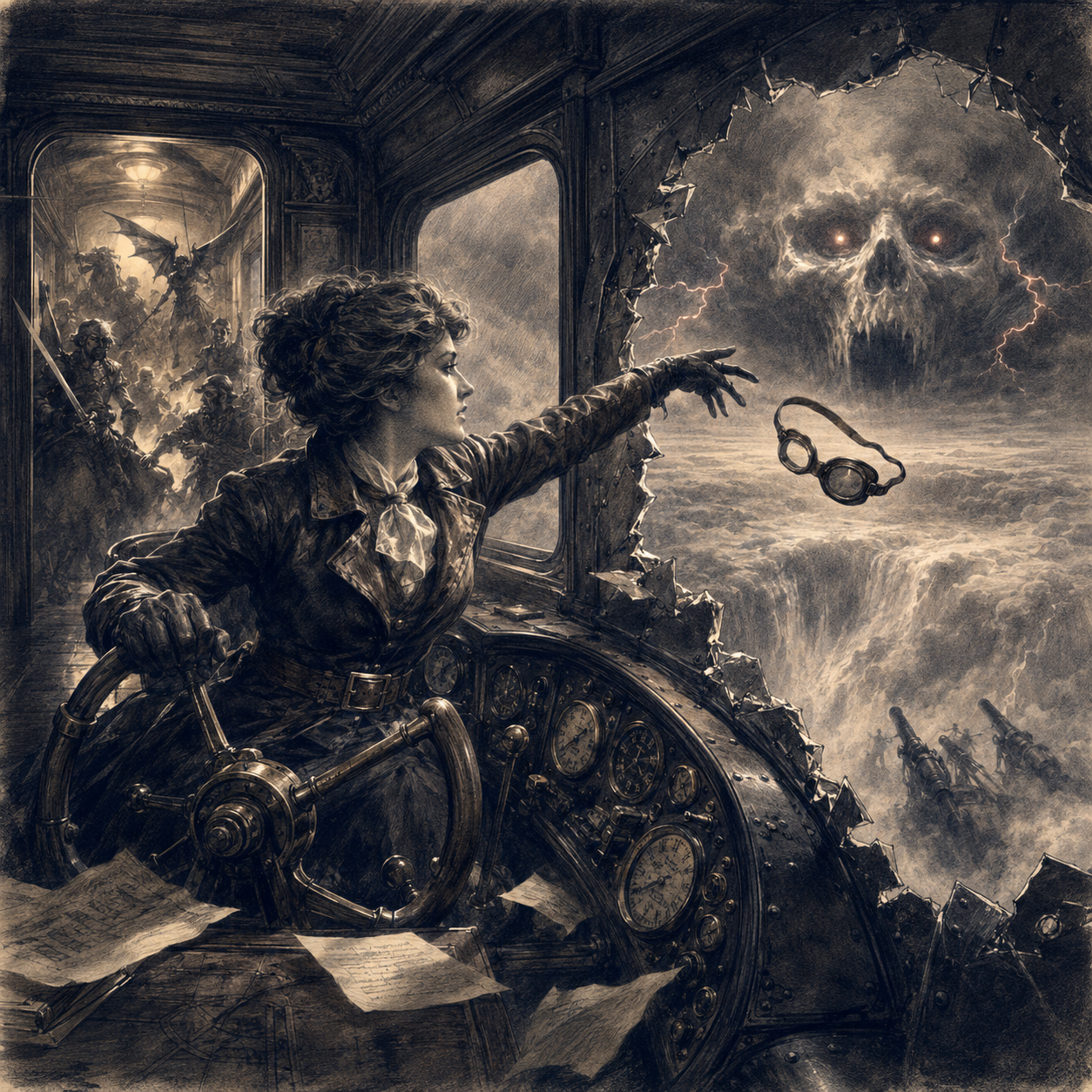
The first impact punched through the cockpit with a sound too large for the space. Metal shrieked inward. Wind exploded through the wound, roaring from one side of the cockpit to the other. A cannonball-sized shot had torn clean through, leaving a ragged hole in the wall and another opposite it.
Claire held the aircraft.
Some pilots fought weather. Some fought enemy fire. Claire fought a train that was a plane because a Swedish occultist had forced a dream to confess new properties while demons and dead cavalrymen battled in its cars above an abyss at the edge of nightmare. She held it anyway.
Another shot ripped through the wooden cars behind. The effect there was worse. Wood did not puncture cleanly; it shattered. Splinters burst through the passage like knives.
Karakov was caught in the storm of fragments. Shards drove into him, tearing cloth and skin, staggering him with sudden pain. Still the train dove.
In the cockpit, Per saw what had fired on them: two ghostly cannons rising from the mist below, their crews unseen or unnecessary. He also saw the ragged hole the cannonball had left in the cockpit wall.
A practical aperture, under the circumstances.
He took the little totem he had carried, small and personal and burdened with meaning, and cast it through the wound in the aircraft.
The wind seized it instantly. For a heartbeat it tumbled away according to the brutal logic of speed and air. Then the Dreamlands imposed another rule. The totem curved, not as debris but as an offering, drawn downward toward the Gulf of Nodens.
Gone.
Per watched it vanish into mist and abyss. Whatever part of him had been tied to it went with it, or began to.
“Claire,” he said, careful not to disturb her hands at the controls more than necessary, “I do not wish to distract you, but this might be your chance, if you want to throw away a burden.”
Claire looked toward the gulf.
There were many things one might discard at such a place: fear, shame, memory, a demon, a debt, a grief. But the burden that rose in her then was not the most obvious one. It was older and quieter, the guilt of standing apart from a war that had broken those she loved. Arthur and Walter had been marked by it in different ways. Others had gone where she had not. She had lived with the knowledge that her skills and her courage and her hands had not been there when the world tore men open.
Now the world had become absurd enough to offer her a battlefield of her own.
The Express screamed downward through storm and cannon fire while winged things pursued and ghosts fought in the baggage car, the gulf opening its mouth below. Claire, at the controls, understood something that did not come as comfort exactly, but as release. She was here now. She was flying now. Whatever else this was, she was not absent from it, and she was not useless before this war of sky and nightmare.
The burden took shape as flight goggles.
Not the goggles themselves, perhaps, but the idea of them: the emblem of a competence denied her, of a role she had imagined too late. She removed them from wherever dream had placed them and crossed the cockpit with impossible confidence, leaving the controls for the briefest moment as if the aircraft understood that this, too, was part of the maneuver.
She flung the goggles through the cannon hole.
The wind tore them from her hand. They spun once in the stormlight, lenses flashing red from the distant eyes of the rider and the lightning inside the skull-cloud. Then they followed Per’s totem downward, drawn into the Gulf of Nodens.
Claire returned to the pilot’s seat unburdened by that much, at least.
Around them, the battle had not ended. The Express still dove, the cannons still waited in the mist, and the winged attackers still came on from the storm; somewhere in the cars behind, the dead of old wars crossed blades with things that had never been human.
But for one impossible moment, amid terror and absurdity and the roar of dream-made engines, the train-plane held its course.
Below, the Gulf received what was given.
Above, the skull-cloud closed around them.
And the Dreamlands Express flew on.
Luke opened the session by recapping the previous events aboard the Dreamlands Express. After the judgment, most of the strange passengers aboard the Dreamlands Express had completed their business. Walter Lake chose not to continue into the Gulf of Nodens. As the Dreamlands Express left Sona-Nyl and entered the Gulf of Nodens, Walter saw something terrible ahead. At the start of the current session, Per clarified the train’s position relative to the skull-like maw. Per was the only investigator who fully perceived the horror of the cloud-skull. Henri appeared in response to Per’s call. Per decided to try to change the dream. Per’s Dreaming attempt changed the train. Per and Henri went to get Claire. Claire and Per rushed toward the front of the transformed train. Claire and Per entered the cockpit and found the porcelain-masked train operators there. Claire took the pilot seat and examined the situation outside. Claire reported danger outside. Luke shifted focus to Arthur Zorba and Viola Sutcliffe. Arthur and Viola encountered signs of a new threat while moving forward. Arthur and Viola prepared to defend the train. Arthur encountered two spectral soldiers in the baggage car. Arthur was forced to confront the battlefield dead. The spectral soldiers advanced. The spectral soldiers spoke in Russian. Arthur fired his Webley at close range. The two train operators entered the baggage car and revealed their true forms. Viola tried to attack one of the ghostly cavalrymen with her weighted purse. Luke returned to Claire and Per in the cockpit. Claire considered where to fly. Monsieur Karakov became relevant to the situation. Claire put the train-plane into a steep dive. Arthur changed tactics and attacked in melee. One of the winged train operators attacked a ghost. Viola tried again to attack a ghost. Luke called for Luck checks by car as the train-plane came under fire. Spectral cannons fired from the mist below. Claire maintained control after the cannon strike. Per discarded his burden into the Gulf of Nodens. Claire decided what burden to discard. The session ended in the middle of the action.Session Notes