The Dreamlands Express left Sonanil beneath the late light of a world that had no right to be beautiful.
Behind it lay the Land of Fancy, with its pleasant airs and sublime promises; ahead waited Serranian, cloud-built and remote beneath the high stars. Between the two, the train took up its appointed course with the serene inevitability of a thing obeying laws older than iron, steam, or sleep. Its passengers had already learned that the Express was only incidentally a train. It wore the shape of one because human minds required rails, timetables, polished wood, and ringing dinner bells. Beneath that courtesy there moved something alive, something vast and obliging, bearing them not merely through distance but through conditions of existence for which waking language had only poor and borrowed words.
Even so, the hour had the softness of evening. The train ran along high cliffs above an ocean of crystalline blue, where dolphins raced in flashing pods below and twin rainbows interlinked overhead like the joined rings of some celestial covenant. Far beneath, the sea foamed against headlands of clear crystal that rose from the water and met in a shining arch.
Arthur watched the spectacle with the guarded suspicion he brought to all marvels. Wonder had never wholly disarmed him. Beauty, in his experience, was often the lacquer applied to something sharp.
Then the Express mounted the crystal arch.
For a moment there was only the upward surge, the terrible knowledge of height, the certainty that no honest train could proceed farther. The track seemed to end in light and air. The engine-creature leapt.
The sea fell away.
No crash came. No plunge into the jeweled waters below.
The train had simply forgotten to fall.
It soared onward into the sky, steady as a thought held too firmly to dissolve. The cliffs vanished behind them. The ocean blurred, then disappeared beneath banks of amber cloud. The evening deepened through red, purple, and blue, and at last the first stars opened their cold eyes.
Arthur found Walter, as he so often did when presented with the impossible and denied the satisfaction of shooting it.
“Walter,” he said, looking out at the clouds through which the train now sailed, “do you have any insight? I mean, certainly we are purportedly in a dream, but a train taking flight…”
Walter regarded the view with the sober discomfort of a man who had made room for miracles in his theology but not for every insolent imitation of them.
“This is not even truly a train,” he said. “It is a living caravan of creatures. Train-like, yes. Especially within. But much here cannot be explained, and perhaps that is the nature of dreams.”
Arthur gave him a dry look. “I tend not to try to remember mine.”
“I have a feeling I will remember this one,” Walter said, though hesitation crept into the words. “I am curious to see whether we have had the same dream. This is quite vivid.”
“Yes,” Arthur said. “You are acting just as I would expect you to act in my own dream.”
Walter inclined his head with clerical gravity. “You as well.”
There was a thin comfort in that, and a deeper unease. Each man saw the other and wondered, perhaps not for the first time, which of them the dream had made and which it had merely trapped.
At half past seven the pre-dinner bell sounded, gentle and civilized, as though the Express had not just ascended into the heavens. It gave them half an hour to dress and compose themselves, and the passengers obeyed.
Dinner was a banquet, arranged in honor of King Kuranes, who had boarded as judge and arbiter in the ancient dispute between the Sarnathians and the beings of Ib. The dining car had somehow been enlarged to accommodate the gathering; the table stretched farther than memory allowed, and the car itself had made room for it with the untroubled courtesy peculiar to dreams.
The king sat at the head of the table, regal without ostentation, thoughtful rather than theatrical. The Sarnathians attended him with practiced respect, though Per, with his careful eye for the machinery of manners, saw calculation beneath their deference. They wished to flatter him before judgment, to be seen as refined and reasonable and the wronged party. Beauty had not made them subtle.
The beings of Ib did not dine. Their place in the evening would come later, when the table was cleared and the matter of justice brought forward.
The meal itself was extravagant even by the standards of the Dreamlands. There was potage à la reine, braised flamingo tongues with truffles from the eastern fungus forest, royal venison from the slopes of Mount Elarion, and peacocks roasted and dressed again in their own feathers upon golden platters set with rubies and diamonds. For dessert came a spun-sugar castle in the shape of Serranian, delicate and gleaming as if the city itself had consented to be devoured in miniature. Fruits, nuts, spices, and sauces of astonishing subtlety completed the feast.
The wine flowed freely. The train flew on.
When one of the Sarnathians attempted, with smiling casualness, to begin rehearsing the merits of their cause before the appointed hour, Kuranes cut the effort short. This was not the time, he said, nor the place. The matter would be heard soon enough. Until then, they would share food and stories, not arguments disguised as conversation.
Per found in that restraint an opening. He spoke not of the case itself, but of judgment. Of fairness. Of the strain placed upon the mind when one party in a dispute was difficult even to endure, when sympathy had to cross not merely custom or grievance but species, scent, texture, and the deep instinctive revulsion of the body.
Kuranes listened with interest.
“The ability to empathize,” the king said, “to see from another’s point of view, is important in understanding how to resolve a dispute. To understand what they want, and why they want it, even if they do not necessarily know.”
He admitted the difficulty. There were beings so different from himself that taking their perspective required conscious discipline. He had practiced for many years to recognize his own reactions, acknowledge them, and set them aside. When he could not, he said, he must abstain.
Per received this with the gravity it deserved. In his own work, empathy had always been both instrument and hazard. It was difficult enough to enter the suffering of another human mind; harder still to approach the mind of something utterly other. He thought, inevitably, of the entity with which he himself remained in conflict, a presence he had failed to understand though he had not ceased to oppose it.
Perhaps, he admitted, he had been too quick to accept enmity as comprehension.
His questions impressed Kuranes. When dinner ended and the proceedings approached, the king invited Per to witness the arbitration. Kuranes had knights to bear witness already, but there was no harm, he said, in adding another observer, especially one who studied the minds of thinking beings and knew that humanity was only a narrow province of thought.
Walter received a different invitation.
He had been seated beside Besweet, who had shed whatever earlier frost had clung to her manner and now treated him with warm, agile charm. She was witty, attentive, and far too pleased with his discomfort. Walter, seeking refuge in businesslike conversation, pressed her about the coming proceedings. Who would speak for the Sarnathians? What was their strategy? What precisely did they intend to argue?
Besweet answered what suited her and flowed away from the rest. Theophed would speak before the king, she said. She herself was merely present for the glory of the train.
But her true interest was Walter.
She praised his stature as a holy man, his reputation as a judge of character, his presumed capacity to discern pure motives where others had maligned them. Slowly, sweetly, she brought the matter around. Would he stand before the king and speak to the kindness, intelligence, and refinement of the Sarnathians? Would he contrast them, by implication if not by direct accusation, with the loathsome beings of Ib?
Walter would not promise to flatter the Sarnathians. He agreed instead to speak truthfully, which was the more dangerous gift.
Besweet took this for victory, which was perhaps the most damning thing about her. Walter made clear that he would include all that had passed: their conduct in the baths, their overtures, their persistent carnal provocations, the noise, the temptations, the prank by which one of the beings of Ib had been shoved toward his companions for sport. Besweet heard none of this as condemnation. To her, these were acts of generosity, vitality, even kindness. The Sarnathians had offered pleasure; Walter had declined. Surely everyone had behaved admirably.
So the dining car was prepared for judgment.
When the beings of Ib entered, the atmosphere changed.
Their entourage came with a waddling, squeaking motion, wet and unpleasant. Their odor filled the car, thick enough to command the body before the mind could mount any defense. Per and Walter had prepared themselves and endured it. One of Kuranes’s knights looked strained; even the king’s eyes watered, though he mastered himself and pressed onward with grave impartiality.
Per, remembering certain practical methods from less rarefied horrors, produced a small pot of strong-scented salve and placed it discreetly within the king’s reach. Kuranes observed the gesture, nodded almost imperceptibly, and touched a little of it beneath his mustache.
Then Henri stated the matter.
A thousand years ago, the city of Sarnath and the gray stone city of Ib stood as neighbors on the shore of Lake Nahr. Ib, it was said, had descended in a single night from the moon, bringing with it its strange inhabitants. The Sarnathians of that age had judged the beings primitive, repellent, verminous. Unable to bear their nearness, they entered Ib and drove its people into the lake with spear points. They took the city, dug mines beneath it, stripped it of precious metals, and seized the statue of the lizard-like god the beings revered.
The beings of Ib claimed that for them only a week had passed.
The Sarnathians answered that a thousand years had gone by. That the perpetrators were dead. That the city and its wealth were now theirs. That the beings of Ib were grotesque. The last they were wise enough not to say plainly, though the thought clung to every polished sentence.
The beings sought damages, apology, and the return of their god’s statue to the place where Ib had stood.
The Sarnathians called Walter Lake as witness.
He rose as a priest, and he spoke as one.
He said that he had interacted with both parties. The Sarnathians, he allowed, had been polite to him, both at first and recently. They had also provided numerous temptations by which he had been able to demonstrate restraint and the true mettle of his faith. Their persistent carnal interests had made rest difficult. Their loud indulgences in the adjacent compartment had disturbed him. Their invitation in the bathhouse had required him to avert his eyes and decline overt pleasures of the flesh. One of them had also shoved a being of Ib into a corner near the others as a prank.
A Sarnathian protested that it had been a jest meant to break the ice.
Besweet, astonishingly, attempted to recast the whole indictment as charity. Walter, she said, had needed opportunities to prove himself before his Christian God. The Sarnathians, recognizing this, had placed challenges before him out of care, even for a stranger.
Kuranes turned to Walter and asked whether his faith had been strengthened by the experience.
Walter considered the question with painful sincerity.
He would have preferred, he said, that all follow the path of Jesus Christ, who would have acted very differently. Yet Christ had been tempted by the devil in the desert, and those trials had shown His strength. In that sense, perhaps the Sarnathians had done for Walter what the devil had done for Jesus.
The Sarnathians took this for praise. Walter had meant it otherwise.
His words did not move the chamber as he might have wished, but truth had still been entered into the record. He also spoke of the beings of Ib and the aid they had rendered during the attack upon Madame Bruja, when Mironim-Mer, possessed or controlled by some malign force, had assaulted her. The beings had given tangible help in combat and investigation. Whatever they were, however difficult their presence, they had not been merely objects of disgust.
Kuranes took note. The attack upon the train troubled him. Such violence was against the laws of the Express, and those laws were enforced by powers greater than himself. When Walter named Mironim-Mer, Kuranes asked whether the passenger remained aboard. Learning that he had disembarked, the king’s attention sharpened into future consequence.
Then Kuranes rendered judgment.
He did not pretend the beings of Ib were pleasant. Even among the varied peoples of the Dreamlands, he said, many would find them difficult to share a room with. But revulsion was not evidence. Disgust was not injury. The beings had done nothing to threaten the Sarnathians, and the Sarnathians, even in their evasive retelling, could not prove any danger beyond the offense of proximity.
The Sarnathians had been the aggressors.
They would meet the demands of Ib. They would pay restitution. Their king would apologize. The statue of the god of Ib would be returned to the place where the city once stood.
Then Kuranes gave warning, and the words fell with the weight of prophecy.
There were many gods in the Dreamlands, he said, and not all were content with tactful prayers. There was a wide gulf between something forgotten and something faded from existence. Sarnath, decadent and proud, had flouted gods and flirted with treachery and blasphemy too often. If it did not see the folly of its ways, doom would come.
The Sarnathians heard him with dejection and petulance. The beings of Ib had won justice, or the nearest thing to it that could be won after a thousand years and one week.
Afterward, as the train neared Serranian, Walter approached Kuranes privately. He thanked him for the justice of the matter, then spoke of his waking quest: the search for the Sedefkar Simulacrum, and the need to rid the world of it.
Kuranes did not know the name. It was, he thought, a relic of Walter’s world, not his own.
But when Walter spoke of Madame Bruja, the king knew more.
A witch, Kuranes called her. Once a walker between worlds. She had originated, he believed, in the waking world as a dreamer, but bargains made in life had debts payable beyond death. She still possessed no small power.
He told Walter a tale called “The Sorcerer and the Crone.”
A sorcerer, married late and foolishly, discovered his young wife with her lover. In rage he summoned dark powers, tore the pair apart, ripped the hearts from their bodies, burned them to ash, and vowed they would have no rest even in death. Their broken remains were thrown to dogs.
But the dead girl’s mother, a crone of terrible malevolence, prayed daily before a church for vengeance. Whether heaven answered was doubtful, for the church stood upon older, grimmer foundations raised in Roman days. One day the crone appeared holding a ruby the size of a clenched fist, shaped like two lovers’ hearts entwined. The sorcerer desired it at once and ordered it seized, but the crone hid it in her breast. When searched, the stone was gone. Even under torture she would not reveal it.
Condemned for witchcraft, she burned in the square before the church. As fire consumed her, the sorcerer demanded the stone. At last she opened her lips.
Hate is stronger than love, she cried, and death is stronger than life.
Only in dreams would he find it.
The sorcerer went mad with desire. In his last days he locked himself in his tower, believing he had solved the taunt, and burned himself alive in his own crypt. Some said the pair knew no rest, but still chased each other amid storm clouds on dark nights: the crone holding her glowing prize aloft, shrieking delight at the sorcerer’s vain pursuit.
Walter understood more than he wished. Madame Bruja’s heart-shaped valise. The red-eyed figure who sought her. Mironim-Mer’s attack, his monstrous hands clawing not merely at her but at the case she guarded. The empty interior when she had opened it. A hidden ruby. A sorcerer who had abandoned death and perhaps humanity in pursuit of it.
Around him, the others weighed their own burdens.
The end of the journey approached. Those who rode to the Gulf of Nodens would be required to cast something away. To pay tribute. To unburden themselves. In doing so they would be marked forever as passengers of the Express and would never ride it again in mortal life. To refuse was possible, but refusal meant leaving the train before the Gulf, waking elsewhere, with the final mystery unentered.
Arthur would remain aboard. So would Claire, Per, and Viola. Each had reasons, some spoken and some held close. Claire carried, perhaps, the shadow Henri had sensed upon her: a dark presence, a menace in her aura, tied to the horror that had come at her in Paris. Per and Arthur had already shaped dream tokens for the coming tribute. Viola had manifested a walking cane, an object heavy with thoughts of infirmity and time.
Walter would not.
The others tried, gently and not so gently, to persuade him. Per suggested that he might cast away something spiritually trivial, such as the burden of paying for luxury hotels across Europe. Arthur suggested his terrible credit. Claire, with mischievous insight, wondered whether pride itself might be the thing. Viola observed that pride was the root of other sins.
Walter did not deny temptation. He admitted the danger of being proud of faith. But to him the answer was confession, not sacrifice to whatever power waited at the Gulf. What mattered was what one did consciously, waking, with one’s single life turned toward God’s purpose. He hoped his reward would lie in how God judged his deeds aboard the train, not in the casting of some idol into the abyss.
The others read it as stubbornness. Walter believed it was fidelity.
Serranian received them in splendor.
The Dreamlands Express arrived at a platform set amid a vast celestial city of pink-veined marble and gold beneath an infinite starry sky. Towers and terraces rose as if architecture itself had learned to praise. Almost all the remaining passengers disembarked there: King Kuranes and his knights, the beings of Ib, the chastened Sarnathians, and the cats, who leapt from the rear of the train and dispersed into the city with the independent purpose of creatures who acknowledged no king.
Henri busied himself with trade. The strange cargo loaded earlier in Ulthar—cabbages, wool, sealed crates, humble and earthly things—was exchanged now for glittering treasures, illuminated books, golden scrolls, and impossible works of art. The commerce of the Express had its own logic, a ladder of value ascending through dreams. Viola received the heavenly pedigree Henri had promised her, another impossibility folded neatly into the train’s accounts.
Before leaving, Walter warned Henri that the assault upon Madame Bruja had arisen during the proceedings. He had given a truthful account, and he did not want Henri blindsided should the matter return upon him.
Henri’s porcelain mask betrayed nothing. In his usual polite, faintly cheerful tone, he thanked Walter and told him not to concern himself. Such burdens belonged to Henri, not to his passengers. He would tuck that little piece of information away for later.
Walter offered the only aid he trusted.
“I will pray for you, Henri.”
For once, the conductor’s thanks seemed to hold something behind it.
Then Walter stepped down onto the platform of Serranian, choosing to wake rather than ride to the Gulf. The others remained aboard. Through the window they could see him standing in the luminous city, a priest alone beneath a sky that was not Heaven, watching the Express prepare to depart.
The train pulled away.
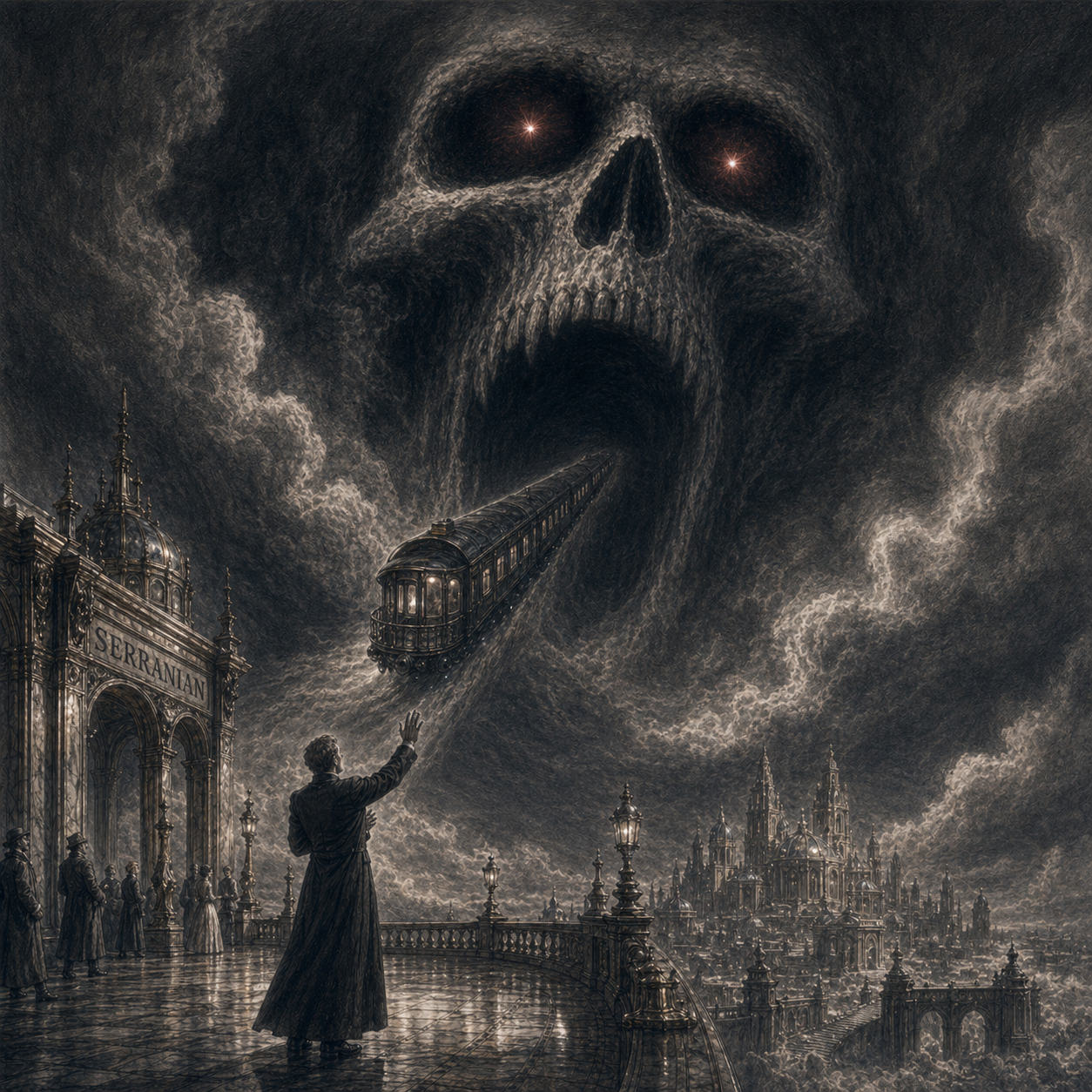
At first there was only the usual gathering of motion, the living cars taking up speed. Then Walter looked beyond it, above the city, where the clouds had begun to darken — and not merely to gather. They roiled, and shaped themselves, and a black skull formed in the heavens ahead of the train, vast and hollow, its sockets kindling with red light. The Dreamlands Express angled upward toward it, toward the open darkness of that impossible face.
Walter’s blood chilled. Around him, others on the platform pointed and stared. This was no private vision, no fever of doctrine: whatever it was, every eye on the platform could see it.
He cupped his hands and cried after the departing train.
“Beware the dark skull and red eyes! The train is headed toward them! I pray for your safe journey!”
His words were torn by distance and wind. Those aboard saw his posture change, saw him point beyond them, saw alarm transfigure farewell into warning. Per caught only fragments — beware, skull, clouds — but the fragments were enough.
Remembering that the roof of the Express could be reached, Per climbed upward. The wind that met him was unlike the earlier gentle currents of the journey. It battered him, urgent and hostile, as though the train had passed from dream into nightmare and the air itself wished to fling him away. He held fast and looked ahead.
There, above Serranian and before the flying train, the skull waited.
Its mouth yawned open into a tunnel of black, swirling cloud. In the depths of its eye sockets burned two red stars.
The Express soared toward that devouring maw, carrying Arthur, Claire, Viola, and Per onward to the Gulf of Nodens, while Walter stood behind them in the city of marble and gold, praying beneath a heaven that had just revealed its teeth.
Session Notes
- The session began with a recap of the previous events aboard the Dreamlands Express, picking up after the attack in the salon car.
- In the prior session, Mironim-Mer had attacked Madame Bruja while apparently under some outside influence or possession.
- During that attack, Per had restrained Mironim-Mer by dreaming vines into existence to hold him in place.
- Mironim-Mer eventually snapped out of his violent state after being restrained and after other efforts were made against whatever had overtaken him.
- The group had spent time speaking with Madame Bruja afterward, though she remained cagey and guarded.
- Viola Sutcliffe and Madame Bruja had shared a more personal conversation, described as a heart-to-heart.
- Henri, the conductor of the Dreamlands Express, had recognized that Mironim-Mer had red eyes during the attack.
- Henri had also recognized another red-eyed figure encountered later: a skeletal man with red eyes.
- Henri identified the red-eyed skeletal figure as someone who had ridden the train years before.
- Henri said that this former passenger had discarded his humanity and had become a seeker of power, obsessed with gaining it.
- Henri considered the red-eyed skeletal man dangerous.
- Henri did not like that the skeletal man had appeared near the train again.
- Henri believed the skeletal man might be seeking someone currently aboard the train.
- Henri had turned the red-eyed skeletal man away from the train because he had already been a passenger once before.
- By the laws and agreements under which Henri operates the Dreamlands Express, passengers are not normally allowed to ride twice.
- This rule is especially strict for those who have discarded something into the Gulf of Nodens.
- Henri indicated that there are limited conditions under which someone might ride again, but those circumstances are exceptional.
- After those events, the Dreamlands Express had continued onward.
- The passengers had stopped in the golden fields of Ira.
- The stop at Ira had been unexpectedly pleasant and comforting, with a waterfall and open fields.
- The group had been concerned that some danger might arise there, but the stop remained peaceful.
- The train then continued toward the lands of Sonanil, described as a land of fancy, sublime poetry, and other pleasant things.
- At Sonanil, MacKenzie departed the train.
- King Kuranes and his knights boarded the Dreamlands Express.
- Henri explained that King Kuranes had come to act as judge and arbiter in the dispute between the Sarnathians and the Beings of Ib.
- This dispute would need to be resolved before the final stop.
- After Sonanil, there would be only one more stop: Serranian.
- After Serranian, the Dreamlands Express would travel to the Gulf of Nodens.
- Passengers still aboard the train at the Gulf of Nodens would have to pay tribute into the gulf.
- Paying tribute was clarified as the same thing as unburdening oneself.
- To pay tribute, a passenger must discard something into the Gulf of Nodens.
- Discarding something into the Gulf marks the passenger as having ridden the Dreamlands Express.
- Once marked in this way, a passenger can never ride the train again.
- If a passenger does not discard something, they may technically ride the train again after death.
- Henri’s explanation made clear that, either way, this would be each mortal passenger’s only chance to ride the train during life.
- The investigators had previously discussed whether they would continue all the way to the Gulf of Nodens and discard something.
- Per and Arthur had both attempted to manifest objects or dream-totems that might be used for this purpose.
- Arthur successfully manifested something.
- Per also appears to have successfully manifested something, though doing so was more costly for one of them.
- Viola Sutcliffe had also manifested a walking cane or similar object, connected to the idea of beginning her infirmity.
- The session proper resumed as the Dreamlands Express left Sonanil.
- It was around 5:00 p.m. aboard the train.
- The passengers were told that the journey to Serranian would take seven hours.
- They were also told they would receive one more banquet aboard the train.
- The train was expected to arrive in Serranian at midnight.
- King Kuranes planned to listen to the arguments of the Sarnathians and the Beings of Ib in the banquet car after the feast.
- King Kuranes intended to make his decision before the train reached Serranian.
- Henri indicated that the arbitration was not intended to be a public spectacle or entertainment.
- The investigators were told they were expected to avoid the banquet car after dinner unless they had been invited or had something important and relevant to share.
- Henri had previously consulted Viola Sutcliffe about whether Mironim-Mer should be brought before King Kuranes for judgment because he had attacked someone aboard the train.
- One possible outcome of that judgment would have been Mironim-Mer being turned over to the authorities of one of the kingdoms along the train route.
- During that conversation, Henri admitted that he did not necessarily think Mironim-Mer was at fault.
- Henri believed Mironim-Mer had been controlled.
- Henri was angry because one of his passengers had caused chaos aboard his train.
- Viola guided Henri toward deciding that Mironim-Mer should not be judged by King Kuranes.
- Mironim-Mer had already departed the train.
- When MacKenzie got off the train, Mironim-Mer asked Walter Lake for his book back.
- Mironim-Mer then left the train with his belongings.
- Arthur asked who remained aboard the train besides the investigators.
- The Beings of Ib and the Sarnathians remained aboard.
- The cats had not yet departed the train.
- The cats had still been aboard when the train stopped in Ira, where many of them got off and romped in the fields.
- Kerikov was still aboard the train.
- The eyeless man was still aboard, as far as the investigators knew.
- Henri could confirm that the eyeless man had been sequestered away with the Beings of Ib.
- Madame Bruja was also still aboard the train.
- Claire asked about something hinted at during a previous session concerning what she might unburden herself of.
- Arthur reminded Claire that this related to the demon that had come at her in Paris.
- The group recalled that Henri had sensed something dark or menacing in Claire’s aura.
- Henri had not been trying to be obscure about it; he did not know exactly what the presence was.
- Henri could sense that Claire was dealing with serious hardship and had offered that the Dreamlands Express might aid her, though he did not know the exact nature of her burden.
- As evening approached, the Dreamlands Express moved along high cliffs above a crystal-blue ocean.
- From the train, the passengers could see twin headlands of clear crystal rising from the sea.
- The crystal headlands met below in a resplendent arch.
- The train gradually descended from the cliffs and moved closer to the water.
- Pods of dolphins raced along beneath the train’s shadow.
- Two interlinked rainbows joined overhead.
- The train routed itself onto the crystal arches.
- Where the arches met, the train leapt outward into the sky toward the ocean.
- For a few moments, the leap was heart-stopping, as though the train should fall.
- Instead of falling, the train continued forward and began soaring.
- The sea faded away below the train until there were only clouds.
- The train did not sprout wings or visibly change.
- The train remained itself, though it now flew through the sky.
- The Dreamlands Express had previously leapt across crevasses and canyons, but this was the first time it had leapt into the sky and not come back down.
- The passengers held their breath long enough to realize the train was not falling and seemed to be ascending.
- The amber sunlight in the clouds shifted gradually to hues of red, purple, and blue.
- Night eventually came, and the stars became visible.
- Arthur remarked on the train taking flight and sought someone to comment on it, likely Walter.
- Arthur asked Walter whether he had any insight, noting that they were purportedly in a dream but that a train taking flight was still remarkable.
- Walter said the Dreamlands Express was not truly a train.
- Walter described it as a living caravan of creatures.
- Arthur acknowledged that, although the train was not truly a train, it represented a train.
- Walter agreed it was train-like, especially on the inside.
- Walter said there was much that could not be explained about what they had encountered in the dream, but he believed that was the nature of dreams.
- Arthur said he generally tried not to remember his dreams.
- Walter said he had a feeling he would remember this one, though he was uncertain whether that would be true.
- Walter expressed curiosity about whether they had all shared the same dream, since the experience was so vivid.
- Arthur said Walter was acting exactly as Arthur would expect him to act in Arthur’s own dream.
- Walter replied that Arthur was doing the same.
- At 7:30 p.m., the pre-dinner bell gently rang.
- The bell announced that the banquet would begin in half an hour.
- The passengers had time to dress appropriately for dinner.
- The group made their way to the dining car for the special feast.
- The feast had been prepared in honor of King Kuranes, a guest of true high nobility.
- The menu included potage à la reine.
- The menu included braised flamingo tongues with truffles from the eastern fungus forest.
- The menu included haunches of royal venison from the slopes of Mount Elarion.
- The menu included a pair of roast peacocks from the hills of Implan, dressed in their feathers and served on golden platters set with rubies and diamonds.
- Dessert included a castle of spun sugar shaped like Serranian.
- The meal also included fruits, nuts, and spices from Sarnathian groves.
- The sauces were prepared by subtle cooks and suited to the palate of every diner.
- The sauce bar had been one of the repeated highlights of meals aboard the train.
- King Kuranes sat at the head of the table.
- King Kuranes carried himself with importance and thoughtfulness.
- The train continued flying during dinner.
- Despite flying, the train interior remained stable, smooth, and steady.
- There was no shaking or rumbling inside the dining car.
- Nearly all passengers aboard the train were present in the dining room, except for the cats.
- The table had been extended to accommodate the larger company.
- The car itself also seemed to have grown larger, since the passengers remembered the previous dimensions and could not otherwise explain the increased space.
- King Kuranes did not behave with excessive pretense.
- He engaged in polite conversation with the passengers.
- Even the Sarnathians showed him respect.
- Per, using his understanding of psychology, could tell that the Sarnathians’ respect may have included an attempt to butter the king up.
- The Beings of Ib had not previously dined with the other passengers and did not dine with them now.
- Their dispute with the Sarnathians was still scheduled to be heard after dinner.
- One of the Sarnathians attempted, in a jesting way, to start laying out their case during dinner.
- The Sarnathian insinuated that the Sarnathians’ standing was obviously more respectable than that of the Beings of Ib.
- The Sarnathian suggested that the Beings of Ib were terrible to look upon.
- King Kuranes immediately stopped this.
- King Kuranes said that dinner was not the time or place for that discussion.
- King Kuranes said that the matter would come soon enough.
- For the moment, he wanted everyone simply to enjoy each other’s company and share stories during the fine meal.
- The investigators were reminded that, unless they had a reason to attend the arbitration or something relevant to say, they were expected not to attend and confuse the proceedings.
- Per expressed curiosity about the arbitration.
- Per was especially interested in the challenge of maintaining fairness when one side was so difficult to be around and the other smelled extremely bad.
- A Sarnathian gave Per a dirty glare in response.
- Per addressed King Kuranes seriously, saying that as someone who investigates psychological reactions to the Other, he knew even the fairest mind could struggle to maintain neutrality when confronted with such an alien presence.
- Per acknowledged that King Kuranes might not be modeled after Per’s own thought process.
- Per asked whether King Kuranes had learned to address such difficulties.
- King Kuranes chuckled at Per’s implication that they might not be cut from the same cloth.
- King Kuranes called Per perceptive.
- King Kuranes said that empathy and seeing things from another’s point of view were important in resolving disputes.
- King Kuranes said that to resolve a dispute, he must understand what both parties want and why they want it, even when they do not necessarily know themselves.
- King Kuranes acknowledged that achieving such perspective is difficult when one party is very different from himself.
- King Kuranes said he must still make every effort.
- He had practiced for many years to recognize his own feelings and biases, acknowledge them, set them aside, and pursue an understanding of motive and what is at stake for each side.
- King Kuranes said that when he feels he cannot put aside his own biases, he must abstain.
- Walter asked whether there were any more stops and what the plan was when the negotiation ended.
- King Kuranes or the surrounding conversation clarified that there was one more stop: Serranian, the Cloud Kingdom.
- The dessert castle on the table was a replica of Serranian.
- Walter assumed that all the delegations would be getting off there.
- It seemed that the delegations would indeed be disembarking at Serranian.
- Per reflected that in his professional work, empathy is critical.
- Per noted that empathy can be challenging when trying to understand someone who has gone through something he has not and could not possibly understand.
- Per said that he himself was in conflict with a being he had failed to understand.
- Per said King Kuranes’s words reminded him that he should not give up so easily, even if he and that being seemed entirely at odds.
- King Kuranes said empathy was a process and could take time.
- King Kuranes said the fruit that understanding yields is sweet.
- Per compared that fruit to the subtle sauces at dinner.
- Dinner continued.
- The wine flowed freely, and the passengers drank as much or as little as they wished.
- After the meal, the plates were cleared and preparations began for the arbitration between the Sarnathians and the Beings of Ib.
- King Kuranes was impressed by Per’s questions.
- King Kuranes asked Per whether, during his time on the train, he had learned or seen anything that might help the king in considering the conflict between the Sarnathians and the Beings of Ib.
- Per said the matter had not been one he thought appropriate to investigate.
- Per said that, in his limited experience speaking with the Beings of Ib, it became clear that their frame of mind and their understanding of what it was like to be him were so insufficient that it took great effort simply to understand a simple message they tried to convey.
- Per assumed King Kuranes had experience interacting with them.
- Per noted that someone lacking King Kuranes’s wisdom might struggle to identify moments when the Beings of Ib’s assumptions mismatched human expectations.
- Per wished King Kuranes good luck.
- Per said the Beings of Ib seemed worth listening to.
- Per admitted that he was curious to observe the proceeding, both to understand the system of resolution and to learn more about the conflict.
- King Kuranes said he should encourage that curiosity.
- King Kuranes noted that Per called himself a student of human psychology, but human psychology was only a small portion of thinking beings.
- Per clarified that his work involved the intersection of human psychology with encounters with the Other.
- King Kuranes invited Per to be a witness to the arbitration.
- King Kuranes said he had his knights to bear witness, but there was no harm in adding a third witness.
- King Kuranes said he was happy to encourage Per’s curiosity.
- Per accepted the invitation and said it would be his honor.
- Per considered whether he could extend the invitation to the others, but it seemed that doing so might press the king’s generosity.
- During dinner, Walter found himself seated next to Besweet, one of the Sarnathians.
- Besweet treated Walter very differently than she had several hours earlier.
- She was charming, funny, and flirtatious with Walter.
- Walter responded to Besweet’s positive engagement in a businesslike way.
- Walter asked her about the Sarnathians’ plans for the negotiation.
- Walter asked who was in charge of negotiating on their side.
- Walter asked whether Besweet herself was in charge.
- Besweet said that Theophed would speak before the king.
- Besweet said she herself was just on the train for the glorious experience.
- Walter attempted to dig into details about the Sarnathians’ case.
- Walter made a Psychology check to understand Besweet’s behavior and failed with a roll of 46.
- Walter did not push the failed Psychology roll and did not spend Luck on it.
- Walter could not tell whether Besweet was being evasive or simply bored by the subject.
- Besweet tended to change the topic whenever Walter asked about the details.
- Besweet instead wanted to talk about Walter.
- Besweet described Walter as an important spiritual leader where he came from.
- She suggested that, as a spiritual leader, he must be an excellent judge of character.
- This got Walter’s attention.
- Besweet spoke about Walter’s ability to discern when someone has pure motives and has been maligned by others.
- Besweet eventually made her request clear.
- She wanted Walter to stand before King Kuranes during the proceedings and say how impressed he had been with the Sarnathians.
- Besweet wanted Walter to testify about how loathsome the Beings of Ib were and how intelligent, kind, and thoughtful the Sarnathians had been aboard the train.
- Besweet believed that Walter’s reputation as a holy man would matter to King Kuranes.
- Walter replied that he would gladly represent the truth and would be happy to convey all that had happened to the king.
- Walter made clear that this would include the group’s interactions in the baths.
- Besweet said she had invited Walter to interact in the bath and he had refused.
- Walter said he could represent all the facts, including his refusal before God to participate in, linger near, or gaze upon such acts.
- Besweet interpreted this favorably.
- Besweet said Walter could highlight the Sarnathians’ generosity, scintillating personalities, and pleasures of the flesh.
- Besweet said they were happy to share those pleasures, even though Walter declined.
- Besweet thought Walter would paint the Sarnathians in an excellent light.
- Besweet did not seem to understand that Walter considered some of their behavior objectionable.
- Walter said he had no problem speaking the truth to the king about what happened and would simply state the facts.
- Besweet appeared satisfied with that answer.
- After dinner, Arthur chose not to attempt to attend the arbitration.
- Arthur decided the arbitration was not his concern and instead planned to have schnapps with Claire.
- Claire likewise did not attend the arbitration.
- The party assembled for the arbitration, including the Sarnathians and the Beings of Ib.
- Per and Walter were in the car with the Beings of Ib.
- Per made a Constitution check against the smell and presence of the Beings of Ib and succeeded with a 23 under 70.
- Walter also had to make a Constitution check against the smell and appearance of the Beings of Ib.
- Per and Walter mentally prepared themselves for the Beings of Ib.
- As the entourage of the Beings of Ib waddled and squeaked into the room, their smell filled the car.
- Per and Walter managed to keep themselves from gagging or making faces.
- Henri acted as host and stated the nature of the dispute as it had been communicated to him.
- Henri had spoken with both parties before the arbitration.
- The dispute was essentially a land dispute complicated by differences in timescale.
- A thousand years ago, the city of Sarnath and the city of Ib were neighbors on the shore of Lake Nahr.
- The gray stone city of Ib had descended in one night from the moon to the lakeshore, along with its inhabitants.
- The Sarnathian records labeled the Beings of Ib as primitive.
- The Sarnathians thought the Beings of Ib were like bugs and found them disgusting.
- The Sarnathians could not bear having the Beings of Ib living alongside them.
- The Sarnathians entered the city of Ib and pushed all the Beings of Ib into the lake with their spear tips.
- The Sarnathians dug deep mines beneath the city and hauled out precious metals.
- The Beings of Ib had kept a statue of their god, described as a lizard-like creature.
- The Beings of Ib wanted that statue returned.
- The Beings of Ib said that from their perspective they had only been away from their city for one week, not a thousand years.
- The difference in elapsed time between the two parties was a key complication.
- The Beings of Ib sought damages for the harm done to their city and people.
- They also wanted the statue of their god returned.
- The Sarnathians’ position was that the events had happened a thousand years ago, that the current Sarnathians were not personally responsible, and that the property was now theirs.
- The Sarnathians also hinted that the Beings of Ib were grotesque, though they were careful not to say that too directly in the formal proceeding.
- The Sarnathians tried to frame their attack by saying they had been startled and appalled by the Beings of Ib’s appearance and thought they seemed hostile because they lived so close.
- Walter asked whether King Kuranes and his guards could smell the Beings of Ib.
- One of King Kuranes’s knights looked visibly uncomfortable.
- The knights tried not to pay attention to the smell and appearance of the Beings of Ib.
- King Kuranes could also smell them.
- King Kuranes looked at the Beings of Ib, furrowed his brow, and his eyes watered slightly, though he tried to maintain impartiality.
- Per had prepared a strong-smelling substance, similar in function to a salve used to mask bad smells.
- Per placed the small pot of strong-smelling substance within King Kuranes’s reach.
- King Kuranes noticed Per’s offer.
- King Kuranes gave Per a slight nod and discreetly rubbed some of the substance above his mustache and beneath his nose.
- The Sarnathians called Walter as a witness.
- The Sarnathians presented Walter as a man who followed his human god and who could speak to their kindness and goodness.
- King Kuranes invited Walter to speak.
- Walter stated that he was a man of the cloth, a priest, and a holy man.
- Walter said he had interacted with both the Sarnathians and the Beings of Ib.
- Walter said he was happy to speak to both parties’ characters and to his interactions with them.
- Walter said the Sarnathians had been polite to him both initially and very recently.
- Walter also said they had provided many temptations that tested his faith.
- Walter said they had given him opportunities to demonstrate proper restraint and his true mettle in resisting temptation.
- Walter stated that he had had a challenging time getting rest because their loud carnal actions had occurred next door to him.
- Walter said he had successfully averted his eyes and declined their invitation to overt physical pleasures in the bathhouse.
- King Kuranes raised a hand and said he understood.
- Walter continued by mentioning that one of the Sarnathians, later clarified as Caramel, had shoved one of the Beings of Ib into a corner near the group’s car as a prank.
- Caramel defended this as “a jest to break the ice.”
- Besweet then addressed King Kuranes.
- Besweet claimed that the Sarnathians had recognized Walter’s need to prove himself in the eyes of his Christian God.
- Besweet claimed Walter needed to prove his own strength to himself in order to be certain of his faith.
- Besweet said this was a difficult but important gift to give someone.
- Besweet claimed that, because the Sarnathians cared about everyone, even strangers, they had taken it upon themselves to place these challenges before Walter.
- King Kuranes raised an eyebrow.
- King Kuranes asked Walter whether his faith had been strengthened by the experience.
- Walter said he would like everyone to follow the path of Jesus Christ, who would have acted very differently.
- Walter compared his experience to Christ being tempted by the devil in the desert.
- Walter said those trials had strengthened Christ’s faith.
- Walter concluded that the Sarnathians had done to him what the devil had done to Jesus.
- The Sarnathians appeared to interpret this as a positive statement about their helpfulness.
- Walter made a Persuade check and rolled a 94, failing badly.
- Walter did not push the failed Persuade roll.
- King Kuranes thanked Walter for speaking.
- The arbitration continued.
- The Beings of Ib did not call outside witnesses in the same way.
- They reiterated the points they had communicated to Henri.
- The Beings of Ib said they had only stepped away briefly and returned to find that the Sarnathians had taken over their town and taken things important to them.
- The Beings of Ib wanted restitution for what had been done to their people.
- Walter also mentioned that the Beings of Ib had provided tangible aid in both combat and investigation regarding the matter of Madame Bruja.
- Walter described the assault on Madame Bruja by the demon-possessed Mironim-Mer.
- Henri was not in the room when Walter brought this up, having left after giving the initial introduction.
- King Kuranes noted that an attack like that was very much against the rules of the Dreamlands Express.
- King Kuranes said those rules were enforced by beings greater than himself.
- King Kuranes asked whether Mironim-Mer was still aboard the train.
- Walter said he believed Mironim-Mer was not.
- King Kuranes asked where Mironim-Mer had disembarked.
- King Kuranes seemed to make plans to track Mironim-Mer down at some point.
- King Kuranes then rendered judgment in the dispute between the Sarnathians and the Beings of Ib.
- King Kuranes acknowledged that the Beings of Ib were revolting to many.
- He said that even considering the breadth of thinking peoples in the Dreamlands, many would find the Beings of Ib difficult to share a room with.
- King Kuranes stated that, despite this, the Beings of Ib had done nothing to threaten or impose upon the Sarnathians.
- King Kuranes found that the Sarnathians had been the aggressors.
- King Kuranes said that even in the Sarnathians’ evasive retelling of the story, they tried to excuse their attack but never proved that the Beings of Ib had been a threat beyond being unappealing.
- King Kuranes ruled that the Sarnathians should meet the demands of the Beings of Ib.
- Even if these were the only Beings of Ib remaining, they were still owed restitution.
- King Kuranes ordered that money be paid.
- King Kuranes ordered that an apology be given from the king of Sarnath.
- King Kuranes ordered that the statue of the Beings of Ib’s god be returned to the place where Ib once stood.
- King Kuranes warned the Sarnathians to relent in any oppression of the Beings of Ib.
- King Kuranes said that there are many gods in the Dreamlands, and not all of them are content with tactful prayers.
- King Kuranes said that in the Dreamlands there is a wide gulf between something forgotten and something that has faded from existence.
- King Kuranes said that the decadent kingdom of Sarnath had flouted the gods and flirted with treachery and blasphemy too many times.
- King Kuranes warned that, if the Sarnathians did not see the folly of their ways, doom would come to Sarnath.
- With that warning, the proceedings ended.
- The passengers were told that there was perhaps another hour or hour and a half before the train reached Serranian.
- It was time for those riding onward to get their dream totems ready or gather their belongings and get off the train.
- Walter approached King Kuranes before leaving.
- Walter thanked King Kuranes for his justice in the matter.
- Walter told King Kuranes that, in the waking world, he was embarking on a journey to find and rid the world of the Sedefkar Simulacrum.
- Walter asked whether King Kuranes knew anything about the Sedefkar Simulacrum or could offer any aid or knowledge.
- King Kuranes said that sounded like a relic of Walter’s world, not one of his.
- King Kuranes said the name had not crossed him before.
- Walter asked whether the name Fenalik rang any bells.
- King Kuranes said it did not.
- Walter then asked about Madame Bruja, who seemed to know something about the matter.
- King Kuranes recognized Madame Bruja’s name.
- King Kuranes described Madame Bruja as a witch and, at one point, a walker between worlds.
- King Kuranes believed Madame Bruja originated in the waking world as a dreamer.
- King Kuranes said that the bargain Madame Bruja made in life had required her to pay off debts in death.
- King Kuranes said Madame Bruja still possessed no small amount of power.
- King Kuranes asked whether she had crossed Walter.
- Walter said no, but explained that Madame Bruja was the one assaulted in the incident he had mentioned during the trial.
- King Kuranes concluded that an enemy seemed to be pursuing her.
- Walter asked whether King Kuranes knew of Madame Bruja’s bargain.
- King Kuranes said he knew a tale that he believed had defined her.
- The tale was called “The Sorcerer and the Crone.”
- In the tale, a sorcerer married late and foolishly.
- The sorcerer discovered his young wife with her lover.
- Enraged, he summoned dark powers and tore the pair to pieces.
- The sorcerer ripped the hearts from their bodies and burned them to ash.
- The sorcerer vowed that the lovers would have no rest, even in death.
- Their broken bodies were thrown to dogs.
- The sorcerer had not reckoned with the dead woman’s mother, a crone of horrid malevolence.
- The crone prayed daily before a church for vengeance.
- Her cries were heard, though King Kuranes said it was doubtful that the answer was truly divine.
- The church was built on an older and grimmer foundation raised by the ancient Romans.
- One day, the crone stood before the church holding a glowing ruby the size of a clenched fist.
- The ruby was peculiarly shaped, as if made from two lovers’ hearts entwined.
- The sorcerer saw the stone and was consumed with desire for it.
- The sorcerer ordered his men to seize the stone, but the crone hid it in her breast.
- The sorcerer had her searched, but the stone was gone.
- Even under torture, the crone would not reveal where the stone was hidden.
- The crone was condemned for witchcraft and burned in the square before the church.
- As flames consumed her, the sorcerer demanded that she give him the stone.
- The crone finally spoke, saying that hate is stronger than love, and death is stronger than life.
- She taunted the sorcerer that only in his dreams would he find the stone.
- The crone then died.
- The sorcerer went mad with lust for the lost stone.
- In his final days, he raved and locked himself in his tower.
- Believing he had found the answer to the crone’s taunt, the sorcerer burned himself alive in his own crypt.
- Some say the sorcerer and the crone know no rest.
- They are said to appear on dark nights, chasing each other amid storm clouds.
- The crone is said to still hold her glowing prize aloft while shrieking with delight at the sorcerer’s vain pursuit.
- King Kuranes said the crone still cries that hate is stronger than love, and death is stronger than life.
- King Kuranes called it a vivid tale.
- King Kuranes said the crone had been pursued by the sorcerer for many years.
- King Kuranes said the crone was still said to hold her prize.
- Walter asked whether Madame Bruja had said that this was what she planned to cast off.
- Madame Bruja had not discussed what she intended to cast off.
- The group recalled that Madame Bruja had never been seen without a heart-shaped valise.
- The group realized that during Mironim-Mer’s attack, in his monstrous form, he had clawed and raked at Madame Bruja while she kept the valise away from him.
- At the end of that encounter, Madame Bruja had opened the valise, and it had contained nothing.
- The group also recalled that Henri had described the red-eyed skeletal man as a former rider of the train who had thrown away his humanity.
- This raised the possibility that the red-eyed skeletal man was the sorcerer from King Kuranes’s tale.
- Per wondered where the gem was and whether the group should try to get it.
- Walter noted that the gem had not helped the sorcerer much.
- Per clarified that the sorcerer never obtained it.
- Walter asked whether Per wanted to go mad as well and lose his humanity.
- Per then tried to persuade Walter to reconsider his decision not to cast anything into the Gulf of Nodens.
- Per said he respected and understood Walter’s perspective on not casting anything into the Gulf.
- Per suggested that Walter could cast away something spiritually trivial, such as the burden of needing to pay for luxury hotels across Europe for himself and his companions.
- Walter said his credit rating disagreed with the idea that he could pay for such things.
- The group suggested that Walter could cast away his terrible credit rating.
- Per suggested that Walter might cast away poverty into the Gulf of Nodens.
- Walter rejected that as greed, which he considered one of God’s vices.
- Claire suggested that Walter could cast away his pride in being such a stickler for God’s plans.
- Walter said that following God’s will too closely did not count as a sin or a negative.
- Viola clarified that Claire meant pride.
- Viola said pride is the root of all other sins.
- Walter admitted he had the temptation to be proud of his faith.
- Walter said the solution to that was confession.
- Claire pointed out that confession was not very different from unburdening.
- Claire suggested that casting off burdens to a priest in confession might be another form of God’s will in the Dreamlands.
- The others continued trying to get Walter to cast something off.
- Walter said what matters is what one does with one’s conscious mind and one life while awake, using that life toward God’s purpose.
- Walter hoped his reward would be based on how God viewed his deeds and actions while riding the train, rather than on an idol he tossed aside at the end of the journey.
- Walter remained steadfast in his belief that the Gulf of Nodens and the act of casting something away represented a test involving a false idol or false god.
- Walter intended to pass that test as well.
- The Dreamlands Express arrived at a platform in the midst of a vast celestial city.
- The city was made of pink-veined marble and gold beneath an infinite starry sky.
- This was Serranian.
- Almost all the passengers on the train disembarked at Serranian.
- King Kuranes and his knights left the train.
- The Beings of Ib left the train.
- The Sarnathians left the train looking dejected and petulant.
- The cats leapt out of the rear of the train onto the platform and dispersed into the city.
- Henri unloaded cargo from previous stops.
- Henri appeared to trade the cargo for glittering treasures, illuminated books, golden scrolls, and impossible works of art.
- The group recalled that Henri had originally loaded sealed crates, cabbages, and wool in Ulthar.
- Henri appeared to have been trading up at each stop.
- Henri had promised Viola Sutcliffe an impossible pedigree.
- Viola received a heavenly pedigree for Sutcliffe.
- Walter told Henri that the assault on Madame Bruja had come up during the arbitration.
- Walter wanted Henri to know in case the matter caused consequences for him later.
- Walter explained that he had given a truthful account of what occurred.
- Henri’s face remained hidden behind his porcelain mask.
- In his usual polite and vaguely cheerful tone, Henri thanked Walter.
- Henri said it was kind of Walter to tell him.
- Henri said Walter need not concern himself.
- Henri described it as a burden that should not cross Walter’s mind as well.
- Henri said Walter was a passenger on the train.
- Henri said he would tuck that little piece of information away for later.
- Walter told Henri that he would pray for him.
- Henri thanked Walter, and this time seemed to mean it.
- Walter’s offer appeared to be received more sincerely than many of his religious statements had been in the Dreamlands.
- The group decided who would stay on the train and who would get off at Serranian.
- Walter chose to get off the train and wake himself up rather than continue to the Gulf of Nodens.
- Arthur chose to stay on the train.
- Viola Sutcliffe chose to stay on the train.
- Per chose to stay on the train.
- Claire chose to stay on the train.
- Walter stood on the platform in Serranian after disembarking.
- Walter understood that he might have a couple of hours to wander the city before waking in his bed.
- Serranian might be a city of wonders and a pleasure to explore, or Walter might interpret it as a blasphemous mirror of heaven that made him uncomfortable.
- The Dreamlands Express left the platform.
- The creatures of the train began picking up speed and moving away.
- Walter looked above the city and saw the clouds begin to roil and darken.
- The clouds took the shape of a black skull.
- Red light began to glow from the skull’s eye sockets.
- The Dreamlands Express began angling upward toward the black skull with red eyes.
- There was still time for Walter to run and catch the train if he wanted.
- Walter asked whether only he could see the skull and red eyes.
- Other people on the platform were also looking up and pointing.
- The passengers aboard the train could not see the skull at first because it was ahead of the train.
- Walter chose not to try to catch the train.
- Instead, Walter yelled a warning toward the departing train.
- Walter warned the passengers to beware the dark skull and red eyes toward which the train was headed.
- Walter said he prayed for their safe journey.
- Walter reminded them that they could wake themselves before reaching their destination if they wished.
- Those aboard the train had been waving goodbye to Walter.
- The passengers made Listen checks to see whether they heard Walter’s warning.
- Per succeeded on his Listen check.
- The others who were watching or listening could tell Walter’s tone had changed and that he was pointing ahead of the train, but they could not fully make out his words.
- Per heard enough to understand something about “beware,” “skull,” and “clouds.”
- Per told the others that Walter had said something about a skull in the clouds.
- Per wondered whether Henri was aware of this.
- Per also wondered what the skull looked like.
- Per remembered that he had previously discovered he could go onto the roof of the train without difficulty.
- Per headed up toward the roof of the train to see what lay ahead.
- As Per climbed out onto the palanquin atop the creature, the wind felt different from before.
- Previously there had been a refreshing breeze, but now Per was buffeted by wind.
- Per briefly worried that he might lose his grip.
- Without fully climbing on top, Per looked from the ladder.
- Per saw that the Dreamlands Express was soaring toward an opening maw of black, swirling clouds.
- Within the black clouds were two glowing red stars, forming the eyes of the skull.
- The session ended with the Dreamlands Express flying toward the skull-shaped storm and its red eyes.