Morning came to the Dreamlands Express not with the certainty of dawn, but with the uneasy suggestion of it. Light seeped through the edges of drawn curtains, tentative and pale, as though even the sun hesitated to follow the train’s course. Within its carriages, the passengers stirred—some reluctantly, others with the restless vigilance that had become second nature.
Arthur Zorba rose later than the others, the weight of the previous night still clinging to him. The image of the skeletal figure at Thalerion lingered in his mind—burned flesh, red eyes, a hunger that seemed to stretch beyond mere mortality. He carried it with him into breakfast, where the mundane ritual of tea and pastry felt almost mocking in its normalcy.
Madame Bruja passed among them, as inscrutable as ever. Arthur, unable to let the matter rest, spoke to her in careful tones, recounting what he had witnessed. The skeletal man. The red eyes. The echo of Mironim-Mer’s transformation. She listened, her gaze narrowing, her lips pressed thin—not in fear, but in something colder. Annoyance, perhaps. Or calculation. Her response was curt, dismissive, and final. She would not be drawn in. Not yet.
The train slowed.
Henri announced their arrival at Xura with an unusual solemnity. Curtains were drawn tight along one side of the train. Incense burned in alcoves, its sweet perfume thick and cloying, barely masking the unmistakable stench of rot that seeped into the air like a living thing. Even those who did not wish to look felt compelled by the pressure of the unseen.
Per Oskarson, of course, looked.
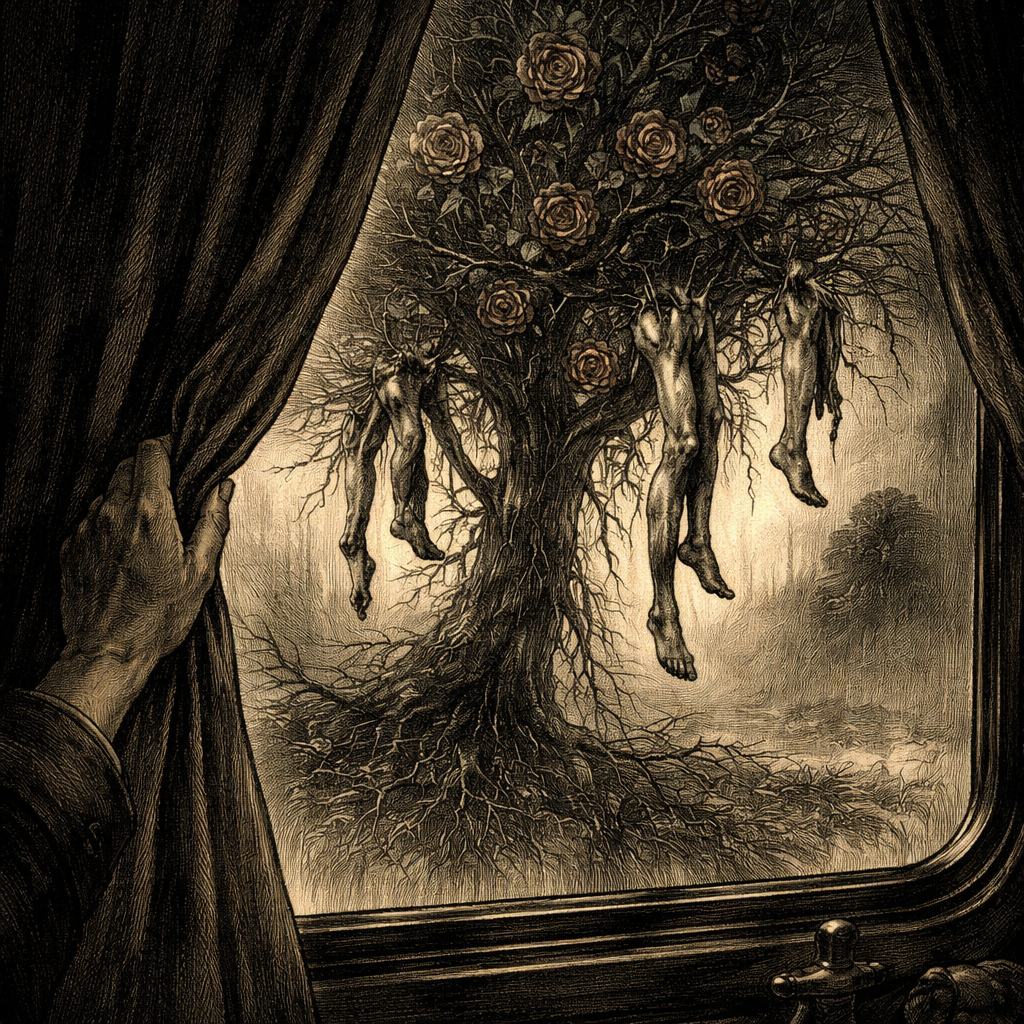
What he glimpsed was fleeting—perhaps no more than a trick of motion—but it lingered with terrible clarity. A rose tree, vast and blooming, its petals rich and red… and threaded through its branches, the unmistakable shapes of severed limbs. Arms and legs, tangled among thorns, their flesh blackened with decay. Beyond it, something moved—something that did not wish to be seen.
He closed the curtain quickly.
The train did not linger. Xura passed like a bad dream half-remembered. Yet as it departed, those with keen eyes noticed something profoundly wrong: the dawn that had seemed to approach simply vanished. Darkness pressed against the windows, absolute and suffocating, until at last—far too suddenly—the light returned, as though nothing had happened at all.
No one spoke of it.
Instead, they climbed.
Per ascended to the upper platforms, seeking explanation. There was none. Behind them lay not a storm, nor a shadow, but a land where night reigned without cause. Ahead, the world resumed its fragile illusion of order. The Dreamlands did not bother with consistency.
Perhaps it never had.
The journey continued, and with it, the quiet work of the mind.
Arthur turned inward, attempting once more to grasp the thing he wished to cast away. The memory came easily—too easily. The choking gas. The dying men. The smell. He tried to shape it, to give it form, but found himself recoiling. To manifest it required more than recollection. It demanded reliving. And that, for now, he could not endure.
Per fared better. His thoughts divided themselves into shapes—small, tangible things. A burning house, frozen in miniature, the suggestion of figures trapped within. A tower, stark and terrible. He held them both, weighing them, as one might weigh sins.
Viola, too, found something within herself. Not a memory, but a condition. The creeping weight of age, the quiet indignity of frailty. She shaped it into a cane—simple, yet deeply personal. It felt right in her hand, and wrong in every other sense.
Henri offered to safeguard these creations. Some accepted. Others did not.
By midday, the train reached Aira.
Here, at last, the world softened. Golden grass stretched across a gentle valley. A breeze carried the scent of something clean, something real. The oppressive tension of the journey lifted, if only slightly.
They disembarked.
The walk was not arduous. Even Walter, cautious as ever, found it agreeable. The waterfall they approached sang with a strange melancholy—a beauty tinged with inevitability. It did not inspire sorrow, but something quieter. A recognition that all things, no matter how perfect, must end.
Arthur felt it and recoiled.
They moved downstream, seeking lighter ground. There, they found it: a place for laughter, for food, for the simple act of being alive. Strange creatures darted through the grass, pursued by playful cats. For a time, the horrors of the journey seemed distant.
They each felt it—the subtle easing of the mind. A small restoration.
It could not last.
The train called them back.
Sona-Nyl rose before them in impossible splendor—golden domes, white walls, gardens too perfect to be real. Yet even here, unease lingered. Henri spoke of what lay ahead: the Gulf of Nodens. The final reckoning. The price that must be paid.
Each of them carried something now.
Each of them would have to choose.
Walter sought answers where he could find them. He pressed Madame Bruja, and though she spoke more than before, her words were not comforting. The Simulacrum he hunted was no mere artifact. It was something older. Something that demanded sacrifice—not in part, but in whole. Her warning was clear: abandon this path.
He did not.
Others offered nothing. The Dreamlands was vast, and its denizens cared little for the concerns of men. Even those who might have known refused him. A single response, delivered in a most unpleasant fashion, amounted to nothing more than a denial.
No.
It was not enough.
As the train prepared to depart, Arthur found himself speaking with Mac. There was a quiet finality to the exchange. Mac would not continue. He would leave the train, pursue his own path, seek something intangible in the lands beyond.
Arthur wished him well.
It felt like a farewell.
Then came the king.
He arrived not as a dream, but as something older—something rooted in legend. Crowned, composed, and radiating a quiet authority that set him apart from all others aboard the train. Even the Sarnathians deferred. Even the beings of Ib emerged to meet him.
King Kuranes.
His presence shifted the air itself. What had been a journey now felt like a trial waiting to unfold.
Henri, ever the master of his domain, stepped aside. This was not his place to rule.
Yet even he was troubled.
He sought Viola in private, confiding a dilemma that weighed heavily upon him. Mironim-Mer had broken the rules. A life had been taken. Justice demanded acknowledgment—but mercy whispered otherwise.
Viola listened, as she always did. She did not offer certainty. Only perspective. The question was not simple. It could not be.
In the end, Henri chose restraint.
He would not bring the matter before the king.
Whether that was wisdom or folly remained to be seen.
The train moved on.
Night approached once more, and with it, the final stretch of the journey. Ahead lay Serenian—and beyond it, the Gulf.
Each passenger now carried their burden.
Each knew, in some quiet corner of their mind, that the time to relinquish it was drawing near.
And somewhere, perhaps not so far behind, something with red eyes watched the train recede into the distance.
Waiting.
Session Notes
-
The session opened with a recap of the immediately preceding events aboard the Dreamlands Express.
- In the aftermath of Mironim-Mer’s transformation and attack on Madam Bruja, the investigators had questioned both Mironim-Mer and Madam Bruja.
- Mironim-Mer appeared to have little or no memory of what had happened, seemed regretful, and—despite not wanting Walter Lake to take his poetry book—ultimately agreed to let Walter keep it until Mironim-Mer left the train.
- The party had attended the second banquet, which had been uncomfortably awkward because one of the guests had murdered one passenger and attacked another, but everyone had attempted to move past it.
- They had watched Henri conduct the “commerce” of the train and learned that he had not imagined the train into being whole cloth, but had built it through negotiations and bargains with strange powers of the Dreamlands.
- The train had reached Thalerion.
- Arthur Zorba had stayed up late to watch over Henri as he conducted business there.
- Henri had explained that Thalerion was a stop where the train only paused to pick up mad dreamers who managed to escape the city, and he had warned the investigators not to leave the train because the city had a way of trapping dreamers who wandered into it.
- During that stop, only one figure had approached the platform: a skeletal, scorched, burned figure in tattered robes with burning red eyes.
- Henri and this figure had a tense exchange.
- The skeletal figure wanted to board the train, but Henri refused, saying that by the rules of the train and the contracts he had signed with Nodens, a passenger could only ride the train once, and that figure had already done so.
- Henri later explained that he had known this person from long ago: a man who had sought power above all else and who, when he rode the train previously, had cast his humanity into the Gulf of Nodens.
- Arthur had noted that the figure’s red eyes were reminiscent of Mironim-Mer’s eyes during his transformation.
-
After the recap, the investigators settled in for the night.
- The train left Thalerion around midnight.
- The night passed without incident.
- The next stop was scheduled for approximately 6:00 a.m., allowing enough time for a full night’s sleep.
- Everyone effectively got a full rest, while Arthur—because he had stayed up later than the others—recovered a little less than the rest, though still enough to refill his available magic.
- The group also refreshed luck at the start of the new in-game day.
-
By around 6:00 a.m., the early risers were awake as the train approached the next stop.
- Suttcliffe was up early.
- Per Oskarson was also awake for the early morning stop.
- Arthur rose a little later, roughly with the sun, and made his way to breakfast.
- Breakfast aboard the Dreamlands Express was described as light and more of a grazing meal than a formal breakfast.
- The train offered pastries, fruit, and even morning champagne.
- Arthur took tea and an interesting pastry.
-
Madam Bruja appeared in the breakfast area.
- Arthur approached her casually as she passed.
- He informed her that he had stayed up late at Thalerion and had seen a strange skeletal man with red eyes—reminiscent of Mironim-Mer during the earlier incident—approach the train and be turned away by Henri.
- Arthur emphasized that her business was her own and that he did not wish to pressure her, but he thought the incident might be related to what had been happening and that she might want to know.
- Madam Bruja looked at him, narrowed her eyes, and through tightly pressed lips thanked him.
- Arthur offered her the pastry he was eating, calling it excellent.
- She deliberately passed over it.
-
The train then reached the land of Xura in the early morning.
- Henri warned the passengers that Xura was not a particularly welcome place for dreamers.
- As the train approached the stop, all of the curtains on the train had been closed.
- The compartments were arranged so that the visible side of the train was away from the stop.
- Passengers could still open curtains in their own compartments, but Henri told them that the scenery of Xura was “not memorable.”
- Scented candles and incense were placed and burned throughout the train in little alcoves.
- These pleasant scents were not enough to fully suppress a stronger odor that permeated the cars: the smell of decay, like rotting flesh.
-
Per could not resist taking a look.
- He peeked through the curtain despite Henri’s warning.
- He succeeded in keeping his composure and did not lose Sanity from what he saw.
- At first glance he thought he saw a large, beautiful blossoming rose tree.
- A closer look revealed that the thorny branches were woven through with severed arms and legs.
- The flesh was clearly putrefying and rotting.
- Beyond that first horrific tree was a lush garden spilling out farther into the landscape.
- Per also thought he saw something moving between the trees beyond.
- He immediately closed the curtain again.
- When he compared it to the strange rosebush the group had previously encountered beneath the manor, the Keeper clarified that this one was different: the earlier one had impossible glowing roses and had seemed ceramic or porcelain in nature, whereas this one was full of unmistakably rotting human flesh.
-
The group also discussed the cats during the stop at Xura.
- The cats mostly kept to their own car near the end of the train.
- Some of them did periodically prowl up and down the train.
- The kitten Black Jack, who had once been a source of fascination, was now mostly just another cat aboard the train.
- Some cats lounged in salon windowsills.
- None of the cats appeared to disembark at Xura.
- Per noted that many cats had boarded the train when the investigators first arrived, but that there had not been a similar influx of cats at each stop since then.
-
As the train remained briefly at Xura, everyone made Spot Hidden checks.
- Those who succeeded noticed a strange temporal anomaly.
- On arriving at Xura, it had seemed as though dawn light was beginning to appear around the edges of the curtains.
- Once the train was fully stopped, however, it was clearly pitch black outside.
- There was no light at all around the curtains.
- After the train departed and Henri reboarded, dawn gradually returned.
- About twenty minutes later, after the train had put some distance between itself and Xura, the light of morning had come back, the curtains were opened again, and the lingering incense was allowed to finish burning so the smell of decay would dissipate.
-
After leaving Xura, Per climbed to the top of one of the train’s smooth, worm-backed cars to investigate the darkness.
- The train rode not on tracks but on giant jelly-worm-like creatures carrying palanquin structures.
- The ride was smooth enough that climbing up was not difficult.
- Looking back toward Xura, Per saw that there was no cloud bank or weather phenomenon behind them.
- The land they had left was simply darkness.
- The sun did not touch it.
- Even though it was clearly morning where the train now was, Xura remained a region of night behind them.
- From the top of the train Per also saw the rugged countryside ahead: steep, rocky land with pine trees and glimpses of the sea on the far side of the train.
- The landscape felt mountainous despite also being coastal.
-
The investigators then spent part of the morning experimenting with Dreaming and trying to prepare for the Gulf of Nodens.
- Arthur continued attempting to practice manifesting the thing he intended to throw away.
- The particular burden he focused on was a memory from the end of the Great War: coming upon members of his regiment choking and dying horribly from mustard gas.
- Arthur tried to imagine this memory taking physical form, perhaps as a particularly strong-smelling yellow candle.
- He made a disastrous Dreaming roll.
- The Keeper ruled that Arthur could not manifest the memory at that time because doing so would require him to truly relive and remember it in detail.
- Arthur felt, instinctively, that he would need to fully inhabit the memory in order to make it real enough to discard.
- He decided not to do that just yet.
-
Per also practiced Dreaming in order to determine what he might eventually choose to discard.
- Unlike Arthur, Per was not certain what he most wished to lose.
- He experimented with two possibilities.
- The first was the attention of the people who had attacked Professor Smith’s house and burned it.
- Per tried to imagine that burden as an object, visualizing a miniature version of the mansion with flames beginning to consume it and only the suggestion of attackers present.
- The second possibility was the monster in the tower at Constantinople that he had once seen ripping people apart.
- For that, he imagined the tower itself as the object.
- Per succeeded at the Dreaming exercise.
- The Keeper allowed him to manifest both objects.
- They appeared as small, carved, toy-like miniatures that could fit easily into a hand or pocket.
- Per kept them on his person as possible candidates for what he might discard later at the Gulf.
-
Walter asked whether the route of the Dreamlands Express mirrored the route of the waking-world Orient Express.
- The answer was no.
- The Dreamlands Express route did not correspond to the terrestrial railway journey.
- Instead, it seemed to run more generally north to south along a coast through the Dreamlands.
-
Walter then approached Madam Bruja directly about his larger quest in the waking world.
- He explained that he was on a kind of pilgrimage or quest to rid the world of the Sedefkar Simulacrum, which had been in the possession of Count Fenalik.
- He asked whether she had ever encountered either the artifact or the count.
- Madam Bruja studied him carefully.
- She noted that he was a man of the cloth and asked whether he was devout.
- Walter answered that he was.
- Madam Bruja replied that she had met many who claimed such devotion, but that when their belief was tested, they faltered.
- She then warned Walter that the simulacrum would test him.
- Walter was immediately struck by the fact that she clearly knew of the artifact.
- When he asked what she knew, she described it as an ancient artifact, powerful, and a tool of the gods.
- She said that some tales claimed it had been unleashed on humanity as a kind of Promethean flame.
- But in her telling, it might have been meant to incite chaos rather than knowledge—or possibly both, because perhaps knowledge itself was chaos.
- Walter asked how he might best destroy such an object and rid the world of its stain.
- Madam Bruja responded with pointed personal questions: whether he loved his family and whether his life was important to him.
- Walter hesitated when thinking of his family, and said instead that he had a stronger bond with God.
- She noticed the hesitation.
- She warned him that his God would be of no aid against the simulacrum if he sought it.
- She said that by the legends, it would cost him greatly.
- Her understanding was that if one were willing to sacrifice everything, the artifact could grant immense power, though she did not know the full nature of that power.
- She concluded by telling Walter that because he was a true believer, the loss of that faith would wound him deeply.
- As a favor to him, she advised him to stop the quest and called it foolish.
- She then turned and left.
- Walter privately reflected that he did not intend to claim the simulacrum’s power at all, but to destroy it, and wondered whether that distinction might matter.
-
The next stop on the journey was Aira, which Henri had described in advance as a good place for a walk.
- Per, enthusiastic about the outdoors, gathered whoever would come for a hike and a picnic.
- Arthur readily agreed to go and explicitly invited Walter, Claire, and Suttcliffe as well.
- Walter agreed to go, though he made it clear he was not interested in strenuous mountain climbing and preferred a flat, easy walk.
- Suttcliffe also preferred an amble rather than a full hike.
- The group asked for a picnic lunch, and on the Dreamlands Express merely expressing the desire was enough to make one appear.
- A well-packed basket with a chilled bottle of wine materialized for them.
-
When the train stopped at Aira, the investigators found themselves at one of the loveliest places yet on the route.
- The platform was made of marble and stood in the middle of an empty valley.
- A cool breeze swept through golden grass.
- Nearby groves of trees shed brilliant red petals that drifted through the air.
- In the distance was a relatively small waterfall.
- Just beyond the platform stood a lone pillar of marble veined with gold, broken halfway up.
- For the first time since boarding the train, the investigators also saw a contingent of cats come bounding down from the rear of the train and spill out into the valley.
- Henri himself disembarked as well.
- The sunlight outside was warm and refreshing, though the breeze remained cool.
-
Henri explained why he came ashore at Aira.
- He said that it was a place of remembrance for him.
- He came there to stand before the broken pillar and think.
- He said the cats simply came there to play.
-
The party made Spot Hidden rolls as they took in the valley.
- Per was mainly preoccupied by the grandeur of the valley itself: the golden grasses, rising hills, and the beautiful multicolored grasses farther up the slopes.
- Those who succeeded in spotting details noticed something odd about one of the other passengers.
- The Russian man, identified in play as Akarov, got off the train and stared out across the valley.
- He shielded his eyes with one hand as he looked.
- Then he suddenly startled, looked sharply in one direction and then another, hunched in on himself, and withdrew back into the train.
- When asked whether there had been anything in the directions he had looked, the answer was no—nothing visible to the investigators.
-
Henri reassured the group that Aira was safe.
- When Per asked whether there were any dangerous local animals or other hazards, Henri said there were none.
- He told them that the place was safe and they could walk freely.
- He also informed them that the train would depart again in two hours and that they should return to the platform by then.
-
Per led the group about thirty minutes in the direction of the waterfall.
- The waterfall could be reached comfortably within the time available.
- Its sound was described as unusual and emotionally affecting.
- Listening to it made the hearers feel wistful.
- It did not exactly produce sadness, but rather the feeling that beauty is fleeting and that pleasant moments inevitably end, and should therefore be enjoyed while they last.
- Arthur admitted that the emotional effect made him uncomfortable, joking that it was making him start to feel emotions.
- To avoid leaning too heavily into that mood, the group moved a little downstream from the falls and chose a picnic spot where the sound was less intense.
-
During the picnic at Aira:
- The group sat and ate their dream-provided lunch.
- At one point they saw several small quick-hopping creatures come darting out of the grass.
- They were mouse-like, but each had a long feathered tail whipping through the air behind it.
- Cats bounded after them through the grass, apparently hunting or chasing them.
- All too soon, the Dreamlands Express gave a deep, bellowing, almost animal-like toot to signal that it would soon depart.
- The investigators packed up their lunch and returned to the platform.
- The stop left them refreshed.
- Everyone gained 1 Sanity from the pleasant outing.
- Arthur described it as one of the best walks he had ever had.
-
The train then continued on toward Sona-Nyl.
- It traveled not on rails but along a trail through the Dreamlands.
- During the journey, the investigators saw a herd of strange hoofed beasts running alongside the train.
- They were large, muscular animals somewhat reminiscent of deer, antelope, or even moose.
- Their antlers were twisted and knotted, like old tree branches made of polished wood.
- The image of them pacing the train was compared to dolphins following a boat.
- As the train approached Sona-Nyl, the scenery became even more fantastic.
- The investigators saw giant gold-domed cities set in pastoral landscapes, quaint pagodas, immense white walls, and perfectly tinted gardens.
-
During this leg of the trip, Henri reminded everyone that the Gulf of Nodens was approaching.
- He explained that after Sona-Nyl there was only one more stop—Serenian—before the train proceeded into the Gulf itself.
- If a passenger did not disembark at Serenian, then that passenger would be committed to riding onward into the Gulf of Nodens and paying Nodens his due.
- Henri stressed that anyone intending to continue should have something ready to discard.
- Per asked whether it would be possible, in theory, to disembark for a short holiday in a place like Sona-Nyl and then re-board later.
- Henri answered sadly that this was not possible.
- The train prolonged a dreamer’s ability to remain in the Dreamlands.
- If one left the train for any extended period, one would wake sooner rather than later.
- In other words, the Dreamlands Express was not a casual hop-off, hop-on line.
- It was also clarified that if someone simply left the train and stayed in the Dreamlands, they would likely wake within four to six hours of Dreamlands time, though perhaps a little longer if especially strong-willed.
-
Walter continued his inquiries into Count Fenalik and the Sedefkar Simulacrum as the train approached Sona-Nyl.
- He first tried Mironim-Mer.
- Mironim-Mer said he did not know exactly what had happened to him earlier, but did not think possession by an evil artifact like the simulacrum matched his experience.
- When Walter described the Sedefkar Simulacrum and Count Fenalik, Mironim-Mer did not recognize either name.
- Walter noted his surprise that Madam Bruja had known of the simulacrum, since few people in the waking world seemed to know of it.
- Mironim-Mer replied that Madam Bruja came from Walter’s world, whereas he came from somewhere else entirely, and that perhaps the object belonged more properly to Walter’s world than to his.
- He smiled and remarked that it sounded as though Walter had found a great mystery, the seed of an incredible tale.
-
Walter then tried asking other passengers.
- He got the distinct impression that the Sarnathians were avoiding him.
- When he went near them, especially in the bath, they seemed acutely aware of his presence and immediately launched into overt physical pleasures rather than conversing, clearly not for his benefit but to dismiss him and make conversation impossible.
- Walter continued trying regardless.
- Eventually Besweet called out to him and said that she knew he was obsessed with her, that it simply was not going to work, and that his friends were terrible.
- That was the closest Walter got to an answer from the Sarnathians.
-
Walter then considered contacting the beings of Ib.
- Because their smell was so overpowering, he wondered how he might even communicate with them without being sickened.
- Henri explained that the beings of Ib were busy preparing for an important meeting with a dignitary who would board at Sona-Nyl.
- They had sequestered themselves in their compartment and did not seem eager to receive guests.
- Henri offered to deliver a letter if Walter wanted to send one.
- Walter wrote a note describing the Sedefkar Simulacrum and Count Fenalik, calling it a shot in the dark and asking whether either name meant anything to them.
- He also wished them luck in their meeting.
-
Henri later returned with a response from the beings of Ib.
- He carried a tray with a covered dish under a cloche.
- When he removed the lid, there was a folded piece of slimy paper on the plate.
- Henri explained, in full seriousness, that the beings of Ib did not know how to write in English and had asked him to write the response for them, but insisted that the letter bear their mark.
- He also told Walter that he did not actually need to open it.
- The answer was simply, “No.”
- When the cloche was lifted, the note immediately released the same revolting fermented smell associated with the beings of Ib.
- Henri promptly closed the dish and took it away again.
-
Walter also asked Henri more directly about how to wake up before reaching the Gulf if he chose not to continue.
- Henri explained that a passenger could simply will himself awake if he had sufficient determination.
- Death would also end the dream, though Henri made clear that this was not the advised method.
- Alternatively, leaving the train would also lead to waking after a matter of hours.
- Walter resolved that when the party reached Serenian, he would try to wake himself by sheer will.
- If that failed, he would disembark there rather than continue into the Gulf.
-
As the deadline approached, Arthur tried again to manifest the burden he intended to discard.
- He returned to the mustard gas memory from the war.
- This time his Dreaming attempt went much better.
- The Keeper described it as though this memory almost wanted to be made manifest once Arthur allowed himself to truly feel it.
- Arthur successfully created a physical representation of the memory at the cost of 1 magic point.
-
Suttcliffe also considered what she might discard.
- She decided that if she could rid herself of anything, it would be her decrepitude—her frailty and the burden of age.
- She made a successful Dreaming roll.
- The thing took the form of a deeply personal object associated with age and weakness, discussed in play as likely a cane.
- The Keeper emphasized that, like the others, she felt a deep personal connection to what she had manifested.
-
Once multiple investigators had manifested candidate burdens for the Gulf of Nodens, Henri noticed.
- He offered to take these precious objects into safekeeping in the locked baggage car.
- He said it would not do for anyone to lose such an item before reaching the Gulf.
- He did not press the matter if anyone preferred to keep their item.
- Arthur chose not to hand his over and kept it on his person.
-
At Sona-Nyl, the train was met by a formal delegation.
- On the platform stood strong men and women in armor carrying great banners.
- They sat on mighty, almost glowing white steeds.
- At their head was a more imposing rider on an even grander horse.
- This man wore a circlet crown.
- He had auburn hair falling in curls to his shoulders.
- Henri disembarked to greet him.
- The Sarnathians and one of the beings of Ib, carrying the squeaker, also emerged from the train to meet him.
- There was a formal greeting and exchange.
- The crowned man dismounted before the introductions, showing notable courtesy and bearing.
- Then he and two mounted, armored companions—effectively knights—boarded the train.
-
Henri remained briefly on the platform to conduct trade.
-
He exchanged for or acquired various luxurious Dreamlands goods:
- little red singing birds in golden cages,
- finely carved pieces of jade,
- and gold spun into thread.
-
Arthur asked whether the crowned man resembled any iconic or legendary figure from lore.
-
The description and bearing strongly suggested an Arthurian king.
-
The man was clearly not a Sarnathian and projected wisdom, authority, and self-control in a way the Sarnathians did not.
-
Once this delegation had boarded, Henri informed the passengers of a change to the evening schedule.
- The third and final banquet of the journey would still occur, but later than usual.
- The dining car was being used for diplomatic negotiations.
-
Before the train fully departed Sona-Nyl, Mac sought Arthur out for a private farewell.
- Mac said it had been a pleasure speaking with Arthur on the trip, but that this was where he would depart “this time.”
- Arthur said it had been excellent speaking with him as well and hoped perhaps they might see one another again when they woke.
- Mac asked whether Arthur was continuing all the way to the end.
- Arthur said that he was.
- Arthur then asked whether Mac had found anything he wished to free himself of.
- Mac did not answer directly.
- He squeezed the briefcase he had been carrying and admitted that he did not know what it was.
- Instead, he said that he had heard there was lovely poetry to be learned there and thought perhaps he might give that a try.
- He wished Arthur luck and hoped that Arthur’s active military days were behind him.
- Arthur answered that the Great War had been the final war and that there would surely be no more after it.
- The two men parted on friendly terms.
- Mac gave Arthur a pat on the shoulder, Arthur gave him a hearty handshake, and Mac stepped off the train at Sona-Nyl.
-
Walter then raised a practical question about Mironim-Mer.
- Walter still had Mironim-Mer’s book of poetry and wanted to know whether Mironim-Mer would be riding to the end or getting off before the Gulf.
- The answer given during play was that Mironim-Mer would likely get off at Serenian, which would allow Walter to return the book to him there.
-
Before the train moved on, Henri sought out Suttcliffe privately for advice.
- He told her that he had known her when he was alive and that she seemed possessed of wisdom and compassion.
- He said he wished to draw on that wisdom.
- Henri explained that the newly arrived King Kuranes was known for his devotion to justice and fairness.
- He admitted that it had not sat right with him that Mironim-Mer had broken the rules of the train and killed one of his passengers.
- Henri said he did not want to be seen as condoning such behavior.
- At the same time, Mironim-Mer was his friend, and Henri did not know whether this strange crime warranted a life for a life.
- He was undecided and asked Suttcliffe what she would do.
-
Suttcliffe thought the matter through carefully.
- She suggested that if it were possible, she would first seek a private audience with the king and lay out the matter hypothetically before naming the person involved.
- She reasoned that, because Mironim-Mer seemed to have been possessed or overtaken by something during the killing, the question of guilt was complicated.
- She explicitly asked whether it had really been Mironim-Mer who had done the killing, or the “other thing.”
- Henri agreed that these were excellent questions and likely exactly the sort of questions the king would ask.
- He also admitted that he doubted the king would offer a judgment before hearing the case fully laid out.
- Henri then asked Suttcliffe whether she herself would find it acceptable and just if Mironim-Mer suffered no punishment at all.
- Suttcliffe answered honestly that she had been inclined to think of Mironim-Mer as innocent, or at least not fully responsible, because he claimed to remember nothing and because he had taken on such a frightful form during the incident.
- She admitted she did not know whether that was the correct interpretation, only that it was how she had felt.
-
Henri revealed the heart of his conflict.
- He said that, if he was honest, he felt much the same way.
- He believed Mironim-Mer when Mironim-Mer said he had not been in control.
- Henri realized that part of his desire for punishment came from personal pride and protectiveness.
- The Dreamlands Express was the work of his lifetime.
- Mironim-Mer’s act had felt like a desecration or disrespect to the train itself, and that had affected Henri deeply.
- But once he acknowledged that pride to himself, he found that he did not truly believe Mironim-Mer had acted with intent.
- Henri concluded that he would not bring the matter before the king’s court.
-
Henri thanked Suttcliffe for her counsel.
- Suttcliffe agreed that life—and dreams—could be complicated.
- Henri said he had already imposed on her too much.
- As a token of thanks, he promised that in the kitchen they had made something only imaginable while passing through Sona-Nyl.
- He said he would bring her an “impossible petit four.”