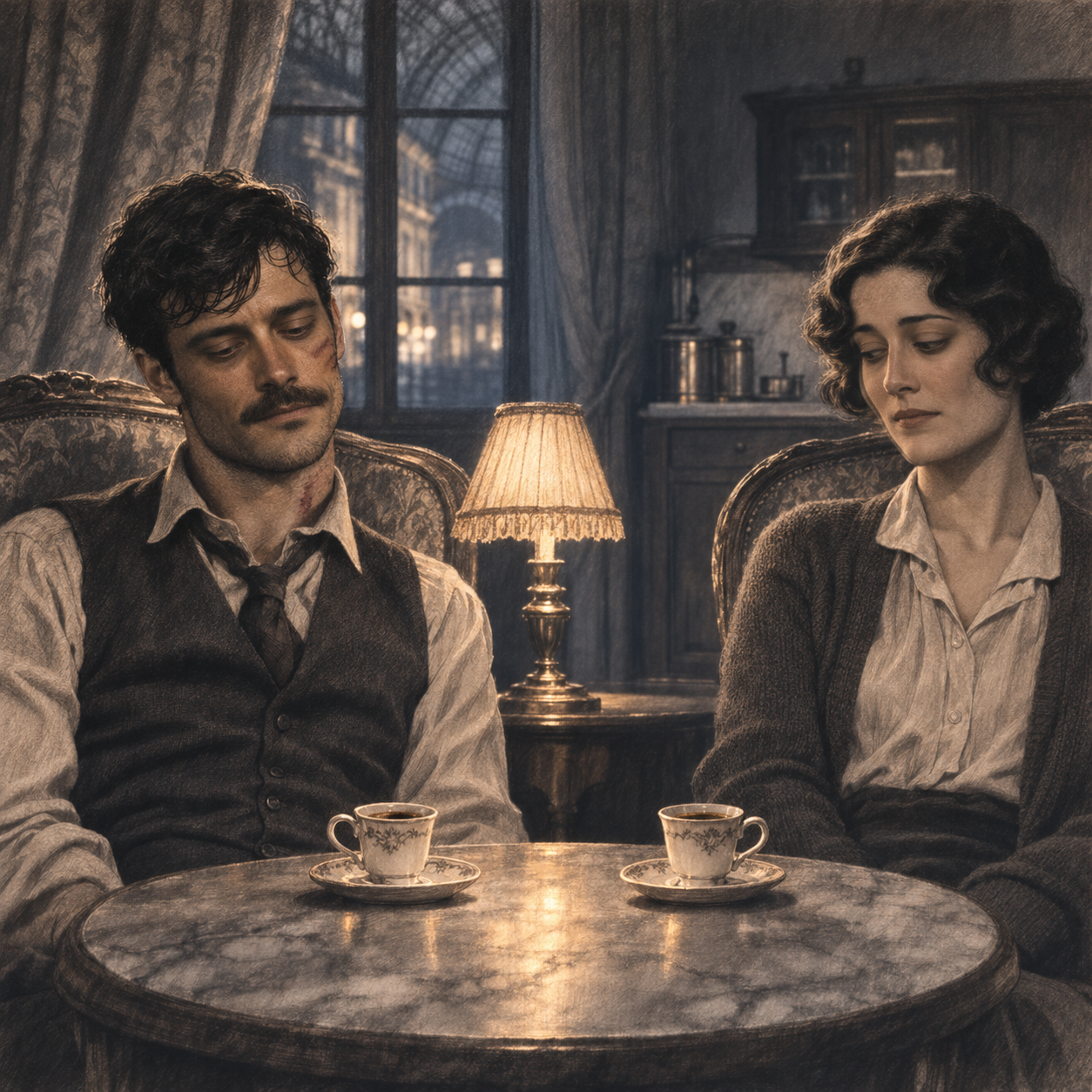
The coffee cup chattered against its saucer before Isabel got it down.
Claire watched the tremor cross the dark surface and settle. Her own left arm lay against her ribs, wrapped and stitched beneath the sleeve. So long as she kept it still, it was merely a presence. Then she forgot and reached for something, and the pain made the rest of the room briefly unimportant.
They had reached the hotel without anyone, so far as she could tell, noticing the blood. Coats and scarves and darkness had done that, together with Arthur’s instinct for alleys. Now, in the rooms above the Galleria, they had chairs, coffee, and leisure to consider how thoroughly they had complicated the disappearance of Caterina Cavallaro.
Viola’s wound was still troubling her. Arthur’s stitches had not done what he hoped, and there was no sensible prospect of her going out again tonight. Claire suspected that sensible prospects ought to exclude her too. She shifted her arm and said nothing.
Arthur looked across at Walter.
“Did you learn anything from that strange old man? We were getting the car started when most of it happened.”
“I have new information,” Walter said, with a distinction Claire felt the evening had earned. “I’m not sure I’d call it learning anything.”
He tried to give an account of Conti’s blasphemies: the abandonment of God, the other faith acquired in its place, the brother of the skin who could not die. Some of the words had tangled in his memory. The essential ugliness had survived intact.
“We found no sign of her in the car or the garage,” Arthur said. “If he had her, she wasn’t there.”
“He could have dropped her anywhere,” Walter said. “We don’t know where.”
They had followed a promising lead into a man’s house and come away with his keys, his pistol, and two wounds between them. Cavallaro was no nearer being found. Conti might be dying. Somewhere in Milan the police had a wrecked Alfa Romeo to examine at their leisure.
Per had been listening with his head a little lowered. At the mention of the skin he looked up, then past them, as if the thing he wanted were somewhere outside the room.
“I have heard that before.”
Claire waited. Per’s knowledge usually arrived with footnotes: where he had read it, what he doubted about it. Tonight he looked less pleased than usual to be remembering.
“Constantinople,” he said. “During the affair of the blood-red fez. Professor Demir mentioned the Brothers of the Skin.”
Claire looked from Per to Viola. Nearly thirty years lay behind that recollection, years written plainly in his face and scarcely at all in hers.
“They were an occult group,” Per went on. “Operating there. Demir did not think they were connected with his child’s disappearance, or that they would be of any help to us.” He paused. “There was another reason he advised us to leave them alone.”
Arthur waited, visibly restraining his impatience.
“They had some quarrel with Professor Smith. That was why Smith did not want to return to Constantinople.”
The hotel room seemed, for a moment, uncomfortably small. Claire had grown up around Smith’s compound; his name belonged among familiar rooms and remembered voices. To hear it here, fastened to Conti’s ravings and an old enmity in a distant city, gave her the unpleasant sense of a door opening somewhere behind her.
“What sort of quarrel?” she asked.
“I don’t know. That is very nearly the whole of what I know about them.”
“We could wire Demir,” Arthur said.
“Yes. We could ask whether he has anything useful to tell us.”
Arthur leaned back. “Which brings us to the next question. It’s late. We’ve fled from the police. We’re conspicuously foreign. Do we stay in Milan?”
There was still the antiquity. They had paid an antique dealer a considerable sum to trace it, and abandoning that now would leave another piece of their journey unfinished. Walter favoured staying to see what the dealer produced.
“Conti may not want the authorities too closely involved himself,” Claire said. “If he’s engaged in something he’d rather they didn’t see.” She examined this comfort and found it thin. “On the other hand, we did assault him and steal his car. We aren’t going to be terribly difficult to find.”
“That’s why I’m not wearing that hat anymore,” Walter said.
Arthur regarded him gravely.
“Excellent. I think that will do it.”
Something in Claire’s chest eased. The hat had been distinctive; retiring it was a genuine precaution. It was also a magnificently inadequate answer to the whole of their predicament, and for a few seconds they could enjoy both facts at once.
“Perhaps we should at least agree where we were this evening,” she said. “After the motor dealership. We were seen asking questions there.”
“We came back here,” Per suggested. “You were so disappointed at not being allowed to drive one of those fine motorcars that you felt obliged to retire.”
Claire looked down at her bandaged arm. The evening had supplied a rather cruel answer to that disappointment.
Isabel moved between the little kitchenette and their chairs, finding tasks for her hands. Arthur took his coffee and asked whether anything Conti had said meant more to her than it had to them. Perhaps there had been a local expression, or some hint of where he might have taken Cavallaro.
“No, signor. Nothing.” Her eyes went to Walter. “He said strange things. He did not seem a well man. And what he said about God…”
She shuddered. Claire had seen frightened animals go on with familiar movements long after the movements had stopped serving any purpose. There was something of that in the careful arrangement of cups, the effort to make their dreadful evening hospitable.
“I’m sorry we brought you into this,” Claire said. “And we’re grateful. We’d have got very little done without you.”
Isabel’s hand closed around her cup.
“This isn’t our first encounter with something strange,” Claire went on. “That doesn’t mean you ought to find it easy. If you need to step away, we’ll understand.”
The cup trembled against the saucer again. Isabel took a breath, lifted it clear, and drank.
“Signora Cavallaro is not just my employer. She is my very good friend.” Her voice steadied once that was said. “This Conti knows something. Perhaps he has done something to her. I can’t walk away. But I don’t know what to do.”
Neither did Claire. She resisted the urge to answer too quickly.
“I would say we should go to the police,” Isabel said. “But the police do nothing now. Not to a man like Conti.” She looked round at them. “You say you have met men like him before. What does that mean?”
Claire tried to explain without offering either a catalogue of horrors or a claim to mastery they could not back. There were strange things in the world, and they had met some of them. None of it made Conti’s words less disturbing or gave them a reliable way to find her friend.
Per set down his coffee.
“I have made something of a personal mission of helping people confronted by such things,” he said. “Although on this journey I have met rather more of them than I am certain I can handle.”
Claire was grateful for the admission. Isabel deserved better than confidence manufactured for her benefit.
“But when we discover horrors we did not know existed,” Per continued, “it helps to remember that there may also be wonders we have not yet discovered. A world full of mysteries need not be only a thing to fear.”
His glance travelled over the rest of them, taking in their bandages and the cups balanced in tired hands.
“And we are together. Friends who take care of us, as you take care of Signora Cavallaro, can help us through very dark times.”
Isabel heard him out. When she answered, the uncertainty was still there, but she had stopped apologising for it.
“I want to continue. I just don’t know what to do.” Then she looked up. “Perhaps someone at La Scala knows more. They have telephoned the apartment. They are looking for her too.”
Arthur pointed out the hour.
“So close to the opening, there will be people there very late.”
At least there were people they could speak to. Claire felt a modest relief at having somewhere to go.
Isabel still wanted to know whether there was any way to make Conti talk. They considered it, but the man they had left under blankets was unlikely to be answering questions tonight. He might already be in hospital. They did not know whether he had survived.
His papers, though, might answer for him. Arthur and Claire had seen his office upstairs. An appointment book, correspondence, private notes: a man might keep all manner of useful things in such a room. They had not had time to search it properly.
“Return to the scene of the crime,” Claire said.
“We have an Italian dictionary,” Arthur offered.
“And his pistol.”
There were ways to make that last possession sound almost respectable. Returning lost property, for instance. Claire doubted any of them would survive examination.
“La Scala first,” Per proposed. “And then, when it is properly the dead of night, we go back.”
The plan received a degree of approval which, under other circumstances, Claire might have found worrying.
Viola would stay at the hotel and rest. The others gathered themselves, settled coats over their injuries, and prepared to go out once more. Claire had to work her left sleeve into place with great care. Isabel waited beside her, ready to help, and Claire let her.
The main entrance of La Scala was dark. Per stood before its shut doors with the uncomfortable awareness that nearly every sensible person in Milan had finished the day’s business.
Along the flank of the building an alley ran towards a lamp above a second entrance. They followed it to an old green door, and Walter knocked.
The man who opened it was heavyset, middle-aged, and armed with a cigar. His expression suggested he had been expecting somebody useful. One hand stayed firmly on the door.
He spoke in Italian. Isabel translated, though Per felt the sense had already been adequately conveyed.
“What do you want?”
Walter explained that they were trying to help find Cavallaro. The cigar travelled from one side of the man’s mouth to the other.
“She isn’t here.”
“We hoped to speak to people who knew her,” Walter said. “People who might have seen her.”
“Are they expecting you?”
“No, unfortunately.”
The grip on the door did not loosen. Behind him Per could hear people still at work, preparing for a performance whose central figure had vanished.
“We have uncovered some information,” Per said. “But we need help understanding it. Those who know her may be able to give that help.”
Isabel translated. The doorkeeper objected. She answered him, then turned back for more.
“If you care about her safety,” Per continued, “I am sure you understand why we have come. And why a delay might matter.”
He disliked pressing a stranger with responsibility for a danger none of them could measure. He did it anyway. Cavallaro had been missing long enough for polite deferral to have become intolerable.
“You would not wish to be the man who kept us from someone who could help her.”
Fingers drummed on the doorframe. After another exchange with Isabel and a final shift of the cigar, he stepped aside. They were to find the stage manager, Paolo Visconti. They were to keep out of trouble. Above all, they were to keep out of the way.
Backstage, keeping out of the way took attention. People were fitting costumes, touching up paint, carrying objects whose purpose Per could not immediately determine. The air smelled of cloth, tobacco, and fresh work. It was nearly eleven, and some tasks were plainly winding down, but nobody could put off tomorrow’s demands.
Several pharaohs were playing cards and smoking cigars.
Per found the sight unexpectedly steadying. There were men in Milan whose principal concern at this hour was their hand of cards, even if they happened to be dressed as the rulers of ancient Egypt.
Isabel knew only a few faces here. Rather than question whoever stood nearest, they followed the doorkeeper’s instructions, and a few inquiries brought them to a workshop where Visconti was conferring with the props master.
He looked up with the face of a man presented with one more task. Then Isabel introduced them, and he set down his ledger, dusted his hands, and greeted each of them properly.
“You speak English?” he asked.
“We do,” Per said.
“Oh, thank God,” Walter murmured.
Visconti had enough of the language for direct questions. They were looking for Caterina and had information. What was it?
Walter began with her departure from the station in a motorcar. Visconti made an impatient gesture; that much had been in the papers, and the police had told him the same. Then Walter said the name Flavio Conti, and the gesture stopped.
“That I have not heard.”
He knew Conti as a patron of the opera. They had met at a party earlier in the week. Nothing he knew of would explain Conti personally collecting Cavallaro from the station.
“Was he a friend of hers?” Walter asked.
“The patrons and the performers socialise. I don’t know of any particular friendship.”
Claire asked what impression Conti had made at the party.
“He seemed in very good spirits,” Visconti said. “He drank and smoked a great deal for a man I had heard was dying of tuberculosis.”
Per watched his companions take this in. Conti’s body had looked frail enough, but his voice, when he shouted, had carried an energy at odds with it. Here was another account of that improbable vigour. Per remembered the incision in his chest and his declarations of a different faith.
He could not yet see how these things fitted together. He had spent enough years collecting oddities to distrust the satisfaction of a pattern formed too soon.
“Would his position have made her willing to accept an unexpected invitation?” he asked. “Simply because he was an important patron?”
Visconti thought it entirely plausible. A celebrated soprano had obligations to the people who kept the opera alive. Within reason, she made time for them. If a wealthy, well-connected man offered to drive her to La Scala, a journey of perhaps fifteen minutes, that was no great imposition.
“But what do you think he could have done with her?”
“Clearly,” Walter said, “he didn’t drop her off here.”
“No. She never arrived.”
There was no uncertainty in it. Per remembered her laughing in the railway carriage. They could trace her as far as the station and the motorcar, and then they knew nothing.
Visconti knew Conti only slightly. The secretary who dealt with the patrons knew him better and might still be upstairs. He offered to take them to her.
Per thanked him, then ventured a delicate request. Conti was well connected. If anyone in authority came asking about them, a certain restraint in the answers would be appreciated.
Visconti made a noncommittal sound. It was, Per acknowledged privately, a substantial favour to ask of a man they had known for a quarter of an hour.
On the stairs, out of earshot of the workers below, Visconti turned the questioning round.
“What exactly is your connection with Caterina? Isabel says you are friends. I do not know all her friends, of course. But you seem…”
“Outside her usual circle?” Per supplied.
Walter explained that they had met on the train. Visconti waited.
“The Orient Express,” Per said. “We had the pleasure of her company a few days ago. She was in excellent spirits, very sociable. Our friend Reverend Lake seemed to get on particularly well with her.”
“Don’t undersell yourself,” Arthur said. “You sang together.”
Per could not keep the smile off his face.
“I did have the unparalleled pleasure of singing a drinking song or two with a famous diva. In Swedish. It is a memory I expect to keep.”
“Ah.” Visconti nodded. “I understand. Caterina has this effect on men.”
The explanation seemed to satisfy him, and Per let it stand. There was little point trying to describe how quickly a stranger could become a friend on a journey, or how wrong it felt to hear that such a person had simply vanished while the world went on making arrangements for her return.
A woman answered Visconti’s knock from behind a glass door lettered with her name and office. Inside, empty espresso cups stood beside columns of figures. Elena Vasecki removed her spectacles, rose, and smoothed her skirt while the stage manager explained them.
Anyone who could bring word of their missing diva was welcome, she told them. Per wondered how often she had already let herself hope that.
Walter introduced himself, and she acknowledged the collar with “Father.” Then came the familiar questions: how they knew Cavallaro, what they had learned, why they believed Conti was involved. Per answered with care. Their confidence that she had left the station with him was a good deal greater than their knowledge of what had happened afterwards.
Vasecki confirmed that Conti had supported the opera for years. He owned machine-parts factories in Milan. He was wealthy, influential, and well connected with the local Fascists.
Of any special relationship between him and Cavallaro she knew nothing. They had met at opera functions, as one would expect. For several years, however, his illness had kept him away altogether. The party earlier that week had been his return.
“Did he seem particularly interested in any of the performers?” Claire asked.
He had praised Cavallaro’s talent in the past, Vasecki said, but had never seemed intent on seeking her out. His collecting her from the station was hard to account for.
“I don’t know what would possess him to do that.”
The phrase went through Per with a small unpleasant resonance. He left it where it lay.
Vasecki crossed to a side table stacked with newspapers. The party had been covered in the society pages; perhaps the account would jog her memory.
They waited while she turned the sheets. The ordinary rustle of paper was welcome after so much speculation. Per looked at the figures on her desk, the patient arithmetic by which singers, scenery, carpenters, and candlelight became an evening at the opera. Some of the money that made all this possible came from men who could frighten their own employees into silence and expect deference from the police.
“Oh,” Vasecki said.
She had stopped at a photograph. She looked at it a second time before turning the page towards them.
“Conti was very friendly with Signor Faccia. I did not know they knew one another.”
Arturo Faccia was another patron. Per fixed the name in memory while Walter returned to the matter of Conti’s health. Had he appeared recovered? Completely recovered?
“He was energetic. He drank a great deal of champagne. He danced.” Vasecki gave a small shake of the head. “Everything I had heard suggested his illness was very advanced.”
So advanced, she said, that she would have been surprised to learn he had lived to see Christmas. Yet there he had been at the party, lively, in apparently remarkable health.
Per thought of the pale, wasted figure in the house. A man could carry the marks of an illness after recovering from it. That reasonable observation did nothing to make the rest of Conti’s conduct reasonable.
“Have you heard of anyone else making a similar recovery?” he asked. “Among the patrons, perhaps? Someone ill for a long time who suddenly became well?”
“No. I can’t say that I have.”
If anything, she said, Milan had acquired a reputation for a general malaise. People spoke of its spirit being quenched. She did not mean a plague, or even physical sickness in the sense he was asking about. An ailment of the heart, perhaps.
Per had no grounds to make evidence of that. Cities could be unhappy for a great many ordinary reasons, and some of Milan’s were already becoming familiar to him.
“And Signor Faccia?” he asked.
She was more careful now. He could hear the pauses between the useful facts. Faccia was extremely wealthy, more successful even than Conti. He owned several factories on the outskirts of Milan and had business interests abroad. He was also among La Scala’s most devoted patrons. He loved the opera.
Nothing in that set him apart from any number of prosperous men whose names might appear in a society column. Per waited, declining to fill the silence for her.
“There was something,” she said at last. “Conti did not ask me about Signora Cavallaro at the party. But Faccia did.”
“What did he ask?”
“Whether she was there. He was very keen to know.”
Cavallaro had been in Paris. Vasecki had told him so, and he had seemed frustrated by her absence.
“At the time, I thought he wanted to speak with her about the performance.”
It remained a possible explanation. Per considered it alongside Faccia’s unexpected friendliness with Conti and his interest in Cavallaro. With Conti’s extraordinary recovery and the missing hours after the station, they had plenty to ask about, but still no answers.
Walter asked whether some other social connection bound the people involved. None that Vasecki knew of. Most of the patrons moved in the same wealthy circles: industrialists, their families, people whose fortunes were older. She could not produce a hidden relationship merely because they needed one.
“What do people here think has happened to her?” Per asked.
The answer was painfully ordinary. The hopeful theory was that Cavallaro had gone off with a lover. Some expected her to appear the following day, just before the performance, ready to sing and scarcely aware of the trouble she had caused.
Per wanted to believe it. He could picture the entrance easily: exasperation dissolving into relief, the story of the adventure improving with every retelling. Against that picture stood Isabel’s trembling cup, and Conti with a revolver in his hand.
Vasecki did not wholly accept their suspicions. She asked again what made them so certain about the motorcar and its owner. Yet she was willing to help, if their inquiries might bring Cavallaro back before the curtain rose. Per could not fault her caution. They had arrived late at night with a troubling story about a man on whose generosity her institution depended.
When they had exhausted what she knew, she offered them the newspaper.
“If you approach any of these men, please don’t mention our conversation. Say you found their names here.”
“Of course,” Per said. “We shall be discreet.”
He could feel Arthur somewhere at his shoulder and hoped nobody was dwelling on the evening’s evidence for that claim.
“And if you have an opportunity to return the kindness,” he added, “we would be grateful.”
Vasecki looked at them over the paper.
“This is not a conversation I would ordinarily have. But you are looking for her. You seem determined.” A pause. “I hope you find her.”
Per took the newspaper. At least they would leave with a name they had not possessed when they walked in.
By the time they left it was nearly midnight. Walter felt the hour less as sleepiness than as a growing difficulty in judging which of their proposed actions was the least unreasonable.
They could seek out Faccia. They could cable Demir, though the thought of passing an inquiry about the Brothers of the Skin through a chain of telegraph operators called for care with the wording. Neither had yet been done. For the moment, they meant to go back to Conti’s house.
Hours had passed since the police arrived. Conti might be in hospital, or somewhere worse. They could hope the house had emptied, but they had no way of knowing. His butler seemed to live there; Arthur and Claire had seen his room upstairs. He might still be on the premises even if his employer had been carried off.
Arthur brought out the keys he had kept. Among those for the car and the garage was one for the house.
“So,” Walter said, “we can at least get in.”
“Entering,” Arthur said. “No breaking.”
The distinction was unlikely to impress a magistrate. Walter nonetheless found it comforting that one part of the plan could be accomplished without violence to either a person or a door.
Outside La Scala the departing staff were gathering along the pavement, and cabs rolled up to collect them. After the crowded passages backstage the night air bit, and Walter turned up his collar, conscious of the absence of his old hat. They needed a cab to take them near Conti’s residence. A long walk held little appeal, least of all for Claire.
He was watching an approaching vehicle when the singing began.
The voice was clear and full, carrying between the buildings with a power that turned him round before he had consciously recognised it.
Caterina.
People stopped around him. A conversation broke off mid-word. Someone farther along the pavement stepped away from the others and looked down the street.
Walter knew the aria. She had sung it for them on the train: “Ritorna vincitor,” from Aida. He knew this rendition, the way her voice shaped the phrase. For an instant the railway carriage came back to him so forcefully that he could almost feel its motion under his feet. Then he was standing outside an opera house, trying to find her.
The sound seemed to come from one direction until he turned towards it. Thrown between the buildings, it filled another opening, another stretch of street. Members of the company began to spread out, peering round corners, searching the shadows beside the entrances. Walter watched for a face, a lifted hand, someone stepping into the light with an explanation ready.
The singing lasted ten seconds, perhaps fifteen. It faded before he could decide where to go.
No woman emerged from the alley, and no one on the pavement called out that they had seen her. Beside him, Arthur still held Conti’s keys. Walter stood with the others outside La Scala, listening to the street where Caterina’s voice had been.
Galleria suites: injuries and the decision to stay The investigators regrouped in their Galleria suites after the encounter at Conti’s house and the Alfa Romeo crash. Their injuries carried over from the earlier events: Claire still had a stitched gash in her left arm and a major wound, while Viola’s injured arm had not benefited adequately from the earlier stitching. The others had received some benefit from first aid, but nobody received additional treatment or healing during this evening’s inquiries. Cavallaro remained missing, and the search of the car and house had not revealed where she had gone. Arthur asked Walter what Conti had said while Arthur and Claire were occupied with preparing the car. Walter described his statements as blasphemous and regarded him as beyond saving. The significant expression they returned to was Conti’s reference to being a brother of the skin. Walter wondered whether Conti might have dropped Cavallaro somewhere else, perhaps in connection with his strange beliefs. This was speculation, but the expression gave them something more specific to investigate. The expression stirred a memory for Per. A successful Occult check, made with a bonus die, brought back Professor Demir’s mention of the Brothers of the Skin during the Blood Red Fez affair in Constantinople, almost thirty years earlier. Demir had included them among the city’s occult groups but had considered them unrelated to his child’s disappearance and unlikely to offer useful help. Per’s successful use of Occult qualified for a later skill-development check; no development roll took place this session. Per also recovered the reason Demir had discouraged approaching the group: the Brothers of the Skin had some kind of hostility toward Professor Smith. That hostility had been one reason Smith did not want to return to Constantinople. The recollection gave Conti’s expression a historical connection and suggested Demir as someone who might know more. The Brothers’ practices, their present activities, and Conti’s possible connection to them remained unknown. Per proposed sending Demir a telegram. Arthur raised the larger question of whether remaining in Milan was sensible after the assault, the stolen car, and their flight from approaching police. Walter favored staying while the antiquities dealer pursued the inquiry for which they had already paid. Claire suggested that Conti might have reasons of his own to avoid official scrutiny, although she acknowledged that their conduct had left them exposed and that they could be found. The group chose to remain in Milan and continue looking for Cavallaro while awaiting the antiquities inquiry’s results. They discussed reducing their chances of recognition and agreeing on an account of their movements. Walter reaffirmed that he would stop wearing his distinctive hat. Claire proposed saying that they had returned to the hotel after visiting the dealership; Per added that she could have retired in disappointment at not getting to drive one of the fine cars. Darkness, alleys, coats, and scarves had probably helped conceal their bloodied condition on the earlier return to the suites. Their proposed account remained untested by any encounter with the authorities. Isabel prepared small espressos in the kitchenette while the discussion continued. Arthur asked whether her understanding of Italian or local idiom had revealed anything in Conti’s speech that the others might have missed. She could offer no additional clue. Conti had seemed unwell to her, and what he had said about God had disturbed her. Her ability to interpret had helped them communicate, but she had no further explanation of his words or Cavallaro’s destination. Claire apologized for drawing Isabel into the danger, thanked her for her help with the language, and offered her the chance to withdraw. Isabel’s cup rattled against its saucer as her hands trembled. She explained that Cavallaro was a very good friend as well as her employer. She suspected that Conti knew something, or might have harmed the singer, and believed that the police would do nothing against a man like him. Per acknowledged that the journey had exposed him to more than he felt able to handle, then urged Isabel to remember that unexplored wonders existed alongside the horrors they had encountered. Friends could help one another face what frightened them. Isabel chose to continue: “I don’t want… I can’t walk away. I want to continue to help.” She suggested La Scala as their next destination. Its staff had called Cavallaro’s apartment, and preparations for the opening meant people were likely to be working late, even though Isabel herself did not know the stagehands well. Conti’s office became a second objective. Arthur and Claire had seen it upstairs during the earlier search, and personal papers or an appointment book might offer information that questioning Conti had failed to produce. His condition and whereabouts were unknown, and he might be unavailable for another confrontation that evening. Per proposed visiting La Scala first, then returning to the residence in the dead of night to search the office. Viola stayed in the suites to rest her injured arm. Conti’s loaded .38 revolver remained in her established custody; no transfer to the departing investigators took place. Claire confirmed that she had 6 HP and the continuing major wound to her left arm. She could still accompany the others without a general penalty, although strenuous use of that arm could prove more difficult and a collapse to zero HP would be especially dangerous. Arthur, Claire, Walter, Per, and Isabel left for La Scala. Viola remained behind and did not witness the subsequent interviews or street encounter. La Scala stage door: gaining admission La Scala’s public entrance and box office were closed when the group arrived. A light near the rear of the building drew them down a side alley to a heavy green-painted stage door. Isabel warned that she was not well acquainted with the stagehands, although someone might recognize her as Cavallaro’s maid. A heavyset, middle-aged man with a cigar answered the door. He appeared to have expected somebody else and challenged the visitors in Italian, leaving Isabel to translate their explanation. Walter explained that they were searching for Cavallaro and wanted to speak with people who knew her. He stressed the urgency of finding useful information: “The longer the case goes unsolved, the colder it gets.” The keeper remained skeptical and asked whether anyone was expecting them. Per pressed the point that they already had information but needed help connecting it, and that obstructing their inquiry might prevent them from finding Cavallaro before it was too late. His successful Persuade check won them admission. The keeper could not leave his post, but directed them to stage manager Paolo Visconti and instructed them to stay out of everyone’s way. It was around eleven o’clock, and backstage preparations were still underway despite signs that the night’s work was winding down. Costumes were being fitted, props handled, and scenery painted; performers dressed as pharaohs were relaxing over cards and cigars. Isabel asked workers for directions and led the party through this activity to a small workshop where Visconti was consulting the props master. La Scala backstage: Conti’s return to society Visconti put down his ledger and greeted the visitors courteously, speaking some English. Walter presented the investigators’ belief that Cavallaro had left the station in Conti’s car. Visconti recognized the general story of the station and the car from the newspaper and police, but clarified that Conti’s name was new information to him. Conti’s identification as the station companion remained the investigators’ working theory, without independent confirmation from Visconti. Visconti identified Conti as a patron of the opera, rather than an owner. He had met him at a party earlier that week and remembered him being in good spirits, drinking and smoking heavily. That behavior had surprised him because he had heard that Conti was dying of tuberculosis. His account added another report of unexpected activity by a man whose illness was supposedly grave, though Visconti himself knew Conti only slightly. The investigators compared that account with the man they had confronted. Conti had looked pale, frail, and weak, yet had spoken loudly and forcefully rather than behaving like a helpless invalid. They had not noticed conspicuous coughing, and they had checked that he was breathing during the earlier encounter. The discrepancy between his sickly appearance and his apparent vigor remained an unanswered question. Per asked whether Cavallaro might have accepted an unusual request because Conti was an important donor. Visconti thought maintaining good relations with patrons was part of her professional role. A short lift to the opera house from a wealthy, well-connected patron seemed like a reasonable courtesy she might accept. He knew of no special personal relationship between them, however, and said that Cavallaro had never arrived at La Scala. Since his own acquaintance with Conti was limited, Visconti suggested speaking to the patron secretary, who knew the donors better, and offered to escort the group upstairs. Per asked that he be unhelpful if the authorities came asking about them. Visconti gave a noncommittal response, without promising to conceal their visit. Once they reached the stairwell, away from backstage ears, Visconti asked how this unusual group knew Cavallaro. Isabel had described them as friends, but they seemed outside the singer’s normal circle. Walter and Per explained that they had met her aboard the Orient Express. Per recalled Walter’s rapport with her, while Arthur reminded him of his own duet with the diva and Per remembered sharing Swedish drinking songs. Visconti accepted the explanation and remarked on Cavallaro’s effect on men before leading them to the patron secretary’s upstairs office. The patron secretary’s office: the photograph and Arturo Faccia Elena Vasecki was still working over paper accounts, with empty espresso cups on her desk. She removed her glasses and stood to welcome the visitors, addressing Walter as Father. She was willing to answer questions and exchange information if it might help bring back the missing soprano before the opening. Her knowledge of the opera’s patrons offered a more detailed social picture than Visconti had been able to provide. Elena described Conti as a wealthy, longstanding patron of La Scala who owned several machine-parts factories and had strong connections to Milan’s fascist party. According to her, his illness had kept him away from opera society for several years. The party earlier that week had marked his return to that circle. Cavallaro had been in Paris and had not attended. Elena knew the two had socialized at opera events, but knew of no special relationship between them. Claire asked whether Conti had shown a particular interest in Cavallaro or other performers. Elena remembered appreciative comments about Cavallaro’s talent, but no habit of seeking her personal company. The investigators’ suggestion that he had collected her from the station therefore seemed unusual to her. She remained somewhat skeptical of their identification, even while cooperating with the search. Looking for details of Conti’s recent appearance, Elena searched newspapers on a side table for the society-page coverage of the patrons’ party. The event had offered a backstage view of Aida and an opportunity to socialize with performers and the director. The written account offered little, but a photograph prompted her to remember Conti being very friendly with Signor Faccia. She had not previously known they were acquainted and thought the friendliness a little odd. Arturo Faccia became a new name for the investigators to pursue. Asked about Conti’s health at the party, Elena recalled an energetic man who drank plenty of champagne and danced. That stood out against what she had heard about tuberculosis that had progressed to a very concerning stage. She had heard reports so grave that even his surviving Christmas had seemed surprising. Her recollection agreed with Visconti’s account of unexpectedly vigorous behavior, despite the physical frailty the investigators had seen for themselves. Per asked whether Elena knew of other people who had made similarly extraordinary recoveries. She knew of none. Instead, she mentioned the general malaise associated with Milan: some people described the city’s spirit as having been quenched. She distinguished that impression from a physical illness or diagnosis. It was a description of the city’s mood rather than another case resembling Conti’s. Elena described Arturo Faccia as an exceptionally wealthy industrialist, more successful than Conti, with factories around Milan’s outskirts and international business interests. He was also an especially devoted patron of the opera. Reflecting further on the party, she remembered that Faccia had approached her with a keen interest in whether Cavallaro was present. He had seemed frustrated when told she was absent. Conti, by contrast, had not asked her about the singer at that event. At the time, Elena had interpreted Faccia’s inquiry as enthusiasm for the forthcoming performance. She knew of no additional shared social circle or personal connection between him and Cavallaro. The investigators considered approaching him, but obtained no address and made no contact during the session. His motives remained unknown; for now, they had Elena’s recollections of his interest in Cavallaro and his unexpected friendliness with Conti to guide further questions. When asked what she thought had happened to Cavallaro, Elena relayed the optimistic theory circulating around La Scala: the diva had gone away with a boyfriend and would reappear just before the following evening’s performance. This was a rumor, and no boyfriend was identified. Elena’s willingness to assist reflected her hope that the investigators could recover the singer before the opening. During the discussion, Per returned to the possibility of asking Professor Demir about the Brothers of the Skin. He worried about putting the name into a telegram that other people could read. Telegram contents would be visible along the transmission chain rather than private between sender and recipient. The group considered ways of disguising the wording, but composed and sent no message. Contacting Demir remained a possible next step. Arthur asked about Conti’s connections with the other patrons named in the society article. Elena explained that they generally moved in the same wealthy Milanese circles, including some old-money families, but supplied no further specific associate or lead. Before ending the interview, Elena asked the investigators not to mention their meeting if they approached the patrons. She would not normally have discussed them this way, but hoped the information might help recover Cavallaro. She gave the party the newspaper so they could identify it as the source of the names. Per agreed: “Well, of course, we will behave with the utmost discretion.” He asked for similar consideration in return, without securing an explicit promise that she would mislead police. The party left with the paper and an agreement to conceal her assistance. Outside La Scala: the intended return and the unseen voice Near midnight, the investigators returned to their plan to search Conti’s office. Arthur asked whether enough time had passed for police to have left the residence. Hours would have elapsed by the time they reached it, but nobody had observed the house since their departure. Conti might have been taken to hospital or might have died; his condition and whereabouts were unknown, as was any continuing police presence. Arthur confirmed that the party had retained the key ring obtained from Conti’s butler. In addition to the car and garage keys, it included a key to the front door. The butler appeared to live at the house and could still be present. With the keys available, the group reaffirmed its intention to return and search the upstairs office for personal papers and an appointment book. Arthur, Claire, Walter, Per, and Isabel stepped outside La Scala and looked for a cab among the passing traffic and departing opera employees. Before they found transport, a powerful soprano voice rang through the street. They recognized Cavallaro’s voice and her rendition of Ritorna vincitor from Aida, an aria she had sung for them aboard the train. It was singing, with a familiar musical identity, but Cavallaro herself did not emerge into view. The voice echoed between the surrounding buildings, making its direction difficult to locate. Opera workers stopped and looked around, and some spread out to search for the source. The passage lasted only ten or fifteen seconds before fading. As far as the investigators could tell, nobody saw the singer, and nothing revealed where the voice had come from. The investigators remained on the street outside La Scala after the singing vanished. They had been preparing to return to Conti’s residence, but had yet to choose whether to continue toward the office search or first pursue the source of Cavallaro’s voice.Session Notes