The fire poker stood in its stand beside a grate that held no fire. Arthur noticed it while he was still measuring the room for places a man might hide an opera singer.
There were none. Flavio Conti’s sitting room was handsome in the way of rooms that had been furnished once, well, and then left alone. The cold had got into the upholstery and the walls. Five visitors and a lady’s maid sat in it, and the room contrived to feel empty all the same. Overhead, the butler had gone up to explain, for the second time, why these foreigners would not leave.
Arthur slipped out.
The house creaked, but a house will tell you where it creaks if you give it a moment, and he had spent four years learning to listen to the ground. Beyond the stairs lay the working parts behind the respectable front: a kitchen, a linen cupboard, a small bedroom with a narrow bed. The butler lived down here, then. Conti’s own rooms would be above, over the garage that took up part of the ground floor. There was a second staircase too, going down. Arthur stopped at the head of it and listened.
He heard no singing, no muffled cry. Men were talking somewhere above him, and the words came apart before they reached him, lost in the thin, steady ringing the guns had left him for a keepsake.
Claire came out to join him, head tilted, listening the way she listened to animals. She got no more from it than he had. Walter was more stubborn about it. He went a few steps up the main staircase and simply stood, very still, in his collar and his Milanese hat.
A chair went over on the floor above, or was flung. The scrape of it carried through the ceiling.
That, Arthur heard.
Walter came down again without a sound. Footsteps crossed the landing, and an older man appeared at the top of the stairs in loose nightclothes and an open robe. The moustache was immaculate. Nothing else about him was. He looked like a man for whom receiving visitors had stopped being a social occasion some years ago and become a form of assault.
“Padre.”
Isabel moved up behind Walter’s shoulder. She explained them in rapid Italian, listened, and turned.
“He says he does not know you. He wants you out of his home.”
Walter answered in the voice Arthur remembered from the clearing stations, the one that had been patient at a great many bedsides.
“Please tell him we shall only take a moment. We wouldn’t trouble him if it weren’t urgent. We are trying to find Caterina Cavallaro. She was last seen getting into a car that matches his.”
Isabel began. Conti cut across her before she was halfway.
“He says he knows nothing about it. He says we are trespassing.”
Arthur watched the face rather than the words. Up to Cavallaro’s name, Conti had worn his anger comfortably, like a dressing gown that suited his station. Now it was slipping off him. His hands jerked and his voice climbed. Under the outrage something else had surfaced, anxious and quick, and it was that something Arthur kept his eyes on.
Viola was watching too, her expression unchanged but her attention sharpened.
Conti gestured, and the robe shifted, and the shirt beneath it gaped. There was a patch of skin at the opening, pink and tight and shiny. Walter’s eyes went to it. Arthur’s followed.
The scar tissue was new. He had seen enough men stripped on stretchers to know the colour of a wound that had only just decided to close. What he did not understand was the shape. The scar ran down the middle of the chest and forked near the top, two short arms reaching for the collarbones. A Y.
His mind, unasked, put a body on a table and a man in a leather apron standing over it. He pushed the picture away. Conti was on the landing shouting at them. Men who had been opened like that did not get up and complain about the company.
And still Arthur caught himself watching the chest under the robe, waiting to see it rise.
Walter pressed on. “Could he at least tell us the nature of his relationship with Miss Cavallaro?”
Isabel hesitated. Then she lifted her voice and put the question over the top of Conti’s. Arthur saw what it cost her. Her mistress was gone, and this frightened, furious old man might know where.
Conti’s hand went into his robe. The revolver came out so fast that Isabel’s translation turned into a shriek halfway through a word. He swept it across them, muzzle travelling from face to face and settling on none.
Walter stepped in front of Isabel.
“Calma,” he said. “Calma. Calma.”
It appeared to be the whole of his useful Italian. Arthur approved of the repetition. He approved rather less of where Walter had chosen to stand while delivering it.
Conti answered at length. Isabel, behind the priest’s shoulder, gave it to them in pieces.
“He says he has friends in the Fascist Party. He could shoot all of you. No one would care.”
Arthur looked at the stairs. They were too long and too open. Conti had the height, and a pistol that was either loaded or not, with no sensible way of finding out which. Any rush would give him all the time in the world.
Arthur stepped back into the sitting room instead and took the poker. It was cold in his hand.
“We will go,” Walter was saying. “But may I leave a telephone number? In case you hear from Miss Cavallaro, or remember anything that might help us?”
Isabel translated. At the word for leaving, Conti went still. He studied them, and then flicked the barrel at a side table where a pad of paper lay.
Walter bent over it. Arthur kept the poker flat against the doorframe, out of the line of sight. Their eyes met for a moment; Walter’s slid away towards the dark passage behind the stairs.
Arthur understood. He went along the wall. From the landing Conti could see his visitors drifting towards the entrance, hear the apologies and the murmured reassurance. What he could not easily see was one man keeping to the shadow of the servants’ hall.
Walter wrote a telephone number and no address. Arthur noted the distinction and liked it. A man who threatened you with Fascists did not need directions.
“Scusi,” Claire was saying. “Scusi.”
They made a great deal of noise about going. Arthur settled his grip. At the front door Isabel drew the bolt. The old wood gave its deep clunk and began to swing. Footsteps came down the stairs.
Conti descended with the revolver at his hip, muzzle tilted at the ceiling. He turned towards the hall, and in turning passed the mouth of the passage.
Arthur took one stride out of the dark.
Conti caught the movement at the edge of his eye. His head came round; his mouth opened. The poker took him across the wrist before the gun could follow, and the revolver left his hand.
“You Fascist bastard!” Arthur shouted. “You can’t threaten us with your government goons!”
Conti folded, wrist hugged to his chest. The gun hit the tiles and skidded.
“Claire, get the gun. Where’s Cavallaro?”
Claire scooped it up and, straightening, pointed it at Conti with the expression of someone who understood that this was what one did with a pistol and very much hoped not to be asked for anything further. Isabel stood in the open doorway, staring.
“Where is she?” Arthur said again.
But Conti was past hearing the question. The colour went out of his face as if a tap had been opened. His eyes rolled up; his breath came shallow through the open mouth. He slid from his crouch to the floor, still cradling the wrist.
Arthur was on his knees beside him before he had decided to be. He had seen this a hundred times: all the noise and fury going out of a man, and what was left turning inward to the single business of going on breathing. He had meant to disarm him. That was all. Looking at him now, at how little of him there was inside the loose clothes, he felt the poker’s weight in his memory as something obscene.
“A blanket,” he said. “Quickly. He’s going into shock.”
He set the iron aside and took hold of the old man with both hands.
Walter took Isabel up the stairs, calling for help in the one word she gave him. She called too, and louder. The doors around the landing stayed shut. Minutes ago the butler had been near enough to fetch his master. Now there was no answer from him anywhere.
Walter opened the first door on the left and found a large bedroom with good furniture and silk on the bed. There was no servant, and no soprano. He stripped the bed.
“See if you can find our singer while you’re up there,” Arthur had called after him, and he would, but there was a man dying on the floor below, or doing a very creditable imitation of it, and the dying came first. He carried the bedding down in his arms. Per had already raided the butler’s room for blankets, and between them there was enough to wrap Conti to the chin.
Arthur and the others worked over him: legs raised, body covered, hands rubbed. The breathing steadied a little. Conti shivered and looked past them all at something that was not in the room.
Before Arthur covered the chest, he opened the shirt further, and Walter saw the scar properly.
Nothing accidental made a line like that. The two arms met below the throat and the single cut ran on downward. Someone had wanted to get at what was inside. The skin had healed over it recently, and Arthur was looking at it with an expression Walter had no wish to see on anyone.
“It looks surgical,” Arthur said, low.
Walter waited.
“As though they opened his whole chest.”
The blankets had become, all at once, rather foolish objects. Walter could pray over a hurt man. He could keep him warm. He had no office for a wound that belonged on a corpse. But the man under it was breathing. One started there.
“Claire, perhaps you should find the butler. Be careful. We don’t know whether there are more guns.”
“I’ll go with her,” Arthur said.
Walter knelt by Conti and gathered the words for the dying. He had said them in worse places, with less time and far less hope of being heard. Whether Conti wanted them was a separate matter. Just now he did not look capable of wanting anything clearly.
The cold had not let up. Walter looked across at the empty grate, then got up and began laying kindling. Whatever had been done to Conti’s chest, whatever he knew about Cavallaro, there was no virtue in letting the man freeze.
Claire carried the revolver up the stairs. Arthur carried the phrasebook. Between the two of them, she hoped, they had most eventualities covered.
They went room by room. The bedroom Walter had stripped lay in disarray. There was a bathroom, more rooms, cupboards deep enough to be worth a look. Arthur called out the Italian for singer. The house declined to answer.
The study was colder than anywhere else in it, its balcony windows wide open on the January night. Papers lay on a desk that had seen use; chairs waited for callers; a heavy ashtray sat on a little table. Behind the desk stood the butler with a telephone receiver in his hand.
He tried to duck. It was not a good duck. Most of him remained in view.
Arthur advanced, thumbing pages.
“Hang up,” he said in English, and then in something hastily assembled from the book. The butler stared. Arthur reached past him, took the receiver, and put it down himself.
“Do you speak English by any chance?” Claire asked.
He had not earlier. He did not now. He shrank back into the corner behind the desk, pale and round-eyed.
“We’re looking for an opera singer,” Arthur said. “And perhaps a rather fine car. Automobile. Opera.”
Opera produced nothing. Automobile did. The butler pointed at the stairs and turned an invisible key.
“Yes,” said Arthur. “Keys.”
They followed him down. He looked at Conti on the floor, and looked away, and went into his own quarters and came out with a ring of keys off a hook. He held them out with a gesture there was no mistaking: take them. Take them and go.
Claire looked at the keys. She had spent a fair part of the day thinking about the Alfa Romeo. Even now, with an old man wrapped in silk on the hall floor, she could not quite stop.
“Much as I’d like to drive it,” she said, “stealing his car would probably bring the police down on us.”
“That isn’t my intention, Claire. Cavallaro was last seen in a car matching this one. I want to search it.”
“For what?”
“Her, ideally. Failing that, a sign of a struggle. A handkerchief with a note on it in lipstick. The sort of thing one finds in those novels Per likes.”
The garage opened only onto the street. Arthur proposed that Claire stay inside; Claire pointed out that someone who knew a motor car might be better placed to say what belonged in one and what did not, and that Walter, Viola and Per could surely manage two subdued old men between them.
The revolver passed to Viola.
“Oh, thank you, dear.” She took it as she might have taken an umbrella someone was holding for her. Then she turned to the butler. “Now, you’re a rascal. Don’t make me use this.”
Outside, the key turned, and the garage door swung open on the black Alfa Romeo RL. For a moment Claire simply looked.
It was very new. The paint had not yet learnt about weather; the fittings still had that costly exactness that use would eventually rub off. It matched, in every particular, the car Caterina Cavallaro had been seen stepping into before she stepped out of the lives of everyone who cared about her.
Claire searched the seats, the spaces beneath and behind them, and the luggage compartment. There was no blood or torn cloth, no forgotten glove or woman’s handkerchief. Nothing said struggle. The garage held oil cans, tools and very little else; it did not hold a captive.
Arthur stepped back from the car.
“Not even a note in lipstick.”
Claire shut the compartment she had been going through.
“There’s something wrong with that old man,” he said. “Did you see his chest? It looked as though the whole thing had been carved open.”
“Then how was he still walking about threatening us with a pistol?”
“I don’t know.”
The plainness of it was worse than any answer. Arthur usually had something, even if it was only a bitter joke. Claire looked back at the house. They had found no singer upstairs, nothing in the car, and a scar neither of them could account for. She wanted the evening to have handed her one thing she could point to and understand.
Beside her, the Alfa Romeo waited, and its keys were in her hand.
Conti had begun to mutter. Viola listened, though she could not pick the Italian out from the noises of distress that laced it. Walter knelt by him. Per stood near. Isabel bent her head close to the old man’s mouth.
It was Isabel’s face, more than the muttering, that caught Viola’s attention. The girl looked puzzled.
“He is saying strange things.”
“What things, dear?”
“A brother . . . a brother of the skin cannot die? He says he will live for ever. I think.”
Viola kept her face where it was. The phrase was unpleasant enough without her adding to it.
“He may be a little delirious. Keep telling us what he says, just in case there’s something useful in it.”
Conti said it again. Isabel listened and shook her head.
“It is the same thing. What is a brother of the skin?”
“I don’t know, dear. The poor man must be off his rocker.”
She could hear how comfortable that sounded. An old man, badly hurt, talking nonsense. It was a perfectly good explanation so long as one did not think about the shape of the cut under his shirt.
Walter tried to reach him through the girl.
“Would he like to make a confession? If there is anything he wishes to unburden himself of, there is still time.”
Isabel spoke to Conti and touched her own throat, drawing his eye to the collar. For a while nothing happened. Then his gaze found Walter and held. The muttering stopped, and a few words came out clear.
Isabel’s face fell.
“He says God abandoned him. So he abandoned God. He has a new faith.”
Walter did not draw back.
“There is always time to repent,” he said. “Ask him about this faith.”
Viola glanced up. The butler had begun to drift towards the front door with the unhurried, unremarkable pace of a man hoping not to become a topic. She moved the pistol an inch.
“No, thank you. Sit down, like a good boy.”
He stopped. So far they had a claim to immortality and a confession of apostasy, and neither brought them any closer to Caterina Cavallaro. Viola watched Walter try to draw more out of the old man. The wood lay unlit in the hearth, and the cold came up through the soles of her shoes.
Then the door banged open, and there was no time for more questions.
Claire heard the sirens when they were already near.
The sound came down between the buildings, rising and falling, impossible to place until it was impossible to mistake. She looked at Arthur. Arthur looked at the house.
“Start the car. I’ll fetch everyone.”
Not long ago she had explained, quite clearly, why stealing the car would bring the police. The police were now coming anyway, and the keys were in her hand. There did not seem much to be gained by repeating herself. She got behind the wheel.
The others came out at a run, Isabel with them. Walter had retrieved the page with his name and number on it; the fire had never caught, so it was in his pocket instead of in the grate. He had left the butler instructions to see to the hearth and to Conti.
Six people stood around a car built for a good deal fewer.
“We’re never all going to fit in this, Arthur.”
“We’re leaving one way or another.”
What followed was a rapid negotiation of knees, elbows and principles. The running boards suggested possibilities nobody would have entertained without the sirens. People discovered that comfort was a thing one could do without. Claire held her place at the controls and let the problem solve itself around her.
“I’m still not certain this is a good idea,” she said.
“Hold on tightly,” Arthur told the others. “And try not to kill us, Claire.”
Viola swung the revolver’s cylinder open. Claire caught it from the corner of her eye.
“It is loaded,” Viola said.
Well. That answered one of the evening’s questions.
Claire gave the car her attention. Fuel, ignition, the little adjustments; the machine wanted its proper sequence whatever was happening in the street, and she gave it. The engine turned over and caught with a sound as even and lovely as anything she had heard all day.
For a heartbeat, under the fear, there was simple pleasure in it. Then she pulled out of the garage and turned away from the sirens.
The cobbles rattled them to the teeth. Milan closed around the car into walls and corners, each street opening for a moment before the next turn shut it again. Claire checked the mirror. There were no lights behind them, no pursuit she could see. Perhaps they had got out soon enough. A few more streets would put a little more distance between them and that house.
The Alfa Romeo answered her hands eagerly. Too eagerly, for the room she had.
She took a corner and found a lorry across the road. There was no space under it for the people in the car. Claire hauled the wheel over.
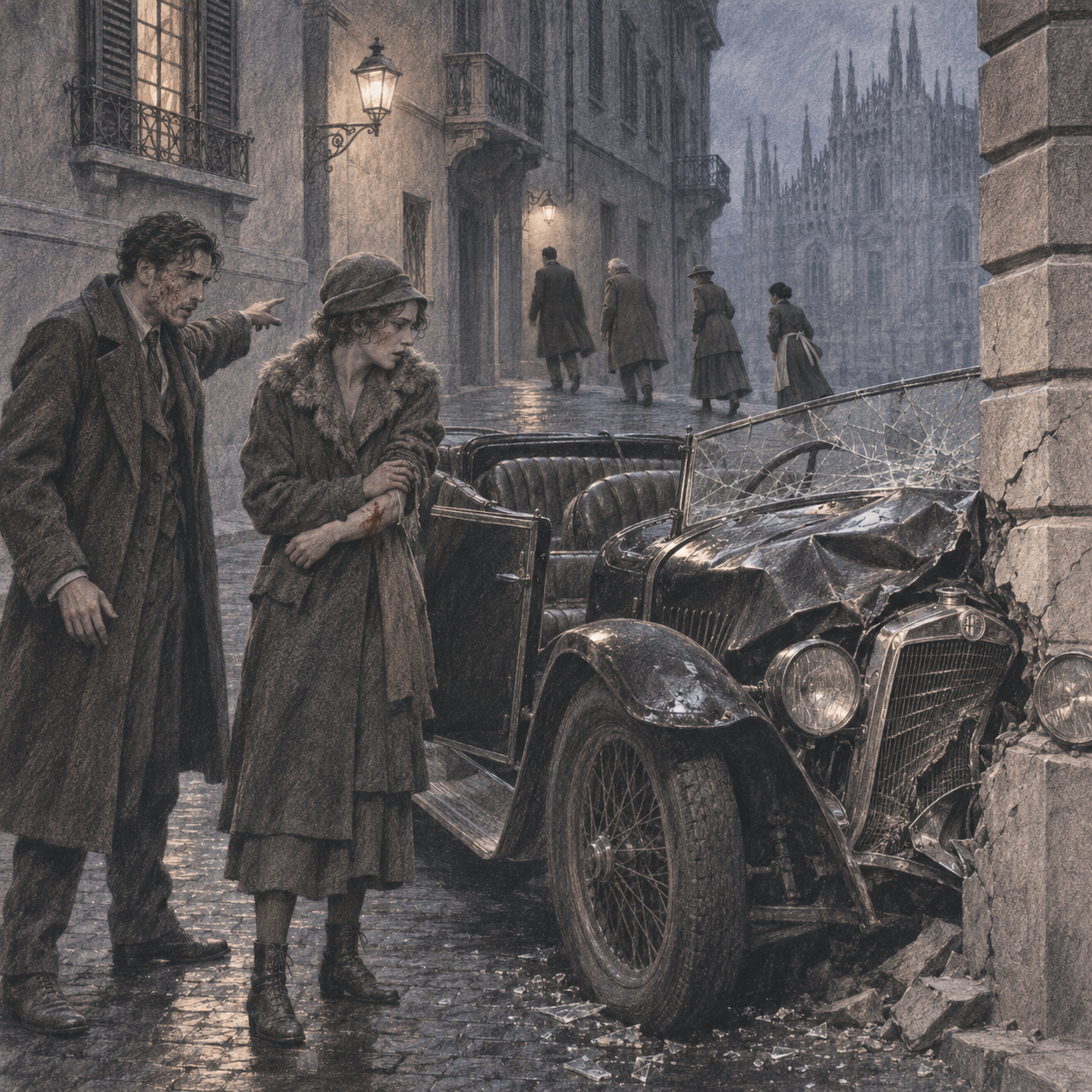
The corner of a building filled the windscreen. The impact threw them all forward in one violent tangle. Glass went. Something struck her left arm with a force that seemed to go straight through the bone and out the other side.
Then the car was still.
For a while she heard only the engine’s failing stutter and the small sounds people make when they are finding out what has happened to their bodies. She was awake. That was a surprise. Her left arm lay against the door, and there was blood down it, far too much for a scrape. Moving it brought the pain into sharp focus.
“Is everyone alive?” Arthur demanded. “Come on. Out of the car. I don’t know about these Italian cars. It might explode.”
Claire tried the engine one more time. What came back was a wet, sputtering complaint from somewhere under the bonnet. The lovely sound was gone. She did not need to try again to know the car would not move.
“All right,” she said. “We walk.”
Getting out took help she would ordinarily have resented. She took it. Across the wreck she saw Viola moving with a terrible carefulness, her face set. Neither of them had lost consciousness, which did not, just then, seem much of a recommendation.
The police were still somewhere behind them in the city. Claire left the driver’s seat and its broken glass and kept her arm against her body.
Arthur got them clear of the wreck before anyone came out to look at it.
At first the streets offered nothing but exposure. A light showed at a window; the way ahead opened too wide. Six people with blood on their clothes could not become invisible by wanting it. Claire and Viola were slow, and hurrying them carelessly would only make them slower.
He checked the next turning, brought the others up behind him, and stopped them short of a patch of lamplight. A shutter opened somewhere close, and a voice called.
Arthur had them into an alley before the face at the window could find them. He waited one breath, then moved them on. After that Milan began to give him what he needed: recessed doorways, dark crossings, corners he could look round before committing anyone to them. The sirens thinned behind them.
He unfolded the tourist map. A bloody thumbprint had swallowed a quarter of the city.
The Orient Express had not published its guide with this in mind. He found a landmark, turned the sheet, found another. The hotel over the Galleria was within reach if they kept moving.
They arrived looking less like guests than like the aftermath of an accident, which had the merit of being true. Those whose faces and clothes had suffered least went in first. A request for ice occupied the desk; while someone was sent for it, the rest went up.
Only when all of them were inside the suites with the doors shut did Arthur let himself stop. The quiet was almost embarrassing. There was no one to hit, no street to cross, no order he could give that would make anything better. Only his friends, hurt in varying degrees, and Isabel with a cut above her right eye.
And Cavallaro still gone.
Walter took the folded note from his pocket and this time made quite certain it burned. He took off the Milanese hat as well.
“I shall not be wearing that again.”
“We looked local,” Arthur said. “Perhaps they’ll be looking for Milanese.”
“The butler knows we’re British,” Viola observed.
Walter put the hat a little farther away.
Isabel went out again to find a pharmacist. Viola watched her go with something close to admiration. The girl had come along to help find her mistress; she had been held at gunpoint, carried off in a stolen car and brought back bleeding, and now she was off to knock on a stranger’s door for dressings.
When she returned they cleared the table and began the slow work of mending what could be mended.
Arthur took Claire first. Her left arm had met the driver’s door hard enough to open a gash that wanted stitching. Claire sat through it, sometimes looking at the wall, sometimes watching his hands with fixed concentration. It would not be right for a long while. But in the end it was closed and covered.
Viola helped where she could. The room took on the sharp smell of antiseptic. Bloodied cloth piled up beside clean linen. Walter, Per and Isabel each had their turn under Arthur’s hands. As he washed cuts and tied dressings, the room began to feel a little more orderly.
Her own hurts were less obliging. Arthur could do very little for them. She bore his apology patiently and then took her turn on him.
“Thank you, Madam Suttcliffe,” he said, as she dealt with a cut. “I’m sorry I couldn’t do as much for you.”
“Oh, you know. I’m used to it.”
Her fingers stayed steady. The rest of her would have liked to lie down and make no further contribution to the evening.
While they worked, they traded what each had seen. Arthur described the study windows standing open and the butler at the telephone. Viola gave them Conti’s words as Isabel had rendered them: a brother of the skin could not die; he would live for ever; God had abandoned him, and he had found another faith.
Saying it in a hotel room did nothing to improve it.
Arthur went over the scar once more. Viola watched him try to fit the living man to the wound and fail. They had left Conti breathing under the blankets. What had been done to him before they ever knocked, and what he believed it had made of him, was beyond their reach tonight.
Nor had they found the thread between him and Cavallaro. The car was clean, and the upstairs rooms held no one. They had searched for a place a person might be hidden, not taken the house apart; the stairs leading downward had never been tried. There were still possibilities nobody wanted to say out loud.
“It could have gone worse,” Arthur said.
Claire glanced at the bandage on her arm.
“We could have been caught.”
“He could have shot us.”
“It was self-defence,” Walter said.
Viola shifted in her chair and found another place that hurt.
“I’m getting too old for this shit.”
The words sat oddly on a face that time had declined to touch. Nobody argued with them.
They had owned, briefly, a magnificent motor car. They had acquired, more lastingly, a revolver. Arthur offered the latter as proof the evening had not been a complete loss, though nobody felt especially confident about using it.
“I’ve got it,” Viola said.
It was in her pocket. She could feel the weight of it each time she moved.
By the time the last dressing was tied the evening had gone. The supplies lay open on the table. Claire held her stitched arm carefully in her lap; Isabel’s cut had vanished under clean gauze. Walter’s hat stood apart from everyone’s belongings like something in disgrace. Nobody reached for the map.
Viola eased back into the chair. Across the room, Arthur set down the scissors. For the moment there was nothing left that he could mend.
Conti’s residence: waiting beside the cold fireplace The investigators remained at Flavio Conti’s residence with Isabel Romano while the butler went upstairs to approach his employer again. Their immediate purpose was still to find Caterina Cavallaro: the earlier investigation had linked her departure to a car matching Conti’s. The sitting room’s fireplace was unlit, and the house was cold. With the servant occupied, Arthur Zorba used the wait to look beyond the room rather than simply remain with the others. Moving quietly through the old, creaking house, Arthur found a kitchen, linen storage, and a bedroom apparently used by the butler. These servants’ rooms lay beyond the sitting room and stairs. He also located stairs leading down, possibly toward a wine cellar, but did not descend. His exploration found no missing singer. It did, however, establish both a source of bedding and a servants’ hall that would become important when the interview turned dangerous. Arthur tried to overhear the conversation upstairs but could distinguish only muffled voices. Claire Corning also tried without success. Walter Lake initially fared no better, then persisted and succeeded on a pushed Listen check. He could make out two men speaking Italian: the butler and an unfamiliar man whose tone conveyed considerable displeasure. Walter could not understand their words, so the exchange supplied a warning about the mood upstairs rather than any information about Cavallaro. A chair scraped violently enough for the others to hear, followed by footsteps approaching the staircase. Walter moved back from his listening position so that he could greet whoever appeared without being caught eavesdropping. Conti then emerged at the top of the stairs and addressed him as a priest. The investigators finally had the direct encounter they had been seeking, but the angry exchange had given them little reason to expect a welcoming interview. At the stairs: Cavallaro’s name, a healing scar, and a gun Conti was an older, extremely thin man with a well-groomed mustache. He wore loose nightclothes beneath a robe left fairly open despite the cold. Isabel stood behind and slightly to one side of Walter, explaining that the visitors were foreigners and translating between them. Conti said that he did not know these people and wanted them out of his house. Walter tried to explain why they had come before the dismissal could end the conversation. Through Isabel, Walter said that people who cared about Cavallaro were worried because she had not returned home. He described the urgency of finding her and said that she had last been seen entering Conti’s car. Conti cut across the translation, denied knowing anything about the matter, and accused the visitors of trespassing. Walter continued asking for information that might establish where the singer had gone and what connection Conti had with her. Arthur and Viola Suttcliffe both recognized a change in Conti’s behavior when Cavallaro was mentioned. His initial indignation had seemed controlled; the singer’s name brought out a more manic, uneasy agitation. Their successful reading of him gave the investigators further reason for suspicion, but Conti made no admission. His reaction did not establish what he knew, whether he had accompanied Cavallaro, or what role he might have played in her disappearance. As Conti gestured and his clothing shifted, Walter noticed tight pink scar tissue on his chest, branching toward the top in a Y shape. Arthur also saw it and recognized fresh healing from his experience with wounded soldiers. The position suggested the disturbing possibility of an autopsy incision. The thought that the man standing before them might somehow be a walking corpse cost Arthur 1 Sanity. The scar was real; that explanation remained his fearful interpretation. Walter pressed for the nature of Conti’s relationship with Cavallaro while Isabel struggled to make herself heard over the shouting. Conti drew a .38 revolver from his robe and swept it across the visitors from the top of the stairs. Isabel shrieked and retreated. Claire lost 1 Sanity at the armed threat. Walter stepped between Isabel and Conti, repeatedly urging him to calm down while the interpreter tried to convey what he was saying. Isabel translated Conti’s boast that he had friends in the fascist party and could shoot them all without anyone caring. The reach of those connections was unproven, but the revolver made the immediate threat plain. Conti’s position at the top of the staircase put him beyond easy reach. The investigators considered disarming him directly and recognized the danger of rushing up the stairs toward an armed man. Walter instead offered to leave peacefully and provide a telephone number in case Conti remembered anything useful. The doorway: a staged departure and Arthur’s ambush While Walter pursued the appearance of a peaceful departure, Arthur took a poker from beside the unlit fireplace and kept it out of Conti’s sight. Walter asked to leave contact information should Conti hear from Cavallaro or recall anything about her. Conti grew still enough to agree and gestured with the pistol toward paper on a side table. Walter wrote his name, clerical identification, and telephone number. He deliberately withheld an address because he did not want Conti’s threatened allies coming to their lodgings. Arthur intended to strike the wrist holding the gun. His first attempt to hide failed, but he pushed his Stealth check successfully and concealed himself in the dark servants’ hall. The others knew what he was doing. They made a conspicuous show of moving toward the heavy front door, with Isabel working its bolts and latch. As the door began to open, Conti followed them downstairs, bringing him past Arthur’s hiding place with his back exposed. At the bottom of the stairs, Conti still held the revolver raised near his hip. Arthur stepped out and brought the poker down on his gun wrist, spending Luck to make the ambush strike connect. Conti noticed the movement too late. He cried out, the revolver flew free, and he crumpled while clutching his injured wrist to his chest. No shot was fired. Arthur demanded Cavallaro’s whereabouts and told Claire to get the weapon; she retrieved it and held Conti at gunpoint. Arthur’s anger at the threat was unmistakable: “You fascist bastard! You can’t threaten us with your government goons!” Isabel was shocked by the sudden violence. The successful disarming did not produce an answer about Cavallaro, and Conti’s condition rapidly became more alarming than the wrist injury alone. He turned pale, his eyes rolled back, his breathing grew shallow, and he collapsed gasping. His wrist had been injured, but its precise condition was not established. Arthur immediately tried to keep Conti from going into shock. “Quickly, a blanket! He seems to be going into shock, having threatened us with a weapon!” Walter took Isabel upstairs, calling for the butler and looking for help, bedding, or any sign of Cavallaro. Their calls went unanswered. They found an empty, well-appointed bedroom with fine bedding and a large wardrobe. Walter brought blankets down, while Per Oskarson stripped another bed to provide more covering. Working together, the investigators wrapped Conti, raised his legs, and successfully administered first aid. Their efforts appeared to help ward off shock, though he remained shivering and poorly aware of his surroundings. Arthur opened his shirt far enough to examine the scar properly. The Y-shaped incision looked surgical and extensive, as though his whole chest had been opened. It was not an ordinary wound, and its extent suggested an operation Arthur would not have expected someone to survive. Its cause remained unknown. Walter considered Conti’s condition grave enough to prepare last rites. He asked Claire to find the missing butler, warning that the servant might also be armed or that there could be other guns in the house. Arthur accompanied her to search for the butler, Cavallaro, and weapons. Claire carried the captured revolver and Arthur retained the poker. Walter, Viola, Per, and Isabel stayed with Conti, dividing the party between searching the house and tending its injured owner. The study and garage: an interrupted call and an unnamed faith Arthur and Claire worked through the upstairs doors, calling out with their limited Italian. They found the bedroom, a washroom, and a study. The study was freezing: its balcony windows stood wide open to the January evening. There were papers on a used desk, seats for visitors, and a table with a large ashtray. Behind the desk, the butler held a telephone receiver and tried unsuccessfully to duck out of sight when the searchers entered. Arthur approached with his English-Italian phrasebook and tried to order the butler to hang up. He then knocked the receiver from the servant’s hand and slammed it onto the telephone himself, ending the call. The butler retreated behind the desk, pale and wide-eyed. Arthur and Claire had found him and stopped the conversation, but they had heard neither its contents nor the identity of the person at the other end. Whom he had contacted remained unknown. Fragmented references to an automobile and the opera finally prompted the butler to gesture toward the stairs and pantomime keys. He led Arthur and Claire downstairs, retrieved his master’s keys from his own area, and handed them over with a gesture to take the car. Arthur explained that his immediate intention was to search it: the vehicle remained their last tangible lead to Cavallaro. Claire initially warned that stealing it would bring police trouble, then volunteered to help inspect it because she knew cars. The garage could be reached only from the street, so both searchers had to leave the house to examine it. Before they went, Claire’s captured revolver passed to Viola, who took over the armed watch inside. The garage contained a black Alfa Romeo RL matching the earlier description. Beyond the car there was little storage to investigate, chiefly oil cans and basic vehicle-maintenance tools. The keys gave Arthur and Claire access to the vehicle without forcing their way into it. Meanwhile, Conti began mumbling in Italian. His words were poorly enunciated, and Isabel had difficulty separating speech from sounds. Her tentative translation was unsettling: “A brother, a brother of the skin can’t die?” She also understood him to be saying that he would live forever, though she was unsure. Viola encouraged her to keep translating in case anything useful emerged, while suggesting that Conti might be delirious. He repeated variations of the same ideas without explaining what a brother of the skin meant. Walter continued religious ministrations in Latin and suggested warming Conti. Firewood and kindling were arranged, but no useful fire was lit before the investigators eventually left. Outside, Arthur and Claire both successfully searched the Alfa Romeo. They found no blood, damage, signs of struggle, or belongings from a woman. Arthur also described the extent of Conti’s chest incision to Claire, who questioned how a man whose chest appeared to have been opened so thoroughly could still be walking around and threatening people. The searches of the ordinary upstairs rooms and closets likewise found no Cavallaro and no obvious place where she was concealed. These were substantial negative results, but they did not clear every possible space in the residence. The downward stairs had not been explored, and hidden compartments had not been ruled out. Nor did the clean car establish that Cavallaro had never ridden in it. The investigators still lacked either the singer herself or physical evidence explaining what had happened to her. Walter offered Conti the chance to make a final confession and unburden himself. Communicating through a frightened interpreter made the appeal more difficult, but Walter spent 6 Luck to succeed at Charm. Conti focused on him, became briefly clearer, and spoke quietly. Isabel’s expression fell as she translated: “He says God abandoned him, so he abandoned God.” She added that Conti said he had a new faith. Walter urged repentance and asked what that religion was, but obtained no explanation of its name, beliefs, or connection to the strange incision. During this exchange, the butler began edging quietly toward the door. Viola noticed, gestured him back with the revolver, and ordered him to sit. He remained under her watch. Conti’s talk of immortality and a new faith supplied another mystery, but neither those claims nor his scar established that he was immortal, that he had returned from death, or that his beliefs explained Cavallaro’s disappearance. The garage: sirens and a hurried departure Outside, Arthur and Claire failed to notice the approaching activity early. Claire persisted with a pushed Listen attempt and failed again, leaving them with very little warning of a larger approaching police presence. When the Milanese sirens finally registered, they were already loud and close, echoing through the streets. Arthur told Claire to start the Alfa Romeo while he gathered the others. The questioning, search, and care of Conti were abruptly cut short by the need to leave. Walter recovered the note bearing his name and telephone number. He first intended to burn it in the fireplace, then pocketed it when reminded that there was still no fire. He told the butler to light the prepared logs and kindling. All five investigators and Isabel hurried out, leaving Conti with his servant. Conti had been alive and capable of speaking when last observed, though still in poor condition. Whether he would recover after their departure was unknown. At the garage, fitting six people into the Alfa Romeo became an immediate problem. Walter’s failed Luck check yielded no alternative vehicle: this was the only car available. The companions considered cramped seating, laps, and running boards before squeezing all six aboard. Viola opened the revolver’s cylinder and confirmed that it was loaded. She kept the weapon, which had not been fired during the confrontation. No second car or other means of getting everyone away materialized. Claire chose to get the engine running and face the driving check during the escape rather than risk being unable to start the car in the garage. With Drive Auto 45, she accepted the danger of handling it at speed and drove out into Milan’s narrow cobbled streets, turning away from the sirens. The group saw no police vehicles behind them and believed that they had not yet been spotted. Their escape began without direct contact with an officer, but the difficult driving still lay ahead. Milan’s streets: the crash and the escape on foot Claire’s driving roll was 97 against Drive Auto 45, a fumble. Rounding a corner at speed, she found a truck blocking the street. She turned sharply to avoid driving beneath it and struck the corner of a building instead. Glass scattered and impacts left the travelers bloody. The car had carried all six away from the residence, but the collision immediately transformed their escape into a struggle to get an injured group off the street. Everyone took crash damage of 1d4+1. Claire suffered 5 damage, dropping from 10 HP to 5, and received a major wound: a deep gash down her left arm where she struck the driver’s-side door. Viola was also badly hurt. The two companions whose injuries required Constitution checks both remained conscious. Isabel suffered 3 damage and a cut above her right eye. Arthur, Walter, and Per were injured as well. Claire and Viola were slow to move when the group began extracting itself. Arthur urged everyone to abandon the car. Claire first tried to find out whether it could still carry them, but her Luck roll of 86 failed. The stopped engine produced only sputtering and gurgling when she tried to restart it. The Alfa Romeo could go no farther. They left the disabled vehicle at the crash site and continued on foot, still needing to get away from the sirens and find somewhere they could tend their wounds. Arthur took responsibility for moving all six through the streets without attracting attention. His initial group Stealth roll of 96 failed, but he pushed the attempt successfully. Someone opened a nearby shutter, yet the companions were already moving down an alley. Arthur kept the group going despite Claire’s and Viola’s slower pace. The immediate danger of being noticed passed, and eventually the sirens faded behind them. They had avoided a police encounter, though their flight did not settle what the authorities might learn afterward. Using their Orient Express tourist map of Milan and recognizable landmarks, they made their way back to the Galleria lodgings. A bloody thumbprint now marked the map. At the entrance, the more presentable companions distracted the lobby staff while those with more visible injuries went upstairs. All five investigators and Isabel reached the suites. Their temporary escape vehicle was gone, but they had gained enough privacy to clean wounds, arrange treatment, and consider the consequences of the visit. The Galleria suites: first aid and unfinished business Walter burned the recovered contact note, destroying the paper bearing his name, clerical identification, and telephone number. He also decided never to wear his distinctive Milanese hat again and intended to return to more British clothing, hoping to differ from a description of the priest at Conti’s house. Viola pointed out that the butler already knew they were British. Destroying the note removed one piece of evidence; changing clothes could not erase the witnesses to their visit or guarantee that they would escape identification. Despite her own cut above the right eye, Isabel went out to a pharmacist for bandages and wound-cleaning supplies. Arthur spent the rest of the evening treating the group, with Viola assisting him and providing a bonus die for the first-aid attempts. Their work cleaned and dressed the injuries from the crash. Claire’s deep left-arm gash was stitched, but the treatment addressed only part of the harm she had suffered. Arthur successfully treated Claire, Walter, Per, and Isabel, restoring 1 HP to each. Claire therefore reached 6 HP after taking 5 damage in the crash, but her major wound remained. Isabel recovered 1 of the 3 HP she had lost. Arthur’s attempt to treat Viola failed, leaving her badly hurt with no HP recovered from the evening’s first aid. Viola then successfully treated Arthur, restoring 1 HP to him. Everyone had received some healing except Viola, and Claire still needed recovery beyond the stitching and bandages. As they reviewed the visit, the limits of the Cavallaro search remained important. The car had yielded no trace, and the upstairs rooms and ordinary closets had been checked for a concealed person. The basement had not been searched, and a secret compartment remained possible. Conti’s agitation, denial, chest incision, and religious statements had deepened suspicion without locating the singer. Cavallaro had neither appeared nor communicated, and the investigators chose no further investigative action before the evening ended. The interrupted telephone call and the later sirens also remained unresolved. No one had heard whom the butler called, seen the approaching officers, or learned why they were coming. Conti’s damaged car now lay abandoned in Milan, while Conti himself had been left alive but seriously unwell with his servant. The companions had escaped immediate contact with police, but neither the extent of the police inquiry nor Conti’s subsequent condition was known. Viola confirmed that Conti’s loaded .38 revolver was in her pocket. It was the party’s lasting material gain from the encounter; the Alfa Romeo had been lost after its brief use in the escape. All five investigators and Isabel remained together in the Galleria suites, wounded and in need of recovery. Their next move was undecided, with Cavallaro still missing and Conti’s references to an undying brother of the skin and a new faith still unexplained.Session Notes