Per held Caterina Cavallaro’s letter in one hand and pinned the open newspaper flat with the other. The paper smelt of ink. The letter still gave off its faint, gracious scent, as if she had only just set down the pen. She had arranged rooms in the Galleria and tickets to Aida, expecting to see them all again. Beneath his other hand, the newspaper reported that she was missing.
He read the passage again. Last seen at the station. Possibly abducted. The words did not improve with a second reading.
They were hard to square with the woman who had laughed at his Swedish drinking songs in the salon car. He could still feel the pleasure of it: a celebrated soprano, head back, finding something to delight in about a song concerning frogs. By the calendar that had been scarcely any time ago. The journey in between had merely felt long.
Arthur leaned over the letter.
“This came from an attendant at the station, didn’t it? Not from anyone aboard our train.”
“Yes.”
“And the station is where they last saw her.”
The letter was on Wagons-Lits stationery. She might have written it on the train and handed it to someone there. Its path, at least, could be traced. Hers could not.
“The police will presumably have spoken to the staff,” Per said.
“The police haven’t got this.” Arthur tapped the letter once with a finger.
That settled it. Per folded the newspaper. Dinner could wait. Tomorrow evening Aida would open at La Scala with an understudy in Caterina’s place if she had not been found. He disliked the practical neatness of that arrangement even while he could hardly fault the theatre for making it. The performance would go ahead; meanwhile, they could look for her.
At the station they had to cast about for some time before finding the porter who had delivered the envelope. The dust and scaffolding were just as they had been that morning, but Per found himself watching the people passing beneath them more closely. There were so many ways to leave a station: through a doorway, into a cab, following a familiar face across a crowd. A disappearance need not begin with a struggle.
After a brief negotiation of languages, Arthur and the porter settled on French. The man’s was accented but serviceable, which put him comfortably ahead of their Italian phrasebooks.
The letter, he explained, had come to him through a conductor. Miss Cavallaro had said that a Mr Oskarson would probably arrive from Lausanne the next day, and had asked that it be put into his hands. The instruction had been passed along; he had found Per; so far as he knew, the business had concluded to everyone’s satisfaction.
“Did you see her leave the train?” Arthur asked.
“Oh, yes. I am a great admirer. I cannot often go to the opera, but she is wonderful. A great prize for La Scala.”
“Then I’m afraid you may not have seen the afternoon paper.”
Arthur told him. The porter’s face changed, and he looked towards the platforms as though yesterday’s arrival might still be standing somewhere among today’s passengers.
There had been people with her, he said. Attendants, helpers, someone seeing to the luggage. She had been talking with a man she appeared to know well. Then an older gentleman had waved to her. She had gone over to him, come back briefly to the first man, and afterwards left with the older one.
“In a car?”
“Yes. A black Alfa Romeo. The new RL.”
The precision arrived with a small, involuntary flicker of enthusiasm. He had seen the model in a magazine. A very fast car. He thought the older gentleman had been driving it himself.
At the second mention of Alfa Romeo, Claire’s head came up. She had no French, but she knew the sound of something worth hearing. Arthur translated for her and the others.
“They make them here,” she said. “In Milan.”
Per steered them back to the passenger. Had any of Caterina’s luggage gone into the car? Had anyone from her party gone with her?
Not that the porter had seen. Her companions had stayed with the bags.
“And the gentleman?” Arthur asked. “Anything distinctive about him?”
The porter gave this proper thought. Thin, he said at last. Very thin. He had looked ill, or like a man who had recently been ill, though he moved briskly enough. His clothes were good, in the Milanese style. The porter had watched from a distance and heard nothing of what was said.
Per glanced down at his own new hat. Milanese clothes, evidently, established rather less than one might wish.
“A new car is a distinctive thing,” Viola said when Arthur had finished translating. “Perhaps the factory keeps records of its customers.”
Claire brightened. “We could enquire as potential buyers. A salesman might be quite forthcoming.”
“Or,” Viola suggested, “we could explain that we’re looking for the missing diva and ask for his help.”
“We could be honest with a car salesman,” Claire allowed. “It’s certainly an approach.”
Per welcomed the exchange more than he had expected to. Ten minutes earlier they had known only that Caterina was missing. Now there was a car, a description, and somewhere to go and ask.
Claire had another thought before they committed themselves to the factory. Caterina lived here. Surely she kept a maid, someone who knew her visitors and might put a name to a gaunt gentleman. Her home might be the better place to start.
“I still think we should drive an Alfa Romeo,” Claire added.
“If you can find a reason, my dear,” Viola said, “I shall root for you.”
They went together to find Caterina’s apartment.
A vase of tired flowers stood in the sitting room. Their heads had begun to bow towards the table, and a single fallen petal lay beneath the glass.
Viola noticed them as the maid showed them in. The apartment sat high in a building near the Galleria, comfortable and well appointed, with the particular air of a home kept ready for someone who had not come back. Nothing was dramatically wrong, but Viola felt the strain of waiting almost as soon as she entered.
The maid was dark-haired, perhaps forty, and wore the careful reserve of a servant confronted by strangers asking after her employer. She tried English when their Italian failed, and had some French besides, though neither language ran easily to long explanations.
The letter helped. At the sight of it she recognised Per’s name.
“Mr Oskarson. Yes. She spoke of you. Of all of you.”
Viola saw what it did to Per. Caterina had remembered them after the salon emptied and the songs were done.
“My mistress is not here,” the maid went on. “I do not know when she will return.”
“We’ve seen the newspaper,” Per said gently. “Is it an overexcited headline, do you think? Or is there reason to be afraid?”
The woman hesitated. Her eyes moved from one of them to the next. Viola could almost feel her weighing the need to help against the obligation to say nothing she ought not.
“Now, my dear,” Viola said, “let us talk quite candidly, so that we can help your mistress. Were you travelling with her, or did you stay here?”
She kept her tone brisk and practical. The woman was already frightened enough.
The maid had travelled with Caterina. She had been at the station and seen the meeting. Before the older gentleman came over, Caterina had been having a small disagreement with her manager. The newcomer was a stranger to the maid, but Caterina had seemed to know him, or at least to be at ease speaking with him. He appeared to make some invitation. Caterina accepted and drove away with him.
“She was in good spirits. She did not seem frightened.”
“And since then?”
“No one has seen her.” The maid pressed her hands together. “The police think… my mistress sometimes follows her wishes. She is an artist. People say she is flighty.” Her English slowed as she hunted for the distinction she needed. “But not now. Not before an opening. She would not simply go away.”
Viola waited.
“Something is wrong.”
“Yes,” Viola said. “We think so too.”
The older gentleman had indeed been remarkably thin. His complexion was sallow, his look unhealthy, though he had smiled and seemed sociable enough. He wore a moustache. There had been light brown hair visible under his hat. His clothes and his car spoke of money.
The maid had not overheard their conversation, and was anxious they understand that she would never have listened to a private exchange.
“Of course not,” Viola assured her. “But you could see how your mistress behaved.”
That she could describe. Caterina had worn her professional manner, the gracious face she kept for people who wished to speak to the diva. The maid thought he might be connected with the opera, or perhaps a patron. Someone acquainted with the public woman rather than a friend.
It was an interpretation, but a useful one. Viola knew how much could be said with a smile held at precisely the right distance.
She asked whether the car had gone towards the opera house. Possibly, the maid said. She could not be certain.
“Then La Scala may be worth trying,” Viola said. “You’ve been most helpful. We shall do everything we can.”
Walter asked how they might be reached if Caterina returned, or if there was news. The maid already had their room numbers: she had arranged the accommodation herself, at Caterina’s request. Per had another kindness to thank Caterina for, if they could find her.
Claire, meanwhile, was thinking of the doors still ahead. A letter of introduction might help, she suggested. Something to show they were respectable people looking for the missing singer.
The maid looked up.
“I am known to some of her acquaintances. People who visit here.” She paused. “You need someone to translate?”
“Very much,” Arthur said.
“Would you come with us?” Claire asked.
For the first time the woman’s face changed in a way that was not simply another degree of worry.
“I need a moment to change.”
She went into the back of the apartment. Viola sat quietly while the others waited. Per watched the doorway through which she had gone with that thoughtful stillness Viola knew of old. Suspicion was not an unreasonable habit in their company. Yet when the maid came back in a plain dark dress, coat and scarf, she looked to Viola like a woman relieved to have something she could do.
“My apologies,” she said. “I did not introduce myself. Isabel Romano.”
Walter’s eye fell on the flowers, and he remarked on their state. Isabel looked briefly embarrassed. They had been there before the journey to Paris, she explained. She should have thrown them out. Since returning she had been distracted.
“Don’t trouble yourself,” Per said. “We shall hope to bring your mistress home with a fresh bouquet.”
Viola rose before the promise could settle too heavily on anyone.
They had two places to try. The opera house would be busy with preparations for tomorrow’s opening, probably well into the evening. The Alfa Romeo showroom would not. If they meant to try it, they would have to go now.
Claire accepted this order of business with exemplary composure.
The cab driver regarded speed as a personal accomplishment and plainly resented any suggestion that an expensive motorcar had something to do with it.
Isabel translated selected portions of his monologue while he threaded the traffic. Claire would have liked to take the matter up with him in more detail, but the corners were demanding enough of everyone’s attention already.
“He says it is the driver who makes a car fast.”
“He appears determined to demonstrate,” Arthur said.
They reached the showroom five minutes before it closed.
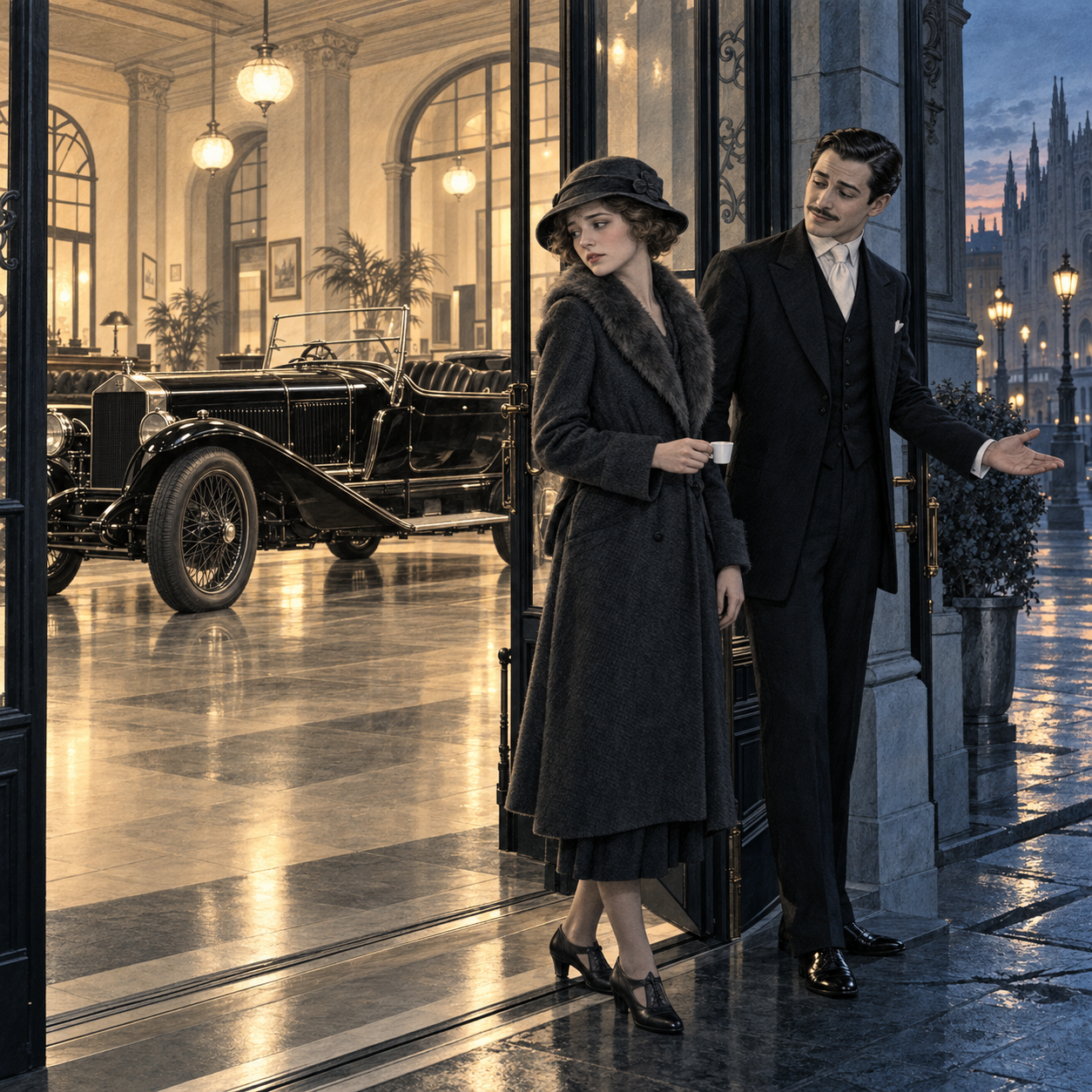
Inside, the cars stood under bright lights with room around them to be admired. Claire felt the familiar, uncomplicated pull of well-made machinery. Here, at least, were relationships one could understand: timing, force, fuel, each component with its purpose. A mechanical fault might be elusive, but it did not as a rule resent being investigated.
The first employee fetched a colleague who spoke English. He was young, with a pencil moustache and a white tie, and had clearly given some thought to looking as sleek as his stock.
Claire asked him about the engines. His manner warmed at once. Soon a bonnet was up and he was pointing out features, answering questions, expounding on the superiority of the design. She leaned in and followed every word. There was no need to pretend that part.
Per gave the conversation a tactful nudge.
“Perhaps this is the place to settle our disagreement about that black car.”
“An RL,” Arthur supplied.
“I thought so,” Claire said.
The salesman led them to the floor model. Their newest car, he explained. Fast and luxurious. A little expensive, naturally, but very much in demand.
Per was not quite persuaded this was the model they had been discussing. Claire disagreed with him. They worked the doubt back and forth while the salesman listened, until Per suggested that perhaps the driver would settle it. A distinctive gentleman. Very stylish, but remarkably thin. Surely, if the young man had sold him the car, he would know which model it was.
Claire watched recognition arrive.
“Oh, yes. Signor Conti. We sold him one quite recently.”
“Conti?” Per repeated, with the mild interest of a man whose question had very nearly answered itself.
The salesman supplied the spelling. Conti Machine Parts. The gentleman’s firm, in fact, made some of the components used in the RL.
Claire looked at the engine again. Some piece beneath that polished bonnet might have come from the factory of the man who had driven off with Caterina. It was absurd to expect the machinery to give anything away about its supplier, but for a moment she found herself studying it as though it might.
Arthur glanced her way.
“Did you want to take this fine sport model for a drive?”
Very much. She said so with as much dignity as she could muster.
The salesman consulted his watch. Claire had caught him doing it before, discreetly, while Per was talking. He had enjoyed her questions, but enjoyment was one thing and keeping a showroom open past closing for a possible sale was another. His glance took in their party again, weighing enthusiasm against purchasing power.
“I am very sorry. We are closed now. You must come back in the morning.”
“Of course,” Arthur said. “Another day.”
Claire took a last look at the car. It was an excellent machine, and she had been very near it.
They were given espressos before being ushered out, so the disappointment at least left a pleasant taste. More to the point, they had a name.
Outside, Arthur found a telephone and asked Isabel to enquire after Conti Machine Parts. She spoke to the operator and came away with an address in the same northern industrial district. They could walk.
It was coming up to half past five. The January light had all but gone, and the streets narrowed and twisted as they followed Isabel away from the showroom. Claire heard their footsteps falling unevenly on the cobbles and thought of Caterina leaving the station without her bags. That was what a person did when they expected to be back shortly. She might have anticipated no more than a conversation or a visit, some professional courtesy too small to inconvenience anyone.
Ahead, outside the factory gates, a small group was gathering up its belongings. Ten or a dozen people were lowering signs and packing them away.
Claire could not read the lettering. Isabel could.
“Justice for Ennio Spinola,” she said.
The name meant nothing to any of them.
Walter had expected his collar to be a liability among striking workers. Instead several of them greeted him warmly, calling him padre. He returned their nods and small gestures of respect, conscious of his conspicuous cross and his thoroughly ecclesiastical hat.
His Italian remained unequal to almost every possible reply. For once, this spared him saying the wrong thing.
At Per’s suggestion, Isabel asked what had happened. The departing group paused. A man drew a rolled newspaper from his bag, opened it, and pointed to an article. Walter watched Isabel’s face sadden as she read.
“A man who worked with them was killed. Near here.” She searched for the next words. “They work together. They are organised…”
“A union,” Per offered.
“Yes. A union.”
She listened again, then relayed their accusation with visible care. They believed their employer had arranged for a fascist to kill their colleague as a warning. They were striking in protest.
Walter looked from the newspaper to the lowered signs. He had approached these people worrying about their politics. They were here because a man they knew was dead.
Arthur asked Isabel whether such killings were common in Milan. She looked away, uncomfortable. He could draw no firm conclusion from her silence, but it did little to reassure him.
They asked when the workers had last seen Conti.
He had been very ill, they said. For some time he had stopped coming to the factory at all. Something in their remarks made Isabel hesitate over the translation; she rendered it as a belief that the old man was going to die.
Then, in the last few days, he had recovered and started appearing again. He had been there that very morning, though he had left around lunchtime.
Walter set that beside the description from the station: a man who looked sick but moved with energy. There might be nothing in it. People did recover. He had prayed at enough bedsides to know how gratefully such a turn was received.
He also knew the company he kept, and the kinds of explanation they had learned to dread. Nobody’s expression improved.
They could return to the factory in the morning. Viola mentioned the opera house again. Walter asked whether the men knew where Conti lived.
One of the workers put a question to Isabel, looking past her at them. She turned to Walter.
“Why do you wish to know?”
It was fair. They were strangers, well dressed, asking for an employer’s home address while the men packed away signs accusing him of murder. Walter could think of several conclusions they might draw, none especially helpful.
“We are trying to find Caterina Cavallaro,” he said. “She is a friend of ours. You may have seen that she is missing.”
Isabel translated. The newspaper was turned over. Caterina’s disappearance filled the front page; Spinola’s death had required a search inside.
“She was last seen leaving the station with a man we believe to be your employer,” Walter went on. “We want to ask him where he took her.”
He let Isabel finish. There was no hurrying words through someone else’s mouth. As she spoke, he kept his attention on the man who had challenged them, trying to judge how he received the explanation.
The man’s expression altered. He said something to his companions; someone answered. Then he gave Isabel the address.
“It is a good part of Milan,” she told them.
Walter thanked the workers. Their goodwill had carried them further than he had any right to expect, and he felt a little ashamed of his first assumptions. Behind the men the factory stood darkening against the evening sky. Whatever had happened to Spinola, his friends would carry their signs home tonight and have to decide whether to bring them back tomorrow.
Arthur wanted to go straight to Conti’s house. Time mattered in a disappearance. La Scala might offer background, but here was the man who could tell them where Caterina had gone.
“We haven’t got our guns,” Claire observed.
Walter remembered the station storage, and the chest they had been obliged to leave there. Arthur’s expression turned dry.
“I have the claim ticket, if you’d like to wave that at anyone.”
Claire still had her pry bar. Walter hoped there would be no occasion to discuss its uses in front of Isabel.
“We are going to ask questions,” Arthur said.
That, for the present, was the plan.
The house near Via Torino had bars on its lower windows and a wooden door substantial enough to make Arthur reconsider the usefulness of a pry bar.
They arrived a little after six, having crossed the city crammed into a cab with Isabel up front directing the driver. Somewhere along the way they had acquired Conti’s first name: Flavio. Arthur turned it over silently as he looked up at the three-storey stone building. Flavio Conti. They had a name, an address, a car and a reported illness, all perfectly ordinary facts. He would have preferred a less forbidding door.
There were lights in the windows. A garage had been let into the property, though its presence told them nothing about where the Alfa Romeo might be. The narrow street left little room for a parked car, and there was hardly any traffic.
Arthur’s eye went automatically to the upper windows. They were unbarred, but not easily reached. The building had not been designed for the convenience of people who wished to enter it uninvited.
“Well?” Per asked.
“The charming people speak first,” Arthur said. “Then the intimidating people, if necessary.”
“And after that?”
Arthur glanced at Walter. The reverend looked prepared to make himself useful in either capacity, and perhaps a third.
“Let’s begin with knocking,” Walter said.
The heavy knocker fell once against the door. They waited. Arthur could hear small movements among his companions, coats being resettled after the cab, but nothing from within. No footsteps approached. When the door did begin to open, it seemed to do so without warning.
An older servant in a dark uniform stood beyond it. Isabel spoke to him, indicated the party, then turned to translate. He wished to know their names and their business with Signor Conti. She had explained that she was acting as interpreter.
“We are friends of Miss Cavallaro,” Walter said. “We would like to speak to him about her.”
Was Signor Conti expecting them?
“No. But it is rather urgent.”
The servant looked them over. Arthur had endured less polite inspections in his life, though few so delicately conducted. Viola appeared to satisfy whatever requirements the occasion demanded.
“Miss Viola Suttcliffe,” she said.
“And Father Lake.”
The servant put another question to Isabel. She looked at Walter with a slight tilt of her head.
“Of the Church of England?”
“Of the Church,” Walter began, and then conceded the more specific affiliation when it became clear that specificity was wanted.
There was a brief, measured reply. Arthur needed no translation to recognise an “I see.” Nevertheless, they were admitted.
The door closed behind them, shutting out the sounds of the street. They followed the servant upstairs to a sitting room, where he asked them to wait while he informed his employer that visitors had called.
Arthur started to unbutton his coat, then stopped. The room was cold. Not bitterly so, but cold enough that shedding a layer felt like an unnecessary sacrifice. He saw the others arrive at much the same conclusion.
The furniture and decorations were unremarkable. There was no sign of disturbance, no discarded belongings that might be connected with Caterina, nothing to justify the attention Arthur found himself giving every corner. The fireplace was unlit. Its tools stood ready beside it, polished, but there was no wood anywhere in the room.
Walter looked towards the hearth, then at the door through which the servant had gone. Arthur kept his coat on.
Waiting in another man’s house imposed its own peculiar discipline. They had come without an appointment, at an inconvenient hour, and been received with formal correctness. They could not search the room because its owner had bought an expensive car and recovered from an illness. Even the workers’ accusation, grave as it was, remained an accusation.
Yet Caterina had left the station with someone matching his description. Arthur returned to that whenever the ordinary rules of visiting threatened to make him feel foolish. She had gone without her luggage, apparently of her own accord. Now she was missing, and this was the nearest they had come to anyone who could say why.
Above them, floorboards creaked under someone’s weight.
Arthur raised his eyes. The movement was brief and told him nothing useful about who was walking, or where. No voices carried. He could not tell whether the servant had delivered their message, whether Conti was weighing it, whether their arrival had interrupted dinner or something else entirely.
Across the room Isabel sat in her dark coat, hands folded. That afternoon she had been alone among her mistress’s things, waiting for news. Now they had brought her here. Arthur was glad of her help, and less glad of how badly they needed it.
The servant returned after a few minutes. Isabel listened, then translated.
“Signor Conti regrets that he is otherwise engaged this evening. He cannot speak to you. If you leave your names and a number, he will telephone tomorrow.”
Arthur felt the refusal tighten something behind his ribs. Tomorrow was a generous stretch of time to offer when one was safe at home. He shifted forward, but Viola spoke before he could.
“We have come some way, and we need only a few minutes. Perhaps you could explain how important it is.”
Her voice stayed mild. Arthur had seen that mildness do work no raised voice could have managed. She gave Isabel time to translate, then went on with the gentle persistence of a woman confident that a reasonable request must eventually be understood.
The servant answered at greater length this time.
“He was told that you wished to speak about Signora Cavallaro,” Isabel said. “He says he knows nothing of the matter. He does not think he can help you.”
Knows nothing. Arthur thought of the black RL, but Viola was already easing the conversation past the denial.
“People don’t always realise what they remember,” she said. “A few little questions might jog his memory. Where he dropped her off, for instance. That could help us enormously.”
Isabel translated. The servant’s attention sharpened.
“You don’t wish the poor woman to remain missing any longer than necessary,” Viola added.
He asked Isabel something quickly. She turned back to them.
“He drove her somewhere?”
“Yes,” Viola said. “She was last seen getting into his car.”
For the first time since opening the door, the servant seemed to have no prepared response. Arthur watched him look from Isabel to Viola and back. Whatever Conti had told him, this was plainly news.
“I will speak to Signor Conti again.”
He left them and went upstairs.
Arthur stayed where he was, his coat still fastened. Beside the empty fireplace the polished tools caught what little light the room had. They listened to the servant’s steps overhead until those, too, fell silent, and waited for him to come back down.
Milan streets: tracing the invitation On Thursday afternoon, Arthur Zorba, Claire Corning, Walter Lake, Viola Suttcliffe, and Per Oskarson turned their attention to the newspaper report of Caterina Cavallaro’s disappearance. Aida was due to open at La Scala on Friday evening—tomorrow—with understudies available. Cavallaro’s whereabouts and ability to appear remained unknown. The newspaper reported fears of abduction, but the investigators did not yet know whether she had been taken against her will. Cavallaro’s invitation offered a starting point beyond the newspaper. It was written on Wagons-Lits stationery, suggesting that she might have composed it aboard the train. The investigators considered whether she had personally handed it to the station employee who delivered it, or whether train staff had passed it along. Either route might lead to someone who had seen her before she disappeared, and the police might not know about the letter. Per wanted to begin immediately rather than stop for dinner. He proposed finding the employee who had delivered the invitation and asking about Cavallaro’s last movements. The group agreed and took a cab back to the railway station, where they searched around the Wagons-Lits office for the same porter. Milan station: the black Alfa Romeo The porter spoke enough French for Arthur to interview him and relay his answers to the others. According to the porter, Cavallaro had given the invitation to a conductor, explaining that a Mr. Oskarson would probably arrive from Lausanne the following day. The conductor had then asked the porter to find him and deliver it. The porter had not received the letter directly from Cavallaro, and the conductor was not interviewed during this visit. The porter was nevertheless an eyewitness to her arrival. An admirer of Cavallaro’s singing, he had watched her while her travelling attendants dealt with the luggage. News that the newspapers feared an abduction visibly surprised him. He had seen her speaking with a man she appeared to know well, then approaching an older man who waved to her. She returned to the first man before eventually leaving with the older one. The porter had been too far away to hear any of their conversation. He remembered their vehicle particularly well: a new black Alfa Romeo RL, a model he recognized from a magazine. He believed the older man owned it and drove it himself, without a chauffeur. He had not seen Cavallaro’s luggage or travelling companions go with her. His account supplied a distinctive car to trace, although it gave the investigators neither a destination nor an explanation for why she had left the station separately from her staff. The older man was strikingly thin and looked sickly, yet moved energetically. The porter described him as dressed in Milanese fashion; this did not establish his nationality. He could supply no name. Claire recognized Alfa Romeo as a Milanese manufacturer, making a local inquiry possible rather than leaving the party with only a general description of an expensive automobile. Viola suggested asking the manufacturer about a recent sale to such a distinctive customer. Claire considered approaching as a prospective buyer and hoped that the visit might include a test drive. Viola favored explaining that a singer was missing and appealing openly for help. The investigators learned that the factory had an attached showroom, so either approach could potentially bring them into contact with someone familiar with its customers. Before they committed to the car inquiry, Claire’s successful Idea check suggested another source: Cavallaro’s household staff might know her acquaintances and personal arrangements. The group considered splitting up but chose to remain together. They would visit her apartment first, keeping the Alfa Romeo lead for afterward. This brought them to the apartment near the Galleria at about 4:30 p.m. Cavallaro’s apartment: Isabel joins the search A dark-haired maid, apparently in her late thirties or early forties, answered the door of Cavallaro’s fine upper-floor apartment. Her English was halting and her French limited, but they could communicate. At Viola’s suggestion, the investigators showed her the invitation. She recognized Oskarson’s name and said that Cavallaro had spoken about the visitors, establishing their connection to her mistress. The maid was initially reluctant to discuss Cavallaro’s private affairs with people who were not police. Per asked whether the newspaper might simply be sensationalizing the situation. Viola’s successful social approach persuaded the maid to speak more candidly: the investigators wanted to help, and understanding what had happened at the station could be important to finding her mistress. The maid said that she had travelled with Cavallaro and witnessed her departure. She had seen Cavallaro disagreeing with her manager before the older man approached. Although she had heard neither conversation, she thought Cavallaro recognized him and accepted an invitation. In her account, Cavallaro appeared comfortable and in good spirits when she left with him. There had been no obvious sign of an abduction in what the maid herself observed. She supplied a fuller description of the companion: an older, gaunt, sallow man who looked ill or recently recovered, with a mustache and light brown or blondish-brown hair visible beneath his hat. He wore good clothes, had an expensive car, and was smiling and sociable. Cavallaro’s manner toward him had seemed professionally courteous. The maid therefore thought he might be connected with the opera or be a patron, rather than a personal intimate; she did not know this for certain. Cavallaro’s apparently willing departure did not reassure her maid about the continuing absence. Her mistress had a reputation for following her whims, but the maid believed she would not abandon an opening without explanation. “She would not simply vanish,” she insisted. “Something is wrong.” Asked whether the car had gone toward the opera, she could only say that it could have. Viola proposed La Scala as a promising place to inquire and assured her that they would help. Walter suggested making sure the maid could contact them. She explained that she already knew their room numbers: she had arranged their accommodation at Cavallaro’s request. Claire then asked for a letter of introduction to support further inquiries. Instead, the maid offered to accompany them. Some of Cavallaro’s acquaintances knew her, and she could translate for the party during their visits. They accepted her offer. While she changed out of her uniform, Per considered whether she might herself be involved in the disappearance. His successful Psychology check supported the impression that her concern was genuine, with no sign that she was concealing something. Having an opportunity to help appeared to relieve her helplessness. She returned wearing a simple dark dress, coat, and scarf, and introduced herself as Isabel Romano. She would remain with the investigators for the rest of the evening. Walter noticed wilted flowers in the apartment. Isabel explained, with embarrassment, that they had been there before the Paris trip and that distraction had kept her from removing them. The neglected flowers reflected her worry over her missing mistress. Per reassured her by promising that they would return with Cavallaro and a fresh bouquet. Alfa Romeo showroom: a name for the car’s owner Per and Viola both regarded La Scala as a useful next destination, particularly given Isabel’s impression of a professional connection. The showroom, however, was about to close, while the investigators expected rehearsal activity at the opera house to continue later. They chose Alfa Romeo first so that the opportunity to trace the car would not be lost for the evening. Walter narrowly succeeded on a Luck check, and the party found a fast, talkative cab driver who wove through the traffic. Isabel translated his boast that speed depended on the driver rather than the car. The hurried journey brought them to the showroom about five minutes before closing, leaving just enough time to engage its staff. The staff found an English-speaking salesman, a stylish younger man with a pencil mustache and white tie. Claire’s knowledgeable questions about automobiles drew him into an enthusiastic explanation. He opened an engine compartment, discussed pistons and timing, and showed them the new RL on display. He presented it as luxurious, fast, expensive, and much in demand. Claire’s enthusiasm was uncomplicated: “Oh, super fast is the best kind of fast, in my opinion.” Per devised a way to ask about the customer without directly revealing the missing-singer investigation. He and Claire would pretend to disagree over the model of a car they had seen around town, describing its distinctive driver and inviting the salesman to settle the question. Claire played along, while Arthur helped bring the conversation around to the black RL and the gaunt man associated with it. Per succeeded on Persuade with a bonus die, and the salesman supplied a name: Signor Conti. He said they had recently sold the car to Conti, spelled the surname, and explained that the buyer’s company supplied some parts for the RL. He named the business Conti Machine Parts. The description now pointed to a specific customer and business, although the investigators had not seen Conti themselves or obtained a direct identification from either station witness. Arthur encouraged Claire to request a test drive, and she enthusiastically did so. A Credit Rating check preceded the salesman’s refusal to arrange an after-hours drive. The showroom was now closed, he said, and they would have to return in the morning. The visitors received espressos and left with their information, but without buying, borrowing, or driving a car. The precise variant of the black RL remained uncertain; the porter had not distinguished between models. Outside, Arthur asked Isabel to obtain the address of Conti Machine Parts through the telephone operator. It proved to be nearby, in the same northern industrial district. Per favored walking: if trouble arose, there would be no cab driver who knew they had gone there. With Isabel guiding them, the party followed narrow, winding, mostly cobbled streets toward the business. It was around 5:30 p.m., and the January darkness was gathering. Conti Machine Parts: the workers’ accusations Outside Conti Machine Parts, roughly ten to twelve workers were packing away signs and belongings after a demonstration. Isabel read a sign demanding justice for Ennio Spinola. The party remained outside the factory and spoke to the workers rather than entering the business. Walter wore his clerical collar, cross, and an Italian priest’s hat; the workers greeted him warmly as a priest, and no political confrontation followed. At Per’s suggestion, Isabel asked what had happened. A worker produced a newspaper and pointed to an article. Through Isabel, the workers said that a colleague had been killed nearby and that they were union members on strike. They alleged that their employer had arranged for a fascist to kill their colleague as a warning. Their account connected the demonstration to a reported killing and alleged intimidation, but the investigators did not independently verify either the circumstances or responsibility. Arthur asked whether fascist killings were common in Milan. Isabel looked away uncomfortably rather than giving a definite answer. The exchange offered no clear answer to his question, and the party’s immediate inquiry remained focused on locating Conti and learning what he might know about Cavallaro. Asked when they had last seen Conti, the workers described a striking recent change in his health. They said he had been gravely ill and absent from the factory; they had expected him to die. During the last couple of days, however, he had recovered and begun visiting the business again. According to them, he had been there that morning and left before or around lunchtime. The cause and extent of this recovery were unknown. Walter asked where Conti lived. The previously talkative workers became guarded and wanted to know why the visitors sought his address. The investigators explained that they were looking for the missing Cavallaro, last seen with their employer. The workers knew the newspaper story but were surprised by this possible connection. Walter succeeded on Charm despite a penalty die for speaking through Isabel, persuading them to provide an address in a more prosperous part of Milan. The exchange also supplied Conti’s first name: Flavio. The investigators reconsidered La Scala, but Arthur urged them to act promptly on the residential address. The first days after a possible kidnapping mattered, and Conti was now someone they could seek out directly. Walter regarded this as the warmer lead, and the group agreed to go to his home rather than visit the opera house first. La Scala remained an open avenue of inquiry. Before leaving, they explicitly acknowledged that none of them had firearms. Their guns remained in railway storage, and Arthur still had a claim ticket. Claire said that she had her pry bar, but it was not used. The party did not retrieve the guns or acquire additional weapons or supplies before continuing. They took a cab toward Flavio Conti’s address near Via Torino, intending first to ask questions. Conti’s residence: an interview deferred Isabel helped direct the cab, riding in front while the five investigators crowded into the back. They arrived shortly after approximately 6 p.m. in a prosperous residential area with narrow streets. The address was in a three-story stone building with lit windows, a heavy wooden street door, barred ground-floor windows, and a garage. The party did not see the black Alfa Romeo or inspect the garage, and it was not established that Conti occupied the entire building. The investigators considered how to gain access. The upper windows were unbarred and might be reachable by a difficult climb, but no one attempted it. They discussed conversation, intimidation, and force as possible stages of an approach, then settled on knocking and letting their more persuasive companions speak first. No climb or break-in took place. An older man in a dark butler’s uniform answered the heavy knocker. Before the door opened, the investigators had heard nothing from inside. Isabel presented herself as their translator, and Walter explained that they were friends of Cavallaro and urgently wished to speak to Conti, despite having no appointment. Their stated purpose was a conversation about the missing singer. Viola succeeded on Credit Rating, rolling 32 against 50, and gave her name. Walter introduced himself as Father Lake. When the butler asked about his religious affiliation through Isabel, Walter initially remained nonspecific but ultimately confirmed that he belonged to the Church of England. The visitors’ respectable presentation gained them admission. The butler escorted all five investigators and Isabel upstairs to a sitting room, then went to consult his employer. The room appeared otherwise ordinary, but the house was uncomfortably cold. The investigators reconsidered removing their coats, and Per favored keeping them on. The temperature was roughly in the high fifties to low sixties Fahrenheit: chilly, though not cold enough for visible breath. The fireplace was unlit. Fire-tending tools were present, but there was no firewood kept in the room. While they waited, footsteps sounded on the floor above. They heard no conversation or other unusual activity, including no sounds of a struggle. The chill added to their suspicions, especially alongside the workers’ account of Conti’s recovery, but neither observation explained the other. Nothing they found established a supernatural cause, a hidden Simulacrum piece, or Cavallaro’s presence in the building. After a few minutes, the butler returned with a refusal. He said Conti was otherwise engaged that evening and could not meet them. If they left their names and a telephone number, Conti could call tomorrow. When Viola pressed the matter, the servant said that he had already told Conti the visitors wanted to discuss Cavallaro. According to the butler, Conti claimed to know nothing about the matter. Conti himself neither appeared nor spoke directly to the party. Viola persisted, successfully rolling 76 against Persuade 90. “I think we could jog his memory if we just got to ask him a few little questions.” She argued that even a small detail could help find the missing woman, suggesting that where he had dropped Cavallaro off might be useful. The butler asked whether Conti had driven her somewhere. Viola replied that Cavallaro had last been seen entering his car. This assertion persuaded the butler to approach his employer again. He went upstairs a second time, leaving the investigators and Isabel in the cold sitting room. The session ended before he returned. Viola had secured another request for an audience, rather than an interview or an answer about Cavallaro’s whereabouts. Where things stand The whole party and Isabel are inside Conti’s residence near Via Torino, waiting for the result of the butler’s second approach. Conti has not been seen or questioned directly. His reported engagement and claim of ignorance remain secondhand, and the investigators do not know whether he will agree to meet them. Cavallaro remains missing. The porter and Isabel described her leaving the station with a gaunt older man; Isabel thought she appeared willing and in good spirits. The car inquiry pointed to Flavio Conti, but his identification as that companion has not been confirmed face to face. Cavallaro’s destination, present condition, and the circumstances behind her continuing absence are unknown. Aida opens Friday evening. La Scala remains an unvisited lead from this session, especially given Isabel’s impression that the older man might have been an opera acquaintance or patron. Isabel is now an active ally and interpreter, and she already knows how to contact the investigators at their accommodation. The workers’ allegations concerning Ennio Spinola and their account of Conti’s recent recovery remain unexplored. The cold residence has no established explanation, and no new connection to the Simulacrum has been confirmed. The party’s firearms remain in railway storage; Arthur has a claim ticket, and Claire has said she carries her unused pry bar.Session Notes