The line about Milan lay across Per’s knees, lifting and settling with the sway of the carriage.
A piece was in circulation in Paris just after the Great War and sold to someone from Milan.
He read it a third time. The words had not improved since Lausanne. No name, no address, no date beyond the vague elbow-room of “just after the war”; and Paris, where someone might conceivably have remembered the sale, now lay a great many miles behind them.
“We might have asked about this while we were there,” he said.
Arthur’s eyes were nearly shut. “We knew it was in Milan.”
“Yes. And now we can ask Milan whether anyone bought anything five years ago.”
Beyond the glass the morning country slid past in bands of grey and white. They had boarded at about seven; Milan would receive them a little after noon. Between the two lay the Alps, the Simplon Tunnel, and some four hours in which nothing would require an answer. Per folded Beddows’s notes along their worn creases. Their research acquaintance in Paris might yet be useful if they wired him, but composing a telegram was work for a better-rested man.
Arthur’s head found the upholstery. He had grown quieter since Lausanne. The old alertness, the readiness to start at a dropped spoon, had given way to something heavier, a withdrawal Per could not mistake for peace. Sleep kept taking him, and when he surfaced he seemed only partly returned.
The carriage offered places to doze rather than proper sleeping compartments; none of them had the energy to complain. Per tucked the folded paper away. He had wanted Edgar to understand what waited for him on waking. Now he wished, uselessly, that he could forget the sound a man makes on discovering there is no waking left for him.
The scroll had come back with them. That much he could be sure of. The statue fragment rode among their luggage, and they had left smoke hanging over Lausanne. He could arrange these things in order, but he could not yet make an account of them that satisfied him.
The wheels kept their steady time beneath his feet. Somewhere under the mountain, he slept.
By the time the staff brought a light lunch, the plain business of being looked after had begun to work on him. They laid plates on clean linen and courteously reminded him that they would shortly be disembarking. The food invited no suspicion, and he ate more readily than he had expected to.
Across from him Arthur studied the little guide to Milan with the solemn attention of a man trying to recall why people travelled at all.
The map offered a cathedral, an arcade, an opera house. Per let his eye rest on these modest certainties. A city could hold other things, naturally. But it was pleasant to see its attractions printed with such confidence.
The station tasted of powdered stone.
Arthur felt the grit on his tongue the moment he stepped down. At twenty past twelve the Orient Express had set them punctually into a place that looked as if someone had begun to dismantle it and then lost interest. Canvas sagged from scaffolding. Broken masonry lay heaped beside the platform in blocks the size of steamer trunks. When the engine’s hiss died, remarkably little rose to replace it.
He looked the length of the platform before reaching for his bag. Only a handful of passengers had alighted. Two porters came up with a cart, wearing the dull faces of men hauled out of insufficient sleep.
Per stopped one of the train’s own staff.
“Excuse me. What has happened to this station? This is clearly not regular.”
The answer came in French-accented English. The government was changing it. Mussolini considered the architecture unsuitable; it failed, apparently, to express the proper values.
“It was a beautiful building,” the man added.
Arthur looked at the rubble. Governments had acquired a remarkable appetite for masonry in the years since the war. He had seen buildings altered to express national values before, though the method had generally involved artillery.
Leaving the station presented a further obstacle. Their firearms brought them into contact with an assortment of opinions on Italian law. At first it sounded manageable: declarations, fees, hunting licences, a separate arrangement for pistols. Arthur followed each instruction until he stood before two policemen who seemed to have been posted there specifically to cure him of optimism.
There were indeed two kinds of permit: one for long guns, the other for revolvers and pistols.
“Excellent,” Arthur said. “And what is required?”
“You cannot have permit.”
He waited for the qualification.
“You are not Italian.”
He tried what advantages remained to him: the uniform, the manners, the air of a reasonable officer seeking a reasonable accommodation. The men did not move. With each repetition the distinction between the two permits grew clearer, and so did the fact that neither was available to him.
“Ah,” he said at last. “There is a fee.”
He laid some notes on the counter. It was meant to pass as the innocent error of a foreign visitor. Perhaps the performance lacked conviction; perhaps the sum did. The policeman slid the money back across the counter with an expression that needed no dictionary.
“You insult me.”
Arthur retrieved it. There were occasions when perseverance amounted to courage and occasions when it merely gave another man time to fetch the handcuffs. He was tired enough to be grateful he could still tell the difference. The railway company would hold their weapons and issue claim tickets. He accepted the arrangement.
Per suggested the statue fragment go into the company’s keeping as well, along with the other lead-lined chests. They had commissioned several sizes in anticipation of acquiring more pieces.
“Possibly the most optimistic purchase we have ever made,” Per said.
“Economies of scale. If you’re having one peculiar box made, you may as well have several.”
The porters received this evidence of foresight without enthusiasm. Even empty, the boxes were unpleasantly heavy. Arthur watched them go into storage beside the occupied one and pocketed his ticket. His pistol had been reduced to a scrap of paper. For the moment, so had their burden.
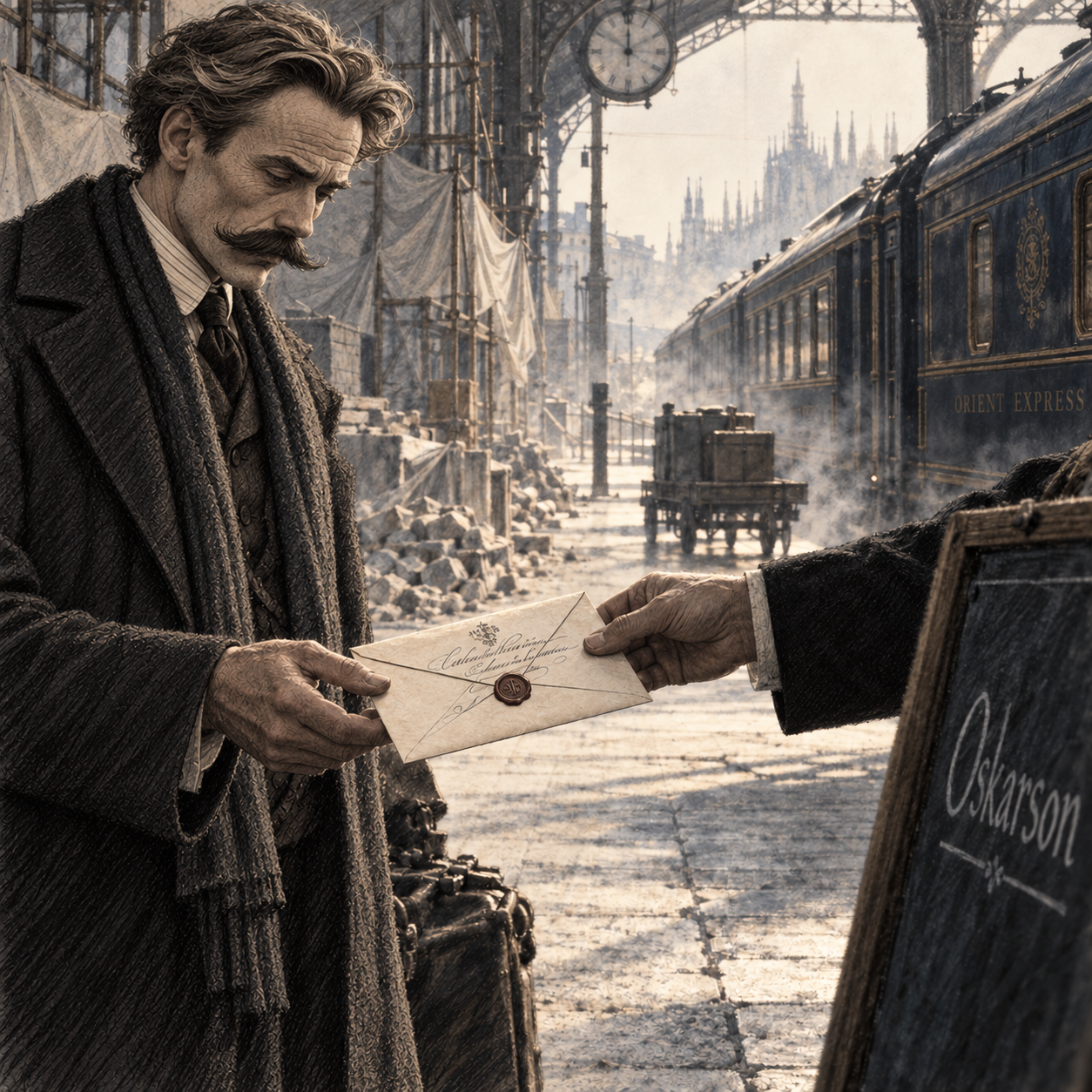
They were gathering what remained of their luggage when a railway employee came hurrying down the platform with a chalkboard held over his head, trying to attract attention without breaking the station’s oppressive hush. Chalked on it was an approximation of Oskarson.
“Well,” Per said. “This is unexpected.”
He stepped forward and introduced himself. The man’s relief was immediate. From his pocket came a sealed envelope, addressed in an ornate hand to my good friends.
Arthur saw Per’s face change before the seal was broken.
“Cavallaro?”
The messenger nodded. Signora Cavallaro had wished to be certain her invitation reached them, should they arrive in Milan.
Of course. The singer from the train. That evening of conversation and Per’s Swedish drinking song belonged to a world Arthur could still recognise, though he had trouble believing how recently they had lived in it.
Per opened the letter. It was as generous as its author had been in person. She had become an enthusiast for Swedish drinking songs, she wrote, though Toscanini must never hear of it. Rooms were arranged for them at La Galleria, above Biffi’s. They would be spoiled. Tickets for the opening of Aida would await them at La Scala under Per’s name, and they must leave her a message there to confirm they were coming.
“I must know where to send my smiles,” Per read.
She closed with a kiss for each of them.
For a moment Arthur could almost hear it in her voice. There was something extravagant and perfectly ordinary in it: a friend offering rooms and an evening out, the pleasure of being expected somewhere.
“It warms my heart,” Per said, looking up. “It is good to know we have a friend here.”
“We must absolutely attend.” Arthur considered him. “Do you suppose she could be persuaded to sing your frog song?”
“She seems anxious that Toscanini remain ignorant of it.”
“A private performance, then.”
“I shall refresh my memory. Just in case.”
Arthur glanced towards the exit. The pull of sleep had returned, but now there was somewhere agreeable to give in to it.
“We could begin by inspecting these rooms. I imagine the beds are comfortable.”
The cab slid sideways on a patch of black ice.
Per caught the seat in front of him, and around him came the small simultaneous sounds of everyone else doing the same. The driver recovered without collision and carried on at his previous unhurried pace, as if the brief disagreement between wheels and road had been settled to everyone’s satisfaction.
Old snow lay in dirty heaps along the kerbs. Meltwater shone between them where the thaw had begun its work; in the shade it had frozen again. Per left his hand where it was.
Then the cathedral came into view, its spires crowding the pale sky. After the ruined station the sheer completeness of it was a relief, stone carried upward in such abundance that the eye lost one pinnacle in the next. The driver named the landmarks in broken English, giving each the confident emphasis of a man whose passengers could at least be expected to admire them.
Near the great arcade he supplied another item of local interest. The architect, he said, had fallen to his death from the arch overlooking the Piazza del Duomo. He pointed out the spot as they passed beneath it, and Per looked up in spite of himself.
Their lodging turned out to be adjoining apartments rather than an ordinary hotel. There was a muddle over names at first, but Oskarson proved as useful here as it had on the platform. Faces cleared, and they were relieved of their luggage and shown upstairs.
Cavallaro had been as good as her word. The rooms were handsomely furnished, their tall windows full of light and looking down over the arcade. Below, the Galleria spread its cafés and shops beneath a high roof, one arm reaching towards the cathedral, another towards La Scala.
Per set down his bag. He had not known how highly he would come to value a room made ready for him, somewhere he might take off his coat without first considering the means of escape.
Arthur went to the window.
“Per, I’m not certain I have suitable clothes for an opening night of Aida. Would you care to go shopping?”
“We bought the finest London had to offer before we left.”
“So we did.”
“Although,” Per conceded, “I have noticed some very keen hats.”
The people below wore them with considerable assurance. Whatever else Milan might be, it took care over its appearance. Coats fitted beautifully; collars, gloves, and hats seemed chosen with an attention that made Per conscious of the angle of his own brim. Even picking through slush, the Milanese looked composed.
“At the very least,” Arthur said, “we could find hats to match our finery.”
Per had meant to rest. There were other things he ought to do as well. The past days had left him low in a way sleep alone was unlikely to mend. He thought of seeking out Viola, or of talking properly with Walter. Admitting that he needed to, even to himself, took effort. For now, Arthur was offering an errand he could readily manage.
“Yes,” he said. “A hat.”
They found no shortage of shops willing to help. The exchange rate made nearly every price sound like a misunderstanding in their favour, and Arthur briefly entertained the merits of buying two. Per submitted himself to the hatter’s mirror with an earnestness better suited to the appraisal of a disputed manuscript.
The first angle seemed too cautious. The next suggested a man who had just heard something improbable. A slight adjustment improved matters.
When they came out, he caught himself checking the result in shop windows. It was absurd how much pleasure the thing gave him. The shape was clean, the fit excellent, and he could enjoy it without having to puzzle over anything.
“We should go to the opera house,” he said. “Let her know we’ve arrived.”
“Now that we can make a proper impression.”
Arthur’s attention kept drifting back towards the comfortable rooms they had left, but he came willingly enough. They crossed the arcade towards La Scala, looking forward to the performance.
Only at the opera house did they discover they had rather more time to prepare than they had supposed.
A corner of pasted paper had lifted from one of the posters.
Arthur stopped to look. Under the amendment he could make out the original opening: Friday, the following night. The new notices all said Sunday. He glanced from one poster to the next. Whatever had happened, someone had gone to the trouble of changing every one.
At the box office he tried French first.
“Pardon, monsieur. Have you tickets reserved for Per Oskarson and party?”
The reply did not assist him. He tried English, then the names of the opera and the singer, which at least belonged to both sides of the conversation. Eventually someone produced paper and a pencil. Written down, Oskarson became a manageable proposition.
The attendant searched a box and found their tickets. Arthur took them with a relief out of all proportion to the accomplishment. In France he had been able to make himself understood. Here, collecting something already arranged demanded the concentration of a treaty negotiation.
Per brought out Cavallaro’s letter and signalled that he wished to write a reply.
The attendant found a notepad, but went on talking, his eyes moving between the letter and their faces. Until then he had conducted routine business. Now there was an awkwardness in him, an appeal Arthur could recognise without understanding a word of it.
Per’s eyes narrowed a fraction.
“Something about Cavallaro.”
“Yes.”
“The change of date, perhaps?”
“Perhaps she’s taken ill.”
Walter offered Latin. It emerged with enough British character to suggest that even the Church might be divided by a common language. The attendant persisted, and Arthur listened harder, catching fragments and sorting them against the French words they resembled. At last he thought he had it.
“He wants to know whether we’ve spoken to her.”
Per looked down at the letter in his hand.
Arthur began counting backwards. Their evening on the train felt distant. Between it and this window lay Edgar’s trial, the pursuit, the waking, the fire. His mind supplied a succession of days that the calendar refused to accommodate. They had left her aboard when they got off at Lausanne, and she had gone on to Milan.
Yesterday.
“Yes,” he told the attendant, attempting the Italian word, then repeating himself in French. “Yesterday.”
The man frowned over this. Arthur could not tell whether he had understood the timing, or whether Arthur had made matters worse. There was more speech, another effort to follow it, and no satisfactory result. They had their tickets and paper on which to leave their message. Beyond that, the conversation yielded nothing certain.
Outside, the pasted dates worried Arthur. There might be a perfectly ordinary explanation. Conductors changed their plans. Singers lost their voices. He resented being unable to ask a simple question and trust himself to understand the answer.
“We need someone who speaks English and Italian,” Per said.
“We do.”
On the way back Arthur bought an English-Italian phrasebook and dictionary. The bookseller’s transaction was refreshingly simple. Coins crossed the counter; a book came the other way. Nobody’s expression suggested that some crucial qualification had gone unmet.
He opened the phrasebook as they walked, reading through greetings, introductions, and requests for directions. He had once acquired French by stages, through necessity and repetition and the sort of errors other men remembered long after the speaker wished them forgotten. That ought to have been reassuring. Instead he was struck by how long it had taken.
Milan moved quietly around them. Footsteps crossed wet paving. People passed in their excellent coats without much conversation. Arthur turned a page and found another useful sentence he would struggle to pronounce.
Walter was glad when Per proposed doing something about the statue.
They had several days before the opera now, and an inquiry, however unpromising, gave them something to do that afternoon. Arthur had raised the possibility of wiring their researcher in Paris. Per doubted a student would know much about the traffic in illicit antiquities, though it was better than no avenue at all. His first preference was a university.
“Historians. Anthropologists. Someone who knows what has found its way into the city.”
The map obligingly offered a University of Milan a few blocks away. A directory made the prospect less satisfying. It was a new institution, still being established, and the other university they found was scarcely older. Milan did not offer the familiar academic footing Per had hoped for. There might be scholars among the clergy, but that too would take time to arrange.
Auction houses seemed the more direct approach. If a piece had left Paris as an antiquity or a work of art, someone who dealt in such things might remember it.
Per turned to Walter.
“Come and talk to them.”
Walter straightened his coat. It was agreeable to be asked for a skill that did not involve confronting anything invisible.
The first welcome was encouraging; the next, more so. His collar did useful work before he had opened his mouth. Shopkeepers received him with an evident pleasure he soon suspected was connected to an assumption about his denomination.
He let the assumption stand. He had too little Italian to correct it, and it would have been ungracious to open every conversation by disappointing his hosts.
The auction houses also supplied what La Scala had not: people accustomed to doing business in English. Their customers came from abroad. They had cultivated the ability to understand a foreigner with money, which Walter considered a commendable professional habit.
Unfortunately, understanding the request did not mean they could answer it. A fragment of an ancient statue, sold in Paris after the war, or believed sold, to a purchaser from Milan gave them little to go on.
“No, Father. I cannot recall such a thing.”
They described the piece as closely as they could from the one in their possession. Per was careful to offer detail without inviting anyone to suggest they fetch the specimen from the railway safe. Walter explained the date range again. Arthur helped where he could. At one establishment they were heard patiently; at another, enthusiastically. Neither manner produced a lead.
Outside, the afternoon light began to lose what little warmth it had held. Walter kept his voice interested and his requests courteous. Each refusal left the next shop no less deserving of a pleasant greeting.
At last a proprietor paused.
“A part of a statue,” he said. “Yes. That does sound familiar.”
Walter waited while the man went to his records. Beside him Per had gone very still.
There had been a listing, the proprietor explained, from a Parisian auction house. More than one listing, in fact, during roughly the period they had named. The historical information had been scanty.
“A torso,” he said. “No arms, no legs. No head.”
Walter looked at Per. After so many polite denials, the words seemed almost indecently precise.
“Do you know who purchased it?”
The man did not. He was not even certain it had sold. There had never appeared to be much interest in it.
“And your interest?” he asked.
“We have leads concerning several pieces of the same statue,” Walter said. “We’re trying to establish whether it can be reassembled.”
“It may have historical significance,” Per added. “In its present state, that is difficult to judge.”
The proprietor considered them.
“And you believe this piece came to Milan?”
“We believe the purchaser was Milanese,” Per said. “Whether it was brought here or taken elsewhere is less clear. We are passing through for the opera and thought we should make inquiries.”
Walter appreciated the distinction. They still had no proof that the torso had reached Milan, or even that the object in the records was the one they sought.
The man offered a solution suited to his profession. They might retain Vincenzo’s House of Auctions to pursue the matter. He would use his local connections, ask whether such a piece had entered the city’s markets, and attempt to trace it.
“For a most nominal fee.”
Per expressed confidence that a lover of art would understand the wishes of fellow collectors. Arthur began assembling the necessary money. For all the ceremony around it, the negotiation was brief. They settled on the equivalent of ten pounds for several days’ inquiries, and Arthur paid.
Walter felt some of the afternoon’s effort go out of his shoulders. They had a description and someone who could make further inquiries in Italian.
Per supplied the last practical detail.
“We shall be here at least until the opening of Aida. We are looking forward to hearing our friend Cavallaro.”
“The diva? You know her?”
“We have that pleasure.” Per watched him. “But her name seems to bring some troubled expressions. Is everything quite well?”
The proprietor shrugged. He did not know one way or the other.
Walter listened to the Italian phrase that followed and could make no more of it than he had of the attendant’s unease at La Scala. The man had given them all he was prepared, or able, to give. They left the auction house with their arrangement made.
Viola noticed the quiet again as the door closed behind them.
At the station it had been easy to explain. Dust, scaffolding, the nuisance of building work: nobody wanted to linger there. In the arcade she had been distracted by the shops and the rooms, by the agreeable proof that Cavallaro remembered them. But now, late in the afternoon, there were people all along the pavement, and still very little sound.
She heard shoes in the wet, the small disturbance of someone passing close, a door shutting farther down the street. What she missed was the rise and fall of voices. People went about their business with lowered faces, beautifully dressed and curiously withdrawn.
For a while she had wondered whether they were dreaming again. She disliked how readily the thought had come. There had been a time when a subdued street was merely a subdued street. Now she found herself looking for some small failure in the ordinary arrangement of things.
Arthur carried his new phrasebook, and Per wore his new hat. Claire walked with them through the narrow channels between heaps of dirty snow. They looked like travellers who had spent a tolerably successful afternoon in a handsome city.
Ahead, a newspaper seller stood beside a stack of the afternoon edition.
“Have we looked at a newspaper?” Viola asked.
They had not. She went up and asked, in English made considerably louder by uncertainty, for a copy. He understood her more readily than she had expected.
“English?”
“Yes. Thank you.”
He found the local paper’s English edition in his stock and handed it over. Viola opened it at the front page.
Cavallaro was missing.
The paper spelled her name Cavollaro, but there was no comfort to be found in that small difference. It was their friend, the singer who had arranged their rooms and invited them to La Scala. According to the report, she had disappeared after arriving at Milan’s Stazione Centrale. Police feared she might have been abducted.
Viola read that part again. A fear, then; the paper did not make it a certainty. It was enough to leave her standing still while the others drew in around her.
The paper crackled between her gloves as she held it where they could all read. Arthur’s attention sharpened. Whatever ease the lunch, the rooms, and the shopping had restored to him went out of his face.
Viola thought of the attendant leaning towards them at the box office, trying to get past their incomprehension. Had they spoken to Cavallaro? They had answered him as though he wanted an introduction.
And the invitation had been waiting at the station. She pictured the railway employee carrying it down that dusty platform, carefully preserving the quiet. The welcome had reached them; the woman who had sent it was missing.
“Well,” Arthur said after a moment, “if it weren’t for Madame Suttcliffe, we shouldn’t even know we were caught up in a mystery.”
There was gratitude in it, but little of his earlier amusement.
“At first I wondered whether we were dreaming again,” Viola said. “Everything seemed so off. So subdued.” She looked down at the page. “So quiet.”
Per drew the envelope from his pocket.
He had been pleased each time he touched it that afternoon: at the apartments, at La Scala, even while they made their inquiries. Someone had remembered them kindly and arranged for their comfort. He had wanted very much to accept that kindness without examining it.
The fold had softened with handling. A trace of perfume still lived in the paper. He opened the letter beside the newspaper Viola held.
I must know where to send my smiles.
He could hear her saying it. A few hours earlier he had been preparing to sing for her again.
“Well,” he said. “This has gone from a charming letter to a piece of evidence.”
Around them the people of Milan went quietly along the pavement. Per kept the invitation open in his hand.
The Orient Express: rest and the Milan lead Leaving Lausanne behind, Arthur Zorba, Claire Corning, Walter Lake, Viola Suttcliffe, and Per Oskarson continued toward Milan aboard the Orient Express. Their route took them through the Alps by the Simplon Tunnel. With another city approaching, they reviewed the Milan entry in the investigation notes supplied by Professor Smith’s man Beddows: a piece of the Simulacrum had circulated in Paris shortly after the Great War and had reportedly been sold to someone from Milan. That transaction was their starting point, rather than an address or a named person they could immediately visit. Arthur and Per recognized that they had not investigated this particular sale while they were in Paris. They considered contacting the research helper they had previously paid there, using a telegram to put someone nearer the original transaction back on the trail. No telegram was composed or sent. The existing information connected a purchaser with Milan, but did not establish that the fragment had actually been brought to the city or that it remained there. Finding the buyer, identifying the sale, and locating the object were still separate problems. Arthur’s recurring sleep condition remained active. Since Lausanne, he seemed less well, with sleepiness taking the place of some of his earlier jumpiness. He remained susceptible to further involuntary episodes, although none occurred during this journey. His ability to wake and function between episodes did not mean that the underlying condition had passed, and no cure or definite duration had been established. Exhausted after Lausanne, the investigators took advantage of the remaining journey to sleep for roughly four hours. They rested in a car with places to doze, rather than in private overnight sleeping compartments. Before arrival, the train staff supplied a light lunch. The comfort and respite of the Orient Express restored 1 Sanity to each of the five investigators: Arthur, Claire, Walter, Viola, and Per. This recovery did not remove Arthur’s continuing sleep condition. The postponed development phase was also completed. Per received his ordinary Luck recovery and an additional 4 Luck from his pulp talent. Viola’s valid Luck recovery was 1 point, and her Spot Hidden improved. These changes accompanied the shared Sanity recovery; no new injury, involuntary sleep episode, or further treatment occurred aboard the train. A guidebook and map provided an introduction to Milan before they disembarked. None of the party had established experience exploring the city, so they approached it with a broad research lead and the prospect of finding useful local contacts. The train arrived on time at approximately 12:20, bringing them from the relative comfort of the carriage into a station whose appearance was immediately unsettling. Milan station: a perfumed invitation and stored weapons The platform was nearly deserted despite the midday arrival. Scaffolding and canvas covered parts of the station, heaps of stone and concrete lay nearby, and dust hung thick enough in the air to taste. Only a few other passengers left the train, while sleepy station porters gathered luggage. The rubble gave the place the appearance of a recent disaster, but no explosion or attack was established. Per asked a train porter, “Excuse me, what has happened to this station? This is clearly not regular.” The porter attributed the work to Mussolini’s government, saying that the existing architecture did not fit its values and was being changed. He regretted the alterations, describing the old station as beautiful. This was the explanation offered to the investigators; they did not pursue an independent inquiry into the building works. A uniformed railway employee approached carrying a chalkboard with Oskarson’s surname. Once Per identified himself, the employee handed him a sealed, perfumed envelope from Cavallaro, the opera singer they had recently befriended aboard the train. She had arranged for the invitation to reach them if they came to Milan. Her affectionate letter recalled their evening together and Per’s Swedish drinking song, joking that Toscanini must not hear of her new enthusiasm for it. Cavallaro had arranged accommodation for the party in the Galleria and opera tickets under Oskarson’s name at La Scala. She wanted them to leave a message at the opera house confirming that they would attend: “I must know where to send my smiles.” Her invitation was to the opening of the current production of Aida. Per welcomed the prospect of having a friend in Milan, and Arthur was eager to attend an Italian opera. The party accepted her hospitality and made the Galleria and La Scala their immediate destinations. Before beginning their activities in the city, the investigators also had to settle the question of their firearms. The station police told them that, as foreigners, they could not obtain the necessary permits. Arthur tried to use his military uniform and charm to secure permission to retain his handgun. When that did not work, he offered money as though he had misunderstood the required fee. His Charm attempt failed, and he declined either to push the attempt or to spend the 25 Luck needed to turn it into a success. The officers took offense and returned the money. Arthur obtained no permit, but no arrest followed. The railway company agreed to hold the party’s firearms securely at the station and issued claim tickets for later retrieval. Per then asked to leave the statue-bearing chest there as well, and Arthur extended the arrangement to their other specially made chests. The lead-lined containers were of different sizes, intended for collecting further fragments; only one currently held their existing statue fragment. The firearms and all these chests remained in railway-company storage when the investigators left. They retained the means to reclaim them, but would conduct their initial Milan inquiries without immediate access to either their guns or the fragment. The Galleria: comfortable rooms and fashionable hats A French-speaking intermediary at the station helped communicate the party’s destination to a cab driver. The drive into central Milan passed the Duomo and crossed roads made treacherous by melted snow that had frozen again. The cab briefly slid on black ice, but there was no accident or injury. Near the Galleria Vittorio Emanuele, the driver pointed out the great arch and claimed that the arcade’s designer had fallen to his death from it. At their destination, some confusion over names ended when the staff recognized Oskarson’s party. Their remaining luggage was carried upstairs, and they were shown to adjoining, well-furnished apartments with large windows overlooking the arcade. Cavallaro’s arrangements gave them comfortable lodgings suited to wealthy travelers and a convenient base for their stay. The Galleria connected the cathedral square with the square near La Scala, placing the opera house, shops, and cafés within easy reach. Outside, Milan combined elegant architecture and fashionable inhabitants with heaps of wet, dirty snow. Well-tailored clothes and modern hats were conspicuous. Per tried to assess the people around them, but his failed Psychology attempt gave him no explanation for the city’s mood. What he could readily observe was the attention Milanese people paid to appearance and beauty, expressed in both their clothing and their surroundings. Those visible details offered no answer to the unusual quiet they had encountered on arrival. Arthur invited Per to shop for suitable opera attire. Per reminded him that they had already bought fine clothes in London, but admitted that he wanted one of the fashionable local hats. They settled on hats to complement their existing finery and visited a Milanese hat shop before calling at La Scala. The favorable exchange rate—approximately ninety lire to the pound—made the purchases affordable. Arthur and Per obtained hats, and Per was subsequently adjusting his new Milanese hat as they walked. Amid these preparations, Per admitted that he felt down after their recent experiences and considered seeking help. He first mentioned Viola, then learned that Walter could offer Psychoanalysis. Per said that he might come to Walter later, and Walter agreed. This established a possible source of care within the party, but no consultation or treatment took place, and Per gained no additional recovery from the conversation. La Scala: a postponed opening and unanswered concern On approaching La Scala, the investigators discovered that their opera plans allowed more time than they had expected. Posters advertised Aida, but pasted amendments had changed the opening date. One amendment was peeling away, revealing the original announcement for Friday, the following day. The replacements advertised Sunday night, three days after the party’s arrival. Whatever their earlier hopes of attending immediately, the performance now gave them several days in Milan. Nothing on the posters explained why it had been postponed. Arthur approached the box office to collect the tickets Cavallaro had reserved. He tried French and English, but the attendant did not initially understand the request. Writing down Oskarson’s name finally resolved the difficulty: the attendant found the reservation and handed over the tickets. The party therefore secured its admission to the production despite the confusion over language and the revised opening date. Per showed Cavallaro’s letter and tried to arrange the reply she had requested. The attendant supplied a notepad so they could leave word that they intended to attend. The exchange then became awkward, however, as the attendant tried to communicate something more personal about the singer. The investigators began the effort to leave a message, but whether a completed reply was left—and whether any reply reached Cavallaro—remained unresolved. Walter attempted Latin without success. Per tried to judge the emotional sense of the conversation, while Arthur managed only partial understanding through French. They gathered that the attendant seemed to be asking whether they had spoken to Cavallaro. Per sensed awkward personal concern, but neither that impression nor Arthur’s partial comprehension gave them the explanation they needed. The attendant’s questions suggested there was more to understand than a straightforward ticket transaction, yet the language barrier prevented them from learning what it was. Arthur wondered whether Cavallaro might be ill; Per considered whether the conversation concerned the postponed opening. Both were guesses. Their most recent contact with her had actually been yesterday: she had remained aboard the train and continued toward Milan when they disembarked at Lausanne. Their experiences in the dream had made the interval feel much longer. Arthur tried to convey how recently they had seen her, but the party left without establishing the reason for the attendant’s concern or the cause of the delay. The frustrating conversation made the need for better communication practical rather than merely inconvenient. Per remarked on the value of finding someone who spoke both English and Italian. Arthur purchased an English–Italian phrasebook and dictionary and began looking through the introductory material. He now had an aid for future exchanges, though the purchase itself did not grant him an immediate language improvement or resolve what they had failed to understand at La Scala. Milan’s auction houses: a possible torso in the records By mid-afternoon, the investigators turned back to the reason they had come to Milan: tracing the reported postwar sale. Arthur asked Per about useful local research contacts and again raised the possibility of telegraphing their helper in Paris. Per was unsure that the student would know artifact dealers, although he thought the contact might be better than nothing. His preference was to seek historians, anthropologists, and libraries that could help establish the statue’s history. Academic and church avenues remained possibilities rather than completed inquiries. The University of Milan was only newly being established, and another Catholic institution under discussion was also new. The party considered church scholars as potential contacts, but spent the remaining business hours visiting art dealers and auction houses instead. Those firms offered a practical route to sale records, provenance information, and international connections that might link a Paris transaction with a Milanese purchaser. No university visit, church inquiry, or telegram followed during the session. Per recruited Walter to do the talking. Walter achieved an extreme Charm success, securing an unusually warm reception among the dealers without needing the offered bonus die. His clerical appearance worked strongly in their favor: the dealers seemed to take him for a Catholic holy man and welcomed his presence as good fortune. Walter allowed that assumption to stand. Unlike the encounter at La Scala, language was less of an obstacle here, since firms handling international clients readily had English speakers available. The investigators described an ancient statue fragment and placed the transaction in the period after the Great War. Their own fragment remained in its chest at the station, so they did not produce it for inspection. Most of the firms they visited could recall no matching piece arriving from Paris. Walter’s reception gave them access to willing listeners, but those early interviews did not identify a buyer or locate another part of the statue. Late in the day, one proprietor found the description familiar and searched his records. He reported that a Parisian auction house had repeatedly listed a torso without a head, arms, or legs during the relevant postwar period. The listing provided little historical information, and he remembered little interest in the object. Crucially, he did not know whether it had ever sold. This gave the investigators a more specific candidate to pursue, but did not confirm the reported transaction, identify the Milanese purchaser, or authenticate the torso as part of the Simulacrum. Walter explained that they had leads on several pieces of one statue and hoped to reassemble it. Per stressed its possible historical significance while acknowledging a limitation in their original lead: even if the purchaser came from Milan, the object might have been taken somewhere else. The proprietor’s records were promising because the object and period could fit their search. They still needed a connection between that listing, the sale described in Beddows’s notes, and whatever had happened to the torso afterward. The proprietor offered the services of Vincenzo’s House of Auctions to make local inquiries and trace whether an object of that description had passed through Milan’s markets. Arthur accepted and paid ten pounds’ equivalent in lire as a retainer for several days of work. The party now had a paid local intermediary with access to contacts and records they lacked. No findings from that commissioned inquiry had yet arrived, and the payment brought neither a guarantee of success nor an immediate location for the piece. Per said that the investigators expected to remain at least until the opening of Aida. He mentioned their acquaintance with Cavallaro and asked whether everything was well, drawing attention to the dark expressions he had noticed when her name arose. The proprietor said that he knew nothing one way or the other. The visit therefore advanced the statue search but supplied no explanation of the concern surrounding their friend. The party left the firm to pursue its inquiries while they returned to the subdued streets. The afternoon newspaper: a missing singer Milan’s public atmosphere remained strikingly quiet. People moved sedately and appeared withdrawn, with few voices breaking the stillness. Viola asked whether anyone had checked a newspaper and approached a hawker in loud, halting English. He supplied Corriere della Sera, English Edition — Milan, giving the investigators an afternoon paper they could read without repeating the language difficulties of the opera house. Its front page reported that soprano Caterina Cavollaro, the friend who had arranged their accommodation and tickets, was missing. According to the article, police feared that she might have been abducted from Milan’s Stazione Centrale. This was a reported fear, with neither an abduction nor an explanation for her absence established by the investigators. The article reported that the singer had not been seen since alighting from the Paris train at 1pm on the previous day, relative to the newspaper. It said she had neither returned to her apartment nor attended rehearsals at La Scala, where she was due to sing the title role in Aida. These details supplied several places and people through which the party might investigate her absence, but they had not yet checked any of the reported circumstances themselves. The paper identified Arturo Toscanini as La Scala’s music director and reported that he had received no contact from the singer since she departed Paris. It also conveyed a police appeal for anyone with information about her whereabouts to come forward and urged Milanese readers to join the search. Cavallaro’s apartment, the station, La Scala’s rehearsals, Toscanini, and the police appeal all offered possible avenues for further inquiry. The undated article described Aida as opening the following night. The posters the investigators had seen at La Scala separately showed an original Friday opening amended to Sunday. The newspaper’s timing remained unreconciled with those amendments. Neither the article nor the party’s inquiries established why the production had been postponed or whether the delay was connected to the singer’s reported disappearance. Arthur credited Viola’s initiative with revealing that they were caught up in a mystery. Viola explained that the city’s strange, subdued atmosphere had already made her wonder whether they were dreaming again. That remained her suspicion about what they had encountered, rather than confirmation that they had entered another dream. The report did not establish any connection between Cavallaro’s absence and Milan’s unusual quiet. Per took out Cavallaro’s perfumed letter and reconsidered it. What had arrived as a charming invitation from a welcome friend now seemed to be a piece of evidence. He retained the letter, but its precise significance—and its timing in relation to her reported disappearance—remained unknown. The session ended with the investigators reacting to the news on Milan’s streets, apparently heading back toward their Galleria accommodation. They had not yet chosen a lead to pursue, approached the police, or begun an investigation of the disappearance. Where things stand The party has a base in Milan and tickets for Sunday. Cavallaro’s adjoining Galleria apartments provide comfortable accommodation close to La Scala. The investigators have collected their Aida tickets and expect to remain at least through the advertised Sunday opening. Arthur and Per have new hats for the occasion, and Arthur has an English–Italian phrasebook and dictionary for further conversations. The newspaper reports Cavallaro missing, with police fearing possible abduction. Its account places her last sighting at Stazione Centrale and says she has not returned home, attended rehearsals, or contacted Toscanini since leaving Paris. Those remain newspaper reports; her actual whereabouts, condition, and the cause of her absence are unknown. The party’s last personal contact with her was the previous day aboard the train. Per retains her invitation as possible evidence, while delivery of their attempted reply remains unsettled. The station, her apartment, La Scala, Toscanini, and the police appeal are available leads, but none has yet been pursued. The reason for the opera’s postponement also remains unknown. The Simulacrum search has a more specific lead and a paid investigator. According to the auction-house proprietor, a headless, limbless torso was repeatedly listed in postwar Paris. Its connection to the Simulacrum, any completed sale, the purchaser’s identity, and its present whereabouts remain unconfirmed. Vincenzo’s House of Auctions has received Arthur’s ten-pound-equivalent retainer for several days of local inquiries. The proposed Paris telegram and academic or church inquiries remain unused avenues. Important equipment remains at Milan station. The railway company holds the investigators’ firearms and lead-lined chests, including the chest containing their existing statue fragment. The party has claim tickets for later retrieval. Nothing has been recovered from storage, and no additional statue fragment has been acquired. The journey provided limited recovery. All five investigators regained 1 Sanity. Arthur’s recurring sleep condition continues despite the rest, and Per remains troubled by recent experiences. Walter has agreed that Per may approach him for psychological care, but no treatment has begun. Wellington’s hidden scroll also remains an unresolved earlier lead, with no new authentication or translation completed.Session Notes