The aftermath of violence lingered in the air like the echo of a scream swallowed by velvet walls. Though the train sped onward through the Dreamlands with its usual impossible grace, something had shifted among its passengers—some subtle but irrevocable fracture in the illusion of civility. What had erupted in the saloon was not merely an incident, but a revelation: that beneath the fragile order of this journey lay forces capable of reaching into flesh, mind, and identity itself.
Claire retreated first.
Behind the closed door of her compartment, the world narrowed to the clink of glass and the quiet tremor of her own breath. The memory of claws tearing at a woman who did not bleed—of a man whose eyes burned red with alien will—refused to settle into coherence. It hovered instead at the edge of comprehension, a thing half-seen and wholly felt. When Per arrived, bearing drink and quiet concern, she let him in not out of readiness, but because solitude had begun to feel like a more dangerous companion.
Their conversation unfolded haltingly at first, like probing a wound to gauge its depth. Per spoke of burdens—of the strange promise whispered by the Dreamlands, that one might shed what weighed upon the soul. Claire resisted the abstraction, grounding herself instead in the tangible: engines, war, memory. But as the hours stretched on, something gave way. Beneath the surface of her confusion lay a quieter truth, one she had not named until now—that her guilt, long carried without scrutiny, had less to do with what she had done, and more with what she had been denied the chance to do.
It was not the horrors of the train that broke her composure. It was the war, and her absence from it.
By the time the final glass was emptied, she felt lighter—not unburdened, but reoriented. The chaos of the Dreamlands no longer pressed inward quite so sharply. There were still questions, still terrors—but now they had edges she could grasp.
Elsewhere, Arthur refused the luxury of retreat.
Drawn by instinct or obligation, he sought out Madame Brugia, whose composure in the face of monstrous assault had been as unsettling as the attack itself. Her door remained closed, her voice sharp with dismissal. She claimed no need of assistance, and the finality in her tone made it clear that further insistence would yield nothing but hostility. Yet even in refusal, there was something brittle in her words—something held tightly in place, lest it fracture.
Viola, more perceptive in such matters, chose not to press. Instead, she later found Brugia in the quiet refuge of the ladies’ parlor, where conversation flowed not toward truth, but around it. Fashion became their shared language, a veil drawn deliberately over deeper concerns. Beneath it, however, subtle currents stirred. Brugia’s poise did not slip, but neither was it impenetrable. There were moments—brief, flickering—when warmth surfaced, unbidden and unguarded. Enough to suggest that whatever bound her to this place was not yet beyond reach.
Arthur’s path led elsewhere.
In the baggage car, amid the strange commerce that sustained the train’s existence, he found Henri. The conductor, ever composed behind his porcelain mask, spoke of Brugia with a detached certainty that carried its own unease. She was not merely a passenger. She was something that had lingered—something no longer of the waking world, yet not released from it either. Like so many aboard this train, she was held fast by a purpose, or perhaps an obsession, that denied her dissolution.
Arthur pressed further, seeking answers for the red-eyed transformation that had nearly turned companion into killer. Henri offered none. The phenomenon was unfamiliar, even to him. Yet his intuition pointed not to the afflicted man, but to Brugia herself. Whatever had seized Mironim-Mer had done so with knowledge—perhaps even intent.
And so the train continued, its passengers left to their own reckonings.
At Aferat, the illusion of normalcy reasserted itself in the form of trade. Beneath towering walls and the scent of distant sea air, Henri conducted his business with practiced ease, exchanging lilies of impossible hues for funerary artifacts shaped by hands that understood death in ways the living could not. The purpose of the lilies—adorning the dead in a city devoted to burial—lent the exchange a quiet gravity. Even here, commerce was bound to endings.
Dinner followed, lavish and disquieting in equal measure.
Mironim-Mer attended, though the weight of what had passed lingered visibly upon him. He remembered nothing of his transformation, yet the knowledge of what he had done settled heavily in its absence. Guilt without memory—a paradox that gnawed at him. Per, extending cautious empathy, sought to bridge the gap between action and identity, offering the possibility that what had occurred was not truly his doing. Whether this comfort took root remained uncertain, but it was accepted, if only as a temporary reprieve.
Madame Brugia, for her part, maintained her composure, speaking lightly with Viola while ignoring the man who had nearly torn her apart. If she bore resentment, she did not display it. If she possessed knowledge, she did not share it.
The tension at the table was palpable, though unspoken. Each knew that the events of the day had not resolved anything. They had only revealed how little any of them understood.
Then came Thalarion.
Henri’s warning was clear: do not disembark. The city ensnared those who looked too closely upon it, binding them in fascination until they could no longer leave. Yet even from the safety of the train, its presence pressed against the senses—glittering lights in the distance, movement glimpsed but not resolved.
Arthur remained awake as the train paused, watching.
It was then that the figure emerged.
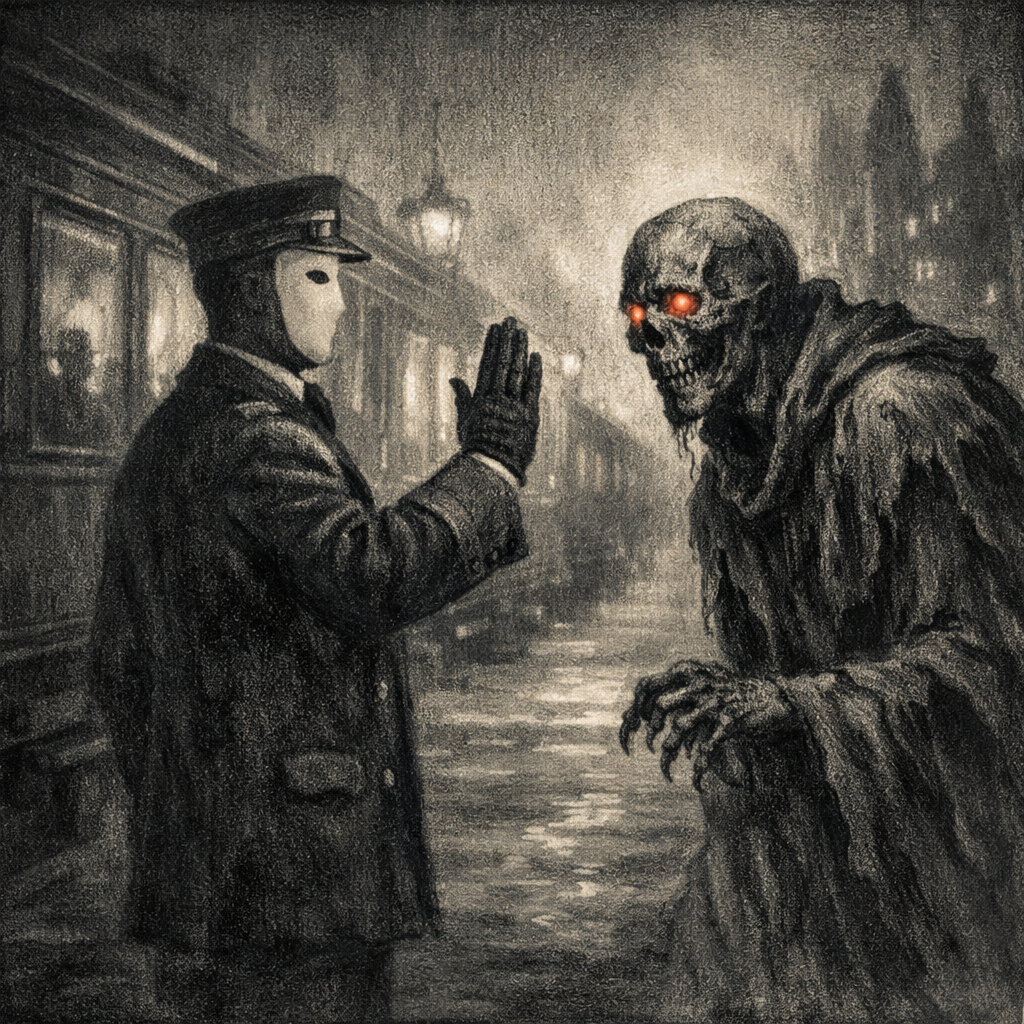
Burned robes, skeletal limbs, a skull marked by fire—and within its hollow gaze, the same terrible red light that had consumed Mironim-Mer. It approached with deliberate purpose, its very presence warping the stillness of the platform. When it spoke, its voice carried the texture of something long destroyed, yet not extinguished.
It demanded passage.
Henri refused.
What followed was not a confrontation of strength, but of authority. The conductor stood firm not by his own power, but by invoking something greater—something that governed the train itself. Nodens. The name carried weight, enough to halt the creature where force might not have sufficed. For all its menace, it was not beyond the reach of that rule.
The figure withdrew, leaving behind only the echo of its presence and the unsettling certainty that it had been here before.
Arthur understood then—at least in part. The red eyes were not an isolated phenomenon. They were a mark, a signature of something that moved through this world with intent, touching minds and reshaping them according to its will.
Henri, for all his composure, could not entirely conceal the tension that followed. When he spoke of the creature, it was with a rare note of doubt. This was not one of those who sought peace or release. It had cast aside its humanity willingly, in pursuit of something else.
Power.
And in doing so, it had become something that even the Dreamlands could not fully contain.
The train departed soon after, leaving Thalarion—and whatever watched from its shadows—behind. Yet the sense of being observed did not fade with distance.
It lingered.
As did the knowledge that whatever had reached into one passenger’s mind might yet reach again.
And that the rules of the train, however powerful, were not absolute.
Session Notes
-
The session begins with a recap of the previous events aboard the train.
- In the men’s saloon, Walter Lake had attempted a dramatic revelation of the mystery, though at that moment he had not actually known who the killer was.
- The real reveal came from a Being of Ib accompanied by a fungal squeaker, which identified Mironim-Mer as the one it had seen.
- Upon being identified, Mironim-Mer transformed into a horrible crustacean-like monster.
- His eyes turned red and he hurled himself across the car at Madame Brugia, trying to seize her valise.
- Madame Brugia proved shockingly effective at keeping the valise away from him.
- In his frenzy to take it, Mironim-Mer clawed her, tearing both her clothing and her flesh.
- Even though those watching could see his claws penetrate her body and could see rents beneath the torn clothing afterward, there was no blood.
- Despite the visible damage to her clothes and body, Madame Brugia did not appear seriously harmed.
- Walter blessed water and threw it across the room while shouting prayers.
- MacKenzie and Karakov tried to pull the creature off Madame Brugia.
- Arthur Zorba was initially so stunned that he mostly stood dumbfounded.
- Arthur then attempted to imagine a pistol into being, but instead manifested a crossbow, which he fired and missed with.
- Claire lost control of herself and fled the car.
- Per Oskarson expended a great deal of luck and magic and lost sanity during the incident.
- Per first appealed to the Being of Ib for help, and the entity telekinetically hurled Mironim-Mer halfway across the car and off Madame Brugia.
- Per then managed to subdue Mironim-Mer with Vines of Nightmare.
- While Mironim-Mer was downed, Madame Brugia screamed that his master would never get what was being sought, and that there was nothing in the case.
- She held the case open over him while she shouted.
- She then left the car and said she was returning to her compartment.
- After the struggle, Mironim-Mer calmed down, returned to human form, and his eyes changed back from red to gold.
- Walter was convinced that the book Mironim-Mer carried was not truly a book of poetry, but “the devil’s pages,” and believed it had led to Mironim-Mer’s possession.
- Mironim-Mer insisted it was one of the last artifacts of his people and did not want it taken from him.
- Walter nevertheless persuaded him to allow Walter to hold onto it until Mironim-Mer was ready to leave the train.
- That was where the previous session had ended.
-
At the start of the present session, it is mid-afternoon and the train is en route to Aferat.
- Claire has regained her wits after fleeing, but remains shaken.
- Per is physically and mentally drained after expending roughly 50 luck, 10 magic points, and losing 5 sanity.
- Per decides he wants something to calm himself, and there are drinks going around after the earlier disturbance.
- He intends to bring Claire a drink and check on her.
-
Claire has withdrawn to her own compartment.
- Each passenger has a private compartment rather than sharing.
- Claire’s compartment is closed when Per arrives.
- Per knocks.
- Claire opens the door.
- Per offers her a drink, specifically bringing her another gin and tonic because it is what he had seen her drinking.
- Claire invites him in.
- Per notes the luxury of the compartment.
- Claire immediately downs the drink he brought her.
- Per tells Claire he wanted to help her with the troubling experience they had just endured, but also wants to discuss another related matter.
- Claire says that if he had tried to have this conversation before, she must have run off to do something else, possibly poker.
-
Per speaks to Claire about the Gulf of Nodens and the opportunity it presents.
- He says he has been wrestling with the question of what burden he might discard there and how doing so might change who he is.
- He realizes he may have been thinking about the idea too much as a psychologist and not enough as a passenger on the Dreamlands Express.
- Per suggests that perhaps the group’s true burdens may include the supernatural entity that seems to be pursuing them and wanting to “ruminate upon their souls.”
- Claire agrees that this sounds right.
- She compares it to Arthur not facing what happened to him during the war.
- Per comments that Arthur also seems to be the one who secures the guns whenever the strange issue with the arms dealer arises.
- Claire says it still troubles her that only some people can hear that phenomenon, but says there are at least three minds involved, so there may be no point in thinking too hard about it.
- Claire says she is muddled and overwhelmed by everything that has happened.
- She complains about “demons in the weird meat engine,” contrasting that with how engines ought to be made of grease and gears.
- She says that what happened with Madame Brugia is so disturbing that she can barely even talk about it or remember it.
-
Per says that the transformed attack by Mironim-Mer was extremely troubling.
- He says there is clearly a larger story there and admits he is the sort of person who cannot resist learning more, comparing himself to a child who keeps touching a hot stove.
- Claire points out that a child is normally supposed to stop after touching the stove once.
- Per jokes that, as a scientist, he must touch it multiple times to test repeatability.
-
Claire develops Per’s idea of burdens.
- She says that perhaps the burdens are more materially real than they first appear.
- She says they may not be something obvious like a wrench, but may still take some more tangible form than expected.
- She says that Henri has been strongly hinting that she is carrying a significant burden.
- Claire suspects it is connected to the “spooky Latin ghoul” who woke her some time ago, though she says she no longer has a clear sense of time.
- Per agrees that being free of that creature’s attention could be valuable.
- Claire says that at the same time, it also seems connected to their mission involving the statue, and she invokes the saying about keeping one’s enemies closer.
- Per says he wonders whether the burden of that creature could somehow be separated from the group’s larger mission.
- Claire jokes that Per’s English sayings baffle him as much as his Swedish expressions baffle her.
-
Per offers Claire psychotherapy.
- He says the incident in the train car is clearly weighing on her, and wonders whether a round of psychotherapy might help her regain some sanity.
- Claire reluctantly agrees and likens it to not allowing a faulty motor to keep misfiring until it blows up in midair.
- Per pushes back on her self-description and tells her she is not a faulty motor.
- He says he wants to help her think about her experiences differently so she can remain herself and move forward.
- Claire agrees to go through with it, but not before finishing another gin and tonic.
- The scene is treated as Per guiding Claire through her recent experiences and perhaps also discussing her parents.
-
While Per is with Claire, the rest of the party acts elsewhere on the train.
- Arthur, realizing that the immediate danger has passed, decides to go after Madame Brugia to check on her.
- Walter and Viola both go with him.
- They make their way a couple of cars away to Madame Brugia’s compartment.
- Her door is closed.
- Arthur knocks and identifies himself, saying that there was quite a lot of mess earlier and that he is concerned for her.
-
Madame Brugia refuses Arthur’s attempt to help.
- Without opening the door, she says she is fine and does not need any more assistance.
- Viola tells her that if she wants to talk, perhaps in the ladies’ car, she should let them know, but that she need not do anything right away.
- Madame Brugia says she simply needs a moment to gather herself, that she is going to drink tea, and then she will decide what is next.
- Arthur says that although she is clearly a capable woman and he does not know her well, sometimes everyone needs a little help, and they are there if she needs them.
- Madame Brugia grows more frustrated and asks why men always feel the need to insert themselves where they are not wanted.
- Arthur replies that it is probably in their nature.
- After that, the group is met only with icy silence.
- Viola tells Arthur that her question was rhetorical.
- Arthur admits he misjudged that.
-
After leaving Madame Brugia’s door, the group notices Walter’s condition.
- Walter is still damp from throwing holy water everywhere.
- He also has a bandage around the hand he cut when he sliced himself with the vessel he used for the holy water.
- Arthur proposes that they get Walter properly cleaned up and bandaged.
- Conveniently, they find a tray outside Walter’s compartment containing bandages and iodine.
- Arthur uses First Aid on Walter.
- The treatment restores 1 hit point.
- Walter’s hand still hurts, but it is no longer a ragged wound.
- Arthur makes sure all the glass is removed.
- Walter is effectively back to full health, because the original injury was only 1 point of damage.
-
Arthur and Walter discuss what happened with Mironim-Mer.
- Arthur asks whether Walter saw what happened, saying he could not track Mironim-Mer during the chaos and only saw something attacking Madame Brugia.
- Walter says he believes Mironim-Mer was possessed by some kind of demon or devil.
- Walter notes that in the dream world such possession may produce a more literal physical metamorphosis.
- Arthur says that sort of matter is right up Walter’s alley.
- Arthur compliments Walter’s readiness with the holy water and says Walter seemed to bless it quite effectively.
- Walter admits he was somewhat disappointed in its effectiveness.
- Arthur points out that the vines that manifested during the struggle may well have been related to Walter’s intervention.
- Walter agrees that God works in mysterious ways.
- Arthur says that the situation was certainly mysterious enough to qualify.
-
The psychotherapy between Per and Claire is mechanically resolved.
- Per initially rolls very poorly on the psychoanalysis attempt and chooses to push the roll.
- The stated risk of failure on the push is that Claire would become more resistant to such treatment in the future, regarding it as nonsense.
- The pushed roll succeeds with an extreme success.
- Because of the extreme success, Claire regains 1d6+1 sanity rather than the normal 1d3 for a session.
- Claire regains 7 sanity in total.
-
Claire has a major breakthrough during the therapy.
- Claire connects the idea of burdens directly to guilt.
- She realizes that a major burden she carries is guilt over not being able to be present with her sort-of siblings during the war, especially Arthur.
- She frames this as being forced by patriarchy to remain at home instead of being there with them.
- Even so, she has continued to blame herself for it.
- Per and Claire also briefly discuss her parents.
- Claire says that her father was good to her, that he taught her to hunt, shoot, and about shadow-beasts.
- She suggests that perhaps the problem was that he taught her such things too young, rather than that he wanted a son instead.
- Per counters by asking who would be better suited to help her friends than someone trained that way.
- After a couple of hours of open and intimate conversation, Claire feels significantly better.
-
Arthur later goes looking for Henri to ask him about what happened.
- Arthur wants an explanation for Madame Brugia’s strange condition and for the red eyes that appeared during Mironim-Mer’s transformation.
- He finds Henri in the baggage car.
- Henri seems to know Arthur is looking for him and stops to face him.
-
Henri explains what he knows about Madame Brugia.
- Henri says she has been terse about her own history.
- He knows only that she sought a ticket for the train.
- He says she is not originally from the waking world.
- Henri explains that she is one of those who has already passed on and is no longer among the living.
- He says he does not know how long she has been in the Dreamlands.
- He adds that she may already have been dead when he began the train.
- Based on what people from the waking world have told him as they board, he estimates that he started the train roughly twenty years ago.
- Arthur remarks that her dress appears a century out of date from his point of view.
- Henri agrees that this aligns with what Arthur has observed.
- Henri says that from what he has seen, the people who remain in the Dreamlands are driven by something that keeps them there.
- He does not know whether there is anything beyond that, or whether such people simply eventually dissipate.
- Henri gestures to the train and says that this is what he himself is not yet ready to let go of.
- He concludes that Madame Brugia must similarly have at least one thing she is not ready to release.
-
Henri explains what he knows about Mironim-Mer.
- Arthur asks whether Henri can place the significance of the red eyes.
- Henri says no.
- He explains that Mironim-Mer is not a dreamer, but that he has allowed him to ride the train from time to time because Mironim-Mer is a good source of excellent wines.
- Henri says he has never seen Mironim-Mer behave in this way before and has never before seen his eyes glow red.
- Henri concludes that whatever happened seems more connected to Madame Brugia than to Mironim-Mer himself.
- Arthur says he has no desire to involve himself in the politics of another realm and that English politics are enough for him.
- Arthur thanks Henri and leaves him to his work.
-
Walter also asks Henri about the burden-discarding place and about the train itself.
- Walter asks whether dead people truly do discard the things they are holding on to when they reach the place where burdens can be given up.
- Henri confirms that they do, consistent with what the party had been told earlier.
- Walter then asks Henri whether the train itself is a burden for him.
- Henri answers no emphatically.
- He says the train is a joy, a privilege, and a purpose.
- Henri explains that when he was alive as a conductor on the Orient Express, he took pride in seeing to passengers’ comfort and also learned to see what troubled them.
- He says that in life, as a mere conductor, he could only do so much to help.
- But after arriving in the Dreamlands and seeing its nature and wonders, he formed a plan and built the train little by little.
- He says he is proud of what he has achieved and what he has been able to do for the people who travel on it.
- He therefore does not see it as merely “hanging on,” but rather as fulfilling a greater purpose.
-
Walter asks how the train was made.
- He asks whether Henri dream-manifested the whole train.
- Henri explains that for the train to persist and be permanent, he had to travel through these strange lands and find various creatures.
- He says he made a number of complicated deals in many different cities and lands.
- He does not describe all of those arrangements in detail.
- He does make clear that the train’s existence depends on agreements with a number of powerful entities.
- Walter says he hopes none of those entities are unscrupulous.
- Henri does not meaningfully expand on that point.
-
Walter offers Henri spiritual care.
- Walter notes that with all of Henri’s focus on helping others, he should also think about self-care from time to time.
- Henri seems genuinely happy and appreciative.
- He welcomes the chance to pray and even to confess.
- The sins Henri confesses mostly involve times when he could not meet someone’s needs or had to let one individual suffer for the safety of others.
- He also thinks of occasions when he had to turn people away from the train even though getting them safely to the Gulf might have helped them.
- Henri thanks Walter for his concern, but overall seems deeply stable in his sense of self.
- His identity remains closely tied to the train and his purpose aboard it.
-
Viola spends time in the ladies’ parlor and eventually encounters Madame Brugia there.
- Viola begins with pleasantries rather than immediately pressing about the earlier attack.
- It is apparent that something heavy is burdening Madame Brugia and that she is dwelling on it internally.
- Even so, she maintains polished social courtesy despite her distress.
- Viola offers her tea and polite conversation.
- The two take tea together with buttery little cookies.
- Viola steers the talk toward light subjects, including fashion.
- Madame Brugia seems to appreciate this.
- Although she does not reveal much about herself, there is at least a spark of warmth in her demeanor that no one else has managed to elicit from her on the train so far.
-
Viola and Madame Brugia discuss clothing and modern fashions.
- Viola praises Madame Brugia’s false sleeves and overskirt.
- Madame Brugia has changed clothes, or at least restored herself to an outfit very much like the one she wore before.
- Her attire still includes the large ruffled collar and the same general style, but it is no longer ripped or torn.
- Madame Brugia says that to Viola those clothes must seem archaic, and she thanks her kindly for the compliment.
- In turn, she says she finds Viola’s clothing bold.
- Viola remarks that Madame Brugia should see what younger women are wearing in the present day and that it would require smelling salts.
- Madame Brugia says she already saw what “that one young woman” was wearing: pants.
- She is scandalized that Claire is wearing pants and substantial boots rather than little riding boots.
- Viola gently redirects the conversation away from criticizing Claire and points out that Claire flies machines.
- Madame Brugia is impressed by that.
- She makes an odd comment that when she was Claire’s age, they did not have flying machines and she had to do it on a broom.
- Viola chooses to treat this as a joke and laughs politely.
-
As the train ride continues through the late afternoon, the other passengers settle into different routines.
- Mironim-Mer retires to his compartment for several hours.
- Karakov sits at the bar looking for a drinking companion and is drinking vodka.
- Arthur joins him at the bar, though Arthur chooses whiskey rather than vodka.
- The general atmosphere softens slightly as the travelers drink and recover from the earlier violence.
-
The train approaches its next stop, Aferat, at around 7:00 p.m.
- Outside the windows, the group sees ruins of limestone pillars and stairs, and beyond them tall sky-blue walls.
- The evening banquet dinner is scheduled to be served immediately after departure from Aferat, around 9:00 p.m.
- It does not appear that any of the passengers intend to disembark there.
- Arthur asks for a description of the city.
- The platform area includes structures outside the city walls.
- The inhabitants visible there wear long toga-like garments.
- Cargo is being brought to the platform.
- Henri is already outside, actively trading with the locals.
- There is lively bidding and bargaining.
- At the previous city, Zar, Henri had loaded crates of lilies in a variety of colors, including some colors the party had seemingly never seen before.
- At Aferat, he is trading these crates of lilies for small pieces of porcelain and pottery and for roughly carved little black figurines.
- Henri studies the offered grave goods carefully before deciding whether to accept them.
- The entire platform feels like a bazaar centered around Henri, with many merchants eager to acquire his lilies.
- The city beyond the walls features minaret-like towers along the top of the walls.
- A small road leads from the platform toward the city.
- The group can smell sea air and see the fading light glinting off waves in the distance.
-
Arthur asks Henri why the lilies are so popular.
- Arthur jokingly wonders whether the flowers themselves are prized or whether Henri is simply so popular that everyone wants his wares.
- Henri explains that the necropoleis of Aferat are a highly desirable place to be interred and that no funerary ceremony there is complete without the lilies of Zar.
- He says the speed of the train allows him to bring them fresher than they have ever been delivered before.
- He also explains that the delicate grave goods of Aferat are in demand in Thalarion.
- Henri says the merchants of Aferat love bargains and especially love haggling.
- Someone calls for Henri, and he has to break off the conversation to resume trading.
-
Around 9:00 p.m., the train departs Aferat and the passengers prepare for dinner.
- The investigators don their dinner clothes and go to the banquet.
- The meal is elaborate and exotic.
- The menu includes chestnut soup.
- It also includes roast macaw birds served dressed in their plumage.
- Another dish consists of camel heels from the Nausicaä Desert, including the roast flesh of a dromedary that tastes pleasantly of garlic.
- There is also fish from Lake Narth and nuts and spices from distant groves.
- The sauces are described as having been prepared by exceptionally subtle cooks suited to every diner’s palate.
- The group still does not see any chefs.
- Henri alone opens the doors, pulls out serving carts, and serves the courses himself.
- The drinks list is mostly the same as before, but the wines of Sarrubia are available.
- Per decides to have Sarrubian wine despite the day’s unpleasant association with Mironim-Mer.
-
Mironim-Mer attends dinner.
- He is quiet and subdued.
- Per or another observer gets enough of a read on him to judge that he is present because he believes it is the polite thing to do.
- He apparently thinks that refusing to dine with the group after what happened would amount to an additional snub on top of everything else.
- He is therefore trying, in his own way, to remain a good traveling companion.
- He is not talkative, but he is as polite and gracious as he can manage.
-
Madame Brugia also attends dinner.
- She asks to be seated next to Viola Sutcliffe.
- She continues the same sort of polite, superficial conversation she had shared with Viola earlier.
- She seems to value that interaction.
-
The Sarnathians do not attend dinner.
- Henri serves a large meal elsewhere that appears intended for a Sarnathian-sized group.
- Since there are absent guests, part of the long dinner table is simply removed rather than being left with empty place settings.
- It is noted that the Sarnathians boarded the train earlier, but still have never dined with the investigators.
-
Mironim-Mer and Mac sit near one another.
- Both men are terse, so they seem content to be seated beside someone equally disinclined to talk much.
-
Per makes an effort to extend an olive branch to Mironim-Mer.
- Per compliments the Sarrubian wine and says he is enjoying it.
- Mironim-Mer responds with a slight smile and says it is kind of Per to say so.
- He explains that it is a difficult vintage to find in the present day, but he has cultivated the necessary sources to keep rare bottles available.
- He flatters Per by saying that while almost everyone will say the wine is delicious, Per has the palate to appreciate it more deeply.
- Per realizes that Mironim-Mer is probably just trying to ingratiate himself and be polite after the day’s terrible events.
-
Per addresses the earlier violence directly with Mironim-Mer.
- Per says that Madame Brugia herself had indicated that Mironim-Mer should not be blamed for what happened, and asks how Mironim-Mer feels about that.
- Mironim-Mer says he does not remember what occurred.
- He says that makes it difficult to know how to feel about being blamed for things he cannot recall.
- However, he recognizes that everyone else did see him do them.
- He specifically refers to the young girl who came to his compartment and says that he attacked her, but that she has since returned to where the investigators are from, so perhaps there was no lasting harm.
- He glances toward Madame Brugia and notes that she also seems well enough.
- He says that perhaps the lack of obvious lasting consequences is why his guilt feels so strange.
- He says he had not thought it possible for an entity to control both his mind and body.
- He adds that Sarrubians are normally very resilient against such things.
- Per says that whatever happened clearly does not feel deserved.
- Per admits he is out of his depth and not sure he can help, but offers to talk further if Mironim-Mer believes it would be useful.
- Mironim-Mer does not answer that directly, but says it would please him if Per enjoyed a little more of the wine and refills his glass.
-
Near the end of dinner, Henri gives the group an important warning about the next stop.
- He says that the city of Thalarion can be mesmerizing.
- He warns that it can catch the eye and ignite the imagination of those who look upon it.
- He strongly advises the investigators not to disembark there.
- Henri explains that Thalarion has a tendency to trap dreamers with its wonders.
- He says that the only reason he stops there is to try to rescue dreamers who have become lost in that city’s strange beauty.
- Per asks whether there will be a later stop where a walk would be advisable.
- Henri says that the Gardens of Zora are also not a place for dreamers like them, but that the fields of Ira would be suitable for a pleasant walk through flowered fields.
- Per says he will look forward to that.
-
At Thalarion, the train stops for one hour at around 11:00 p.m.
- It is late, and several party members are exhausted from the day’s events.
- Per goes to bed after dinner.
- Walter also retires, tired from his own successful but strenuous detective work and from pondering what it means to dream in the dream world.
- Arthur, however, stays awake because he had gone to bed early the previous night and because he feels increasingly protective of Henri.
- Arthur sits where he can watch the platform through the window, likely in the saloon car, to make sure Henri returns safely from the dangerous city.
-
Arthur observes Thalarion from the train.
- The city beyond is gloomy.
- Glittering lights dance in its streets.
- Arthur never clearly sees any people moving there.
- The impression is of eerie beauty and distance rather than ordinary urban activity.
-
About thirty minutes into the stop, a strange figure appears.
- A lone figure emerges from the gloom and begins climbing the platform steps toward Henri.
- It is dressed in what looks like burnt old robes hanging in tatters.
- Skeletal legs protrude beneath the robes.
- Its feet are bare.
- Its skull is scorched.
- It has glowing red eyes.
- It moves slowly at first, but with clear purpose, heading straight toward Henri.
-
Arthur calls out to warn Henri.
- Arthur slides open a window in the saloon car and asks Henri whether these are the same red eyes they saw before.
- Without even turning to look at Arthur, Henri replies that yes, he believes they are indeed the same.
-
Henri confronts the skeletal figure.
- Still standing rigidly with his gloved hands behind his back, Henri addresses the figure as someone he has met before.
- The skeletal figure answers in a voice like burning coals and declares that it will board the train.
- Henri refuses.
- Henri says that perhaps if it were only a matter between the two of them, he might not be able to stop it.
- But he explains that the rules of the train are enforced not by him, but by Nodens.
- Henri says that if he recalls the figure’s reputation correctly, it is a sorcerer of renown, but still not a god.
- The skeletal figure then turns away instead of pressing the issue.
- It strides back into the darkness much faster than it approached.
- As it departs, it throws sparks and flames from the stone beneath its feet.
-
Arthur watches Henri after the confrontation.
- Arthur attempts to read Henri’s reaction, but does not succeed well.
- Even so, he can plainly see that Henri does not move until the figure is truly gone.
- Once it has disappeared into the darkness, Henri’s posture relaxes.
- He glances up toward Arthur.
- He then resumes a more ordinary tone and engages Arthur in friendly conversation.
-
Henri explains what he knows about the skeletal sorcerer.
- Arthur says he stayed up because he had heard so many good things about Henri from his grandmother and wanted to make sure Henri was safe in the dangerous place.
- Henri says he appreciates Arthur watching over him and assures him that all is well.
- Henri says he knows little about the strange skeletal figure.
- He explains that, when his train was still new, that being was one of the first riders.
- Henri says that the encounter almost made him question whether creating the train had been wise.
- He says the figure had cast away its humanity.
- Arthur asks whether humanity had been a burden to it.
- Henri says that the figure seemed to see it that way.
- Henri says that this case made him wonder whether he was truly helping people at all.
- He says that others discard things he may find questionable, but which still seem to bring them peace.
- This figure, however, was not seeking peace.
- Arthur says he imagines the figure was seeking power instead.
- Henri agrees.
- Arthur says too many men have sought power and caused suffering.
-
The stop at Thalarion ends.
- Henri does not find any lost dreamers to bring aboard during this stop.
- When the hour is over, Arthur offers Henri a hand up back onto the train.
- Arthur then retires to bed.
- The train leaves Thalarion and heads onward toward the Gardens of Shura.
- The session ends there.