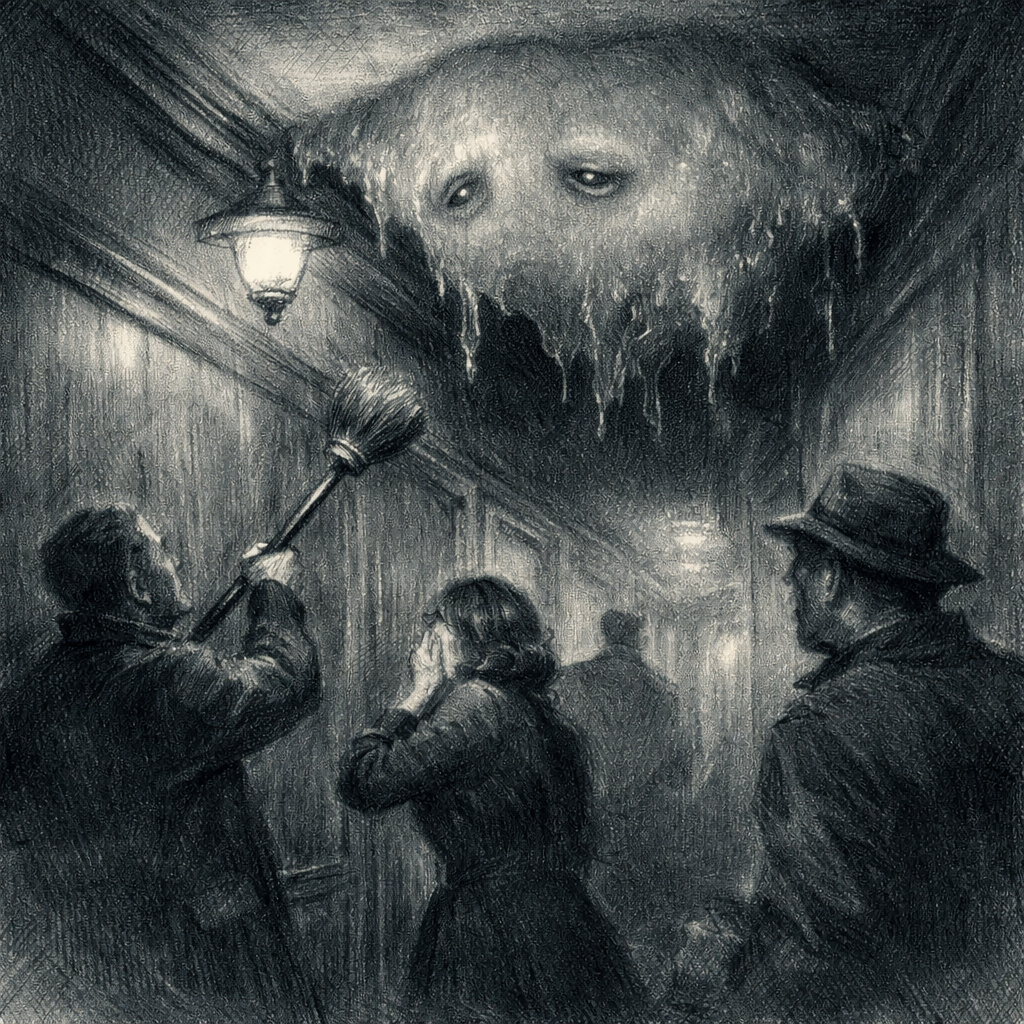
The Dreamlands Express shuddered onward through a landscape that refused to settle into any single shape, its windows framing vistas that slid between nightmare and half-remembered reverie. The train’s rhythm should have been comforting—steel on rail, the steady reassurance of motion—but instead it seemed to echo too loudly, as if each clatter carried with it the promise that something unseen was keeping pace just beyond sight.
They stood clustered in the narrow corridor outside the compartment, the smell of blood still heavy in the air. Zsusza’s body lay within, pale and unmoving, her life already retreating into the safe unreality of waking existence. The wounds in her chest—three precise punctures arranged with an almost ritual deliberateness—troubled Arthur deeply. War had taught him the many shapes violence could take, and this was not the work of panic or rage. This was intent. Worse, it was intent carried out without leaving the usual human traces: no footprints, no smear of blood leading away, nothing but the faint, unsettling sense that the room itself had been violated by something that did not obey the rules of flesh and gravity.
Walter murmured prayers, his voice steady despite the strangeness of the setting, anchoring the moment with words older than the rails beneath their feet. Per, ever the scholar, leaned out through the window in search of answers, only to find emptiness rushing past—a reminder that the outside of the train was a place hostile to human certainty. Viola watched quietly, her expression unreadable, her eyes suggesting that this was not the first time she had seen death wear so peculiar a mask.
Henri assured them, with a calm that felt practiced, that Zsusza would live on in the waking world, her journey cut short but not her existence. The relief this brought was thin comfort. Someone—something—had acted with purpose aboard the train, and purpose in the Dreamlands was rarely benign.
They began to speak with the others. Miroslav Karakov, shaken and pale, bore the look of a man who had stumbled too close to horror without understanding it. His story rang true: surprise, fear, the instinctive recoil of someone confronted with death. No deception clung to him. The owner of the room, Mironim-Mer, presented a more troubling puzzle—golden eyes unreadable, his solitude conveniently unobserved at the crucial hour. He claimed ignorance of how Zsusza came to be in his compartment, and though nothing in his demeanor betrayed obvious guilt, his isolation made him an unavoidable suspect.
The investigation carried them through the length of the train, gathering passengers from baths and parlors, drawing groans and theatrical sighs from the Sarnathians, who treated the prospect of a murder mystery as a mildly diverting annoyance. Their laughter grated against the gravity of the situation, yet Arthur could not ignore how their amusement masked something sharper—a casual cruelty, perhaps, or a familiarity with horrors that no longer inspired fear.
It was in the corridor near Madame Brugia’s compartment that the investigation took a turn from unsettling to truly grotesque. Clinging to the corner where wall met ceiling was a being of Ib: gelatinous, reeking, its vaguely formed face an affront to the idea of symmetry. The sight struck like a physical blow. Stomachs churned, minds recoiled. Yet the creature did not attack. It merely existed, trapped and pitiable, as if it had wandered somewhere it did not belong and lacked the means to escape.
With careful, reluctant cooperation, they freed it from the wall, peeling it loose with a broom until it dropped to the floor in a wet, undignified mass. The act felt absurdly humane in a place where humanity itself seemed optional. The being responded with simple sounds—burbles and pops—but there was intelligence behind them, alien though it was.
Henri returned with a curious fungal orb, a translator of sorts, and at last the being of Ib could speak. Its testimony chilled the air more effectively than the open windows. It had seen a face outside the window: a thing of tendrils and mottled flesh, with grasping limbs like elongated, sharpened claws. Not a human face. Not anything that belonged among them. And yet, when pressed, the creature confirmed the most disturbing truth of all—the murderer was present, in the room, even now.
A ripple of tension passed through the assembled passengers. Chairs creaked. Eyes darted. Arthur’s instincts screamed that the danger had not passed; it had merely been waiting for the right moment. When the being’s description sharpened—when the mention of wine from Sarrubia stirred a memory—the truth snapped into focus.
Mironim-Mer moved with shocking speed. The illusion fell away as his body twisted, bones and flesh reshaping into something that could no longer pretend at humanity. He lunged, monstrous and undeniable, his attack cutting through the fragile civility of the gathering like a blade through silk.
In that instant, the Dreamlands Express ceased to be merely a conveyance between worlds. It became a stage for revelation, a reminder that the Dreamlands did not merely host horrors—they invited them aboard, seated them among the living, and waited patiently for the moment when masks would fail.
And as the train thundered onward, indifferent and eternal, it was clear that whatever bargain the passengers had struck by boarding it was still unfolding, clause by terrible clause.
Opening / recap of the prior session state The Keeper (Luke) states he does not have a prepared recap and that it has been a while since the group last played. The investigators are still confused about being in the Dreamlands and how the Dreamlands Express works. The group previously picked up two new passengers, including: A screaming, eyeless madman, described by Henri as “a lost dreamer.” A scream was heard across multiple cars, drawing people to the sleeping compartments. The scream came from the compartment of Zsuzsa the dancer. The door was locked; Henri arrived with a key and unlocked it. Inside, Zsuzsa was found dead, with blood pooled around her body. It is reaffirmed that Zsuzsa was the woman Per slowed the train to help catch when she boarded late the previous night. The murder appears to have occurred the following day, after lunch (the investigators had lunch together and saw her there). Immediate investigation at the murder scene (Mironim-Mer’s compartment) Arthur Zorba wants to search for clues beyond the puncture wounds. The Keeper calls for a Spot Hidden roll. Arthur rolls and gets a hard success. The group references details about the window: Per Oskarson attempts to check outside the window for evidence. The Keeper calls for Spot Hidden. Per rolls a failure. Assessing the puncture wounds Arthur asks if the puncture wounds indicate a specific weapon shape (single stiletto vs claw/triangle, etc.). The Keeper describes the wounds as three points in a triangle. Establishing whose compartment it was / questioning those present It is clarified that the compartment where Zsuzsa was found is Mironim-Mer’s room (the “golden-eyed” wine merchant). The group recalls that Miroslav Karakoff was banging on the door when people arrived. The investigators question Karakoff about why he was at the door. Karakoff states he heard the scream and came because it sounded like someone was in trouble. Arthur asks whether he believes Karakoff (a psychology/“scrutinize” style read is discussed). Arthur rolls Psychology (despite being poor at it). The Keeper’s read: Someone asks about Karakoff’s injured hand. A rules/setting question is raised: what happens if someone is hurt or killed in the Dreamlands? Henri explains the consequences of Zsuzsa’s death on the Dreamlands Express: Early theory: motive tied to “unburdening” A theory is stated: the “murder” may matter because it prevented Zsuzsa from reaching the destination to unburden herself. The investigators ask whether anyone knew Zsuzsa. Identifying known passengers and who was (not) at lunch The Keeper names/mentions various passengers/groups present on the train: The Keeper tries to recall who skipped lunch: Walter’s “idea” and adopting a locked-room approach The Keeper prompts for an Idea (INT) check to frame next steps. Walter Lake rolls INT and is treated as exceptionally intelligent. The Keeper describes Walter’s insight: Decision: gather everyone together The group decides to gather all passengers in a common car (the men’s saloon and ladies’ parlor are referenced as train spaces; the group converges on gathering people in the saloon). The Keeper asks whether they split up or stay together. Karakoff and McKenzie accompany the investigators as they move through the train. Collecting the Sarnathians The group finds three Sarnathians in their compartment. A Sarnathian named Besweet reacts with excitement at the idea of a dramatic solution: Additional Sarnathians are found naked in the baths. Collecting the cranky passenger (Madame Brugia) The group goes one palanquin over and finds Madame Brugia in her compartment. Finding Mironim-Mer The group locates Mironim-Mer. Detour: encountering a being of Ib stuck in the corridor The investigators attempt to locate a being of Ib for possible testimony. The Keeper calls for a Sanity check upon seeing it up close. Madame Brugia states she did not invite it and kept her distance. Arthur makes Spot Hidden (and gets an extreme success). He observes Sarnathians whispering and giggling about the being of Ib. A male Sarnathian is identified by name as Rommel. Arthur quietly communicates to Walter that a Sarnathian appears responsible for shoving the being of Ib into that stuck position. Walter attempts to communicate with the being of Ib. Besweet interrupts Walter, mocking him for being distracted from the murder mystery. The Keeper calls for CON checks due to the overwhelming stench. Walter fails (rolls 98). Claire is also described as rapidly leaving due to the combined distress of the being of Ib and the smell. The investigators decide to help the being of Ib down from the corner before leaving. Regrouping plan: return to the saloon and consult Henri The investigators discuss checking in with Henri for what the attendants observed. Henri reports: Questions are raised about the beings of Ib: Requesting the beings of Ib to testify Per asks Henri to invite the being of Ib (the one found stuck in the corridor) to come speak, noting communication was limited. Per also raises concern about the lost dreamer they brought aboard. Henri departs; the investigators now have gathered most passengers in the saloon, excluding: The investigators observe Henri briefly stop and lean as he moves away; shortly thereafter, the windows in the car open one by one. Tension in the saloon: Sarnathians demand a dramatic reveal The Sarnathians grow fidgety and press Walter to announce the killer. Walter states more work is needed before the reveal. Formal questioning begins: Mironim-Mer’s alibi The investigators question Mironim-Mer first. Mironim-Mer states: Per asks to borrow Mironim-Mer’s book. Mironim-Mer hands it over. The book was closed when handed over; Per cannot identify where Mironim-Mer had been reading. Per does a quick read/skim (an INT-based approach is discussed and implicitly applied). Mironim-Mer questioned about Zsuzsa being in his compartment Arthur and Claire inspect Zsuzsa’s own compartment Arthur and Claire leave the saloon briefly to check Zsuzsa’s compartment. The door is closed but unlocked. Inside, it appears lived-in, with belongings placed on surfaces. Arthur makes Spot Hidden and gets a regular success. The book itself is described as light fiction (no special note or marked passage found). The compartment window is closed and latched. The investigators clarify compartment placement: Henri returns with a being of Ib and the speaking device Back in the saloon, Henri arrives with: The gathered passengers physically shift away from the being of Ib, uncomfortable with its presence. The Keeper clarifies a rules point: Testimony: what the being of Ib saw Walter asks the being of Ib (through the orb) whether it saw anything related to the murder. The orb relays the being of Ib’s statement: The investigators ask for a description. The being of Ib describes: Arthur attempts a Dream Lore check to recognize what the description might indicate. Testing the testimony’s reliability Per proposes a Psychology check to determine whether the being of Ib is being truthful. The Keeper allows it only at extreme difficulty. Per initially fails by two levels, then spends a significant amount of Luck to achieve an extreme success. Result: Crucial question: is the culprit present? Per asks directly whether the person seen outside the window is present in the room right now. The investigators then ask the being of Ib to indicate who it was. The Keeper narrates that the creature’s description is recognized as matching a Sarrubian (connected to earlier information: mention that Mironim-Mer sells Sarrubian wine). At that realization, Mironim-Mer abruptly leaps from his chair. The session ends immediately on this cliffhanger confrontation.Session Notes