The Dreamlands Express did not so much depart Dilithleen as slip its moorings from reality, the black basalt spires receding like a half-remembered nightmare as the locomotive surged onward through a darkness that shimmered with impossible color. Morning came gently, filtered through gauze curtains and the faint, disquieting sense that rest here was deeper than sleep and thinner than waking. The beds had been too comfortable, the kind of comfort that invited surrender, and each of them woke with the peculiar certainty that they had dreamed—yet also that the dream had been dreaming them in return.
Arthur rose early, as he always did. Habit was armor. He drank his tea with the careful ritual of a man who trusted routine more than introspection, biscuits broken cleanly, crumbs brushed away with military precision. He tried, as Henri had suggested, to call forth his burden and give it shape. Nothing came. No object, no symbol—only the same familiar pressure behind the eyes, the echo of artillery thunder that refused to coalesce into something he could throw away. The failure irritated him more than he cared to admit. If there was a task, it should be done; if there was a burden, it should show itself. The dream, however, offered him nothing but resistance.
Breakfast brought conversation instead. Arthur sought out Per, whose ease with reflection felt both enviable and faintly suspect. Their talk circled the question that gnawed at them all: if one cast away the weight that had shaped a life, what remained? Arthur spoke of the war, of how it had swallowed his adulthood whole, and wondered aloud—quietly, carefully—whether removing that burden would hollow him out entirely. Per, gentle as ever, offered no certainty, only the unsettling reassurance that some burdens might be worth the risk, and others might not. There were no clean answers in the Dreamlands, only choices with consequences that could not be measured in advance.
Elsewhere, Walter endured his own trial of the spirit. Besweet, radiant and insistent, pressed poetry into his hands—verses contemplating mortality, beauty, and at last, desire. He read cautiously, screening each line through conscience and doctrine, refusing the one poem that dared too much. She praised his restraint even as she questioned it, wondering aloud whether such constant denial could itself become a wound. Walter answered with the calm certainty of a man who feared the damage that indulgence might unleash. Some restraints, he believed, were all that stood between order and collapse.
By late morning the train slowed into Zar. From the platform, the city was a vision of aching loveliness: towers and terraces formed of dreams that had never quite been born, beauty abandoned before it could find a place in the waking world. Henri warned them not to enter. Zar was a place for lost dreamers, those who had wandered too far inward and could not find their way back. Arthur and Claire stood on the platform instead, sharing a cigarette and the cool, flower-scented air, watching cargo unloaded—textiles, ivory, crates of pale bulbs whose purpose was unclear.
That was when the man came staggering up from the road.
He moved too quickly for someone so broken, rags flapping, head tilted back as if straining toward voices only he could hear. Where his eyes should have been were raw hollows, dark and ruined. He cried out about visions unthought and unborn, about tearing out his eyes and still seeing. When he reached the platform, he thrust forward a gold ticket with desperate insistence, clawing at Henri’s coat, begging—demanding—to be taken away.
Claire moved without hesitation, pinning him with practiced strength, her voice steady even as his panic thrashed against her grip. Arthur stood ready beside her, the old instincts flaring, prepared to intervene if the situation turned violent. Henri wavered. The man was clearly lost, perhaps dangerous, but leaving him here felt like a sentence worse than exile. Per attempted mercy through understanding, conjuring a crude, dream-forged syringe whose contents calmed the man’s frenzy without restoring his reason. The poor soul remained trapped behind his own terror, unable to grasp the simple truth that might have freed him.
In the end, compassion won out over caution. The man was taken aboard and lowered into the foregone, into the care of the strange beings that dwelled below, the hatch closing like a living eye. It was an ugly solution to an uglier problem, but it spared him the endless wandering of Zar. The train pulled away again, leaving the city’s impossible beauty behind.
The afternoon drifted by with uneasy calm. Lunch was lightly attended. Conversations returned, inevitably, to burdens—what to cast away, what to keep. Viola spoke with quiet conviction of memories that had shaped her, good and bad alike, and of her reluctance to discard any of them. Pain, she argued, had its uses. It sharpened conscience, steeled resolve, and reminded one that horrors could return. Better to carry such things knowingly than to forget and be caught unprepared. Walter, for his part, resolved to endure the journey without surrendering anything, intending to wake himself before the final, blasphemous temptation could claim him.
It was in the midst of this uneasy reflection that the scream tore through the train.
It was sharp, unmistakably human, and wrong in a way that made the air itself seem to recoil. Chairs scraped back. Glasses were abandoned. They converged instinctively toward the sound, down the length of the train toward the sleeping compartments. The corridor outside one cabin was already crowded when they arrived. Karakov stood there, his hand bandaged and bleeding, pounding on a closed door, muttering about guns and tormentors. Mackenzie hovered nearby, pale and accusatory. Blood seeped slowly through the cloth wrapped around Karakov’s fist.
Henri arrived moments later, grave and efficient. He unlocked the door.
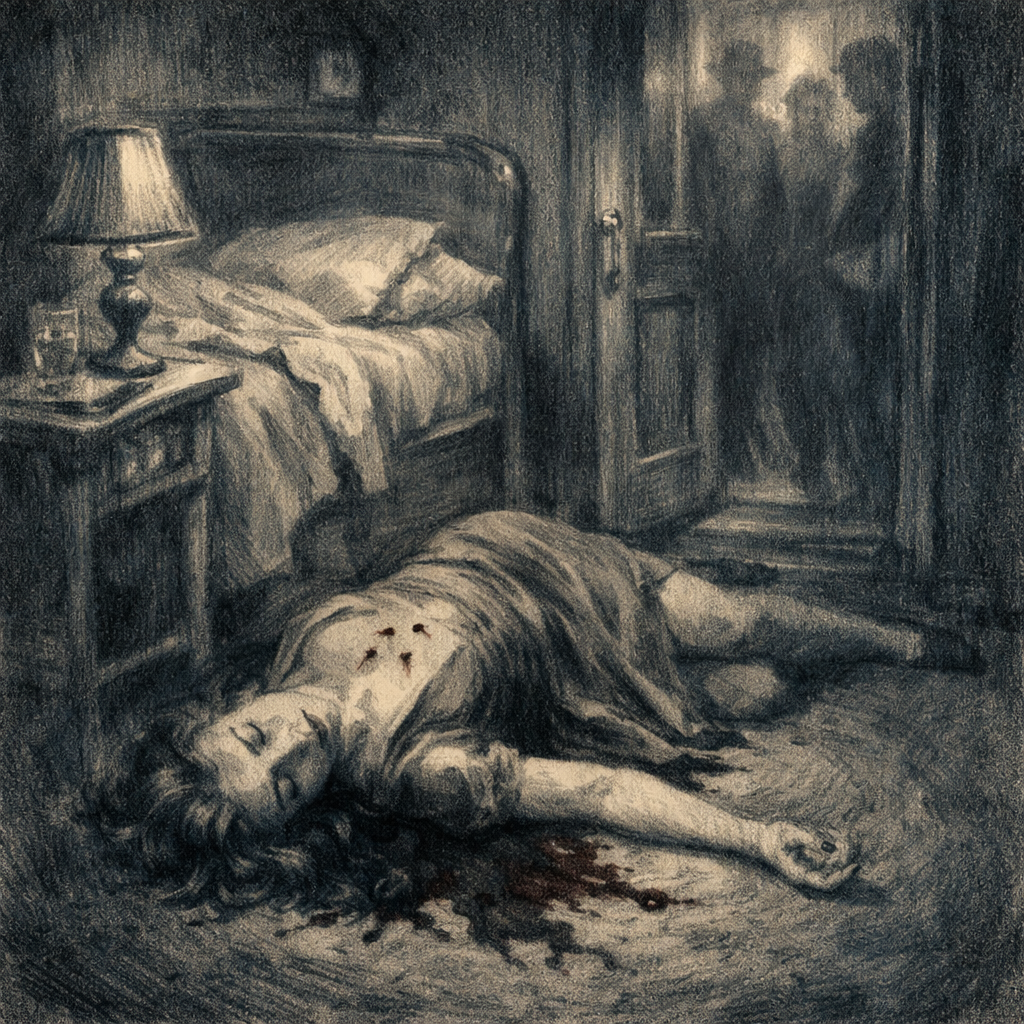
The sight within struck them like a physical blow. Zsusza lay sprawled on the carpet, her body twisted, a dark pool spreading beneath her. Three neat puncture wounds marked her chest, precise and merciless. The locked room offered no immediate answers, only the obscene finality of her death. Some looked away too late; others wished they had never looked at all. Walter began the rites at once, voice steady even as the reality of her passing settled in. Arthur knelt to assess the damage, but it was already done. Her heart had been pierced beyond saving; she died there, with witnesses who could do nothing but mark the moment.
Viola moved through the room with careful attention, her gaze sharp despite the horror. She noted the position of the body, the warmth lingering in the cushions where someone had sat only moments before, the small smear of blood beneath the window latch—unfastened, as if used. The locked door no longer seemed so simple. Whoever had done this had not vanished into thin air; they had left traces, subtle but damning.
As the weight of the murder settled over them, the Dreamlands Express rolled on, indifferent to human outrage and grief. Another burden had been added to their journey—one they could not easily cast away. Somewhere on the train, a killer walked free, and the dream, vast and uncaring, watched with quiet interest to see what they would do next.
Session opens with the Keeper recapping the party’s recent Dreamlands Express journey (continuing from the prior stop): The Dreamlands Express had paused at Dylath-Leen (described as a city of black basalt spires), where cargo was exchanged. A Sarnathian woman named Besweet had pursued Walter Lake with intense interest. Over brandy and conversation, the travelers wrestled with metaphysical questions about why they had been brought to the Dreamlands. The conductor Henri explained that the Dreamlands are shaped more by the waking world than they shape it in return. Henri also suggested, with melancholy, that the dead pass into these lands—framing the Dreamlands as a purgatorial space—an idea that troubled Walter. Henri revealed a darker concern: he sensed a darkness hovering over the party, particularly around Claire Corning, and believed something sinister (possibly a ghoul, or worse) had attached itself to her soul. The group’s earlier strange encounters were referenced as part of a larger puzzle Henri could not fully solve: Henri counseled Claire to manifest her burden in dreams so she might cast it away. In the salon, Per Oskarson discovered the train held more than books when a wine trader named Mironim-Mer appeared with unsettling golden eyes and bottles of legendary Sarrubian vintage. During a later commotion when Zsusza (a singer and dancer) nearly missed boarding while fleeing a prince’s turbaned men, Per manifested an emergency cord through sheer force of will to stop the train. The train now rushed toward Zar through the dreamscape darkness, with Henri implying the passengers had been chosen—selected by his uncanny sense for souls in peril. The party wakes aboard the Dreamlands Express (morning after the Dylath-Leen departure): Henri establishes that the Dreamlands follow a day/night cycle. The party is in assigned sleeping compartments: The beds are described as supremely comfortable, and the party wakes well-rested. Arthur Zorba wakes with first light, draws the curtains, and receives a tray with tea and morning refreshments. Breakfast (leisurely, around 9 a.m.) and discussion of “burdens”: Arthur seeks out Per Oskarson at breakfast to ask about manifesting burdens. Per describes having had a dream-within-the-dream—interrogating himself about the nature of his dreams. Arthur admits he tried to visualize and manifest his burden but nothing happened, and he asks Per for insight, noting Per seems “in touch with [his] feelings” and “not British.” Per responds that he is struggling with what it means to cast off a burden and what it would mean for who he is afterward. Per proposes that if a burden is tied to a specific event, then a totem/object/memory from that event might be what is cast off. Arthur raises a central fear: Per agrees this is the fundamental question and says he does not know where to draw the line between burdens worth discarding and burdens that should remain. Per asks Arthur if there is a single night/week/event he would be rid of. Arthur connects his burden to the Great War and the military, noting war and service are the entirety of his adult experience; he questions who he would be without that. Walter Lake at breakfast: Besweet’s poetry and a probing conversation about repression: Late morning arrival at the city of Zar (around 11 a.m.): The Dreamlands Express reaches Zar and pulls alongside a platform for embarkation/disembarkation. Henri begins unloading cargo. The stop is expected to last a couple of hours. Arthur asks Henri what Zar is and whether there are any sites to see. Henri describes Zar as a place of indescribable beauty that should be seen from a distance, not entered. Henri explains he stops at Zar specifically to see if there are lost dreamers he can help recover. Henri advises the party to view Zar from the platform but not to enter the city. Claire comments that if most stops aren’t meant to be visited, it raises the question of the point of travel; Henri replies not all cities are dangerous, but the Dreamlands can be. Arthur decides to stand on the platform, enjoy the view, and smoke; he invites Claire to join him. On the platform at Zar: unloading cargo and the arrival of a lost dreamer with no eyes: The weather is perfect with a cool sea breeze and flowers on the air. Henri unloads wool, textiles, ivory, and crates containing what look like flower bulbs (one crate is open). A ragged man staggers toward the train from the road leading from the city, moving faster as he approaches. As he draws near, the party sees he has no eyes. He yells about horrifying visions: Arthur speaks to him and asks if he is looking for the Dreamlands train. The eyeless man reacts to the sound of Arthur’s voice, claiming he hears voices “on the wind,” and becomes fixated on where the voice came from. Henri approaches and warns the group the dreamer may be too far lost and may be a danger to people on the train. The eyeless man thrusts his hand up, holding a gold ticket, and tries to force his way onboard, shouting for the conductor to take his ticket. Henri asks the party how they feel about having him on the train. The eyeless man finds the stairs and charges aggressively up them, screaming and shoving at Henri. Henri tries to calm him, asking him to show the ticket properly. The eyeless man grabs Henri’s coat and pulls him; Henri protests that this is improper and tries to pry the ticket from the man’s clenched fist. The party restrains and attempts to help the eyeless dreamer: Claire intervenes physically and succeeds in controlling the man (described as a successful brawl/physical restraint outcome): Arthur addresses the man firmly, telling him to stop assaulting the conductor and that they can assist him in boarding if he calms down. The eyeless man continues screaming that he wants to be taken away from Zar. Henri, flustered, says this seems like a poor idea and initially refuses passage, telling the man he must find his own way out of his dream. Walter asks Henri aloud if one can simply pinch oneself awake; Henri replies: Walter tells the man directly that he is dreaming and needs to will himself out; the man does not respond rationally. Per arrives and proposes that sedation would be the first step. Under sedation, the eyeless man relaxes and stops fighting as much, though he remains jumpy. Per attempts psychotherapy to convince him he can wake himself by willing it, but the effort fails: Henri suggests an alternative: if they can keep the man calm until the train reaches the Gulf, the man will awaken when passing through it. Claire raises the possibility of physically restraining him (even barbarically) if it would save him from wandering the Dreamlands blind and insane. Convincing Henri to take the eyeless dreamer aboard: The “padded compartment” and the foregone hatch: Claire escorts the sedated man forward toward the foregone/baggage car, feeling on edge due to proximity to earlier unsettling entities. Henri brings Claire to the baggage car and points out the hatch in the floor, which is described as fleshy inside. Henri kneels and addresses the beings below, introducing a new passenger and asking them to help keep him comfortable. A strange wheezy voice responds from the dark below. Claire and Henri slide the eyeless man down through the hatch; he is still drugged and mumbling strange phrases: Henri closes the hatch with a lever; the hatch is described as an iris hatch, likened to a sphincter-like mechanism. Henri expresses gratitude and apologizes for imposing work on passengers who are meant to relax and enjoy the journey. Henri offers Claire tea and arranges for tea to be brought to her compartment. Early afternoon: the train departs Zar (around 1 p.m.) and lunch: The Dreamlands Express starts moving again around 1 o’clock. Lunch is served shortly after the train is moving. The next stop is clarified to be at 7 p.m., shortly before dinner. Lunch attendance is lighter than breakfast: Arthur speaks with McKenzie and mentions they picked up a new passenger who has no eyes and claims he tore them out after seeing too many dreams. Arthur notes the man was immobilized and escorted somewhere “padded,” implying Henri can produce what he needs aboard the train. Mid-to-late afternoon: Per speaks with Viola Sutcliffe about unburdening: Per seeks out Viola Sutcliffe in the salon to ask what she intends to do about the “unburdening” at the Gulf of Nodens. Viola acknowledges it is an unprecedented opportunity and should be taken seriously. Viola, raised in the Church of England, says it feels wicked to dispose of burdens and is inclined to keep hers. Per explains he shares hesitation for different reasons: he fears the inextricability of memory, self, and burden. Per references horrors from the earlier island incident, noting doubts and fears—especially uncertainty about a creature they saw and whether it still exists and might be coming for them. Viola is unsettled and raises a practical objection: Viola states her unpleasant memories serve a purpose: Per suggests that discarding an incident or two might leave them stronger, but Viola maintains she has lived long with her memories and believes carrying them longer will not harm her. Viola concludes she will keep her burdens and “take them to God.” The conversation ends with light drinking plans (Viola preferring sherry). A sudden scream and the party’s rush toward the sleeping compartments: Across the length of the train, everyone hears a high-pitched woman’s scream from somewhere ahead. Multiple PCs immediately move to find the source: The Keeper calls for Listen checks to determine direction and distance. Per determines the scream is several cars ahead and likely from the sleeping compartments. Based on the voice, Per suspects it may have been one of the young Sarnathian women or Zsusza (and rules out Claire’s voice by familiarity). Claire, from her closer position, identifies it as toward the rear and nearby (from her location at the time). The group rushes through cars; other passengers begin to stir as well. At the sleeping cars: McKenzie and Karakov outside Mironim-Mer’s compartment: The party arrives to find McKenzie out in the corridor, alerted by the scream from the next compartment. Karakov is already outside the door, pounding on it. The door to the compartment is closed. McKenzie calls out to ask if the occupant is all right, and mutters to Karakov accusingly: “What did you do?” Karakov denies doing anything and claims he heard “the booming of the guns and then the screams.” Karakov says his tormentor is inside and demands to know whether someone is behind this. Henri arrives from the front of the train, responding to the disturbance. Henri produces keys, announces himself, and says he will be opening the compartment. The locked-room death scene: Zsusza’s body and the sanity check: Henri unlocks the door and slides it open. The group is prompted to make Sanity checks upon seeing what is inside. Inside the compartment, on a beautiful oriental carpet, lies the body of Zsusza, collapsed in a spreading pool of blood. The door had been locked, and there is no one else inside the room when it is opened. Immediate response and examination of Zsusza’s wounds: Walter begins performing last rites immediately. Arthur attempts first aid (or directs attention to assessing whether she can be helped). The party determines Zsusza is actively dying/expiring in front of them and cannot be saved. Zsusza has three puncture wounds over her heart: Zsusza dies in front of them shortly after the discovery. Spot Hidden/scene details: attacker position, warmth, and the key clue at the window latch: Viola Sutcliffe steps into the room and paces carefully to avoid stepping into the pool of blood. Based on the body’s position, the group determines the attacker would likely have been standing or seated on the side of the victim near the padded seating area (the divan). A hand is placed upon the padded seat; it is found to be still warm, suggesting recent presence or contact in that spot. A hard success on Spot Hidden reveals a crucial detail: Session end:Session Notes