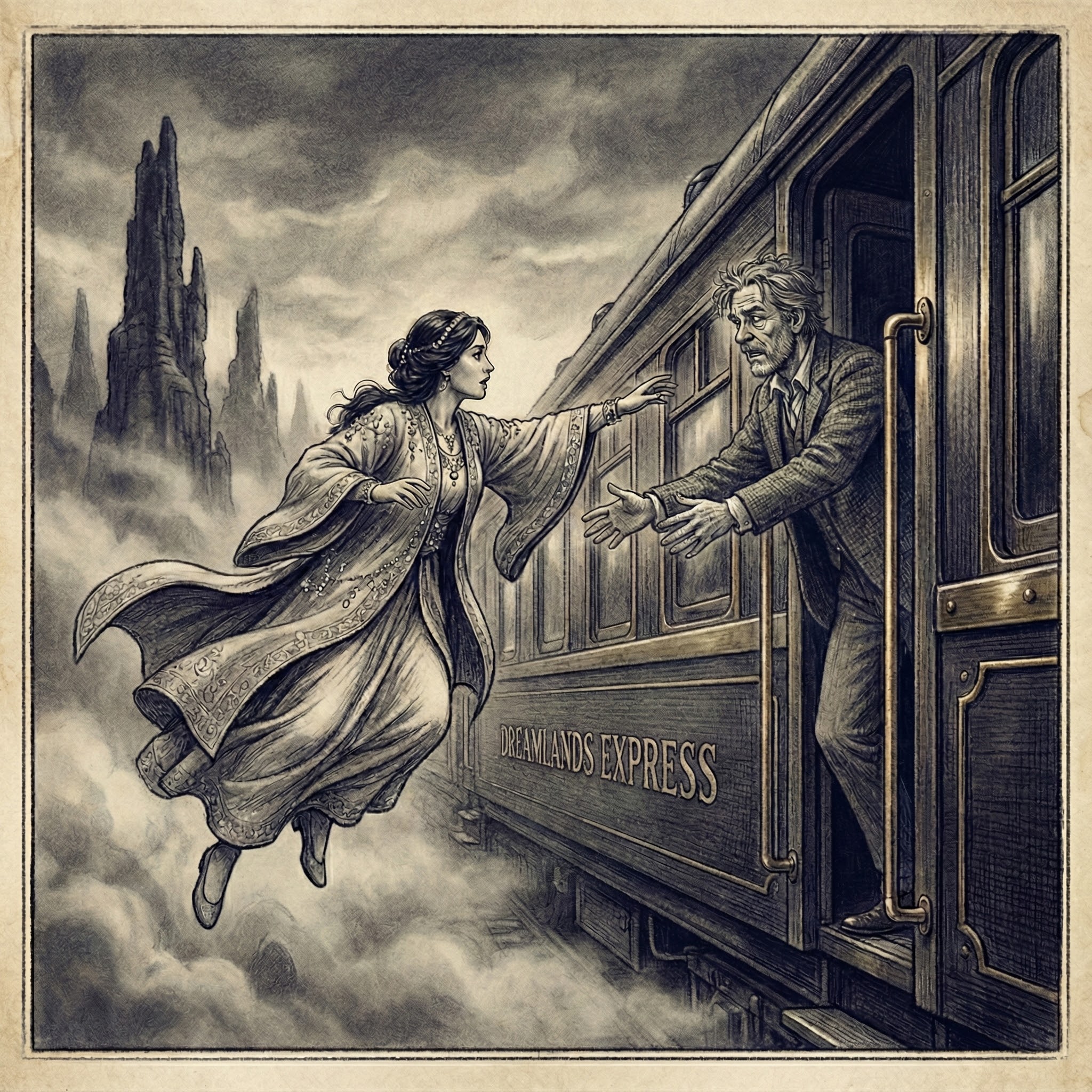
Night still clung to the Dreamlands like a damp shroud when the Express eased into Dylath-Leen, its basalt towers looming over the platform like the vertebrae of some titanic fossil. The investigators stepped briefly into that stagnant, starlit air—though even that simple act felt fraught with uncanny weight. The city was beautiful in the way a cathedral of bones might be beautiful: arresting, ancient, and better admired from a distance. Henri warned them not to wander, and even the boldest among them understood the warning was not meant politely.
It was here that the tensions of the moment revealed themselves. Delegates from Sarnath glided aboard in robes that shimmered with the arrogance of long memory; behind them, the gelatinous Beings of Ib oozed into a maw that opened obligingly in the train’s side. The contrast was surreal even by Dreamlands standards: beauty and mucus, pride and slow undulating resignation. Arthur and Claire spoke with the Sarnathians enough to glean the contours of an ancient grievance—one side insisting the sin lay a thousand years in the past, the other insisting it was hardly a week old. Time here did not behave properly. It stretched where it should snap, snapped where it should yield. Even Walter, ever anchored in doctrine, felt the uneasy wrongness of it.
And always, Henri worked. His silhouette wove among crates and tentacles as he loaded the last of the cargo. He moved with impeccable grace for a man who admitted, with a quiet sigh, that he was no longer among the living.
The train lingered in the station for hours—long enough for doubt to bloom. Walter’s suspicion of the Dreamlands, always simmering, spilled into earnest inquiry. What truly mattered here? Could actions in this realm touch the waking world? Was any of this safe, righteous, real? Claire listened, still shaken by the memory of a wraith that had marked her arm with an icy caress. Walter questioned Henri about souls, salvation, the nature of death itself. Henri answered as one who had no reason to lie: the Dreamlands were shaped first by the waking mind, but the dead gathered here as well, reshaping themselves as something adjacent to their former selves. The implications landed on Walter like cold water down his spine.
But what cut deepest was Henri’s confession that something dark hovered within Claire—something he had sensed long before offering them passage. It clung to her like a parasitic destiny, a burden thick enough to weigh down a soul in any world. Her arm ached where the wraith had touched her, though no mark remained. Walter examined it with worried precision; Claire masked her fear with wry humor, but the joke rang thin.
Henri urged her toward unburdening. If she could manifest this thing—drag it into the Dreamlands where thought held weight—she might cast it off. Walter balked at the danger; Claire considered it with a grim sort of courage. Here, in a land shaped by dreamers’ minds, the monstrous might take form. But here, too, it might be destroyed.
Their conversation frayed as exhaustion claimed them. The night wore on. Arthur retreated to rest; Claire followed, shaken but unwilling to show it. Walter prayed, though the prayer tasted strange in a world where the dead served as guides.
Per, however, resisted sleep. He prowled to the Men’s Salon, driven by the stubborn conviction that if one could think differently here, reality might oblige. He experimented with belief like a scientist prodding a volatile compound: spoons that should bend, fatigue that should vanish. The Dreamlands resisted him with dreamlike indifference. Eventually, he found himself reading—seeking any text that might illuminate this realm’s unwritten rules.
It was there that the man with the golden eyes entered.
Mironim-Mer, he called himself: a wine trader, a wanderer, a man whose irises shone like molten coin and bore no pupils. He poured himself a nightcap and spoke calmly of rare Sarrubian wines and distant shores. His tone was polite, his smile thin as paper. Per studied him with the wary mind of a man who has seen too many curious strangers across too many cursed thresholds. Mironim-Mer’s gaze—if gaze it was—never quite found him. Yet the stranger’s presence pulled at the room’s edges like gravity.
When Mironim-Mer retired, Per finally surrendered to the inevitable and prepared for bed. But just as he reached the threshold, a cry shattered the air:
“Wait! I meant to board the train!”
A figure sprinted along the platform—jewels flashing, silks streaming behind her like a comet’s tail. She moved with desperate grace, her heels striking sparks from the stone. Instinct overtook Per. He ran, muttering Henri’s name as though invocation alone might summon the conductor. And as he reached the stairwell, the red emergency cord appeared—impossibly, abruptly, obedient to a wish he barely dared form.
He pulled it. The train answered like a living creature: slowing, yielding, allowing the woman to catch up. She leapt into Per’s arms with theatrical flourish, clinging to him as though she had always known he would be waiting. Her smile was dazzling, hungry for attention rather than assuming it. They climbed the stairs together, Per half carrying her, half carried by momentum.
Henri appeared where Per needed him—immaculate, composed, apologetic for nothing.
The woman produced a golden ticket, her voice tremulous in the way of someone expecting to be told she was too late. But Henri accepted it with a bow, calling her Zsusza, and assured her she had been expected. She promised a performance for the passengers—song, dance, spectacle—and hinted at princes who sought to imprison her in palaces. Whether truth or vanity, the narrative clung to her like perfume.
And Per, now utterly drained, accepted a glass of the sleeping draught Henri conjured without his hands. Even here, exhaustion claimed him with mortal insistence.
By the time he finally collapsed into bed, the Dreamlands Express had left Dylath-Leen behind. The city’s black spires receded into the night as the train glided toward its next destination—Zar, where dreams frayed at the edges, and forgotten sorrows whispered in abandoned towers.
Sleep claimed the investigators one by one, and the Dreamlands shifted around them.
Each carried a burden.
Not all would leave with one.
Session opens with a recap of the prior events on the Dreamlands train The investigators had been interacting with other passengers and talking about the Dreamlands before the train arrived at Dylath-Leen. At Dylath-Leen’s platform, Henri had warned that it was not safe to wander at night, advising the group not to stray from the station area. The group still stretched their legs on the platform and took in the city skyline. The group observed multiple parties boarding at Dylath-Leen: The group did not interact with the beings of Ib, but did talk at length with the Sarnath delegation. The group also noticed a well-dressed, dark-haired man who: The beings of Ib boarded in an unusual way: Clarifying the Sarnath–Ib dispute and the train’s broader context The Sarnath delegation explained they were traveling to present their case before King Kuranes, who was described as fair and wise. The Sarnathians believed they were being unjustly accused of mistreating the beings of Ib. The situation was framed as an arbitration (not yet a criminal trial). A major point of confusion in the dispute was time: Arrival atmosphere and the stop at Dylath-Leen The Keeper described Dylath-Leen visually: The train remained in Dylath-Leen for a significant period (a couple of hours total; with the boarding activity concentrated in roughly 30–45 minutes). During the stop: A Sarnathian woman was noted to be flirting with Walter: Party discussion: what is the purpose of the Dreamlands journey? Walter (and the group) wrestled with what their “objective” in the Dreamlands should be: The group reiterated constraints already learned: Walter specifically wondered: Walter speaks directly with Henri about the Dreamlands, causality, and time Walter approached Henri to ask how “real” the Dreamlands are and what impact they might have. Henri explained the relationship between worlds: Walter asked about time: Whether time is unmoored enough to encounter dreams of historical figures (Henry VIII, Genghis Khan), or figures relevant to the party (Comte Fenalik). Henri said time feels somewhat flexible: The party asked about creating a direct link to a dreamer: Henri’s identity and the “dead pass into the Dreamlands” question Walter asked if Henri was a dream-version of himself, or a dream created by one of the investigators. Henri responded with a sad sigh and said no. Henri raised the idea that people say the dead pass into the Dreamlands. Walter reacted with concern, framing it in religious terms: Henri said he did not know, but stated: Henri reveals why he brought the investigators onto the train Henri stated that he knew, in at least a small way, that the investigators face unusual troubles in the waking world. Henri singled out Claire: Henri confirmed he had a knack for finding people with burdens: Henri noted the investigators were unusually self-aware in the Dreamlands: Attempting to connect Comte Fenalik to the Dreamlands train Walter asked whether Henri could bring Comte Fenalik into the Dreamlands (in the same way Henri brought them). Henri said he could try, especially if Fenalik had a heavy burden that needed to be unloaded, but he would need more information. Henri clarified limits of his knowledge: The party connected Fenalik to their larger situation: Per was pulled into the conversation to share what he knew: Henri’s response: deceased figures and Dreamlands entry Henri reacted apprehensively to the description of Fenalik. Henri asked whether Fenalik was deceased and historical. Henri explained: The haunting presence affecting Claire: what it said, what it might be The group debated whether the entity haunting Claire was Fenalik: From Claire’s recollection and Walter’s understanding of the Latin: Henri offered a possibility: Henri explains what he knows about ghouls Henri described ghouls as: When asked why a ghoul would care about a statue: When the investigators described the ashtray incident (the entity turning to mist): Can Claire be “unhaunted,” and does unburdening help? The group pressed for advice on breaking the link to the entity haunting Claire. Henri admitted he did not know the true source, but said he could sense: Claire asked whether unburdening could remove the connection to the evil. Henri advised: The group questioned the risk: Henri answered: Henri then returned attention to his duties: Returning to cabins and late-night interactions Arthur offered to help Henri with cargo; Henri declined and emphasized Arthur was a guest meant to rest comfortably. Per asked about reading material: The group began turning in for the night (noted as very late, around 1–2 a.m. in conversation). Walter checked on Claire’s forearm: Besweet appeared beside Walter again: Per stays up: reading and testing Dreamlands “control” Per chose to spend time in the men’s salon reading rather than immediately sleeping. He pursued an experiment: Per attempted a Dreaming roll to resist fatigue and maintain control: Per meets a late-night passenger: Mironim-Mer A man entered the men’s salon and nodded politely. Per greeted him and noted he had seen him board earlier. The man introduced himself as Mironim-Mer and described himself as: Mironim-Mer’s appearance: Conversation topics: The bottle Per had seen exchanged at the platform: The wine’s name and reputation: Per asked about the politics of the Dreamlands and the Sarnath–Ib conflict: Mironim-Mer finished his drink, excused himself, and said he looked forward to dining with Per before going to bed. Per also retired, downing his nightcap and heading off to sleep. A passenger nearly misses the train: Per intervenes As the train began moving again, Per heard a woman outside shouting to board: Per moved quickly to get a view and then to reach her: Per decided to help her board: Per manifests an emergency cord to slow the train Per decided there “ought to be” an emergency brake cord and attempted to manifest one. Per made a Dreaming check and improved his odds by spending 7 magic points (described at the table as converting to improved success chance). The result: Per pulled the cord: Per assesses the woman: not Sarnathian, attention-seeking Per wondered if she was among the Sarnath delegation. Per made a Psychology check and spent luck to succeed. His read: Her style was distinct from the Sarnathians’ understated elegance. She was flashy and performed for attention. Per noted the subtle distinction that: Henri meets the new arrival: Zsusza and her golden ticket As Per brought her into the connection between cars, Henri was already there, composed and dressed perfectly, as if he had been waiting. Per apologized for disrupting the train; Henri dismissed it as no trouble. Henri identified the woman by name: Zsusza produced a golden ticket from her clutch: Per questioned whether Zsusza was performing confidence or was uncertain: Zsusza’s announcements: She said she looked forward to seeing Per in the morning at breakfast. She said that the next evening she would entertain the passengers: Henri formally affirmed that the passengers were excited she had joined. Why Zsusza was late Zsusza explained her delay: She indicated she had many such stories but was exhausted and wanted to rest. Per receives a sleeping draft and the train continues Per asked Henri for the sleeping draft Henri had previously offered. Henri provided it in a supernatural fashion: The train was described as now underway to its next stop: The session ended with the investigators settled in for the night as the Dreamlands train traveled onward.Session Notes