The Dreamlands Express glided soundlessly through the night — a phantom locomotive suspended between sleep and waking. Its polished brass and silken drapery gleamed in the light of unseen moons, and the rhythmic pulse beneath its floorboards seemed not mechanical but alive, as if the train itself dreamed. Within its carriages, conversation drifted like incense — laughter, confessions, and the soft clink of glassware forming the lullaby of those who dared travel the roads of slumber.
The evening had begun in deceptive peace. Zorba and the mysterious soldier called Mac had taken to the roof of the train, sending golf balls arcing into the darkness — each white sphere vanishing into a horizon that never came nearer. Below, Per Oskarson, Claire Corning, and Reverend Walter Lake sought lighter diversions in the lounge. Their talk with Karakov — the haunted arms dealer who heard phantom gunfire — had left an unease hanging over them like the smell of cordite after battle. So they turned to cards. A Swedish game, “Huit Goober,” became the night’s entertainment — a contest of luck and laughter played with Henri’s Dreamlands poker chips, each bearing the mask of the train’s enigmatic conductor. Karakov lost gleefully, and for a while, his haunted eyes softened.
Yet even in this supposed place of rest, no mind could truly find peace. Per, ever the scholar, felt the tug of the waking world’s burdens — the Devil’s Simulacrum, the threads of cosmic dread that wove through their quest. He questioned whether dreams could touch the waking world, whether acts here could ripple backward into reality. Henri’s words returned to him: “The Gulf of Nodens will unburden you — if you believe.” But belief came hard to a man who had seen too much.
When the train slowed, the passengers felt it not as motion but as a shift in pressure — the Dreamlands themselves exhaling. Midnight in Dylath-Leen. The city lay in shadow by the sea, its towers black and salt-streaked, its streets glistening as if perpetually wet. A faint phosphorescence clung to the stones, a mockery of moonlight. Henri warned them against wandering; Dylath-Leen was not safe, he said. Yet curiosity gnawed at every mind aboard, and soon they found themselves stepping onto the platform, breathing the cold, dream-thick air.
There were others waiting — six figures draped in flowing robes of pale silk, their faces serene, their eyes aglow with self-assured righteousness. The delegation from Sarnath. Their words carried the musical cadence of an old civilization grown arrogant on beauty and ease. They regarded the newcomers with cordial condescension, as one might regard animals at a zoo. And beyond them, at the far end of the platform, shadows moved — not men, but shapes. Bulbous, unsteady forms that recoiled from the light. Henri stood before them, speaking softly to the darkness.
Per squinted, straining to see. His scholarly reason rebelled against the dream’s limits, so he tried something else — belief. He believed that he could see like an owl, hear like one, pierce the veil of shadow by will alone. The effort left him dizzy; the night refused him. But when he blinked, there was a spyglass in his hand — as though the dream had humored his wish in its own peculiar fashion. Through it he glimpsed the truth: Henri speaking with things that slithered and breathed like fish out of water, their limbs coiling and uncoiling in obscene parody of humanity. They offered him a small creature — dead or dying — and the conductor accepted it with the calm of one accustomed to such transactions.
Zorba, beside him, muttered that the shapes were grotesque yet somehow pitiable — like corpses trying to remember how to live. Henri did not hide his dealings; he merely preferred them unseen. And so, as the investigators watched, the things crept aboard the train, vanishing into the baggage car’s side as it opened like a mouth, swallowing them whole.
The Sarnathians, seeing the gazes cast that way, spoke with airy disdain. “Do not trouble yourselves with the folk of Ib,” said their spokesman, a tall man whose jeweled circlet caught no light. “They are unpleasant creatures — in smell, in visage, in disposition. We are to meet them in parley. Old business, from a thousand years ago.” His smile did not reach his eyes. “They claim our ancestors destroyed them last week. Imagine!”
Their words slithered as easily as the Ib-creatures themselves. A thousand years to them was a recent slight; a week to the creatures of slime perhaps an eternity. The Dreamlands, it seemed, kept no honest calendar.
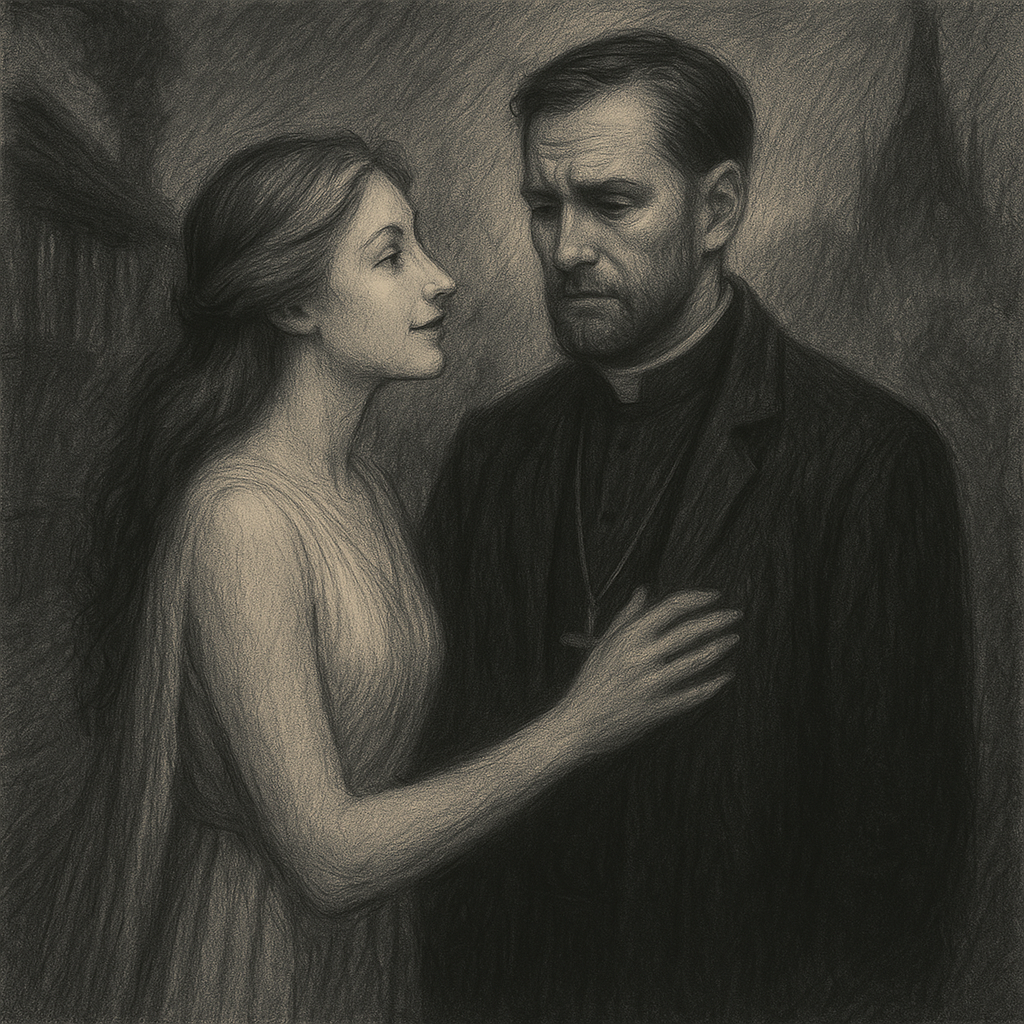
While Per engaged them in polite discussion, Walter found himself the subject of uninvited fascination. One of the Sarnathian women — youthful, radiant, and disturbingly perfect — drew near, invading the solemn priest’s space with a smile that felt like sunlight reflected off a blade. Her eyes lingered too long, her tone thick with insinuation. “You would fit well in Sarnath,” she purred. “We live without care, without burden. You could unburden yourself… entirely.”
Walter’s throat tightened around his answer. There was no fear in him — only the grim humor of a man accustomed to temptation dressed as piety. “I’m afraid I’ve already given up pleasure for another master,” he said softly. Yet when her laughter rang, it had the chill of wind over a tomb.
The others watched, half amused, half uneasy. The delegation’s talk of their eternal youth, of never having known the waking world, carried a hollowness beneath the perfection. They spoke of time without ever quite believing in it — as though the very concept of aging, of consequence, were vulgar. When Walter asked if they had families, they answered with confusion, as if he’d spoken of some archaic ritual.
And still the faint sound of movement came from the baggage car. The slithering of the newly boarded passengers — the beings of Ib, the wronged and forgotten. The smell of brine drifted through the corridor, faint but undeniable.
As the whistle sounded — a low, mournful tone that seemed to echo from the bones of sleeping gods — the Dreamlands Express began to move once more. The Sarnathians took their seats in the luxury car, faces serene, garments gleaming like pearl. Henri appeared again, expression unreadable behind his mask. Somewhere in the belly of the train, something wet shifted in the dark.
Per thought of the old legends — the ones that said Sarnath had been built on the bones of Ib. Zorba fingered his uniform collar, feeling the phantom grit of battlefields long gone. Claire, ever curious, wondered what a city of beauty could owe to one of slime. Walter stared after the woman who had smiled at him and thought — not without irony — that temptation never sleeps, not even in dreams.
And outside, Dylath-Leen receded into the mist, its towers vanishing like memories upon waking, leaving behind only the scent of salt and something else… something older. The train pressed on into darkness, bearing saints, sinners, dreamers, and monsters toward the Gulf where burdens must be cast away — and where, perhaps, the sleepers might learn that some burdens refuse to be left behind.
Recap of prior Dreamlands Express events and immediate state Dreamlands mechanics and goals reiterated Zorba and Mac on the roof; Mac’s satchel Card play with Karakov Arms-dealer morality and wartime loyalties (table talk with Karakov) Per’s waking-world concerns resurface Inquiry about Comte Fenalik Do dream stops grant practical knowledge? Late evening and “moon-tree wine” Arrival at Dylath-Leen (around midnight) Who and what was at the platform Attempting enhanced senses by Dreaming What the spyglass and observation revealed Conversation with the robed delegation (Sarnath) The robed group noticed the party observing the far end; they warned: “I wouldn’t spend too much time thinking about them—they’re unpleasant.” They introduced themselves as a delegation from Sarnath; the blob-like beings were representatives of Ib. Purpose: to travel by the Express to a summit with a moderator to resolve ancient issues between Sarnath and Ib (later they would meet a king, off-train). Sarnath–Ib dispute as explained by Sarnath Sarnathian interest in Walter Philosophy and amenities Boarding and the Ib “baggage” Train capacity note Session endpointSession Notes